

TL;DR
To a dog with drive and nothing to do, the cat is the most exciting thing in the house. Manage it so the chase can’t happen, teach a real “leave it,” and feed that drive every day with something it’s allowed to chase. Introduce a new cat in stages with the dog leashed and the cat always up high, and learn how the drive works in prey drive training. A dog that’s already grabbed or hurt a cat needs the red flags section and professional help first.
Who This Is For
- Two-pet homes where the dog stares, stalks, or chases the cat
- Anyone bringing a new cat home to a dog, or a new dog home to a cat
- Owners of high-drive breeds asking if their dog is safe with cats
- People whose dog goes nuts at the neighbor’s cat through the fence
- Cat owners tired of their cat living on top of the fridge
Why Dogs Chase Cats
There’s usually three reasons a dog chases a cat and they each need a different fix. Prey drive is the hunt kicking in on something small and fast, play is your dog starting a game the cat never signed up for, and guarding is the dog running the cat off food or toys or a spot, so I’d figure out which one you’ve got before you start training anything.
Prey drive: quiet and fixed
The ASPCA notes that dogs still chase and grab things that move fast, pets included, and some bite and even kill if they catch what they chase. It also warns that a predatory dog rarely growls first, so it can seem to come out of nowhere. A lot of times the giveaway is how still the dog gets, with a hard stare, a lowered head and a slow creep. That’s the front end of the predatory motor pattern.
Play: loud and bouncy
When it’s play the dog’s usually loud and loose, bouncing around and play bowing, and it’ll back off when the cat swats it. But the cat might not think it’s a game at all, and even a friendly chase can teach your dog the cat’s the best toy in the house. Dog body language breaks down the difference in detail.
Guarding: space and stuff
The ASPCA also notes that a lot of dogs guard their stuff whether they need to or not. So if the chase only kicks off around the food bowl or a bed or a toy, that’s guarding and not hunting. Feed the pets apart and read resource guarding in dogs.
| What you see | Prey drive | Play | Guarding |
|---|---|---|---|
| Body | Still, stiff, fixed stare | Loose, bouncy, play bows | Stiff over an object or spot |
| Sound | Often silent | Barks, noisy | Growl or freeze |
| Trigger | Cat moving or running | Any time the cat is near | Food, toys, beds, doorways |
| Takes food near the cat? | Usually not | Usually yes | Away from the object, yes |
| Risk level | Highest | Moderate, still stops | Moderate |
These are general patterns and not a diagnosis. If you’re on a phone, swipe the table sideways.
The Safety-First Plan to Stop the Chase
There’s four things to do here and I’d do them in order. First set up the house so the chase can’t happen. Then teach the two cues that break it up, practice from far enough away that your dog can still think, and give that drive somewhere to go every single day. People skip the management part and that’s how cats get hurt while the training’s still new.
1. Manage the house
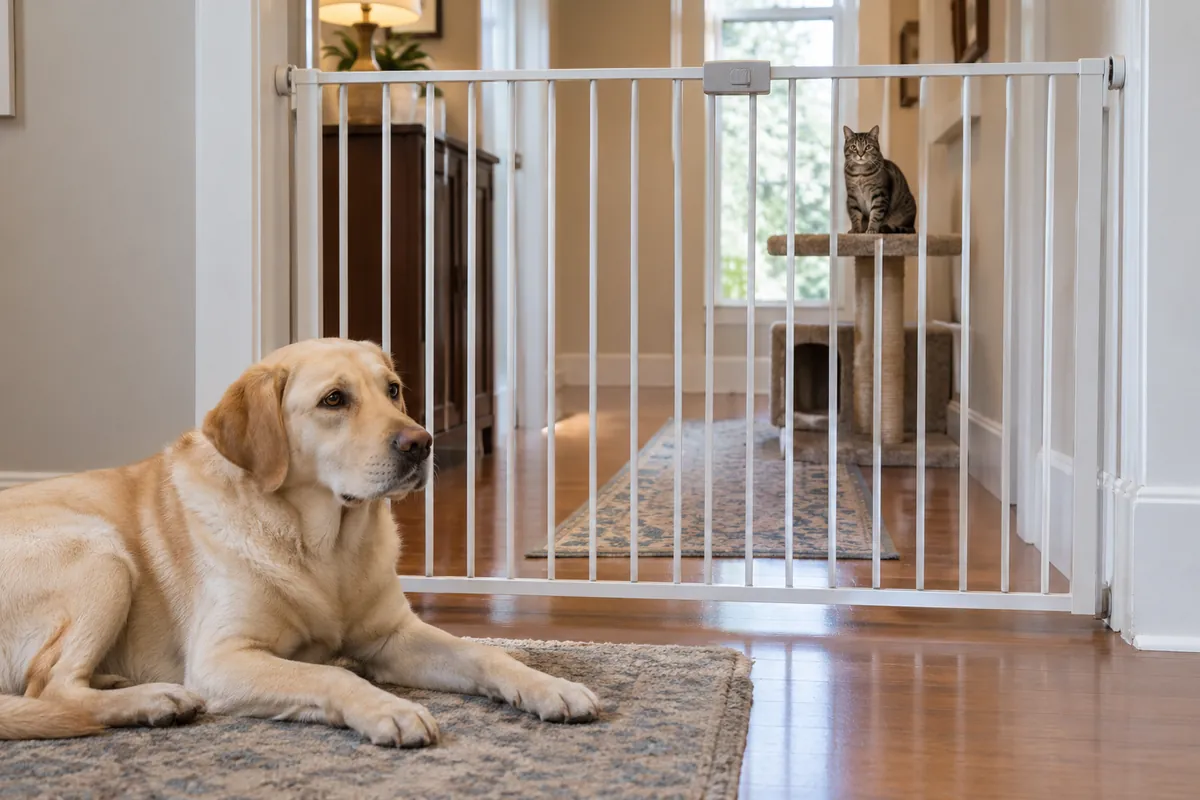
- Baby gates or a shut door between the dog and the cat’s room
- A leash or light drag line on the dog inside while you’re watching
- A crate or pen for the dog any time you can’t watch it
- Cat trees, shelves, and gated rooms the dog can’t reach
The AKC says the cat should always have a way out, and to never leave a new dog alone with your cat until you’re sure they won’t have problems. And every chase you stop before it starts is one the dog doesn’t get to practice, so it’s worth the hassle.
2. Teach “leave it” and “look at me”
Start “leave it” nowhere near the cat. The AKC leave-it method puts a treat on the floor under your hand, marks the second the dog quits trying, and rewards from your other hand. For “look at me,” the AKC watch-me steps bring a treat up to your eyes and reward eye contact, starting out somewhere quiet.
I’d get both cues solid in a boring room before the cat is anywhere close, and after that “look at me” is the cue you use the second your dog’s eyes lock on the cat.
3. Work at a distance your dog can handle
Put the cat behind a gate at the far end of a room and your dog on a leash, and if your dog can look at the cat, look back at you and take a treat, that distance is working. A dog that quits eating, stares or lunges is too close so back up, and close the gap over a lot of short sessions instead of trying to do it in one afternoon.
4. Give the chase a legal outlet
Drive doesn’t go away cause you said no. A flirt pole gives your dog a stalk, a chase and a catch on a lure every day, and you decide when it starts and stops. The AKC self-control guide even lists a flirt pole as one of the games that help teach a dog to settle. Run it with the cat shut away safe in another room, and use the flirt pole impulse control drills to build the off switch.
You’re not gonna train the prey drive out of a dog. What you can do is give it a better target than your cat and teach it to stop when you ask.
How to Introduce a Dog to a Cat
It goes in five stages, starting with separate rooms and then swapping scents, then seeing each other through a barrier, then a meeting on leash, and last you slowly back off on watching them. PetMD’s vet-reviewed guide says it can take a couple of weeks to a few months. So I’d only move to the next stage when both animals are relaxed at the one they’re on.
Slow is safe
Separate rooms
Give the new one its own room with food, water, bedding, and a litter box if it’s a cat. PetMD says keep a new pet apart at least three to four days and get it a health check.
Swap scents
Swap their bedding, and let one roam the house while the other’s shut away, then switch. That way each one knows the other’s smell before they ever meet.
See through a gate
Let them see each other through a pet gate or a cracked door while there’s food or treats or play going on. Keep it short and keep the dog calm.
First real meeting
Do the first meeting in a shared room with the dog on a loose leash. Before the dog comes in, make sure the cat’s got somewhere high to sit or a way out.
Ease off supervision
Ease off watching them a little at a time as they show you they can stay calm, but don’t leave them alone together till you’re sure.
These stages follow PetMD’s dog and cat introduction guide and the VCA five-step introduction, and both say to leash the dog for the first meeting. It doesn’t always go in a straight line either, so I’d drop back a stage after a bad session.
Stop signs during the introduction
PetMD lists the dog signs to watch for, moving slow, stiffening up, locking onto the cat, barking or lunging. For the cat, watch for crouching, freezing, a flicking tail, ears pinned back, hissing or the fur going up. See any of that and I’d end it calmly and back up a step. For a brand-new rescue, the first two weeks guide covers the settling in period first.
When a Dog Should Not Live With Cats
Some dogs shouldn’t share a home with a cat, and saying so isn’t failing. A dog that’s hurt or killed a cat, stalks without a sound, or can’t take food anywhere near the cat is a serious risk. The ASPCA warns that predatory attacks rarely come with a warning, so good behavior yesterday doesn’t guarantee anything.
- Your dog has grabbed, shaken, hurt or killed a cat or other small animal
- It stalks the cat silent, with a fixed stare it won’t break for food or its name
- Weeks into the plan your dog still lunges at the gate every time the cat moves
- The cat is living in hiding and takes off any time the dog is in the room
If any of these fit, I’d keep the animals completely separated with doors and not just gates. Veterinary behaviorists writing for VCA call predatory behavior toward other pets a dangerous problem that sticks around, is unlikely to be cured, and has to be managed.
When to call a professional
I’d call for help after any injury or any red flag above, or if you just don’t feel safe running the plan yourself. The ASPCA points owners to a board-certified veterinary behaviorist (Dip ACVB), a certified applied animal behaviorist, or a qualified trainer with real aggression experience. A lot of times your vet is a good first call cause they can refer you. The reactive dog training guide goes over what that work usually looks like.
One Chase for the Dog, One for the Cat
A house with two pets does best when both of them get their own hunt, in separate rooms. The dog gets a flirt pole session that ends in a catch with the cat shut away, and the cat gets its own session later so it burns off some drive instead of watching from the fridge. And I’d never run a pole with both of them in the room.
Why a flirt pole and not more walks? A walk doesn’t let the dog chase and catch anything, and chasing is the itch. A pole ends in a real catch. If you’ve never used one, start with how to introduce a flirt pole.
The Whimsy Stick for the dog
Dogs 30 lbs and up need the Rugged XL with its 800-lb Dyneema line, and it ships free in the US. Dogs under 30 lbs use the Standard with a 450-lb Kevlar line.
More Chase Problems, Solved
Want more of this in your Google results? Add Whimsy Stick as a preferred source.
Dogs Chasing Cats: FAQ
How do I stop my dog from chasing my cat?
I’d manage it first so the chase can’t happen, with gates, a leash inside and a cat room the dog can’t get to, and then teach leave it and look at me and practice at a distance where your dog can still eat. And give the chase something it’s allowed to go after every day, like a flirt pole, with the cat in another room.
Why does my dog chase my cat?
A lot of times it’s one of three reasons, prey drive, play or guarding. Prey drive looks quiet and locked in, play looks loud and bouncy, and guarding happens around food, toys or beds, and each one needs a different fix so I’d figure out which one you’ve got first.
Is my dog playing with the cat or hunting it?
A dog that’s playing tends to be loose, noisy and bouncy and it backs off when the cat swats, but hunting looks still and quiet, with a hard stare, a lowered head and a slow creep. The ASPCA warns that predatory attacks rarely come with a warning, so I’d take any silent stalking serious.
How do I introduce a dog to a cat?
I’d go in five stages, separate rooms, swapping scents, seeing each other through a gate with treats, a meeting with the dog on a loose leash, and then slowly watching them less. Give the cat high places and ways out and only move ahead when both animals stay relaxed.
How long does it take a dog to get used to a cat?
PetMD’s vet-reviewed guide says a couple of weeks to a few months, depending on the pets, and it doesn’t always go in a straight line. So I’d plan on weeks and not days, and drop back a stage after any rough session.
How do I introduce a high prey drive dog to a cat?
Slower, with more barriers and more distance, so keep the dog leashed longer and the gate sessions short and give the dog a hard flirt pole session before each one. If a dog still can’t take food or look away from the cat after weeks of work, I’d get a professional to look at it before any off-leash meeting.
Can a dog with high prey drive live with cats?
A lot of them can with management, training and time. The AKC says most breeds can live calmly with a cat if they’re socialized as puppies and trained to leave the cat alone, and it flags terriers, sighthounds and herding breeds as the ones to watch closest. But a dog that’s hurt a cat or stalks it silent may need to live without cats for good.
Should I use a shock collar to stop my dog chasing cats?
I wouldn’t use one for this, cause it may break up one chase but it does nothing about the drive under it, and the ASPCA warns that badly planned punishment of aggression can make a dog worse. Management, a solid leave it and a daily outlet work better, and a behavior professional can help with the serious cases.
What do I do if my dog catches my cat?
Separate them safely without putting your hands between them and get the cat to a vet right away. From then on I’d keep the animals completely apart, and get a veterinary behaviorist or qualified trainer involved before you try any new introduction.
How do I stop my dog chasing cats outside?
I’d keep the dog on a leash or long line around cats and wildlife, even in a fenced yard, until you can count on the leave it, cause the AKC notes that recall usually falls apart once a dog is in full chase mode, so calling it back in the middle of a chase isn’t something to count on.
This page is general education from a working dog trainer, not veterinary or behavioral advice. See the exercise disclaimer before starting any new exercise routine.


