High prey drive is not a behavioral problem. It is a neurological state with no structured outlet. Training a high prey drive dog by suppressing or punishing the drive produces a frustrated dog whose drive comes back stronger. Training a high prey drive dog by completing the predatory sequence deliberately, then layering structure and impulse control on top, produces a dog that is regulated, engaged with the handler, and reliable in real-world situations.
The framework in order: Stop unsupervised rehearsal through management. Complete the predatory sequence daily through structured drive sessions. Build impulse control under real drive arousal. Transfer control into real-world trigger exposure. Most high prey drive dogs show measurable improvement in handler engagement and baseline arousal within 2 to 3 weeks of daily consistent application.
This guide is for owners of dogs that fixate on squirrels, bikes, cats, joggers, or other dogs and become functionally unreachable the moment prey arousal fires. It applies to dogs that listen perfectly at home and act like you do not exist outside. It applies to working breeds and any high-drive individual regardless of breed. If your dog’s drive has ever overridden training that was solid in low-distraction environments, this is the protocol that addresses why that happens and what to do about it.
Hard fixation on moving objects, stiffening body, lowered head, and stalking posture when prey stimuli appear. Pulling with full body weight toward anything that moves. Name and recall become meaningless mid-drive. Gets progressively more activated over a walk rather than calming down. Chases things to the end even when called off repeatedly. Difficult or impossible to settle after high-arousal outings. Worse on leash than off, or worse after exercise rather than better. Any of these indicate drive that is regularly firing without completing, which is exactly what this protocol addresses.
What High Prey Drive Actually Is, and Why Suppression Fails
Prey drive in dogs is not aggression, stubbornness, or defiance. It is a hardwired neurological sequence that evolved over thousands of years as the mechanism for hunting. The predatory motor pattern has six stages: orient, stalk, chase, grab-bite, kill-bite, and dissect. Different breeds have been selectively developed to emphasize different parts of that sequence. Herding breeds have intense orient, stalk, and chase components. Terriers have strong grab and shake. Sighthounds have explosive chase. But any individual dog can be high prey drive regardless of breed.
When the sequence fires and does not complete, the drive accumulates. A high prey drive dog who chases on leash but never gets to complete the sequence is a dog whose drive is building with every outing. This is why high prey drive dogs often get progressively more reactive and harder to manage over months of the same walk routine. The walks are activating the sequence repeatedly without ever resolving it. Understanding this is what makes the difference between training that works and training that produces temporary compliance that collapses the moment a squirrel appears.
According to the American Kennel Club, prey drive is one of the most fundamental canine behavioral drives and is best managed through structured outlets rather than suppression. Research published in Applied Animal Behaviour Science confirms that dogs with high predatory motor sequence drive show significantly better behavioral regulation when the sequence is allowed to complete in structured contexts compared to environments where the drive is repeatedly activated but interrupted.
You cannot train prey drive out of a high prey drive dog. Every attempt to suppress the drive without providing an appropriate outlet produces the same result: a dog whose drive comes back harder when suppression fails. The only approach that produces lasting behavioral change is completing the sequence deliberately on your terms, then building the impulse control and engagement that makes you worth listening to when the drive fires in the real world.
The Predatory Motor Sequence: Why Completion Matters
The predatory sequence has a built-in neurological resolution point at the end. Cortisol drops and a dopamine release occurs at the completion of the sequence, specifically at the possess and release phases. This is the neurological equivalent of the hunt concluding successfully. The dog genuinely settles after a completed sequence in a way that no amount of aerobic exercise produces, because exercise activates the chase component without completing the sequence.
A structured flirt pole session run correctly walks the high prey drive dog through every step of this sequence under handler control. The orient and stalk happen during the wait phase before each release. The chase is the controlled pursuit of the lure, functioning as a handler-controlled chase toy that you direct rather than the environment directing. The grab is the catch. The possess is the 3 to 5 seconds of holding. The release is the drop-it on cue. When all six steps complete and the all-done sequence closes the session, the neurological resolution happens and genuine calm follows. This is why a high prey drive dog that has completed a structured session is measurably more regulated on a subsequent walk than one who has only run fetch or jogged alongside a bike. For the full session protocol, see the Flirt Pole Training Guide and Prey Drive Training for Dogs.
Approaches that fail high prey drive dogs
- Suppressing or punishing chase behavior without providing an outlet
- Relying on treats when arousal is above the point treats are relevant
- More aerobic exercise that activates the sequence without completing it
- Avoidance training that never builds control in the presence of triggers
- Commands trained only at low arousal, expected to hold at high arousal
- No structured outlet, so the drive creates its own outlet in the worst moments
Why instinct-based training works
- Completes the predatory sequence daily so drive does not accumulate
- Builds impulse control under real drive arousal, not just calm conditions
- Makes the handler the source of the most satisfying predatory experience
- Lowers baseline arousal before walks and trigger exposure
- Transfers control into real-world situations progressively and systematically
- Produces a high drive dog that is focused and regulated, not suppressed
High Prey Drive by Breed Type
The training framework for a high prey drive dog is consistent across breeds but the expression of the drive, and which components of the predatory sequence are most prominent, varies. This affects which parts of the protocol require the most emphasis.
Border Collies, Aussies, Shelties. Drive oriented at movement control. Orient and stalk are the strongest components. Flirt pole sessions with pauses and direction changes most effective. See Herding Breed Guide and the Border Collie specific protocol.
German Shepherds, Malinois, Dutch Shepherds. Full predatory sequence drive with high frustration threshold. Impulse control work is especially critical. See GSD and Malinois Guide.
Greyhounds, Whippets, Salukis. Explosive chase drive that activates in milliseconds. Management around small animals is permanent. Drive sessions emphasize the possess and release phases most.
Strong grab, shake, and kill-bite components. Tug with rules and flirt pole with emphasis on the drop-it phase. Terriers often need longer possession phases before release cue is reliable. When the grab component redirects toward hands and clothing, see the jumping, nipping, and impulse control guide for the specific redirection protocol.
Retrievers, Spaniels, Pointers. Drive expressed through flushing and retrieve sequences. Flirt pole and structured fetch with two-toy protocols most effective for this sequence profile.
Prey drive varies widely within breeds. A high prey drive Labrador requires the same protocol as a high prey drive Malinois. Drive level matters more than breed label for how to train a high prey drive dog.
How to Train a High Prey Drive Dog: The 5-Phase Protocol
Every unsupervised chase a high prey drive dog completes strengthens the neural pathway. Long lines in open areas until recall is proofed. Structured household rules, consistent meal times, door manners, and no self-directed access to high-stimulation environments. If drive overflow is also producing jumping on people or destructive behavior, those are the same unresolved drive expressing through different outlets and should be managed simultaneously. Avoid off-leash situations where prey triggers are likely until drive fulfillment sessions and impulse control are well established. Management is not a failure to train. It is what gives training time to take hold before the drive practices itself into an even more consolidated pattern.
Before everything elseA structured flirt pole session run once or twice daily is the foundation of training a high prey drive dog. The session walks the dog through the full predatory motor sequence under handler control: orient and stalk during the mandatory wait, chase during the controlled lure movement, grab at the catch, possess for 3 to 5 seconds, release on the drop-it cue, and neurological resolution at the all-done sequence into a settle. Sessions run 7 to 10 minutes maximum. The high prey drive dog that enters a walk having completed this sequence has measurably more threshold space than the one who has not. For the full structured session, see Prey Drive Training for Dogs. Follow the session with a cognitive enrichment cooldown to bridge the transition from drive to genuine calm. For a complete breakdown of why this approach produces more genuine tired than hours of walking, see How to Tire Out a High Energy Dog.
Daily, before walks and trigger exposureTraining a high prey drive dog to hold commands in distraction environments requires that those commands be proofed under real arousal first. The mandatory wait cue before every flirt pole release is the most direct impulse control training available because it requires the dog to sit with intense predatory arousal for 5 to 10 seconds before discharging it. This is precisely the skill that fails when a squirrel appears on a walk. Build it under drive first, in the controlled session context, before expecting it to hold in real-world situations. For the full drill progression, see Impulse Control Drills.
Built into every session repA high prey drive dog that has no structured outlet sees the environment as the only reliable source of predatory stimulation. Once daily drive sessions are running and the handler is controlling the most satisfying predatory experience the dog has, the handler becomes more valuable than random environmental stimuli. This engagement shift is what makes recall training possible with a high prey drive dog. The recall is not competing with the squirrel in the abstract. It is competing against a squirrel when the dog already has a reliable daily outlet that is more structured and satisfying than a random chase. That changes the equation significantly. Practice name response, hand targets, and handler engagement games during the low-arousal post-session settle window when the dog is most receptive.
Post-session training windowOnce drive fulfillment, impulse control, and handler engagement are established, introduce real-world trigger exposure at a distance where the high prey drive dog is aware of the trigger but able to take food, respond to their name, and recover quickly. The dog is now entering these situations with a depleted drive baseline and a practiced skill set for staying regulated. Reward orientation toward you, voluntary disengagement from the trigger, and rapid recovery after noticing prey stimuli. Decrease distance only as recovery speed improves. For the full trigger exposure framework, see the reactivity training protocol, which applies directly to prey-driven reactivity as well as social reactivity. If leash pulling and barking at movement are the primary real-world problems, see Flirt Pole for Barking, Leash Pulling, and Recall for the specific on-leash protocol.
After foundations are establishedHigh prey drive dogs are the easiest dogs to train once you understand what they need. They are not stubborn. They are not defiant. They are motivated to an extreme degree and every ounce of that motivation is available to you the moment you become the source of what they are driven to do.
Christopher Lee Moran, Instinctual Balance Dog Training2-year-old Border Collie, impossible to recall around movement of any kind
The owners had done two rounds of obedience training. The dog had a reliable sit, down, stay, and recall in class and at home. Outside with any moving target in view, the dog was functionally unreachable. The owners had been advised to carry higher-value treats and use a long line indefinitely. They had been doing both for 8 months with no improvement in real-world reliability.
Week one: Added a daily 8-minute structured flirt pole session before the morning walk. Mandatory wait before every release, drop-it after every catch, all-done into a settle. No changes to the walk or training protocol. By the end of week one the dog was noticeably more oriented toward the handler at the start of walks. Week two: Added the same session before the afternoon walk. Handler engagement games practiced during the post-session settle window daily. Week three: Working recall at 40 feet from a stationary cat with no lure bait needed for the first time.
By week six, the dog had a reliable recall at 25 feet from moving bikes and jogging people, both previously impossible. The owners reported the dog was initiating check-ins on walks rather than pulling constantly toward stimuli. Eight months of treat-escalation had not moved the needle. Six weeks of daily drive fulfillment changed the dynamic entirely.
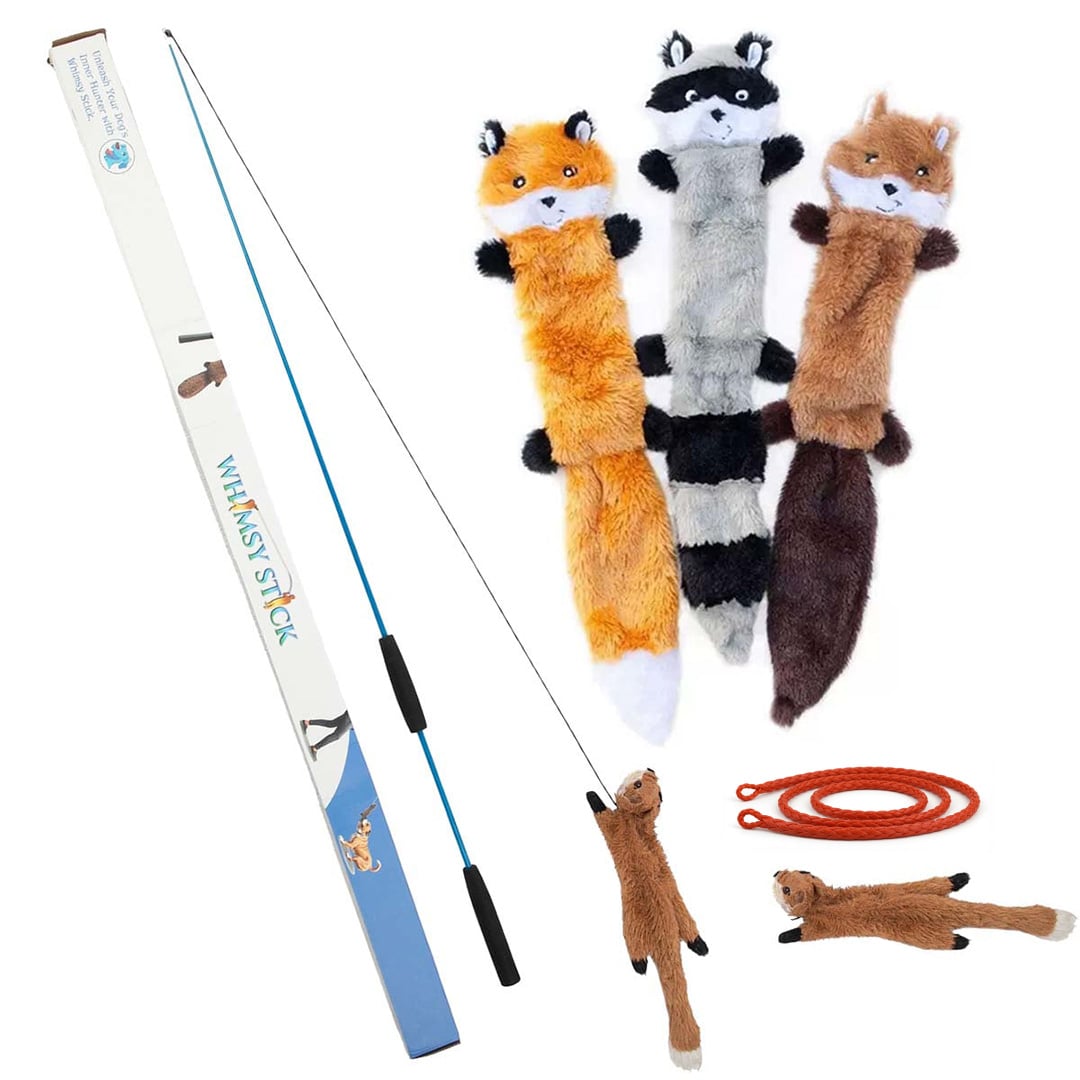
Kevlar line, no elastic snap-back, smooth deliberate movement the handler controls completely. Built for the structured daily drive sessions that complete the predatory sequence and lower baseline arousal before walks. The right tool for terriers, smaller herding breeds, and any high drive dog under 30 lbs. $54.95, free shipping, 30-day guarantee.
Shop Standard →Reinforced for the German Shepherds, Malinois, Border Collies, and high-drive large breeds whose predatory sequence needs a tool built to handle real drive intensity. Same Kevlar line, 8-ft radius, multiple lure options. Starting at $74.95, free shipping, 30-day guarantee.
Shop Rugged XL →For a full breakdown of what separates training-grade flirt poles from generic pet store options, the buying guide covers materials, construction, and the design differences that matter for high prey drive work. For the top-rated option specifically, see the Whimsy Stick review. For a comparison of all interactive toy categories ranked by training value, see Dog Enrichment and Mental Stimulation Toys.
The Mistakes That Keep High Prey Drive Dogs Uncontrollable
Corrections, leash pops, and aversive interruptions applied to prey drive expression without providing an appropriate outlet produce a dog whose drive accumulates behind the suppression and emerges with more intensity when the suppression fails, which it eventually always does. The suppression approach also damages the handler relationship because the handler becomes associated with preventing the most neurologically compelling thing the dog experiences. Working with the drive is faster, more durable, and produces better handler engagement than any suppression approach.
More fetch, more running, more walks. This is the most common response to a high prey drive dog and it reliably makes the problem worse over time. Repetitive aerobic activity activates the chase component of the predatory sequence without completing it. The dog’s arousal system gets trained to stay elevated, not to come down. High prey drive dogs that run five miles a day are often more reactive and more difficult to manage than those who run one mile because the chase arousal has been trained into a chronic state. Structured sessions that complete the sequence produce the calm that exercise alone cannot. For a full breakdown of how much exercise your dog actually needs by drive level, see the exercise guide.
A recall that works in the backyard and at low-distraction parks is not a recall for a high prey drive dog. It is a recall for a low-arousal dog. The commands need to be proofed at progressively higher arousal levels, specifically including drive arousal, before they become reliable in real-world prey situations. This is exactly what the impulse control work in structured drive sessions builds. A high prey drive dog whose recall has been proofed through flirt pole drop-it training under full drive has a fundamentally different recall from one whose recall was proofed with food at increasing distances in calm environments.
Off-leash freedom is the last thing a high prey drive dog earns, not a management tool used while training is in progress. Every successful unsupervised chase is a rehearsal that strengthens the pattern. A long line in open areas is the correct bridge between on-leash management and genuine off-leash trust. The long line allows the dog to experience distance and open space without the ability to complete an unsupervised chase. Off-leash access comes when the recall has been proofed specifically in the presence of the dog’s highest-value prey triggers at progressively closer distances.
Some owners wait for the high prey drive dog to mature out of the behavior. Working breeds and other high-drive dogs typically do not. Prey drive often intensifies through adolescence and into early adulthood as the dog develops more physical capability and coordination to express it. A high prey drive dog at 4 years with no structured outlet or training has significantly more consolidated chase behavior than the same dog at 10 months. Starting the structured drive outlet and impulse control protocol earlier produces faster results, but starting at any age is better than waiting.
High prey drive becomes a safety concern when the dog directs the predatory sequence at small children, small animals with intent to injure, or livestock. Fixation combined with silent stalking, no warning signals, and full predatory pursuit of a living target is a different behavioral profile from reactivity or frustrated prey drive expression. This warrants professional assessment before any home training protocol is applied. The structured drive outlet protocol reduces predatory arousal in most high-drive dogs and is safe and appropriate for standard prey drive expression toward environmental stimuli like squirrels, bikes, and other dogs.
How to Train a High Prey Drive Dog: FAQ
For more trainer protocols on prey drive, impulse control, and structured play across all breeds, see the full training blog.