
Low stockOnly 62 Rugged XL’s left
- Only 62 Rugged XL’s left
- Rugged XL Pro Kit $129.95 Pole + 5 lures + spare 800-lb line. Free US shipping
- Rugged XL 3-Lure Bundle $94.95 Best value. Free US shipping
- Every kit: 30-day money-back guarantee
The Flirt Pole for Dogs That Wreck Flirt Poles
I’m Chris, and I’ve been working with high-energy dogs for 10 years now, over 400 of them. What I have found is a dog with a satisfied animal instinct is a much better behaved dog, and the biggest instinct they’ve got is hunting. That’s why I built this pole. It’s one 46-inch fiberglass rod with a line that doesn’t stretch, and you keep the lure low on the grass so your dog gets to run and cut and catch like they want to. What my clients tell me most is their dogs are a lot more relaxed after, calmer, and they just seem more satisfied.
- 4.9 across 49 product reviews
- 30-day money-back guarantee
- Free US shipping on every Rugged XL kit
What’s your dog doing that made you look this up?
Pick the one that sounds like your house. Each one goes to the page where I’d walk you through it, and some of those fixes don’t even need a flirt pole.
Something else? Jumps on everyone · Bites and nips · Pulls, won’t come back · Never settles down · Destroys the house · Obsessed with chasing · Won’t play or fetch
Your dog isn’t bad. Their inner wolf is unemployed.
You walk them and you love them, and still every chewed-up shoe and every 10pm zoomie is telling you the same thing. You’ve got a bored predator living in your house, and it doesn’t have a job.
Why a flirt pole works when walks don’t
There are a couple of ways to satisfy what’s in a dog. One is exploration, another is play, and the biggest one is hunting. A dog wants to stalk something, chase it down, catch it and then get the win. A walk moves their legs but it never lets them do any of that. Fetch gets the chase going and then asks for the prize back, and puzzle feeders work the brain but there’s nothing to chase.
A flirt pole lets them do the whole thing right in your yard, and you’re the one who decides when it starts and when it’s over. That second part is a bigger deal than most people think. If you want to read more on channeling prey drive the AKC has a good piece on it, and my training guide goes over how I run a session.
Low and wide. The lure stays on the grass so the dog is running and turning, not jumping.
Your dog isn’t tired. They’re unfinished.
Walking burns calories, but your dog never gets to hunt on a walk. Fetch starts the chase and then asks them to hand the prize back, which is kind of backwards, and puzzle feeders work the brain but there’s nothing to chase, so they solve it and go looking for the next thing to tear up.
The hunt has four parts, and a flirt pole runs all of them in about ten minutes
- Stalk. The lure sits still on the ground, the eyes lock on and the whole body gets low and coiled up.
- Chase. Then they go full speed after something moving along the grass like real prey would.
- Catch. They get their mouth on it, which is the part a walk or a game of fetch never gives them.
- Win. They get to own it for a minute before you trade for the drop, and that’s when a dog can actually settle down.
15,000 years domesticated, and the hunt never left
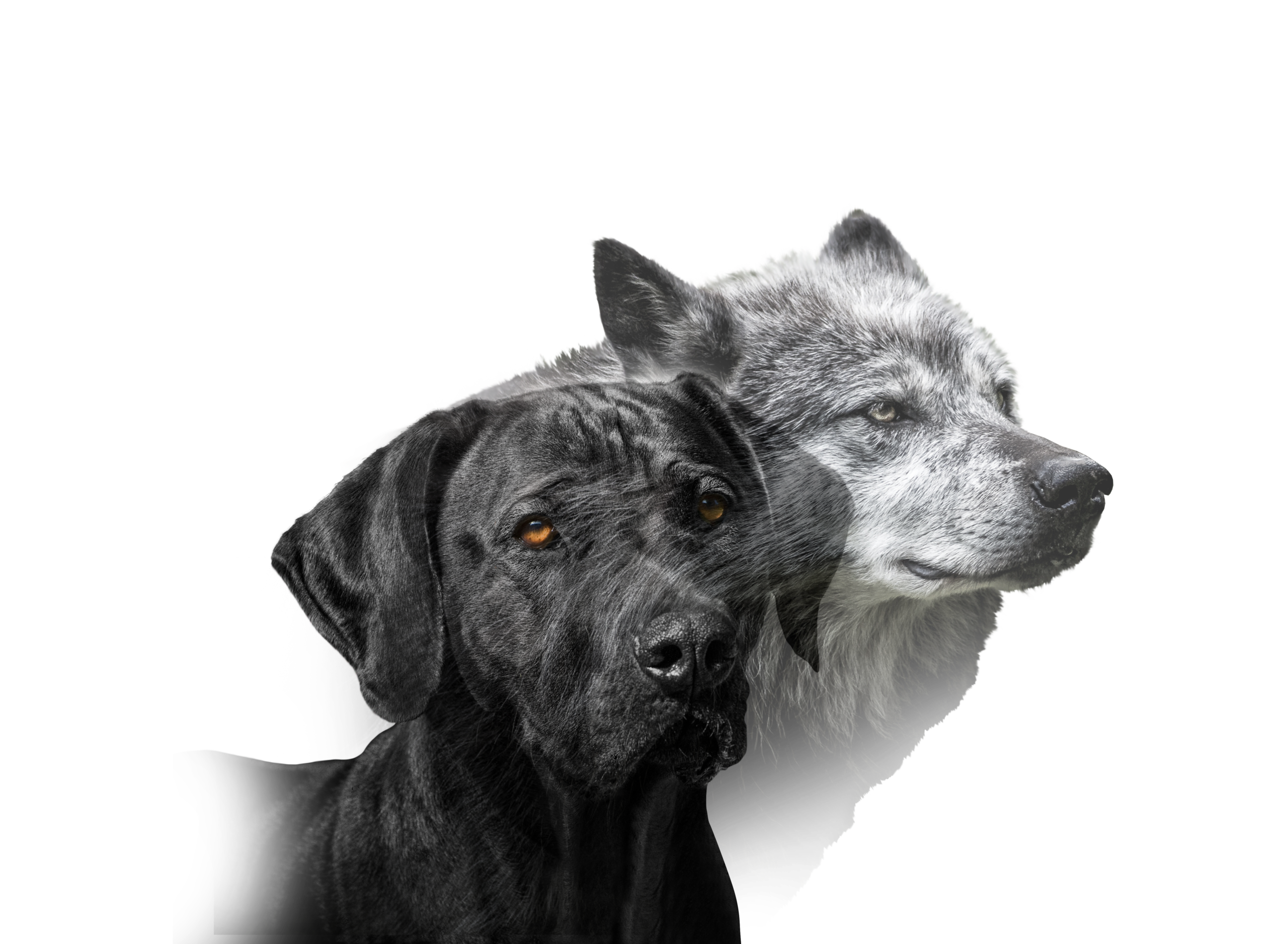
Dogs share most of their DNA with the gray wolf. We changed their size and their coat and their ears, but the part of the brain that wants to stalk, chase, catch and win stayed right where it was.
That hunting sequence runs in every breed, every day, and a walk doesn’t finish it while fetch only gets you about half of it. Whatever’s left over comes out as chewing and pacing and reactivity.
You didn’t get the wrong dog. You got a hunter living in your house, and a flirt pole gives them about ten minutes a day to be one.
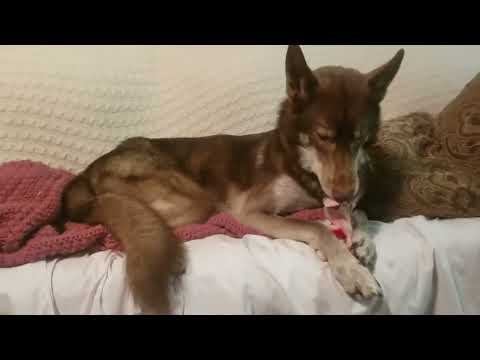
A pet Mexican Red Wolf running the whole hunting sequence on a stuffed toy. That’s the same wiring your couch dog has.
Want the long version? Here’s how I handle prey drive training.
Show up with a flirt pole and see what happens
Every dog goes at their own pace, so don’t hold me to a calendar. These are the changes to look for over the first couple weeks of daily sessions, and what my clients tell me most is their dogs are a lot more relaxed and calmer, and just seem more satisfied.
Less wrecking around the house
Chewing and shredding usually isn’t your dog being bad, it’s a dog that never gets to finish the hunt. Give them ten minutes of real chase and catch, and look for the couch cushions to start getting left alone.
Calmer walks
Run a short session before the walk and look for the squirrels to turn into background noise, with a little less pulling on the leash.
Quiet evenings
Once they’ve had their hunt for the day, look for less pacing and fewer 10pm zoomies, and a lot more of the dog just crashing on the couch.
A closer bond
You’re the one running the game they love most, and that tends to pull a dog a lot closer to you.
Why this one: the four things I check on any pole
Most people judge a flirt pole by how tough it looks in a picture, and that tells you about nothing. There are a lot of flirt poles out there that I have tried. Some were too short or bulky, some had a violent bungee cord, and some were just too heavy. So this is what I actually look at, and I hold mine to it too.
The current Rugged XL under load. One blue rod with no joints, and it bends instead of breaking.
1. Field of chase
Field of chase is how far out that lure can go and how much ground your dog gets to cover going after it. It matters a lot for bigger dogs and for different kinds of breeds, cause an Irish Wolfhound takes long leaps and a herding dog is quick and cuts tight. On the Rugged XL the rod is 46 inches and the line with the lure is about 4 feet, so the lure gets out about 8 feet from your hand. I’d like it longer, but shipping anything over 4 feet costs a whole lot more. The line being about the same length as the pole isn’t an accident either, I call that pole balance. If the line is a lot longer than the pole it actually shrinks your field of chase, because the lure just comes back to you. Give yourself grass about 20 feet across.
2. A static line, never bungee
I won’t use a bungee line, ever. When the dog grabs, a bungee stretches and loads up and then it whips the lure right back at you. A static line just goes where your hand goes. The Rugged XL uses Dyneema rated at 800 lbs and the Standard uses Kevlar rated at 450 lbs, and those numbers are the line ratings, not a promise about the whole pole.
3. The lure stays on the ground
Prey runs along the ground. If you wave the lure up over your head the whole game turns into leaping and twisting, and that’s hard on a dog’s knees and back. A rod with the right amount of stiffness lets you sweep it low and keep it down there.
4. Built for the grab and shake
The hardest moment on any pole is the catch, when a big dog clamps down and shakes. A good pole should be lightweight and somewhat flexible, but not too flexible. Some people like a horsewhip, but it has a violent movement tendency as it flexes. I started with about a 5-foot fishing rod with no eyelets and no reel, cause let’s not lie, you ain’t reeling in a dog, and fiberglass ended up being light and flexible enough at the right length. Two-piece and collapsing poles lose strength, and if you add metal fittings to get it back the pole gets heavy and it’s not fun to use anymore. So the Rugged XL is one glossy blue rod with no sections and no threads to work loose. It has two black foam grips spaced apart so your second hand can choke up, and a 3-inch silver ferrule at the tip with the red-orange line tied to its split ring. The whole thing weighs about 8 ounces, and the Standard is about 4.
This is for you if
- Your dog has more energy than anything you’ve tried can burn off
- Walks, fetch or daycare still don’t get you a calm dog
- You’ve already gone through a pile of “indestructible” toys
- Your dog won’t fetch, or gets bored of it pretty quick
- Your dog gets restless or destructive when they don’t get enough exercise
- You’ll put in about ten minutes a day
It’s not for you if you want a toy you can toss in the corner and walk away from, or your dog is already calm and doesn’t need it. It works cause you work it, it’s a training tool, not a babysitter.
Pick your pole
Pick by your dog’s size and how hard they play, not by the price. If your dog is under 30 lbs and plays moderate, get the Standard. If they’re 30 lbs and up, or they play hard at any size, get a Rugged XL kit. Right at 30 lbs? Go XL. In my own use the Rugged XL holds up to a 120-lb power breed.
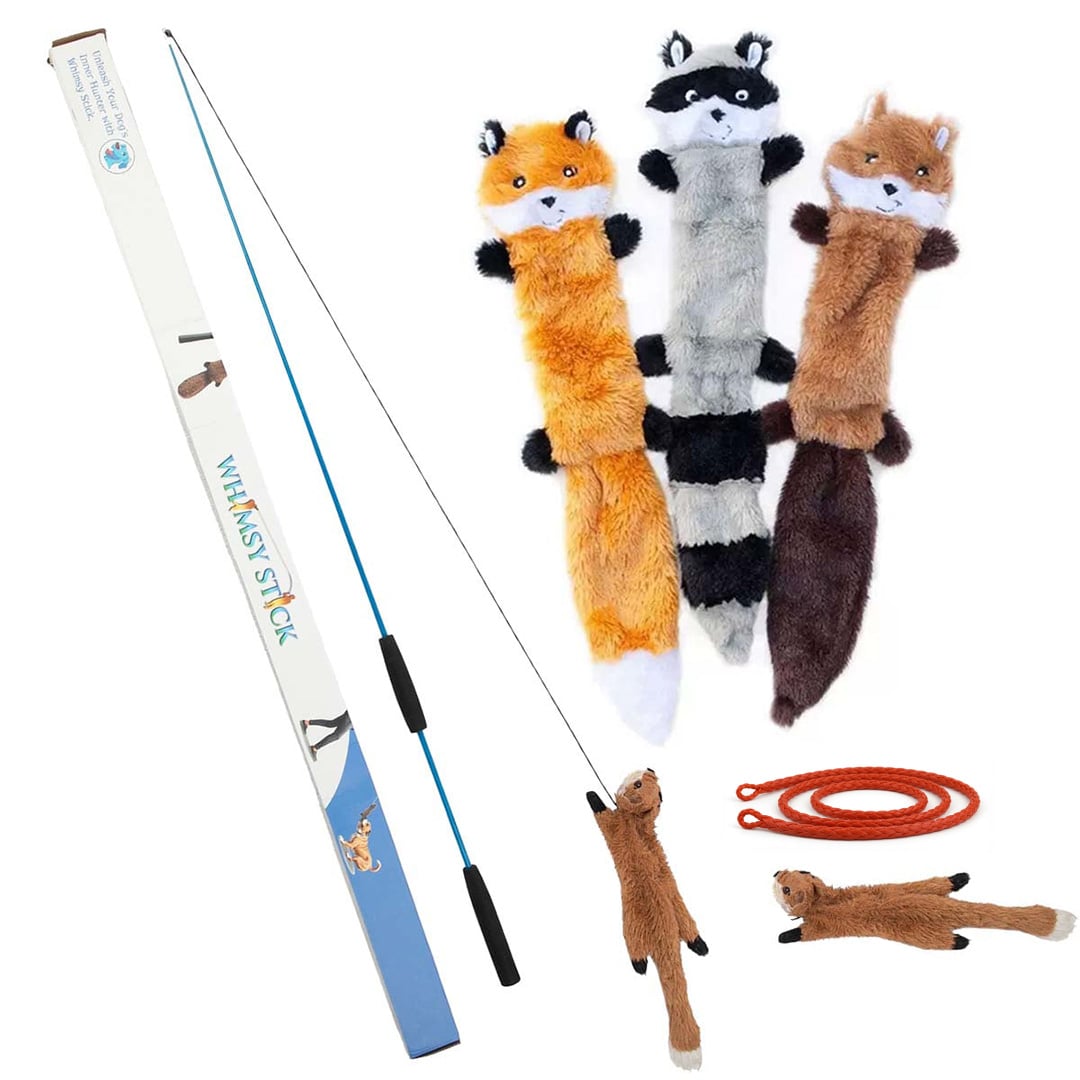
Rugged XL Pro Kit
- One-piece 46-inch fiberglass rod, 800-lb Dyneema static line
- 5 lures and a spare line, so a worn part never ends a session
- Dogs 30 lbs and up · free US shipping
30-day money-back guarantee · usually ships within 2 days
Rugged XL + 3 Lures
- Same pole and line, 3 lures
- Dogs 30 lbs and up · free US shipping
The Standard ships for $20 cause it goes out in a longer box. Right now there’s only 62 Rugged XL’s left. Still comparing? Here’s every Rugged XL kit side by side, or the whole shop with the lures and lines.
Real sessions, real dogs
These aren’t staged studio shots. Every session clip on this page is my own footage. In this one a young German Shepherd works a fox lure along the grass while a Malinois holds a down-stay on the other side of the split.
Chase on one side and control on the other, and both of those are part of the same game.
The wait. Before any chase the lure goes still and the dogs hold a sit or a down. That pause is where you build the off switch.
See the impulse control drillsAfter a Whimsy Stick session. Two tired dogs that are done for the night, and that’s what I’m going for every time.
What owners say, including the one who didn’t like it
There are two numbers here and they count different things. The Whimsy Stick itself has 4.9 stars across 38 product reviews from the website, Amazon, Facebook and Etsy. If you add the 268 reviews of my training and walking work on Yelp, Google, Facebook and Wag, it comes to 306 reviews across 7 platforms. Every quote below was copied from a real review.
Video reviews from buyers
Jordan · Dog parent · Video review
Wesley · Professional dog trainer · Video review
Written reviews, good and bad
“…it is way more equipped to hold up to the body slamming my shepherd does. Even the string attachment is improved and my girl is VERY happy to have her ‘squirrel’ (now a raccoon) back. … Best purchase I ever made.”
Alyssa T. · Rugged XL · Shepherd · Jun 2026
“He’s a working dog mix breed who has energy to spare. We can play with him and his Whimsy for several 15 minute sessions a day; it definitely takes his high drive edge off.”
Anna C. · Rugged XL · May 2026
“I love this lightweight flirt pole! Our dog is super hyper and this pole wears him out in 5 minutes! It’s easy for me to handle even at my age, 74.”
Shirley · Amazon
“My dog doesn’t really like it. He prefers fetch.”
Daniel T. · Website · 1 star We don’t hide this
More from owners
- Brenda M., Rugged XL 3-Lure Bundle: “Neagley loves it! Engaging, exciting fast paced play that wears her out. She gets so excited just to see us pull out the pole.”
- Jake K., website: “I would give 6 STARS if I could.”
- Flavia G., pit mix, website: “Life changing since our dog doesn’t fetch. She is also not good with other dogs so now we can get some exercise in our backyard.”
- David M., website: “He’s a border collie, so lots of energy. He loves this thing, and it wears him out.”
- Ken R., website: “We have an extremely active working dog mix 6 month old puppy and 5 minutes of this tires him out.”
- Ben R., posted on the website: “It keeps him engaged, excited, and is one of the few things that can actually tire him out.”
- Molly R., pittie lab mix, website: “…she’s constantly overflowing with energy and this is one of the only toys that tires her out.”
- D. Richardson, Amazon: “Great training tool! We have used this with our puppy for the past six months and have found it to be very useful for his training as well as for his playtime.”
- Mike T., Facebook: “If you’re looking for a fun and very tiresome game for your fur friends? Then this is the toy for you.”
- Victor P., Amazon Verified Purchase: “One of the best flirt poles I have gotten for my dog. He loves it.”
- Samantha, Etsy: “Very lightweight and good. My pups love it.”
- Elaine A., Facebook: “Fantastic toy! My dogs love it!”
Who builds it
Me. I’m Christopher Lee Moran, a working dog trainer. I started out walking and sitting dogs on Wag back in 2016, then ran dog adventures, then went into private training, and it’s been about 10 years and around 400 client dogs since then. Controlled Freedom is the name of the method I train with. I don’t have certifications or vet letters after my name. A lot of what I know came from taking the dogs other trainers couldn’t fix, like resource guarders, dogs with bite histories and rescues that had shut down.
Flirt poles helped those dogs, but the poles I could buy didn’t hold up. I bought the ones I could find, handed them out to clients and watched what broke. Then I built my own and kept testing it on high-drive client dogs for years before I ever sold one. Whimsy Stick is based in Cisco, Texas.
Shipping, returns, and what happens if it breaks
- Shipping: orders usually ship within 2 days. Every Rugged XL kit ships free in the US. The Standard is $20 because of the longer box.
- 30-day money-back guarantee: if it isn’t a fit, email me for a refund. You pay return shipping unless the pole failed.
- Breakage: if the pole breaks during play, whether your dog is over 120 lbs or under, I’ll work with you to fix it, replace it or refund it. If it got left out with the dog and chewed up, that one’s on you.
- Wear parts: lures get shredded and lines fray, that’s normal. It’s why I sell a $12.95 lure and a $19.99 Rugged XL line.
Not working out? Email me first. A lot of times I can send you a couple of tips that get a hesitant dog into it. I’m a one-man company and I want you happy with it, so I’ll work with you.
Full details: refund and returns policy · contact me
Before you buy: straight answers
What is a flirt pole for dogs?
It’s a pole with a line and a lure on the end that you drag along the ground like something running away. Your dog stalks it, chases it, catches it and gets the win, and you decide when each round starts and stops. With a little bit of structure it gives that chase drive somewhere to go, right in your backyard. More on that here: what is a flirt pole.
What size should I get?
Under 30 lbs and not too rough, get the Standard. 30 lbs or more, or a rough player at any size, get a Rugged XL kit. Sitting right at 30? Go XL.
Will it hold up to my 90-lb power chewer?
That’s who the Rugged XL is built for, big dogs that grab and shake. It’s one piece of reinforced fiberglass with a Dyneema line rated at 800 lbs, and in my own use it holds up to a 120-lb power breed. It’s not a chew toy though. If it breaks during play I’ll work with you to fix it, replace it or refund it. A dog left alone with it is gonna chew it, and that’s not covered.
My dog won’t fetch. Will a flirt pole work?
A lot of times, yes. Fetch only covers part of the chase, and plenty of dogs that ignore a ball light up when something moves along the ground. Some dogs still won’t care for it, and the one 1-star review on this page is exactly that. Email me before you give up on it, cause a couple of tips usually help.
Won’t it make my dog more hyper?
Not if you run it with some structure. Hold a wait before every chase, let them catch it every few rounds, trade it for a drop-it, and end it on purpose with an all-done word. A flirt pole gives chase drive an outlet, but it isn’t a treatment for reactivity or aggression, and if that’s part of the picture bring in a qualified behavior pro too.
How long is a session?
About 10 minutes total for most healthy adult dogs, done in short bursts with breaks in between. On a hot day go early and keep it short. Seniors, dogs coming back from surgery and flat-faced breeds need shorter and easier sessions, and get the okay from your vet first.
Is a flirt pole safe for puppies?
Wait until your puppy is at least 6 months old and ask your vet about growth plates. Until they’re 12 months keep it to 3 to 5 easy minutes with no hard cuts. The AKC’s guide to puppy exercise covers the growth plate side of it.
Can it help with leash reactivity?
It can take the edge off before a walk, and that makes the leash work easier to practice. It won’t fix reactivity on its own though. Start with my reactive dog training guide, and if there’s fear or aggression involved, work with a qualified behavior pro.
How much space do I need?
On the Rugged XL the lure gets out about 8 feet from your hand, so about 20 feet of clear grass across works good. More room is always better.
What makes it different from a cheap flirt pole?
A cheap pole usually has telescoping joints and a bungee. Mine is one solid rod with a static braided line, and the lure comes off so you can replace it when it wears out. Honestly, if your dog is small and gentle and plays once a week, a cheap pole is fine. If you’ve got a big dog that plays most days, the build is what you’re paying for.
Further reading: AKC on puppy exercise · AKC on reactivity vs. aggression · my step-by-step reactivity method · is a flirt pole safe?
Try it for 30 days, or get your money back
If it isn’t a fit for your dog, email me for a refund. You cover return shipping unless the pole failed. Big dogs go through lures, so the Pro Kit is the one I’d start with.
Get the Pro Kit, $129.95Smaller dog? The Standard is $55.95
Find the page that sounds like your dog
- Best flirt poles of 2026, ranked
- Best flirt pole by breed
- Flirt pole buying guide
- Best flirt pole for high-energy dogs
- DIY vs. a professional pole
- Best dog toy 2026
- Dog exercise toy for real conditioning
- The daily dog exercise routine
- Enrichment toys for high-energy dogs
- Mental stimulation for large dogs
- Big dog toys to keep them busy
- Toys for dogs who don’t like toys
- A dog chase toy for the yard
- Dog park alternatives
- How long does it take to bond with a dog?
- Exercise a dog when your own mobility is limited
- Free dog training course
- All training guides
Also from me: mypooch.ai, a free dog app on Google Play and the App Store.
Based on my own experience training dogs. Not veterinary advice. Check with your vet before strenuous exercise for puppies, seniors, dogs after surgery and flat-faced breeds. Exercise disclaimer.


