
Always On. Never Off. Time to Settle.
How do you teach a dog to settle? You train it, same as you’d train a sit, cause waiting around for your dog to feel like relaxing doesn’t get you anywhere. Pay it for lying still on a mat, put a settle cue on that, and practice it every day till it’ll relax when you ask. But a dog that’s still wound up can’t learn any of this, so get the energy out first with some real exercise and then catch the calm that comes after.
The AKC agrees it’s taught, not born: emotional self-control “is something most dogs need to be taught,” and “impatient and demanding puppies don’t magically mature into patient and restrained adults.” That’s from the AKC’s self-control guide.
The quick version, 3 steps: (1) Drain, about 10 minutes of real exercise first. (2) Capture, pay calm on a mat, low and quiet, about 5 minutes. (3) Name it, add a settle cue and practice a little every day, then in new places.
By Christopher Lee Moran, working dog trainer, about 10 years and around 400 client dogs, Controlled Freedom method. I designed the Whimsy Stick. Get the energy out with the flirt pole training guide, then layer on the impulse control drills.
Who this is for
Your dog is worn out and still won’t relax. It follows you around and whines and gets up and lays back down somewhere else, and it just never switches off. Sound familiar? Being calm is something a dog learns, and a lot of dogs never get taught it, so you can train an off-switch the same way you’d train a sit, with a clear cue and a whole lot of practice that gets paid.
- Your dog never seems to switch off
- It’s tired but still restless
- You’ve got a high-drive dog that can’t relax inside
- It paces, whines or keeps moving spots all evening
- You want a dog that can settle at a cafe or a friend’s house
- You’re tired of a dog that wants attention nonstop
- You exercised your dog and you still get no peace
Signs your dog has no off-switch
- Tired but still pacing, whining or can’t lie still
- Follows you room to room and never settles
- Always after your attention, even after exercise
- Gets up and lays back down somewhere else every few minutes
- Amped up and restless every evening
- Has a hard time relaxing in public or new places
- Only stops when it finally crashes
If the restlessness also comes out as jumping, nipping and attention-seeking, a lot of times all of that goes back to a dog that isn’t getting enough to do, see dogs hyper after walks.
Calm is a trainable skill
A lot of dogs were never taught to settle, so they just don’t know how. Think about it from the dog’s side: people tend to react to the exciting stuff and ignore the quiet moments, so the dog figures out that doing something is what gets your attention, and it never gets any practice just being calm.
You can flip that around. Pay your dog for being still the same way you’d pay a sit and it figures out calm pays. The AKC says the same thing: “don’t forget to reward calm behavior whenever you see it. Anytime your dog is showing restraint, be sure to give them a treat or kind word.”
Drain first, then teach
A dog full of energy can’t learn to be calm, so the exercise comes first. Once some of that is used up, your dog can actually practice the off-switch instead of fighting you on it the whole time.
How to build the off-switch, step by step
There’s three pieces to it. Catch the calm on a mat and reward it quietly, add a settle cue once your dog’s pretty reliable at being still on the mat, and then go practice it in new places. And since a wound-up dog can’t practice calm, you always get the energy out first and pay the relaxing that comes after.
Step 1: drain, then capture calm on a mat
Give your dog a mat and pay any moment it’s still and calm and quiet about it. You’re paying for relaxing, so keep your own energy low and just drop the treat down between its paws without making a big deal. Do that for a while and your dog starts hanging on to the calm longer to earn it.
Step 2: add the settle cue
Once your dog’s calm on the mat pretty reliably, give it a name. Say your cue, wait for the dog to settle, then pay, and that word starts meaning relax, till after a while just saying it helps get the dog there.
Step 3: practice everywhere
When it works at home, take the mat out. Practice the settle at a cafe or a friend’s house or somewhere busy, and then the off-switch goes wherever you go instead of only working in your living room.
What relaxed actually looks like (so you know what to pay)
This part trips people up, cause a dog lying down isn’t the same thing as a dog relaxing. A vet handout from Today’s Veterinary Practice lists the signs to mark: “hips shifted to the side, stretching a leg out, putting a shoulder down, lying on one side, putting the head down, or placing the chin between the paws,” plus “sighing, closing the eyes, or slowing the breathing rate.” Those are the moments you pay.
- Keep sessions short. The same handout says sessions should ideally run “2 to 5 minutes, 2 to 3 times per day,” and that you can still make progress with one 30-second session a day.
- Build time slowly. It starts at 2 seconds of relaxation before the reward, then 3, 5, 10, 15, 30 and so on, and if the dog can’t hold it you back up “by at least 5 seconds” and go slower.
- Want the full version? Veterinary behaviorist Dr. Karen Overall published a much longer relaxation protocol in 2013, and that handout links to it.
Use play to practice it
Here’s one people don’t think about. The AKC actually says “a game of tug-of-war, a flirt pole for chasing, or even just wrestling with your dog are all great ways to teach them to settle down. Simply add moments of calm into the middle of the fun.” Start with gentle play, stop and ask for a sit or down, and restart the game as the reward, then slowly turn the intensity up before each settle break.
Calm in the middle of the fun. A Malinois holding a down and a doodle holding a sit with the lure right there.
Impulse control drillsWhy it isn’t working yet
The biggest mistake is skipping the exercise. A wound-up dog really can’t relax, so trying to train calm while it’s full of energy just frustrates both of you. Get the energy out first, every time.
The other one is getting excited when you pay. Praise in a high, happy voice and you just wound back up the dog you got calm, so keep everything low and boring, cause calm is what you’re paying for. And don’t ever punish a dog for being restless, that just piles on the stress you’re trying to take away.
Be patient and consistent
An off-switch builds slow, so I wouldn’t expect it in a few days. A little practice every day adds up though, and one day you’ll just notice your dog actually relaxes.
The settle routine: drain, capture, name it
- Drain, about 10 minutes: a real exercise session first, cause a dog full of energy can’t learn calm.
- Capture, about 5 minutes: mark and pay calm on the mat, and keep your own energy low and quiet while you do it.
- Cue, daily: add your settle cue and practice a little every day till it sticks.
Key takeaway: tired and calm aren’t the same thing, and calm has to be taught, so get the energy out, pay the stillness, then name it and keep at it till the off-switch holds.
Rule out pain first. If your dog suddenly can’t settle, it could be pain or anxiety or something medical, so when a dog that used to relax just can’t anymore, I’d check with your vet. Restlessness that shows up along with other changes should get a professional look before you try to train it away.
The Whimsy Stick: drain first, then settle
The off-switch works best on a dog that’s already tired. A flirt pole gets the energy out quick, so the calm training after it has a chance to stick, and it’s a good place to practice the settle too, cause you’re stopping the lure, asking for a down and waiting for calm right when the dog’s most fired up.
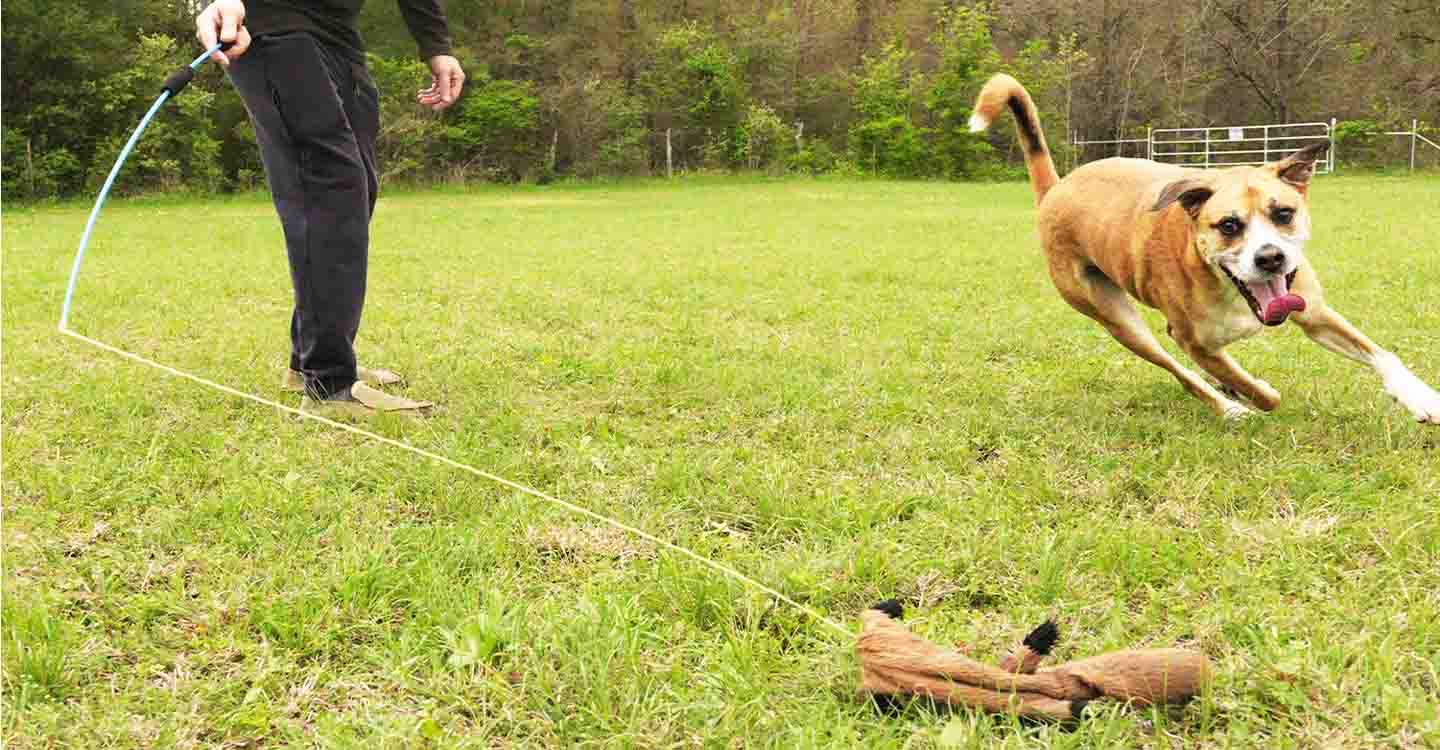
The Rugged XL is one 46-inch piece of reinforced fiberglass with no joints and an 800-lb Dyneema line, for dogs 30 lbs and up. Under 30 lbs? That’s the Standard, with a 450-lb Kevlar line. I bought the flirt poles I could find, handed them out to clients and watched what broke, then designed my own and tested it on high-drive client dogs for years before I ever sold one.
Rugged XL
- Dogs 30 lbs and up · 1 lure
- 800-lb Dyneema line · free US shipping
Rugged XL + 3 Lures
- Same pole and line, 3 lures to rotate
- Dogs 30 lbs and up · free US shipping
Rugged XL Pro Kit
- The XL with 5 lures and a spare line
- For dogs that shred lures · free US shipping
The Standard
- Dogs under 30 lbs · 450-lb Kevlar line
- $20 flat US shipping, cause it goes in a longer box
Every order has a 30-day money-back guarantee, and you pay return shipping unless the pole failed.
Want more of this in your Google results? Add Whimsy Stick as a preferred source.
Teaching a dog to settle, FAQ
How do I teach my dog to settle down?
You train calm like any other skill, so you pay stillness on a mat, add a settle cue and practice every day till your dog relaxes when you ask. Get the energy out with real exercise first though, cause a wound-up dog really can’t learn to settle.
Why can’t my dog relax even when tired?
Cause tired and calm aren’t the same thing. A dog can be worn out in the body and still amped up in the head, especially if nobody ever taught it to switch off, and teaching a settle gives your dog a way to come down instead of spinning.
What is a settle or place command?
It’s a cue that tells your dog to go relax on a mat or bed and stay calm there. A stay is about holding still, but a settle is about actually relaxing, and if you build it right you’ve got an off-switch you can use just about anywhere.
How long does it take to teach a dog to settle?
Every dog’s different, so I’m not gonna give you a number. It builds slow, and doing it every day matters a lot more than doing it for a long time, so get the energy out first, pay calm every day, and give it a real chance before you decide how it’s going.
Should I exercise my dog before settle training?
Yeah, always get the energy out first, cause a dog that’s full of it can’t practice calm and the training just frustrates everybody. Do a real session, then catch and pay the calm that comes after.
Can you train a hyper dog to be calm?
You can teach even a high-drive dog an off-switch. It’s still gonna have a lot of energy, but it learns to relax when you ask once it’s had a chance to use some, and the way I see it a real outlet plus settle training is what makes the difference at home.
Why does my dog get more excited when I try to calm it?
A lot of times the rewards are too exciting, and praising in a high happy voice winds back up the dog you just got settled. Keep your voice and your movements low and slow and hand the treats over quietly, cause calm is what teaches calm.
Is it bad to punish a dog for not settling?
Yeah, punishing adds stress and makes settling harder. A restless dog isn’t being stubborn, it either hasn’t learned it yet or it’s still got energy to burn, so get the energy out, pay the calm, and be patient with it.
Always-on dog. An off-switch at last.
Settle training works best on a dog that’s already tired, and the Rugged XL takes care of that part. It’s for dogs 30 lbs and up, ships free in the US, and comes with a 30-day money-back guarantee.
Add the Rugged XL, $75Under 30 lbs? See the Standard, $56
Keep reading
- The Controlled Freedom course (10 free lessons)
- Trigger stacking: why dogs suddenly react
- Teach a reliable door threshold wait
- Flirt pole for overexcited dogs
- Building confidence in your dog
- Why dogs are hyper at night
- Fixing ball obsession
- Why dogs get the zoomies
- How much exercise does my dog need
- How to exercise a dog without walking
- Flirt pole basics
Based on my own experience training dogs. Not veterinary or behavioral medical advice. Exercise disclaimer.


