
Best Interactive Dog Toys (2026): Every Type Ranked by a Dog Trainer
If you want a closer bond and a dog with more self-control, the best interactive dog toys are the ones you play together. Sniffing and food toys do a different job, they’re for calm and alone time, and that’s just as useful. This is how I’d rank them: 1) a flirt pole, 2) a tug toy, 3) fetch with rules, 4) snuffle mats and search games, 5) puzzle feeders, 6) stuffable and treat-dispensing toys, 7) automatic launchers and electronic toys. The top three need you on the other end and the rest are for solo time and calming down.
By Christopher Lee Moran, working dog trainer, around 400 client dogs · Updated October 2026
Just so you know, I designed the Whimsy Stick, which is a flirt pole, and I sell it, so keep that in mind. I ranked toy types, not brands, and I put down where each one falls short, mine too.
Interactive dog toys compared at a glance
| Toy type | Best for | Supervision | Budget option |
|---|---|---|---|
| Flirt pole | Active, chase-driven dogs; self-control practice | Always; put away after | DIY flirt pole |
| Tug toy | Dogs that love to grab and pull; indoor play | During play | Braided fleece strips |
| Fetch toys | Retrievers, open space | During play | Any ball sized so it can’t be swallowed |
| Snuffle mat / search games | Calm-down, rainy days, mealtime | Until you know your dog won’t chew it | Treats hidden in a rolled towel |
| Puzzle feeder | Brain work, fast eaters | At first | Muffin tin with tennis balls over the treats |
| Stuffable / treat toy | Alone time, settling | Check for wear | Freeze dinner in one you already own |
| Automatic launcher / electronic | Activity when you’re busy | Yes, and limit time | Skip it |
What makes a dog toy “interactive”?
People use that word for two different things. Some toys are interactive cause you’re playing with your dog, like a flirt pole or a tug toy or a ball you throw. Others are interactive cause the toy does something on its own, it gives out treats or rolls around or launches a ball.
I’m not knocking the second kind. Sniffing and foraging are good for a dog, especially for calming down. But only the first kind lets you practice waits and drop-its and recalls while your dog is all excited, and that’s why those are at the top of my list. And just so it’s said, no toy by itself fixes reactivity or anxiety.
How I judged each type
- Does it need you? If you’re the one running it, your dog’s focus ends up on you.
- Can you build cues into it? Wait, take it, drop it, come.
- What does it work? The body, the nose, the brain, or calming down.
- Will it hold up to your dog’s size and grip?
- Can you replace the parts that wear out?
Every interactive dog toy type, ranked
The play-together toys come first (1 to 3), then the solo stuff (4 to 7).
1. Flirt pole
Best overall for active dogsThis is the one I built my business around, so take that how you want. It’s a pole and a line and a lure your dog gets to chase and actually catch, and every wait and drop-it is impulse control while they’re all fired up.
The downside is it needs rules, some outdoor space and an adult on the pole. I wouldn’t do it with young puppies at full speed or with dogs that have joint problems.
2. Tug toy
Great, with an “out”Tug is grip and pull and a clear “out” on cue. You can do it inside, and it makes a great reward when you’re training.
There’s no chase in it though, and with no rules it turns into a wrestling match pretty quick. Teach the “out” first by trading the toy for a treat, don’t yank it away.
3. Fetch, with rules
Good for retrieversFetch is fine if you put some rules on it, like a wait before each throw and a drop when they bring it back.
Where it goes wrong is throw after throw after throw, cause that winds some dogs up instead of tiring them out. Keep it short, and you decide when it’s over, not the dog.
4. Snuffle mats and search games
Best calm-down toySnuffle mats and search games are all nose work, and that settles a lot of dogs down. I like them after exercise, on rainy days and at mealtime.
They don’t give your dog any physical outlet though, and some dogs will chew up the fabric if you walk off.
5. Puzzle feeders
Good brain workPuzzle feeders make a dog think, and they slow down how fast they eat.
Smart dogs figure them out in a few minutes and a frustrated dog might just quit on it, so start easy and rotate them.
6. Stuffable and treat-dispensing toys
Good for alone timeLicking and chewing help a lot of dogs settle, especially with the frozen ones.
It keeps them busy but it doesn’t teach them anything. Get one big enough that your dog can’t swallow it.
7. Automatic ball launchers and electronic toys
Use with careThese keep a dog moving when you can’t get out there and play.
The problem is they take you out of the game, and you’re the whole reason the top three work. Automatic fetch over and over can wind some dogs up too, so if you use one watch them and limit the time.
My pick: the flirt pole I designed
I built the Whimsy Stick cause the flirt poles I bought and handed out to clients kept breaking. The Rugged XL is one 46-inch glossy blue fiberglass rod with no sections and two black foam grips spaced apart. The line is static so the lure goes where your hand goes, and when a lure gets chewed up you just swap it out.
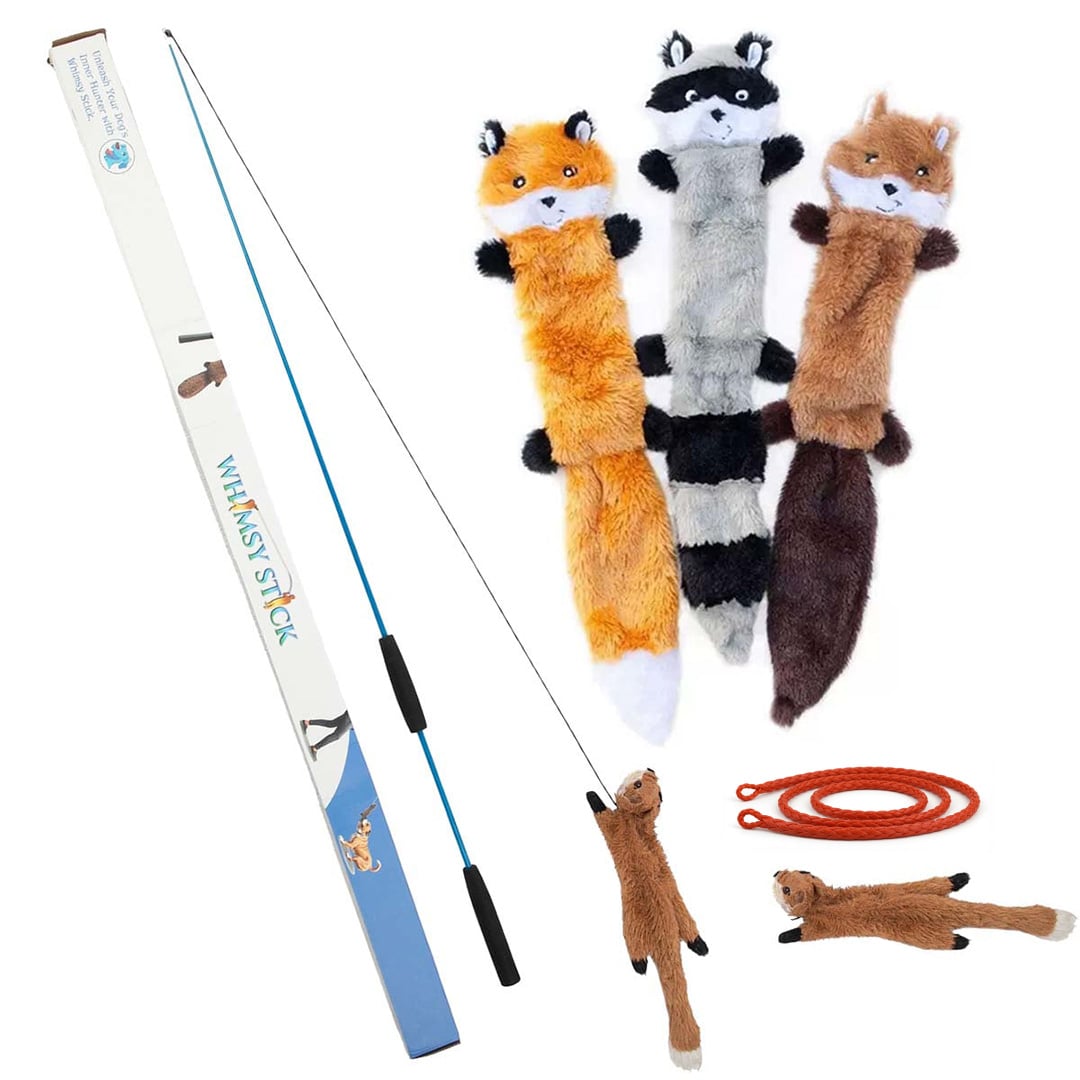
Rugged XL Pro Kit
- One-piece reinforced fiberglass pole, about 8 feet of reach
- Dyneema static line rated at 800 lbs, plus a spare line
- 5 lures · free US shipping
Rated 4.9 stars across 49 product reviews · 30-day money-back guarantee · usually ships within 2 days
If you’re comparing flirt poles, look at the best flirt poles for dogs, ranked by design.
The best interactive toy for your dog
| Your dog | Start with | Add |
|---|---|---|
| High-energy or chases everything | Flirt pole | Snuffle mat to wind down |
| Loves to grab and pull | Tug toy with an “out” | Flirt pole |
| Retriever type | Fetch with rules | Search games |
| Anxious or easily overwhelmed | Snuffle mat, lick mat, easy puzzles | Slow, gentle play |
| Senior | Search games, easy puzzles | Slow, low lure play if your vet agrees |
| Home alone a lot | Frozen stuffable toy | A play session with you before and after (if your dog panics when alone, that’s separation anxiety: see your vet or a trainer) |
Got a high-energy dog? I go deeper on toys for high-energy dogs.
Best interactive toys for puppies
Puppies need to play, but their bones are still growing, and how fast they grow up depends on size and breed. So I’d start with soft tug toys (easy, at puppy level), search games, easy puzzle feeders and simple training games. The flirt pole waits till at least 6 months, and even then keep it to slow drags on the ground with no jumping or sharp turns, and ask your vet when fast chasing is okay for your dog.
The AKC also has some easy indoor games that work at any age, like hiding a treat under one of a few cups, hide-and-seek, or “wild sits,” where you get your dog excited and then ask for a sit in the middle of it. I really like that last one, it’s the same self-control idea as the wait on a flirt pole. And if you want toys made for inside, here are the indoor dog toys I’d pick.
Safety with any interactive toy
- Watch them with new toys, and throw out anything that’s breaking into pieces your dog could swallow.
- Put rope and string and line toys away after play, flirt poles too. If your dog swallows string or line, call your vet.
- Match the size to your dog’s mouth and how hard they grip.
- Keep chase games low and on grass, and on hot days play early.
Want more of this in your Google results? Add Whimsy Stick as a preferred source.
Quick answers
What is the best interactive dog toy?
For most active dogs, a flirt pole. You play it together and it builds self-control while it burns energy. For calm time I’d go with a snuffle mat or a puzzle feeder, and honestly most dogs do best with one of each.
What are the best interactive toys for puppies?
Soft tug toys, search games, easy puzzle feeders and short training games. Fast chase games wait till your vet says your puppy’s growth plates are closed.
Are interactive dog toys worth it?
The ones you play with your dog usually are, cause they double as training. Toys that run on their own have a place for alone time, they just don’t replace playing together.
What toys are best for dogs with high prey drive?
A flirt pole, used with some structure. It’s the closest thing to a real chase that you still control, and tug is second. See how to train a high prey drive dog.
Are automatic ball launchers good for dogs?
They can keep a dog moving when you’re busy, but endless fetch over and over can get some dogs too worked up. Watch them, limit the time, and keep playing with your dog yourself too.
The best toy has you on the other end of it
Try it for 30 days. If it isn’t a fit for your dog, email me for a refund, and you cover return shipping unless the pole failed. I’m a one-man company and I want you happy with it, so I’ll work with you.
Get the Pro Kit, $129.95Smaller dog? See the Standard, $55.95
Based on my own experience training dogs. Not veterinary advice. Exercise disclaimer.


