
Flirt Pole for Overexcited Dogs: Structure Builds the Calm
A flirt pole for overexcited dogs can calm him down or wind him up worse, and the difference is whether the session has rules. The way I see it, the calm comes from letting the dog finish the whole chase: a wait before the release, the chase, a real catch, a drop-it when you ask, then all done and a settle. Honestly, tiring him out isn’t really what does it. I keep it to 5 or 10 minutes, most days.
The 5 steps: 1. Wait. 2. Release and chase. 3. Catch and hold. 4. Drop it. 5. All done, lure away, settle. Skip the wait or the all-done and an overexcited dog can come out of it more wound up than he went in.
By Christopher Lee Moran, working dog trainer, about 10 years and around 400 client dogs. I make the Whimsy Stick, so I’m not neutral about flirt poles.
Who this guide is for
- Your dog is overexcited pretty much all the time and can’t seem to settle
- Your dog nips or jumps, or gets more worked up the longer you play
- Your dog comes back from walks worse instead of calmer
- Your dog bounces off the walls every time something changes in the day
- Your dog has a ton of energy and no off-switch anywhere
Signs your dog needs a structured routine
- Nipping, jumping, or grabbing hands and leashes instead of toys
- Can’t hold a sit for even a few seconds once he’s excited
- Hyper, whining or circling after exercise instead of settling
- Lunging at stuff harder after walks
- Tearing up furniture or taking it out on stuff around the house
- Seems to get worse the more you exercise him
The tool isn’t the problem. Structure is.
A flirt pole can calm an overexcited dog when the session has structure, and wind him up worse when it doesn’t. The pole doesn’t care either way. With no rules, no wait, no drop-it, and you stopping in the middle while he’s still bouncing off the walls, you’re teaching the dog to get wound up and stay that way. The chase starts and never gets finished.
With structure you get the opposite. A wait before every release teaches him to hold it together while he’s excited. A drop-it after every catch teaches him to come out of it when you ask. And the all-done gives the game a clear ending, which a lot of overexcited dogs don’t get anywhere else. AKC makes a similar point about prey drive: ask for calm behaviors while you play exciting games like tug, so your dog can learn to think, rather than immediately react.
| What happens | Play with no rules | A structured session |
|---|---|---|
| The chase | Starts but never gets finished | Gets finished every session |
| Self-control | No practice anywhere | Practiced in every rep |
| What the toy means | Going crazy | A game with rules |
| The ending | Stops in the middle, excitement carries over | A real ending, calm after |
| Over time | Harder to handle after every session | Better at calming down |
The calm doesn’t come from wearing him out. It comes from letting him finish the chase with some rules to it. Just tire a dog out and you can end up with a dog that’s worn out but still wound up. More on that in the impulse control drills.
Before you start: get a working drop-it
No working drop-it yet? Build that first. It doesn’t need to be pretty. He just has to let go within a few seconds when you ask, even when he’s wound up. Without it you can’t finish the session clean, and the all-done turns into a wrestling match that winds him up more.
The easiest way I know: let him catch the lure and hold it, then go completely still and boring. No tugging, no pulling, no saying it over and over. Wait for him to let go on his own, mark it, and start the chase right back up, cause the chase is the reward. Do it a bunch over a few short sessions and most dogs catch on. When he’s letting go every time, then you add the word, right before you know he’s about to drop it.
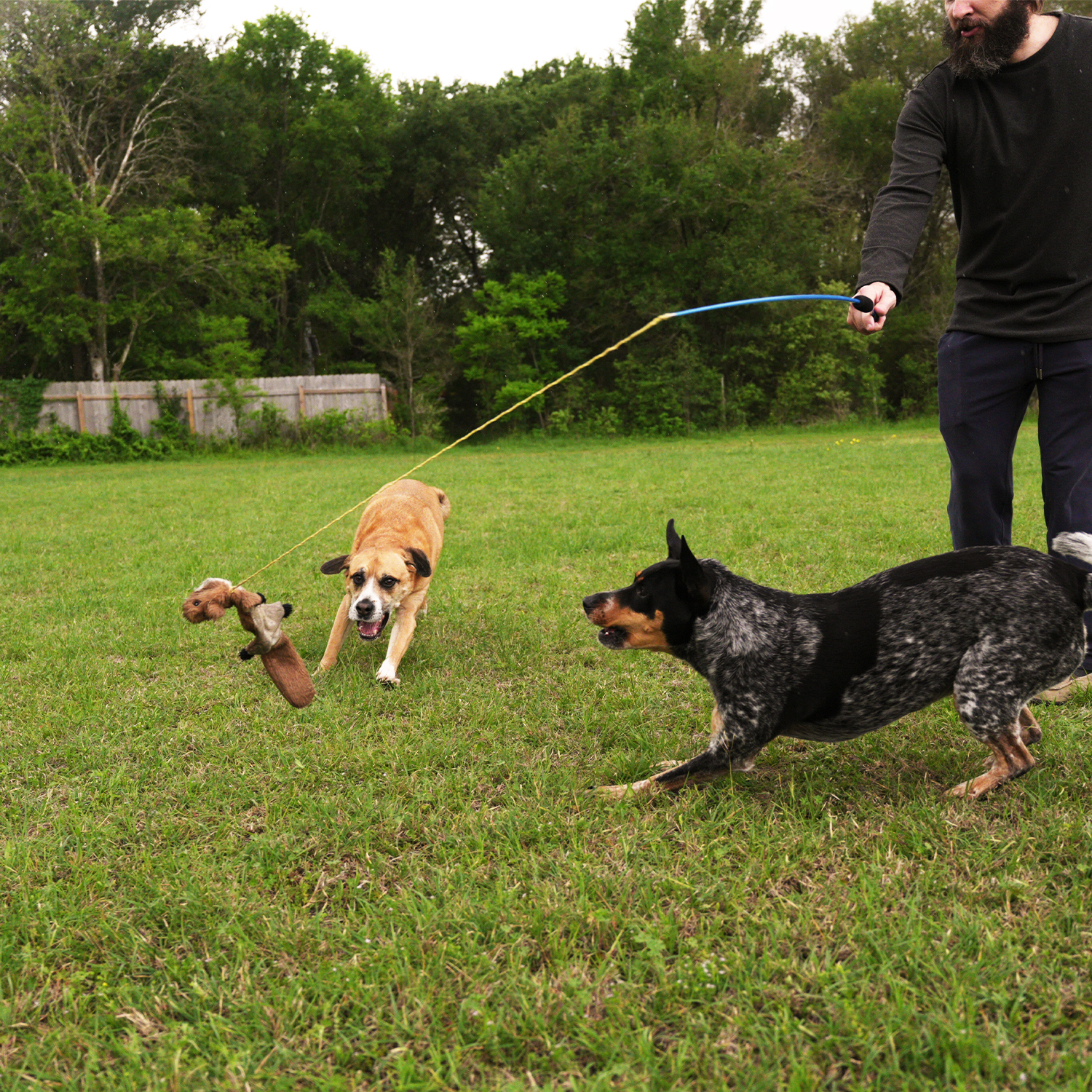
The five-step routine for overexcited dogs
With a dog like this, the wait and the all-done do most of the work. Skip those two and you’re back to square one.
1. Wait, every single rep
Lure on the ground, not moving. Ask for a sit or a stand and make him hold it a full 5 to 10 seconds before you let him go. This is the big self-control rep of the whole session, so I don’t rush it. What you want to see is him sitting there with that lure right in front of his face, staring at it, not moving a muscle.
The wait, in real life. A Malinois holding a down and a doodle holding a sit until the release.
Impulse control drills2. Release and a controlled chase
Then say your release word and drag it low and smooth. Change direction and stop it here and there, cause every little stop gets him stalking again. Whip it around and he’ll go nuts, so how you move pretty much decides how the whole session goes. You want him tracking the lure, not tearing around in circles.
3. Catch and hold, never skip it
Every third or fourth chase, let him have it. Stop the lure, let him grab it and hang on a few seconds before you ask for the out. A dog that never gets to catch it just gets frustrated and wound tighter. When it’s going right he holds it pretty calm and then lets go without it turning into a tug war.
4. Drop it on cue
Then ask for the out, pay him for letting go, and go right back to the wait. A drop-it while he’s fired up is about the best self-control practice you’ll get, and it carries over to reactive dog training. Good looks like: he drops it within a couple seconds even when he’s all fired up.
5. All done, lure away, settle
After 5 to 10 minutes, end with one last catch and drop. Say all done and put the lure all the way out of sight. Then ask for a down or place and pay for calm, cause the settle is what gets him from fired up to calm. After a few minutes settled, let him go with your release word. That’s how you build a real off-switch. See how to teach a dog to settle.
After the all-done. Two dogs settled on the couch in the evening after a session.
Why dogs are hyper at nightWhen to run a session
Before walks
Run a short session 15 to 30 minutes before the walk and he heads out with some of that drive already spent. Just make sure you finish it all the way and let him settle before you grab the leash.
After walks
If he comes home from a walk still spun up, a short session heavy on the wait and the drop-it can help bring him down. More on that in dogs hyper after walks.
Evening wind-down
An evening session can help a dog let go of the day and settle for the night. If his excitement comes out as barking, the evening one is a good one to have.
Never when you’re already flustered
Plan your sessions, don’t grab the pole in a panic. If you’re stressed and worked up yourself, the lure gets jerky and the session makes it worse. And if his excitement has turned into tearing stuff up, run sessions before the times he usually does damage, not after.
How often
Most days. Two short sessions, one before the morning walk and one in the evening, beat one long session once a week. The wait, the drop-it and the all-done are habits, and habits take a lot of reps.
The mistakes that make overexcited dogs worse
Sessions that run too long
Past about 10 minutes, a lot of overexcited dogs can’t hold the wait or drop it when you ask anymore. At that point you’re not training self-control, you’re running a dog past what he can handle. If he can’t hold a 5-second wait by the third rep, the session is already too long or too hard.
Ending without an ending
If you just stop, toy in the bag and done, the chase never gets finished. He’s still fired up with nowhere to put it, and that carries right into the walk or company coming over. Skipping the all-done is a common reason people decide the flirt pole didn’t work.
Skipping the wait because “he can’t hold it”
That’s backwards. The wait is harder for an overexcited dog, and that’s exactly why he needs it. Make it shorter if you need to, even 2 seconds counts, just don’t drop it.
Matching his energy with wild lure movement
Fast, jerky movement winds a dog up. Go smooth with little pauses and you’ll swear it’s a different dog. You don’t match his energy, you steer it, so when he gets frantic, slow the lure down.
Never letting him win
Yank it away every time and he gets frustrated and more frantic, locks onto the toy and forgets you’re there. Holding it is what makes letting go mean something.
Signs you’ve gone too long or too hard. He can’t hold the wait for even 2 or 3 seconds, the drop-it is gone, and he’s running around frantic instead of following the lure. End it right then with all done and a settle. Next time, cut the time in half and slow the lure down. If the excitement comes with stiffness, growling or snapping, get a qualified behavior professional involved.
Why the line matters with an overexcited dog
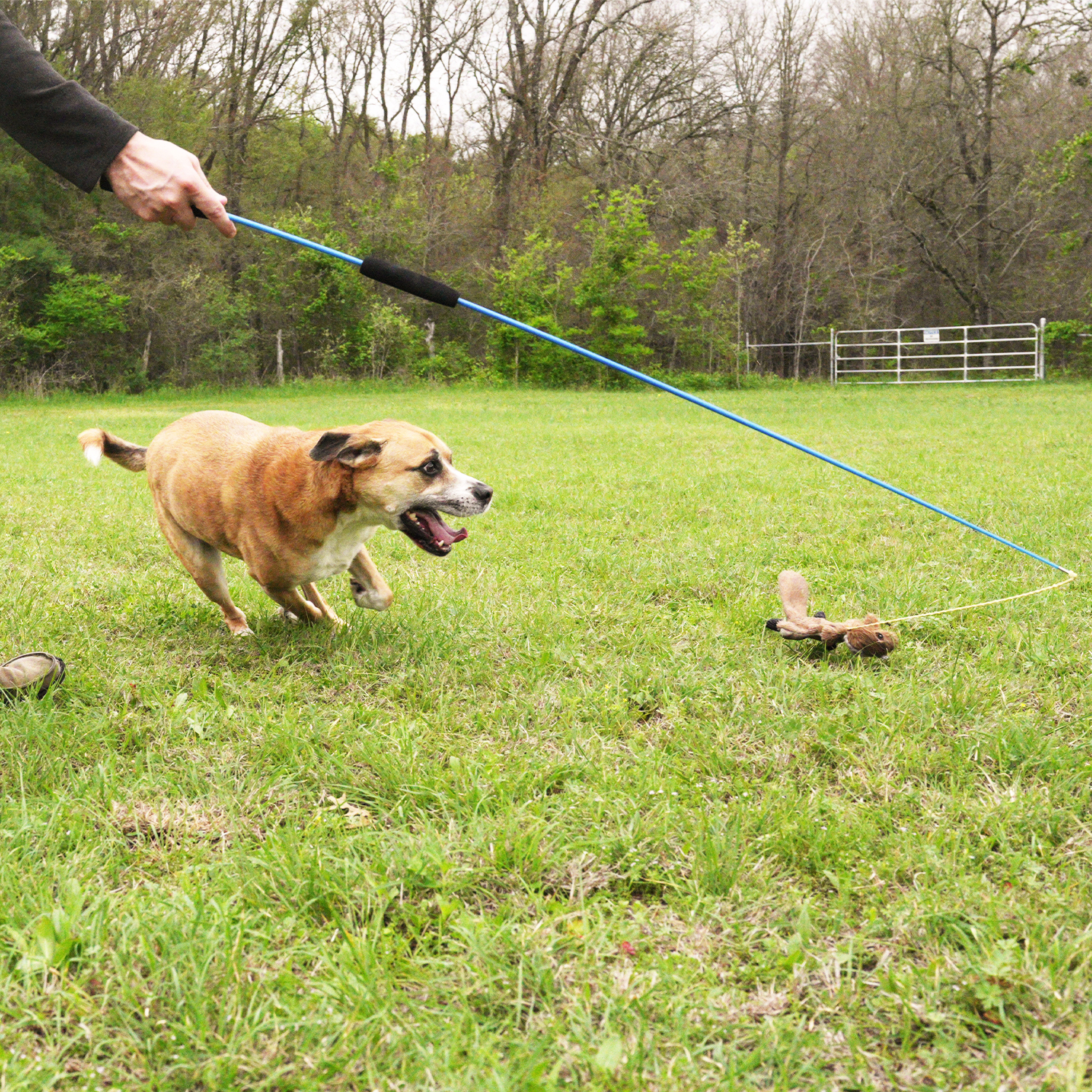
I wouldn’t use a flirt pole with a bungee cord on an overexcited dog. When he catches the lure, the bungee snaps back, and all that bouncing makes the lure hard to follow, so he ends up reacting to chaos instead of stalking something. Both Whimsy Sticks use a static line with no bungee, so what your hand does is what the lure does. You slow down and pause, the lure slows down and pauses, and that’s a big deal when you’re using movement to bring a dog back down.
Under 30 lbs gets the Standard with a 450-lb Kevlar line. Thirty and up gets the Rugged XL, one 46-inch piece of reinforced fiberglass with an 800-lb Dyneema line. I bought the flirt poles I could find, handed them out to clients and watched what broke, then built my own and tested it on high-drive client dogs for years before I ever sold one.
Rugged XL + 3 Lures
- Dogs 30 lbs and up · 800-lb Dyneema line
- 3 lures to rotate · free US shipping
Rugged XL Pro Kit
- The XL with 5 lures and a spare line
- For dogs that shred lures · free US shipping
Rugged XL
- Same pole and line, 1 lure
- Dogs 30 lbs and up · free US shipping
The Standard
- Dogs under 30 lbs · 450-lb Kevlar line
- $20 flat US shipping, cause it goes in a longer box
Every order has a 30-day money-back guarantee, and you pay return shipping unless the pole failed. For more on picking a pole, see the buying guide.
Want more of this in your Google results? Add Whimsy Stick as a preferred source.
Flirt pole for overexcited dogs: FAQ
Can a flirt pole for overexcited dogs make the problem worse?
Honestly, it can if you use it with no rules. Skip the wait, stop in the middle, whip the lure around, or quit without an all-done, and you’re teaching the dog to get wound up and stay that way. With a wait before every release, a drop-it after every catch and a clean all-done, I think it’s one of the best tools there is for teaching a dog to come down.
How long should flirt pole sessions be for an overexcited dog?
About 5 to 10 minutes, and two shorter sessions a day beat one long one. Past about 10 minutes a lot of overexcited dogs can’t hold the wait or the drop-it anymore, so two short sessions with a real cooldown do more than one 20-minute session.
What is the best way to calm an overexcited dog using a flirt pole?
Run the full 5-step session: a wait before every release, smooth lure movement with pauses, a catch every 3 or 4 reps, a drop-it when you ask and a clean all-done into a settle. After a session, watch for a dog that settles and stays settled.
Should I use a flirt pole before walks with an overexcited dog?
Yes, as long as you finish it right. A full session and a short cooldown can take the edge off before a walk, but if you end without a clean all-done, you’re just taking a wound-up dog out into a busy world.
Does a flirt pole replace walks for overexcited dogs?
No, keep the walks. Walks give a dog easy sniffing and time out in the world, and a flirt pole doesn’t. For a lot of overexcited dogs I’d do a session, a real all-done and cooldown, then the walk.
How do I teach drop-it during flirt pole play with an overexcited dog?
Let him catch it and hold it a few seconds, then go totally boring: no tugging, no pulling, no repeating yourself. The second he lets go, mark it and start the chase back up, cause the chase is the reward. Once he’s doing it every time, add the word.
Can I use a flirt pole for overexcited dogs when I have multiple dogs?
One dog at a time, at least until each one has good self-control on their own, cause two overexcited dogs wind each other up. If either dog has ever guarded stuff, keep them separate for good and get a qualified behavior professional’s help. Once both hold the wait and the drop-it, try taking turns, one in a down-stay while the other works.
What if my dog gets too worked up during the session?
If he can’t hold even a 2-second wait, won’t let go of the lure, or is running around frantic, end it right then with all done and a settle. That’s him telling you it was too much for where he’s at. Next time, cut the time in half and slow the lure down.
How long until my overexcited dog shows consistent calm after sessions?
Every dog is different, so I’m not gonna give you a date, and early on it can feel like most of the session is just the wait. Keep going most days and watch for a quicker wait and an easier settle. What clients tell me a lot is their dogs are a lot more relaxed and calmer and seem more satisfied.
Same dog. Same toy. Add the structure.
A wait, a real catch, a drop-it and a clean all-done, about 5 to 10 minutes most days. A static line with no bungee, and 30 days to try it.
Add the Rugged XL + 3 Lures, $94.95Under 30 lbs? See the Standard, $55.95
Based on my own experience training dogs. Not veterinary or behavioral medical advice. Exercise disclaimer.


