
What Is a Flirt Pole for Dogs? How It Works and Who It’s For
A flirt pole is a pole with a line on it and a lure on the end. You hold the pole and sweep the lure along the ground, and your dog chases it and catches it, then lets go when you ask. Think of a cat wand, but built for a dog that pulls. I’ve been working with high-energy dogs for about 10 years, and what I have found is a dog with a satisfied animal instinct is a much better behaved dog. The biggest instinct they’ve got is hunting, and that’s what this lets them do, with a few simple rules so they’re practicing self-control too.
By Christopher Lee Moran, working dog trainer, around 400 client dogs · Updated October 2026
The three parts of a flirt pole
- The pole. Usually 3 to 4 feet long. It’s there for reach, so the lure gets out away from you and isn’t just dragging around your ankles. With strong dogs I’d go with a one-piece pole. When a pole breaks down into pieces or collapses you lose strength and pole integrity, and if you add metal fittings to make up for it the pole gets heavy.
- The line. It goes from the pole to the lure. With a static line that doesn’t stretch, the lure goes where you put it, and with a bungee it snaps back at you. A lot of poles I tried had a violent bungee cord on them and I won’t use one.
- The lure. This is what your dog actually cares about. It’s usually fleece or plush or something like a tug toy. Lures get chewed up, so a good flirt pole lets you swap them out.
You’ll hear it called a flirt stick or a lure stick or a chase pole too, and it’s all the same thing.
How a flirt pole works
A lot of trainers break the chase down into watch, stalk, chase and catch. Most games only give a dog part of that, but with a flirt pole your dog gets the whole thing in one short game, and you’re the one who decides when each part starts and stops. This is the basic session I’d run.
- Wait. Leave the lure still on the ground and have your dog hold a sit or a stand till you say go.
- Chase. Sweep the lure low and wide for 15 to 30 seconds, on the ground and not up in the air.
- Catch. Every few rounds let your dog win, so they catch the lure and get to hang on to it a few seconds.
- Drop it. Stop moving and ask for the drop, and trade for a treat if you have to. A lot of times the next chase is the reward they really want.
- All done. Stop while your dog still wants more, 10 minutes is plenty for most adult dogs. Give a calm all done, put the pole away and give them some water.
The AKC lists a flirt pole along with tug as a good game for teaching a dog to settle. You stop the fun, ask for a sit or a down, and then start the game back up as the reward, so that’s the wait and the drop it right there. For the whole routine, read how to use a flirt pole with your dog.
Flirt pole vs fetch, tug, and walks
| Activity | What your dog gets | What’s missing |
|---|---|---|
| Walk | Movement, sniffing, the outside world | Little or no chasing |
| Fetch | Running and retrieving | No stalk; some dogs get more wound up with every throw |
| Tug | Gripping, pulling, the “out” | Starts at the grab, so there’s no chase |
| Flirt pole | Watch, stalk, chase, catch, and let go, with you in control | Needs rules and a clear ending |
I’m not telling you to quit walks or fetch, and none of these replace each other. But a walk doesn’t let a dog hunt, and fetch has them bringing the prize right back, so for a lot of high-drive dogs the flirt pole fills in what’s missing. If your dog is still wired after a long walk, see why dogs get zoomies after a walk.
Is a flirt pole good for your dog?
Usually a great fit
- High-energy dogs that are still restless after a walk
- Dogs that go after squirrels or cats or bikes, pretty much anything that moves
- Herding, working, terrier, and bully breeds
- People who want to work on wait and drop it and recall while their dog is excited
Check with your vet first
- Puppies, I’d wait till 6 months or later and keep it to slow easy drags, and save the fast chasing till your vet says the growth plates are closed
- Dogs with joint problems or injuries, or heart or breathing problems, and that includes flat-faced breeds
- Older dogs, a slow short game down low can still be a lot of fun for them
Not a fix for aggression. If your dog guards toys, has a bite history or reacts hard to people or dogs, work with a qualified trainer first. A flirt pole can be one part of that, but it’s not gonna fix it by itself. See reactive dog training.
Choosing a flirt pole
In any brand I’d look for one piece, a line that doesn’t stretch and lures you can replace, and then get the right size for your dog. A good flirt pole should be lightweight and somewhat flexible but not too flexible. On mine that’s the Rugged XL for dogs 30 lbs and up, a 46-inch glossy blue fiberglass rod with two black foam grips spaced apart and a bright red-orange braided line. If your dog is right at 30 lbs I’d go XL. You’ll want open grass about 20 feet across too, cause the Rugged XL reaches about 8 feet out every direction.
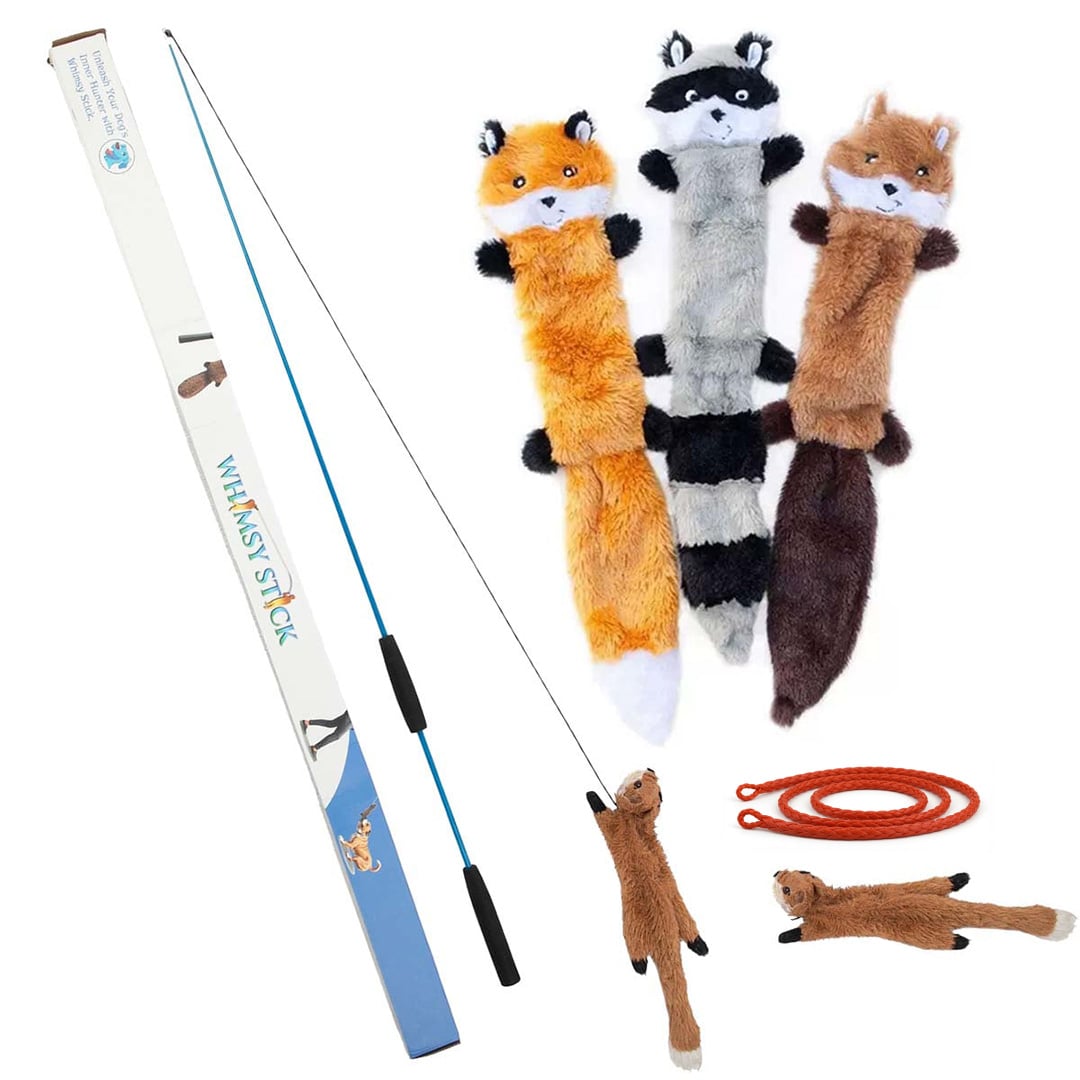
Rugged XL Pro Kit
- One-piece reinforced fiberglass pole, about 8 feet of reach
- Dyneema static line rated at 800 lbs, plus a spare line
- 5 lures · free US shipping
Rated 4.9 stars across 38 product reviews · 30-day money-back guarantee · usually ships within 2 days
Every Rugged XL kit ships free in the US. The Standard is $55.95 plus $20 shipping cause it goes in a longer box. Replacement lures are $12.95 and a Rugged XL line is $19.99. If you want to try the game first, here’s how to make a DIY flirt pole. If you’re comparing brands, see the best flirt poles for dogs.
Flirt pole safety basics
- Low and wide. Keep the lure on the ground with wide turns. If you swing it over your head it turns into a jumping and twisting game, and I won’t do that.
- Soft ground. Grass or turf, not concrete or tile. I know that rules out some yards.
- Short sessions. Fit them to your dog’s age and health and how fit they are, and take breaks. If your dog limps or pants a lot harder than normal, or gets frantic, you’re done for the day.
- Heat. On hot days play early or late when it’s cooler.
- Put it away. It’s something you play with together, not a chew toy. When the game’s over, put it up where your dog can’t get it.
Quick answers
What is a flirt pole for dogs?
It’s a pole with a line and a lure on the end. You move the lure along the ground and your dog chases it and catches it, and if you add some waits and drop its it’s exercise and self-control training at the same time.
Are flirt poles good for dogs?
For most healthy adult dogs, yes. Keep the lure low and the ground soft, and keep it short with a clear ending. Puppies, older dogs and dogs with joint or breathing problems should get the okay from a vet first.
What is a flirt pole used for in dog training?
It burns energy pretty quick, and it lets you work on self-control while your dog is excited. So waiting before the chase, dropping the lure when you ask, and settling down once the game is over.
Is a flirt stick the same as a flirt pole?
Yep. Flirt stick, lure stick, chase pole, it’s all the same thing, a pole with a line and a lure on the end.
How long should a flirt pole session be?
Ten minutes or less for most healthy adult dogs, in rounds of 15 to 30 seconds with breaks in between. Go shorter for young dogs, older dogs or dogs that aren’t in great shape, and always end while your dog still wants more.
Try it with your dog
You’ve got 30 days to try it. If it isn’t working for your dog, email me for a refund, and you cover the return shipping unless the pole failed. I’m a one-man company and I want you happy with it, so I’ll work with you.
Get the Pro Kit, $129.95Smaller dog? See the Standard, $55.95
Based on my own experience training dogs. Not veterinary advice. Exercise disclaimer.


