
Point at what your dog keeps doing.
You don’t have to grind through a whole course to get help with one thing, just tap the habit that’s driving you nuts and it’ll take you to the fix, and if you want to know why your dog does it in the first place the guides further down get into all that.
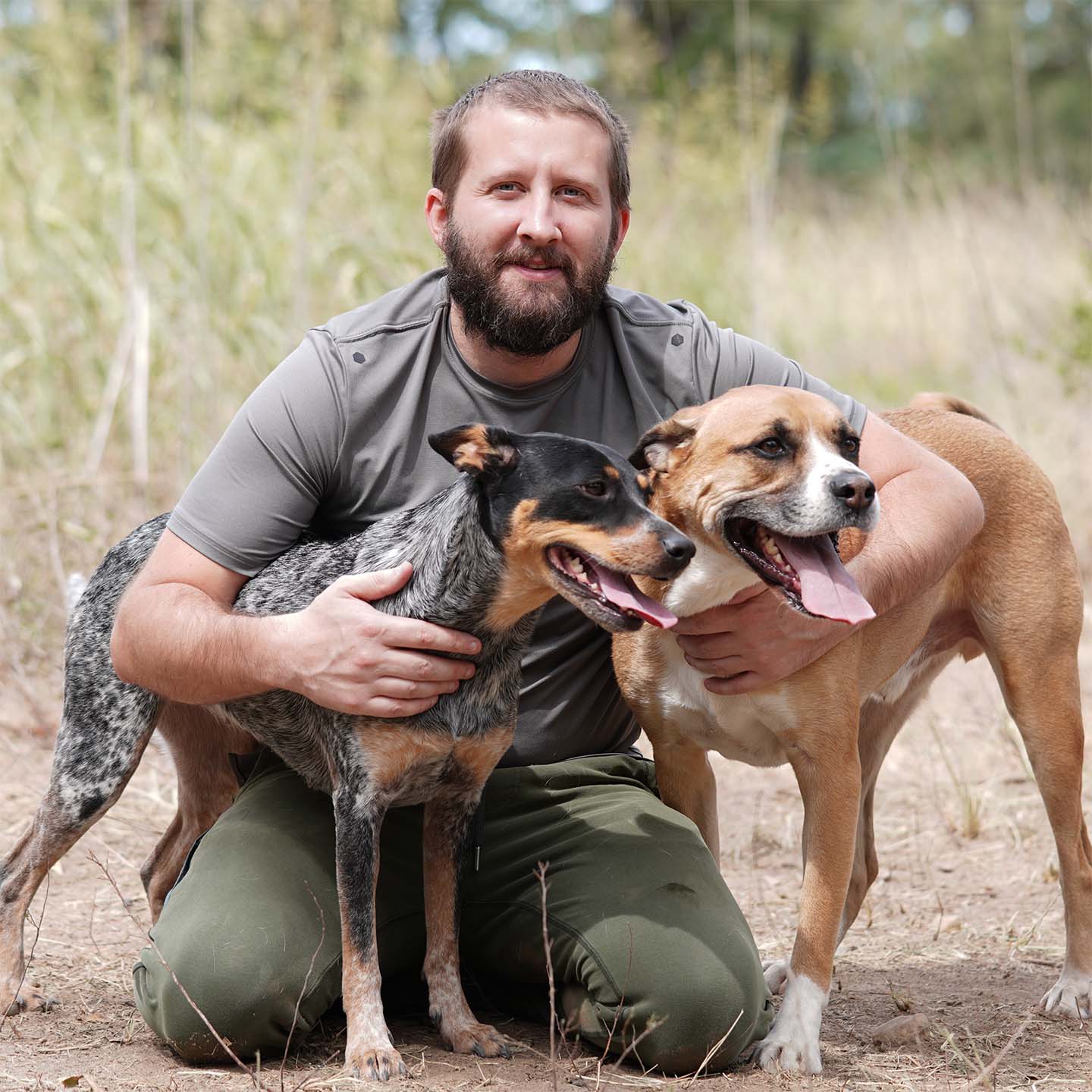
What is your dog actually doing?
Pick whichever one fits your dog. These are all real common problems and every one of them can be worked on once you quit guessing, and since a lot of them come from the same place you’ll notice the fixes keep pointing you back to the same few lessons.
Pulls like a freight train
Every walk ends up a tug-of-war, and most of the time that’s cause there’s no structure on the leash and the dog’s got energy that never gets burned off.
→ Lesson 06Whimsy Stick 02 My dogSafetyBolts and won’t come back
It’ll come when you call it in the house and then forget its own name the second you’re outside, cause the cue never got practiced around distractions.
→ Bonus: Recall 03 My dogStructureJumps on everyone
Anybody who walks in gets mugged at the door, and a lot of times it’s cause the dog doesn’t have a calm default or a spot of its own to go to.
→ Lesson 05 04 My dogDriveBarks and lunges at other dogs
The whole walk it’s scanning for the next dog to go off on, and since it reacts before it thinks it never gets the chance to learn to look away.
→ Lesson 08Whimsy Stick 05 My dogDriveChews and wrecks the house
Shoes, the trim, the couch cushions, and if a busy brain doesn’t get an outlet it’s gonna go find its own job to do.
→ Lesson 03Whimsy Stick 06 My dogDriveNever settles down
Zoomies, pacing, no off switch at all, and that’s what you get when the drive keeps building up with nowhere to go so the dog just stays wired.
→ Lesson 09Whimsy Stick 07 My dogStructureBlows me off completely
It knows the cue and ignores you anyway, and usually that’s cause when there aren’t clear rules, listening to you is kinda optional as far as the dog’s concerned.
→ Lesson 02 08 My dogSafetyGuards, snaps, or panics alone
It growls over food or falls apart when you walk out the door, and a lot of times that comes from fear and fuzzy boundaries and not from it being a mean dog.
→ Lesson 07Your dog didn’t snap out of nowhere
First the mailman, then a skateboard, then a dog barking behind a fence, and none of those on its own would’ve done it, but stack them up close together and they can push a dog over its threshold, so the growl or lunge you saw was really just the last one landing.
That’s called trigger stacking, and it plays a part in a lot of reactivity and guarding. So once you learn to see it building you can add some space and let the dog come back down before it tips over.
Read the trigger stacking guide →The reference library
The fixes tell you what to do and these guides get into why, so you’re reading the actual dog in front of you instead of following a script, and pretty much everything else in the portal leans on them.
Dog Body Language
Learn to read your dog before a bite and not after one, going through tails and ears and eyes and the calming signals people tend to miss one sign at a time.
→ Read the guide B MechanismTrigger Stacking
Why a calm dog “suddenly” reacts. What a threshold is and how the stack builds up, and why the cool-down after a bad moment matters for the next walk too.
→ Read the guide C ProtocolResource Guarding
Food, toys, the couch, sometimes even you, so this one’s about why dogs guard stuff and what makes it worse and how to use trades to make it better instead.
→ Read the guide D DevelopmentFear Periods
When your confident puppy all of a sudden is scared of everything, this walks you through what the normal fear stages look like and the mistakes you’ll want to skip.
→ Read the guide E SafetyDoor Dashing
If one open door means your dog is gone, this teaches a solid wait at the door using impulse control so you’re not stuck just holding the collar tighter.
→ Read the guideThree steps to get started.
You don’t need to read the whole site tonight, just do these three things and then keep on doing them.
Find your dog above
Tap whichever problem matches and it’ll send you straight to the lesson for it, and you can skip everything you don’t need yet.
Read that one lesson
It takes about 20 minutes, and every lesson ends with an exercise and a scorecard cause reading about it doesn’t change your dog, doing the reps does.
Do today’s rep
Ten minutes today before you forget, or let the app give you the rep and check in on it so you actually do it every day.
The whole portal, in an app that trains you every day.
Every lesson and fix on this page is also in mypooch.ai, the training app built around the same method. Reading the fix is the easy part and doing it every day is where a lot of people fall off, so the app takes the lesson you picked and turns it into a plan for your dog, then checks in and adjusts as you go.
Think of this page as where you start and the app as what keeps you doing the reps. You get a drill for the day, you can see your progress, and it checks in on you so you stay honest. It’s free to start, on the web or in the App Store.
It’s the same method on the site and in the app. And when a plan calls for a drive outlet, it points to the same Whimsy Stick you see here.
One method under every problem
Every tile and guide here comes back to one idea, a dog earns freedom by showing you it can handle it. You give structure first and then open things up as the dog shows it’s ready. The goal is to be clear with your dog, not soft and not harsh.
Structure first
Rules that stay the same, that you actually stick to, and a real outlet for instinct. When a dog knows the game and how to win it, there’s a lot less guessing and a lot less of the worry that comes with guessing.
Freedom earned
Off-leash trust, being calm in public, a dog you can actually live with. You don’t hand any of that over early, each piece opens up once the dog shows you it can handle it.
Half these problems are one thing: unspent drive
Look at the tiles again. Pulling, chewing, zoomies, lunging, a lot of times that’s the same dog with a full tank and nowhere to empty it. Structure sets the rules but the dog still needs a way to burn it off.
That’s what the Whimsy Stick is for. I built it after buying the flirt poles I could find and watching them break on client dogs, and it’s made to let a dog chase and catch while learning to hold it together when it’s all fired up. It has 4.9 stars across 38 product reviews, and 306 reviews across 7 platforms if you count my training reviews too. You don’t need it for the lessons, but when a lesson calls for an outlet, this is the one I use.
The Standard is $55.95 and it’s for dogs under 30 lbs. Dogs 30 lbs and up should get the Rugged XL, which is $74.95, or $94.95 with three lures.
Shop the Whimsy Stick →Want the whole thing? Ten lessons, in order.
Everything above is the shortcut. If you’d rather build the whole thing than patch one problem, here’s the full course, and I’d go top to bottom and let each scorecard tell you when it’s time to move on.
Mindset and Philosophy
The Dog You Didn’t Expect
Why love on its own isn’t enough for a dog, and the 48-hour Honest Audit that shows you who’s really running your house.
Lesson 02Control Is Not Cruelty
Why structure is one of the kindest things you can give a dog, and the Three Rules Reset.
Understanding the Dog
Instinctual Needs and Stagnant Energy
Why a dog can be tired and still wreck the house, and the Drive Profile Assessment.
Lesson 04Energy, Emotion, and the Human Factor
Your dog picks up on how you’re feeling, so this one starts with your side of the leash.
Foundations
Foundations Before Training
Crate, Place, owning your space, and the Structured Homecoming for when you walk in the door.
Lesson 06Leash Walking and Public Behavior
Structure on the walk, getting your dog used to leash pressure, and manners that hold up out in public.
Problem Behaviors
Separation, Guarding, and Biting
What each of these problems really is and how to work on them from the root.
Lesson 08Threshold Work and Engage-Disengage
Teaching a reactive dog to think around the things that set it off instead of just reacting.
The Work and the Lifestyle
Tools as Communication and the Whimsy Stick Protocol
How the right tools help burn off drive and get a dog listening even when it’s fired up.
Lesson 10The Lifestyle
The daily routine and upkeep drills that keep a balanced dog that way.
Recall and Off-Leash Freedom
Before you start
Is the dog training portal really free?
Yep, every lesson and guide is free to read on this site with no signup and no paywall. It’s here to show you how Controlled Freedom works, and honestly it also backs up the tools Chris builds and sells.
Do I have to do the whole course to fix one problem?
Nope, that’s the whole reason the portal is set up this way. Tap the habit that’s driving you nuts and you land on the lesson that works on it from the root, and if you want the whole thing after that, all ten lessons are listed in order right above this.
What is the difference between the problems and the reference guides?
A problem tile takes you to a lesson that has a fix and a daily rep in it. The guides are more about the why, body language, trigger stacking, fear periods, that kind of thing, so you understand what the dog’s doing and you’re not just shutting it down.
Do I need to buy anything to use it?
Nope. The method runs on structure, consistency and the basics from the first few lessons. I’ll be honest, a flirt pole like the Whimsy Stick makes the drive and impulse-control work a lot easier, but you can get through every lesson without one.
Is this positive-only or balanced training?
Balanced. You reward what you want and you set clear, fair boundaries on what you don’t, and every tool and correction comes with the why behind it so you’re never just doing something cause somebody said to.
Your dog isn’t broken. It just needs a plan.
Scroll back up, tap the problem that fits and do one rep today. That’s all I’m asking.


