
Stop Dog Jumping: Fix the Arousal, Not the Behavior
How do you stop a dog from jumping? Bring the excitement down before the moments your dog usually jumps, build self-control while they’re fired up, and teach a sit for greetings to take the jump’s place. A short, structured flirt pole session before guests come does the first two, with a wait before every chase. Then everybody in the house sticks to the same rule: the greeting only happens from a sit.
The plan in one line: manage it so the jump stops paying off, use up some drive before greetings, practice the wait while your dog is excited, and make the sit the only way anybody says hi.
By Christopher Lee Moran, working dog trainer, about 10 years and around 400 client dogs. I make the Whimsy Stick, so I’m not neutral about flirt poles. For the bigger picture, see flirt pole for overexcited dogs.
Who this guide is for
- Your dog launches at guests when the door opens
- Your dog jumps on everybody you pass on walks
- Your dog can’t settle when people come over, even after you tell them no
- Your dog jumps harder when you push them away or correct them
- Your puppy never learned to keep four paws on the floor
- Your adult dog has been jumping for years
Signs it’s become a real problem
Jumping on older visitors or little kids who can’t handle it. Nipping or grabbing clothes when you block them. Jumping harder and faster when you correct them. Nothing you say stops it once they’re going. If any of that fits, your dog is so wound up that corrections aren’t getting through anymore.
Why dogs jump, and why the usual fixes don’t hold
Jumping is a lot of times excitement spilling over. The dog gets excited about a guest, you coming home or a walk, and that excitement has to go somewhere. If nobody taught them something else to do, it goes up, toward the face of whoever got them excited. AKC calls jumping up a natural canine behavior, cause dogs get to say hello face-to-face, and it’s guaranteed to get attention.

Why ignoring it isn’t enough
Ignoring the jump takes away your attention, but it does nothing about how wound up the dog is. AKC makes the same point from another angle: ignoring it should work in theory, but every person your dog meets isn’t going to know the rules, so the dog needs to be taught what to do instead. Their example is a good one, “sit” for greetings is an easier rule than “don’t jump.”
Why physical corrections backfire
Kneeing the dog, grabbing paws or pushing them down is the same mistake, just rougher. To a lot of high-drive dogs, any touching while they’re excited feels like you’re playing, so the jumping gets worse. What works better is taking everything away the second the jump starts, then paying them the second all four paws are back on the floor.
Puppies under 12 months. I’d skip full chase sessions while the growth plates are still developing. Under 6 months, just let a puppy check out a still lure. From 6 to 12 months, short, slow drags on the ground with no sprinting, and ask your vet when full sessions are OK. The sit and the house rules still apply from day one.
What’s really behind the jump
A lot of dogs that jump on guests have been building up drive all day with nothing to do with it. Then the doorbell rings and all of it goes straight up. So the fix isn’t standing at the door waiting to correct the jump. You want the dog getting to the door with some of that drive already used up, with something trained to do instead, and knowing calm is the only way to say hi.
| What keeps jumping going | What this plan does instead |
|---|---|
| Ignoring the jump and never touching the excitement behind it | Uses up some drive before the big moments |
| Physical corrections that feel like play | Takes everything away, pays four paws on the floor |
| Different rules from different people | One rule, for everybody, every time |
| Only practicing the sit when it’s calm | Practices self-control while the dog is fired up |
| Trying to fix it after the dog already jumped | Works before the jump happens |
The 5-step plan to stop dog jumping
1. Stop the practice with management
Every jump that works makes the habit stronger. Use a house line inside during the big moments, like guests coming over and the excitement after walks, and a gate or crate when you can’t watch. Teach a place near the front door and make that where the dog goes every time somebody shows up. A dog that gets to jump all day is practicing it more than you’re practicing anything else.
2. Use up some drive before the big moments
A dog that’s been building up drive all day doesn’t have much room left when a guest walks in. Run a structured flirt pole session of about 7 to 10 minutes 20 to 30 minutes before people get there, finish with the all-done and a settle, then let guests in. If your dog is wound up in general, not just at the door, see why dogs get hyper after walks.
3. Build self-control while they’re fired up
The wait before every flirt pole release teaches the exact thing a jumping dog is missing, holding it together while really excited. The lure is moving and your dog holds a wait for a few seconds before you release them. That’s the same skill you want when a guest walks in. Build it in sessions first, and don’t expect it at the door until it holds in the yard. The step-by-step is in impulse control drills.
The wait, in real life. A Malinois holding a down and a doodle holding a sit until the release. That’s the same hold you want at the front door.
Flirt pole training guide4. Teach a sit for greetings
A dog can’t sit and jump at the same time. Teach a good sit somewhere quiet first, then add a little excitement at a time, like you jogging to the door, knocking, or somebody they know walking up. Ask for the sit before any greeting starts. If the dog jumps, everything stops right then and only starts again once they’re sitting and holding it a few seconds. For puppies that bite during greetings, see stop puppy biting.
5. Make calm the ticket to everything
After anything exciting, ask for a calm settle before the dog gets attention or gets to roam. That goes for after a greeting, when a guest leaves, after a session and after a walk. The dog gets nothing while wired and jumping, and calm gets them everything. One person letting the jumping go sets it back for everybody.
The mistakes that keep jumping going
Mixed rules in the house
This is a big reason jumping hangs on. One person never allows it, and somebody else lets it go cause the dog is excited or it feels mean not to say hi. So the dog learns jumping works with some people, and a habit that pays off once in a while is a hard one to break. Everybody in the house, and people who come over a lot, have to do the same thing every time.
Corrections that wind high-drive dogs up
Kneeing, grabbing paws, pushing the dog down. For a lot of high-drive dogs that just feels like a game. Go still instead, no eye contact, no talking, no touching, and wait until all four paws are on the ground and stay there a few seconds.
Only practicing the sit when it’s calm
A sit taught in a quiet room isn’t gonna hold when the doorbell rings. Build up slow, from you knocking on something, to somebody they know jogging toward them, to the real door opening, then somebody they know coming in, and only then somebody they don’t know. Skip steps and the sit falls apart the first time things get exciting.
No outlet before the big moments
A lot of plans only look at the moment the jump happens and never at what the dog was doing all day before the guest showed up. If your dog is too wired to listen at greetings, look at whether they’re getting enough of an outlet before you add more obedience.
Taking the jump away without a replacement
If the dog has nothing trained to do when excited, it comes out somewhere else, like mouthing, spinning or barking. That’s why the sit for greetings matters. You’re not asking the dog to stuff the excitement down, you’re giving them a way to show it that happens to be a sit.
When it’s more than excitement. Normal jumping comes with a soft, wiggly body, and there’s no growling or going stiff. It’s a different thing when the body goes stiff before or during the jump, there’s growling with the contact, snapping at faces, or it gets worse when you block it. If you see any of that, get a qualified behavior professional to see your dog in person before you try anything at home. See trigger stacking and reactive dog training.
The guest arrival routine, step by step
A lot of jumping happens at the front door, so treat every guest as a training session. Twenty to thirty minutes before people get there, run the full flirt pole session and finish with the all-done and a settle.
- When the doorbell rings, put the house line on if it isn’t already, cue place, and have the dog hold it until you release them.
- Open the door with the dog on place, and have the guest wait in the doorway.
- Release the dog from place and cue sit. The guest only comes over if the sit holds.
- The second the dog jumps, the guest stops, turns away and waits, and you go back to sit.
- After the greeting, ask for a short settle before the dog gets to hang out with the guest.
Tell your guests the rules before they get there: no eye contact, no touching and no talking to the dog until they’re holding the sit. A guest who bends down to pet a jumping dog or laughs it off just paid for the jump. For the full framework, see the flirt pole training guide or the free Controlled Freedom course.
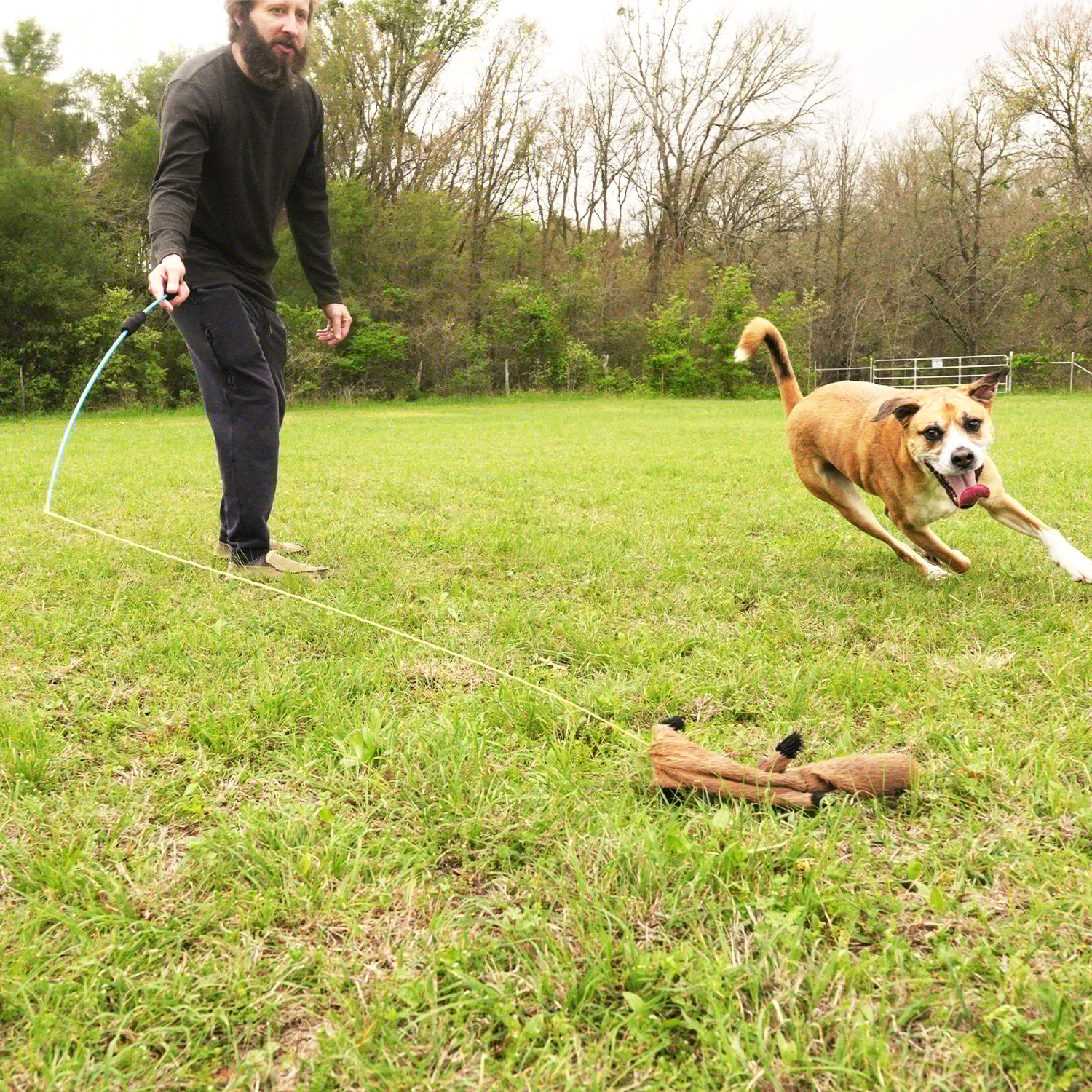
The Whimsy Stick for the session before guests
Under 30 lbs gets the Standard, with a 450-lb Kevlar line. Thirty and up gets the Rugged XL, one 46-inch piece of reinforced fiberglass with an 800-lb Dyneema line, and in my own use it holds up to a 120-lb power breed. Neither one has a bungee, so nothing snaps back and the lure goes where your hand goes. I bought the flirt poles I could find, handed them out to clients and watched what broke, then built my own and tested it on high-drive client dogs for years before I ever sold one.
Rugged XL + 3 Lures
- Dogs 30 lbs and up · 800-lb Dyneema line
- 3 lures to rotate · free US shipping
Rugged XL Pro Kit
- The XL with 5 lures and a spare line
- For dogs that shred lures · free US shipping
Rugged XL
- Same pole and line, 1 lure
- Dogs 30 lbs and up · free US shipping
The Standard
- Dogs under 30 lbs · 450-lb Kevlar line
- $20 flat US shipping, cause it goes in a longer box
Every order has a 30-day money-back guarantee, and you pay return shipping unless the pole failed. For build details, see the flirt pole buying guide.
Want more of this in your Google results? Add Whimsy Stick as a preferred source.
Stop dog jumping, FAQ
Why does my dog keep jumping even though I ignore it?
Cause ignoring it does nothing about the excitement behind it, and not everybody your dog meets is going to ignore it. Give the drive a structured outlet so they’re not as wound up to start with, build self-control while they’re excited, and teach a sit to do instead.
Does kneeing a dog in the chest stop jumping?
No, and a lot of times it makes it worse, cause to a high-drive dog getting touched while excited can feel like play. Take everything away the second the jumping starts and pay them the second all four paws hit the ground.
How long does it take to stop dog jumping?
Every dog is different, so I won’t give you a date. If you do the management, the sessions and the sit training together and everybody sticks to it, look for less jumping first, then four paws on the floor with people they know, then with people they don’t.
Is jumping worse in puppies or adult dogs?
Starting with a puppy is great cause they haven’t practiced it much yet, and an adult dog has had a lot longer to make it a habit, so it can take longer. It’s the same plan for both, and puppies that jump and bite need the nipping work going at the same time.
Can a flirt pole help stop dog jumping?
Yes, in two ways. A structured session before guests come uses up some of the drive that spills over into jumping, and the wait and the drop-it build self-control while the dog is excited, which is exactly what a jumping dog is missing when somebody walks in.
Should I teach off or teach sit to stop jumping?
Teach sit. Off is for after they already jumped, and a sit that’s just how your dog says hi stops the jump before it happens. Teach it somewhere quiet, practice it with more and more excitement, and make it the only way a greeting starts.
My dog only jumps on some people. Why?
Cause it pays off with some people and not others, so the dog has figured out who’s worth jumping on. Everybody the dog deals with needs the same rules, cause one person letting it go sets it back for everybody.
How do I stop my dog from jumping on guests specifically?
Plan every arrival ahead of time. Run a session 20 to 30 minutes before they get there, have the dog on a house line, cue sit before the door opens, and tell your guests the rule: no eye contact, no touching and no talking to the dog until the sit holds.
What if my dog jumps during walks?
Jumping on walks a lot of times comes from a dog that’s wound up before they ever leave, so a short session before the walk can take the edge off. On the walk, ask for a sit before anybody says hi and end it right away if they jump. See barking, pulling and recall and how to bond with your dog.
Calm greetings start before the doorbell rings.
Use up some drive with a short session, practice the wait while your dog is fired up, and make the sit the only way anybody says hi. 30 days to try it.
Add the Rugged XL + 3 Lures, $94.95Under 30 lbs? See the Standard, $55.95
Based on my own experience training dogs. Not veterinary or behavioral medical advice. Exercise disclaimer.


