
For the Dogs That Watched the Ball Roll Away
My Dog Won’t Fetch
Good.
Direct from the trainer who built it.
What dog owners say.
Key takeaways
- Most dogs that won’t fetch still want to play, there’s just one piece of the game missing. Maybe the breed was never built to carry stuff back, or nobody ever taught the retrieve, or the ball just doesn’t move like prey. And a lot of times handing it back feels like losing to them.
- Fetch has to be taught. The trainer who wrote the American Kennel Club (AKC) guide to fetch says it doesn’t come naturally to every dog, and the guide starts with a “hold” and adds distance a few inches at a time.
- Chasing is the part that comes built in. Fetch only uses a small piece of the predatory motor sequence (orienting, stalking, chasing, grabbing and keeping prey), but a flirt pole lets your dog stalk it and chase it and catch it all in the same session.
- If your dog grabs the ball and runs off with it, quit chasing him, cause every time you do he’s learning keep-away, and honestly that’s a more fun game than the one you were trying to play.
- Tug isn’t a bad habit. The AKC points to studies showing that well-run tug games don’t make dogs aggressive or dominant.
- If fetch just never clicks, give him a game he already wants to play instead, like two-toy chase or tug or scent games or a flirt pole.
Already know which one you need?
Fetch just doesn’t work for every dog, and that’s okay.
A lot of people think their dog is lazy or stubborn, and then that same dog will stare at a squirrel for ten minutes straight. So the drive is there. My whole method for putting it to work is in the flirt pole training guide, but first here’s why the ball keeps losing.
The ball doesn’t move like prey.
A tennis ball goes in one straight line and then it just stops. Prey darts and freezes and doubles back, and it does it low to the ground, so a lot of dogs watch the ball stop rolling and lose interest pretty quick.
Fetch makes him give the prize back.
Your dog finally gets the ball and the very next thing fetch asks is for him to hand it over. To a dog that can feel like losing every single time, so some of them just stop playing.
Quitting makes sense to the dog.
If he’s done after two throws, he isn’t being defiant. Dogs keep doing what pays off for them and drop what doesn’t, and we only seem to call it stubborn when it’s our game they dropped.
Why won’t my dog fetch?
Usually a dog that won’t fetch still has plenty of drive, there’s just one piece of the game missing. The breed might not have been built to carry things back, or nobody taught him the retrieve as a skill. The ball might move nothing like prey, or giving it back might feel like losing. Figure out which one it is and the fix gets a lot more obvious.
Breed and drive: not every dog was bred to bring it back
Drive is just a dog’s built-in urge to chase or grab or carry or sniff. Retrievers were bred to bring birds back to a hunter’s hand and terriers were bred to catch and shake, so when a terrier grabs the ball and kills it he’s doing what he was bred for. He isn’t ignoring you.
Nobody taught the retrieve
The retrieve is a skill and it has to be built. The AKC’s guide to teaching fetch says some dogs never played with toys as puppies and simply don’t know what to do with one. That dog just hasn’t been taught yet, and that’s fixable.
The ball loses, and so does your dog
A thrown ball bounces a couple times and stops, and then your dog has to give it back. If your dog used to love fetch and then quit on you, the flirt pole vs fetch breakdown goes into why the game wears out.
How do I teach my dog to fetch, step by step?
You teach the retrieve backwards, so the hold is first and then the pick-up and carry, and distance is the very last thing. Most people start by throwing the thing, and that’s actually the last step. I’d keep sessions to a few minutes and pay every little win with a treat, and don’t add distance till the hold is solid, and even then just a few inches at a time.
The six-step retrieve
- Start with something your dog already likes to carry. A soft toy he walks around the house with is gonna work way better than a tennis ball he won’t look at.
- The second he sniffs or mouths it, say “yes” and hand him a treat.
- Once that’s easy, wait a beat while his mouth is on the toy before you pay, and stretch that beat out a little each time.
- Then set the toy on the floor right in front of him, say “get it,” and pay when it comes up into your hand.
- Distance comes in inches. Back up one step at a time, and if he drops it halfway, no big deal, just go closer again.
- The throw is the very last piece, so keep tosses short, trade a treat the moment it gets back to you, and quit while he still wants more.
If your dog runs off with it
Don’t chase him, whatever you do. The AKC’s tug-of-war guide says not to chase a dog that runs off with the toy cause all you’re doing is teaching him not to listen. What I’d do is grab a second toy just like the first one and make that one the fun one.
Fetch vs tug vs flirt pole: which tires a dog more?
If your dog doesn’t care about the ball, a flirt pole or tug is usually gonna do more for him than fetch, cause he’s not really gonna play fetch anyway. With a ball-crazy retriever that can flip around. Whatever game he’ll keep playing hard is the one that tires him out, and the thinking it takes to stop and start on cue adds to it.
| Game | Parts of the hunt it uses | Has to be taught | Main workout | Watch out for |
|---|---|---|---|---|
| Fetch | Chase, then carry | Yes: the hold, the carry, the release | Repeated straight sprints | Sudden stops on hard ground; ball obsession |
| Tug | Grab, hold, pull | Mostly the “drop it” | Neck, shoulders, back | Hands too close to the toy; no drop cue |
| Flirt pole | Stalk, chase, catch, keep | Only the rules: wait, then drop | Sprints, turns, stops on cue | Tight turns on slick floors; dogs not cleared to sprint |
Tug is safe when it has rules
The AKC’s tug guide counts a trained “drop” as part of the game, and that same wait and release rule is what keeps a flirt pole session from turning into a frenzy, so it’s still training and not just a dog going nuts.
Got the opposite dog, the one that fetches till he drops and still can’t settle? That’s a dog obsessed with the ball, and that needs a different fix.
What if my dog just isn’t interested in fetch?
Quit forcing the retrieve and give him more of the part of the chase he already loves. If he chases the ball but won’t bring it back, try a two-toy game. Grabbers do well with tug, stalkers and sprinters do well with a flirt pole, and nose-first dogs get scent games, cause the point was always exercise and fetch was only ever one way to get there.
Four games that don’t need a retrieve
- Two-toy chase is where you throw one toy and then make the second one come alive, so nobody has to hand anything over.
- Tug with a drop cue means short hard pulls and a clean release, and then you go again.
- Scent games are another good one. The American Society for the Prevention of Cruelty to Animals (ASPCA) recommends “find it” treat hunts and notes that sniffing can be stimulating and calming.
- A flirt pole is a lure on a line that runs the chase while you stand in one spot, and I walk through it below.
If you want weekly totals, check out how much exercise a dog needs.
Swap the ball for something that moves like prey. Here’s how.
Chasing is a big part of your dog’s prey drive, and I’d rather give it somewhere to go on purpose than pretend it isn’t there. The AKC’s guide to channeling prey drive covers the theory, and the pole is how you actually do it.
Start the lure low and slow. Dragging it along the ground looks a lot more like prey than a toy does, and that’s a big reason dogs that ignore the ball will go after it.
Feed the stalk. Let him lock on and drop his shoulder and creep up on it, that’s the part of the hunt fetch skips.
Grant the catch. Give him a couple near misses and then let him win, and let him keep it in his mouth and parade it around for a bit.
Trade and go again. A calm release is what starts the next round. Clients tell me their dogs are a lot calmer and more relaxed after using the flirt pole, and they seem more satisfied.
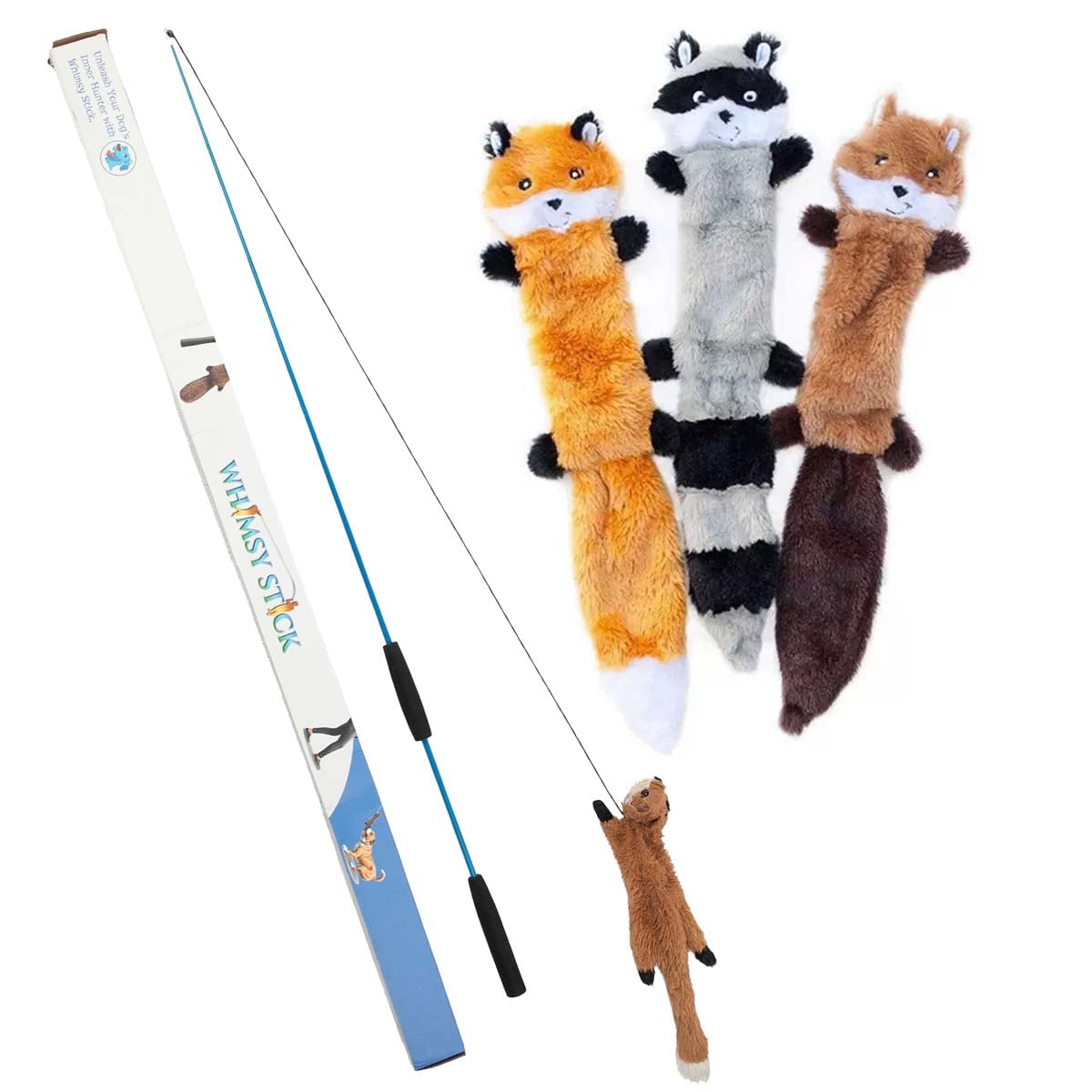
Chase games compared, side by side.
Here’s how the four options stack up when you look at what the dog actually gets out of each one, and what it costs you to run it.
| Game | Stalk phase | Who keeps the prize | Your effort | Ball-indifferent dogs |
|---|---|---|---|---|
| Fetch | Skipped, throw then sprint | You take it back | Shoulder sore by round 20 | They walk away |
| Tug | None, starts at the bite | Contested the whole time | Full-body workout for you | Some like it, many shrug |
| Ball launcher | Skipped, faster ball, same ball | You reload it | Less throwing, more fetching by you | Ignored, just at higher speed |
| Whimsy Stick | Built in, the lure creeps and freezes | Your dog, every single catch | A wrist flick from one spot | This is who it was built for |
“It’s truly amazing! Life changing since our dog doesn’t fetch. She is also not good with other dogs so now we can get some exercise in our backyard. Pit mix, strong girl.”
“One of the best flirt poles I have gotten for my dog. He loves it.”
An honest fit check before you spend a dollar.
Built for your dog if…
- He ignores balls but goes nuts for squirrels
- He’ll chase just fine but never brings anything back
- He’s a smart breed and quits the same old game pretty quick
- You’ve got a full toy box and he’s still bored
- You want a game that has a clear ending
Skip it for now if…
- You want a toy he plays with by himself while you’re on your phone
- He has joint issues or is coming back from surgery and your vet hasn’t cleared him to sprint
- He has serious resource guarding and you don’t have a behavior pro helping yet
- You don’t want to stick to the catch-and-release rules
Chase work is the hard exercise, but it shouldn’t be the only enrichment he gets. On rest days the slower ideas in the ASPCA’s enrichment guide are a good way to round things out.
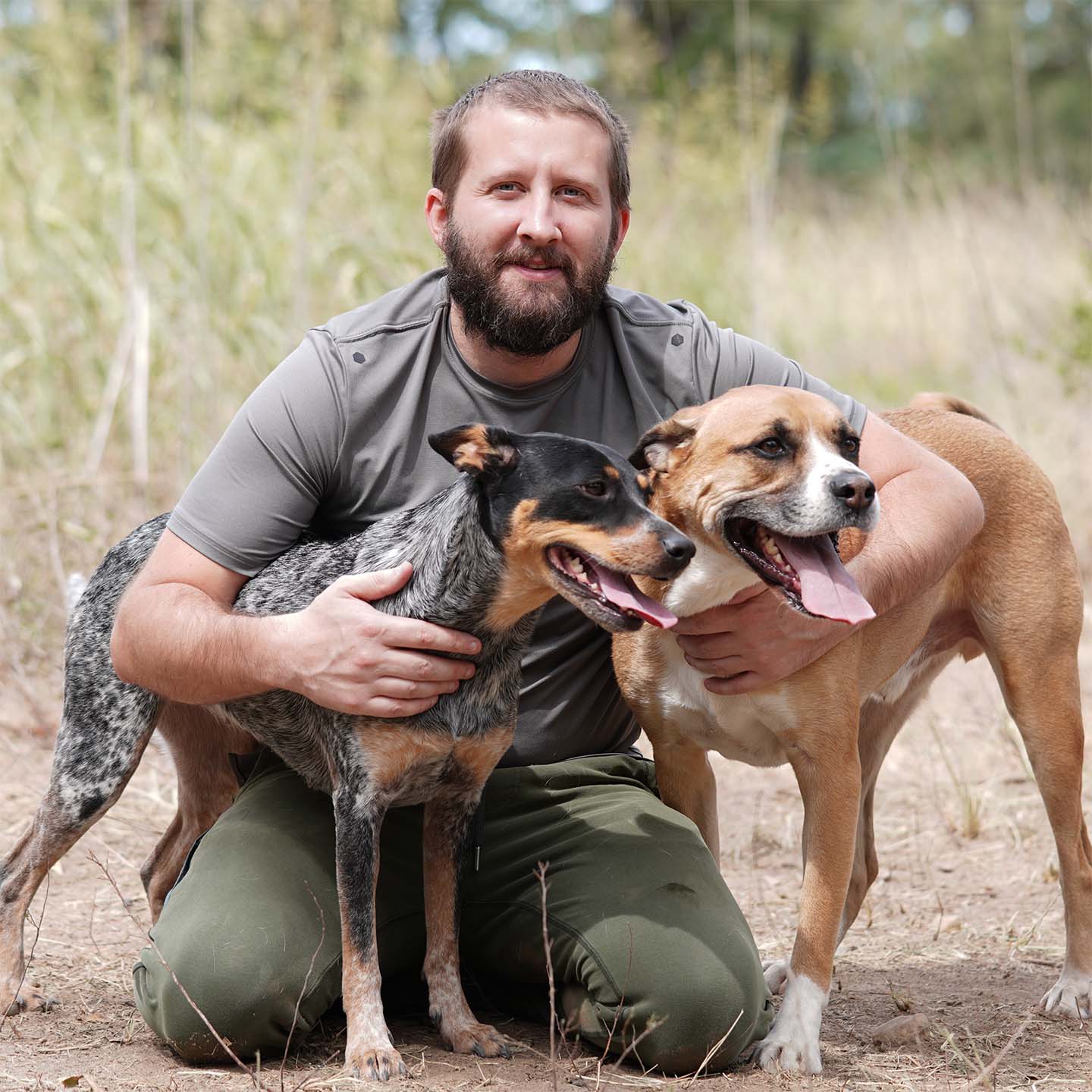
Who built this and why.
I’m Chris. I’ve been working with dogs for about 10 years and with around 400 client dogs, and I don’t have any certifications or vet credentials. What I know I learned by doing it, a lot of times with dogs other trainers had already failed with.
A lot of people feel like something’s wrong cause their dog won’t even fetch. He didn’t flunk anything. Chasing was never the problem, the game was.
I bought the flirt poles I could find and handed them out to clients, and then I watched what broke. They were too short or too bulky, some had a violent bungee cord, and some were just too heavy. So I built my own and tested it on high-drive client dogs for years before I ever sold one.
“A dog with a satisfied animal instinct is much better behaved, and the biggest way to satisfy it is hunting.”Christopher Lee Moran · Working Dog Trainer
Built for the dog fetch left behind.
If your dog is under 30 lbs, the Standard covers it. If he’s 30 lbs and up, or he shreds toys for sport, go with the Rugged XL.
- Light, flexible fiberglass pole, about 4 oz
- 1 prey lure, Unlucky the Squirrel
- 450-lb Kevlar static line, no bungee
- 8-foot play radius
- 30-day money-back guarantee
- One-piece 46-inch fiberglass rod, no joints, no bungee
- 3 prey lures: squirrel, fox, raccoon
- 800-lb Dyneema static line
- In my own use it holds up to a 120-lb power breed
- 30-day money-back guarantee
- Everything in the Rugged XL Bundle
- 5 prey lures total
- Spare 800-lb Dyneema line included
- Lures and line wear out, so you’ve got spares
- 30-day money-back guarantee
What you read here reflects my own experience training dogs. Not veterinary or behavioral medical advice. See the full exercise disclaimer →
The Risk Is Mine
30-Day New Favorite Game or Your Money Back.
Run it for 30 days. If the dog that refused fetch shrugs at this too, email me directly and I’ll refund the pole. Return shipping is on you unless the pole failed. And if your dog breaks it in play, I’ll work with you to fix it, replace it or refund it. I’m a one-man company and I want you happy with it, so I’ll work with you.
Real questions from fetch dropouts’ owners.
Why won’t my dog fetch?
Usually cause fetch only gives him a small piece of the hunt, and kind of a boring piece. A ball goes in one straight line and stops, and the parts a lot of dogs really want, the stalk and getting to keep it, never happen. Opting out is just a preference and there’s nothing wrong with him.
Is it bad that my dog doesn’t fetch?
Not at all. Honestly fetch is a human game that some dogs love and plenty just put up with, and the chase instinct underneath is there either way. Give that instinct a better outlet and a lot of times the dog you thought was lazy goes away.
How do I play with a dog that ignores balls?
I’d move something along the ground the way prey moves, darting and freezing and changing direction. A flirt pole does that, so a lot of dogs that never brought a ball back will stalk it and chase it, and you keep the rounds short and let him really catch it so the hunt actually finishes.
Will my dog like a flirt pole if he ignores toys?
A lot of them do, cause the lure moves and toys sitting on the floor don’t. If your dog shrugs at this one too, you’ve got 30 days to send it back for a refund, and return shipping is on you unless the pole failed.
Do retrievers need fetch?
They don’t. Retrieving is one piece of the hunting sequence that got bred in, and plenty of labs and goldens still won’t chase a ball. A retriever that won’t fetch isn’t defective, and the whole stalk and chase and catch can work for him too.
My dog chases the ball but won’t bring it back. What game fits?
That dog is showing you the chase and the keep are the parts he likes. A flirt pole is built around those two, cause he wins the lure and gets to parade it around before he trades it for another round. Nothing gets taken away from him, so he doesn’t quit.
What size flirt pole should I get?
The Standard is for dogs under 30 lbs, and the Rugged XL is for dogs 30 lbs and up or any power chewer. The XL is a one-piece 46-inch fiberglass rod with no joints and an 800-lb Dyneema static line, and in my own use it holds up to a 120-lb power breed. Dyneema is an ultra-strong polyethylene fiber used in heavy-duty rope.
Can you teach an older dog to fetch?
You can. Age changes the pace but the method stays the same, so start with the hold, pay the pick-up and add distance by inches just like you would with a puppy, in sessions of a few minutes. If your dog has stiff joints keep the tosses short and on grass, and ask your vet before you add any sprints.
Does fetch or tug tire a dog out more?
It depends on which game your dog plays hard. A ball-crazy retriever can run himself out on fetch, but a dog that won’t fetch gets almost nothing out of it, and tug works strength and the drop cue. A flirt pole runs the whole chase, so for a lot of dogs that don’t care about the ball it’s the one that actually gets them moving.
Is tug of war bad for dogs?
No. The American Kennel Club points to studies showing well-run tug doesn’t make dogs aggressive or dominant. I’d just give it some rules, like a long toy so your hands stay clear, a trained drop cue and short bouts. Letting your dog win sometimes is fine, cause it teaches him that playing with you pays off.
Quit asking for fetch. Offer the hunt.
You’ve got 30 days to see if he takes to it. If he doesn’t, send it back for a refund, and if he does you might have the first game he ever begs you to start.


