
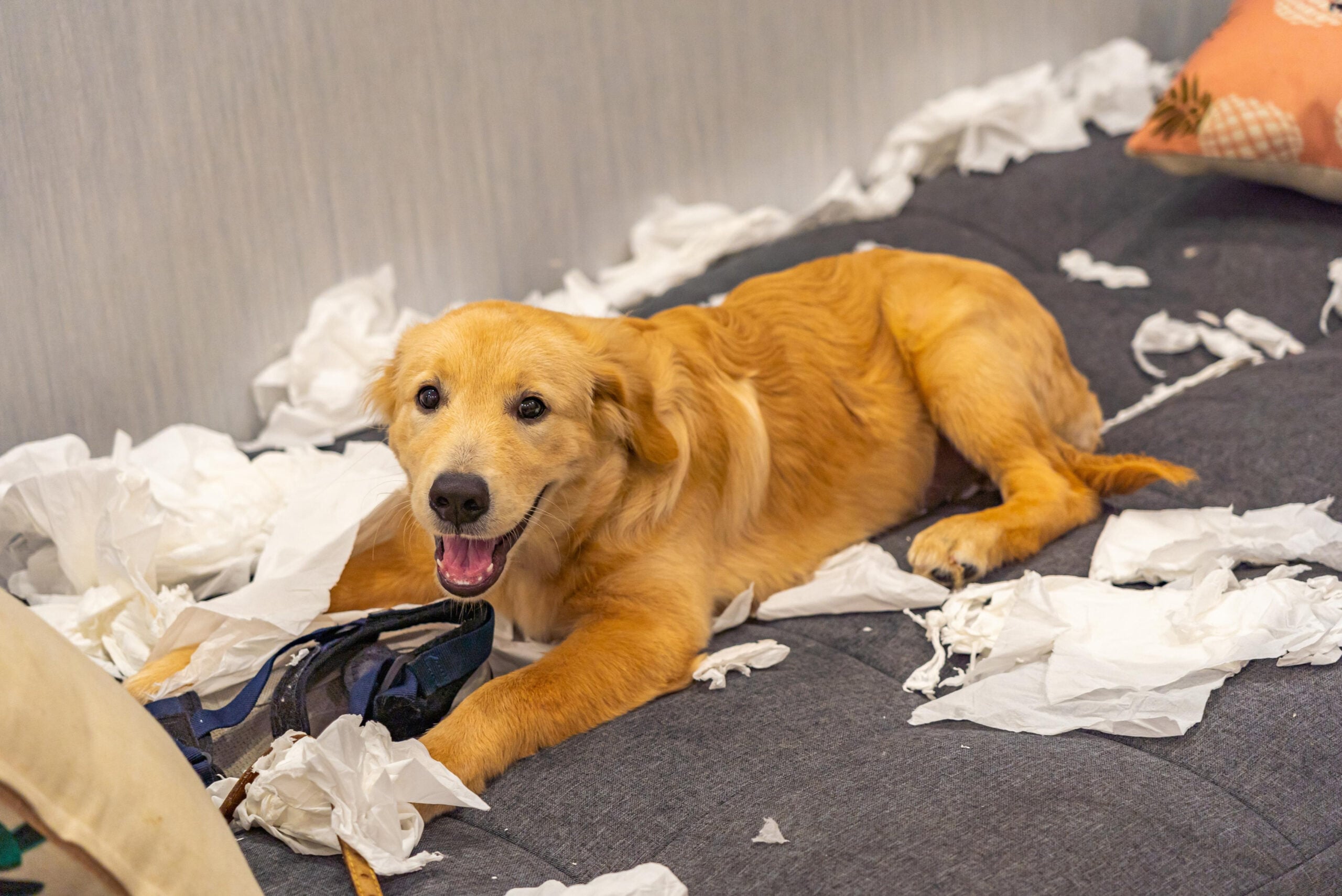
A lot of times a bored, destructive dog has an instinct that isn’t getting satisfied, not a discipline problem. Without an outlet for prey drive every day, dogs make their own fun, and it usually involves your furniture. More toys and stricter rules usually don’t fix it.
Give it 5 to 10 minutes a day of structured chasing so the dog gets to run the whole stalk and chase and catch and win, and that’s a real job for it. Do it every day and see if the damage around the house starts going down. Ending every session with a real cool-down is a big part of it. For picking a pole, see the flirt pole buying guide.
Who This Guide Is For
- Your dog chews furniture, shreds pillows or wrecks shoes when they’re alone
- You’ve tried puzzle toys, bitter spray or the crate and it only helped a little
- Your dog is high-energy or high-drive and still wired after walks
- You need something that takes under 10 minutes a day
- You’re tired of replacing baseboards, blinds and everything else
Signs Your Dog Needs a Structured Outlet
- Chewing baseboards, door frames, or furniture legs
- Shredding pillows, shoes, or household items
- Counter surfing or stealing items to destroy
- Pacing, whining or not being able to settle
- Still hyper after walks or fetch
- Tearing stuff up whether you’re home or not
Why Dogs Destroy Things When Bored
When a bored dog doesn’t have anywhere to put its body or its brain or its instincts, it tears stuff up. The boredom goes to frustration and the frustration goes to the couch and the pillows and your shoes, and honestly it’s just the dog making its own outlet cause it didn’t have one.
A lot of times you’re looking at a dog with needs that aren’t getting met more than a dog with bad manners. Left alone with nothing to do, dogs make their own fun. Chewing feels good to a lot of dogs so it pays for itself, and the more they do it the more of a habit it gets to be, and that’s hard to break unless you give them something else. According to the ASPCA guidance on destructive chewing, it’s one of the most common complaints owners have and it’s almost always tied to boredom or unmet needs and not spite. The AKC’s piece on channeling prey drive says about the same thing, give that drive a safe outlet through games.
Common causes are long hours alone, a lot of prey drive with nothing to chase, not much going on during the day, and no real routine. The dog isn’t choosing to be destructive, the drive just has nowhere else to go. That same thing can show up as pulling on the leash, reactivity and being hyper after walks. For why walks aren’t enough for high-drive dogs, see the other guide.
The self-reward loop

Tearing stuff up tells you something’s missing, and it doesn’t make your dog a bad dog. A lot of times it’s prey drive with no outlet, and if you work on that, the destruction usually eases up.
Boredom vs. Separation Anxiety: Know Which One
This matters cause you handle them differently. People mix them up a lot, and if you guess wrong you can burn a lot of time on the wrong fix. Look at what the dog goes after and when it happens and that’ll tell you which one you’ve got.
Boredom destruction
- Happens whether you’re home or not
- Goes after whatever’s around (shoes, cushions, trash)
- Dog seems bored, not panicked
- Gets better with structured play every day
- This guide is made for it
Separation anxiety
- Starts when you leave, not at random
- Goes after ways out (doors, windows, crates)
- Comes with barking or howling, pacing and trying to get out
- Talk to your vet or a qualified behavior pro
- Use the separation anxiety guide instead
If it only happens when you leave and your dog is clearly stressed, I’d guess anxiety more than boredom. A structured chase before you leave helps either way, but real anxiety needs your vet or a veterinary behaviorist. This guide is for the bored kind.
Why Walks, Toys, and Crates Don’t Fix This
Most people try all the usual fixes first. They’re trying hard, these just don’t get at why the dog is doing it.
More walks
A walk burns some energy but doesn’t touch prey drive. A lot of dogs come home more wired after a walk cause they got all worked up and never got to finish anything.
Passive toys
Puzzle feeders work the brain but there’s no chase and no catch. A lot of high-drive dogs blow through them fast and go right back to the couch cushion.
Crate training
A crate keeps your stuff safe but it doesn’t do anything about the drive. The dog sits in there with all that energy, and as soon as they’re out it starts again. That’s managing it, and it doesn’t fix anything.
Punishing them after doesn’t work either. A dog isn’t gonna connect getting in trouble with something they chewed three hours ago. It just makes them more anxious, and that can make the chewing worse.
What I’d do is give the dog a structured outlet every day where they get to finish the whole chase, stalk, chase, catch and win. A dog with a satisfied animal instinct is much better behaved, and a lot of times they just don’t need your furniture as much. For dogs that get overexcited at the wrong times, the same chase work helps there too.
Walks tire out legs and toys keep mouths busy, but neither one lets the dog finish a chase. You need something that lets them stalk, chase, catch and win.
How to Stop Destructive Chewing in 5 Minutes a Day
Punishing it won’t fix anything. Give the dog a structured job that satisfies the instinct behind the chewing instead, and a lot of times the chewing eases up on its own cause the dog already got what it needed.
5-Minute Boredom Buster
Ask for a sit and pay for calm, and get the dog paying attention before you start so they know this game has rules.
Do 5 or 6 rounds of 20-second chases with a flirt pole, and stop between rounds and cue a sit or down before you go again. Those pauses are where the dog learns self-control while they’re fired up. For more on the pole, see the canine flirt pole.
Let the dog actually catch the lure and then ask for a drop, cause that’s how they get to finish the whole stalk, chase, catch and win. A lot of people skip the catch and then wonder why the dog stays amped.
Put the lure away and give them a chew or a snuffle mat, and then cue place or bed. Going from all fired up to calm on purpose is a big part of breaking the habit.
What to Expect: Progress Timeline
Every dog is different so I won’t promise you a timeline, but if you do the routine every day and end with calm every time, this is the kind of thing to watch for.
If your dog shows self-injury, extreme panic, or aggression during sessions, stop and talk to a veterinary behaviorist before you keep going. Structured play is for the bored kind of destruction, and it doesn’t replace professional help for real anxiety, compulsive behavior or a dog with a bite history.
What to Do Before You Leave the House
A lot of the damage happens while you’re at work. So I’d time the session around when you leave, that way the dog finishes the session and is busy with a chew instead of wound up and looking for something to wreck.
- Do the 5-minute routine 30 to 45 minutes before you leave, and not right before, cause the dog needs some time to come down before you’re out the door.
- Take a short easy walk of 5 to 10 minutes after the session, just quiet sniffing and nothing exciting, so there’s something between play and you leaving.
- Hand over a good chew, like a stuffed toy or a bully stick, about 5 minutes before you go, cause you want them working on the chew when you leave and not watching you put your shoes on.
- I wouldn’t make a big deal out of leaving or do long goodbyes, the dog’s done and busy with a chew, so just walk out quiet.
Structured chase also builds your bond and gives the day some routine. If you want to use these sessions to get closer with your dog, see how to bond through play.
Why Puzzle Toys Alone Don’t Fix Destruction
Puzzle toys and long-lasting chews do help some dogs, and they really do tire the brain out. But high-drive dogs need more than brain games. A bored dog that’s tearing stuff up needs to move, to chase, and to get the catch they were born wanting.
Puzzle toys work the brain but don’t do anything for prey drive, and a lot of times that’s the drive behind the damage. Use puzzle feeders and chews as extras after the chase, they work great as the cool-down in the routine above, but I wouldn’t make them the main fix. For more on how enrichment for high-energy dogs compares to structured chase work, see the full breakdown.
Common Mistakes That Keep the Cycle Going
Besides skipping the structured session, these four things trip a lot of people up.
Punishing after the fact
Dogs don’t connect punishment to something they did earlier, and it makes them more anxious, which can make the chewing worse, so giving them what they need works a lot better long term.
Leaving high-value items out
Leave good stuff out with a bored dog and it’s gonna get chewed, so I’d pick things up while you build the new routine, cause managing it is part of the fix until things get better.
Toys only when alone
If the only toys show up when they’re alone, the dog learns alone means boring toys and keeps chewing. Play needs to be with you running it, cause that’s what changes things.
No structured outlet
If you don’t give them something that satisfies the same drive the boredom builds right back up, so you have to give them something better to do and not just take away the bad thing.
A big mistake is trying to just stop the chewing instead of giving the drive behind it somewhere to go. Give the dog a real job where they get to finish the chase, and the chewing doesn’t do as much for them anymore.
The Tool the Boredom Buster Runs On
The routine runs on a flirt pole made for daily structured play. A lot of the poles I tried had a violent bungee cord, so I went with a static line that doesn’t snap back, a rod that lets you make wide arcs on the ground, and a lure dogs actually want to chase. The Standard is for dogs under 30 lbs, and the Rugged XL is for dogs 30 lbs and up.
About 4 oz with a 450-lb Kevlar static line and replaceable lures, made for dogs under 30 lbs and daily structured chase.
A one-piece 46-inch reinforced fiberglass rod with an 800-lb Dyneema static line, for dogs 30 lbs and up. In my own use it holds up to a 120-lb power breed.
Dog Destroying Things When Bored: FAQ
Cause and identification
Why is my dog destroying things when bored?
A lot of times it’s prey drive with nowhere to go. Boredom turns into frustration and chewing feels good, so it takes the place of the hunting the dog was born wanting to do, and honestly it isn’t spite.
Is my dog destroying things because of boredom or separation anxiety?
Bored chewing happens whether you’re home or not and goes after whatever’s lying around, while separation anxiety starts when you leave, goes after doors and windows and comes with barking or howling and trying to get out. If it only happens when you leave and your dog is clearly stressed, it might be separation anxiety, and I’d talk to your vet or a qualified behavior pro.
Why does my dog target furniture over other things?
Furniture has some give and texture to it that a lot of dogs like to grab and tear, and chewing can also feel good to a dog, so it keeps itself going. I’d rather give them structured chase where they get to finish the whole thing than just hand them a chew toy.
Telling them apart
My dog only destroys things when I leave. Is that boredom?
It depends on what they go after and how they act. If it’s whatever’s lying around and they seem calm otherwise, it’s probably boredom, but if it’s doors and windows and they bark or howl, pace or try to get out, it might be separation anxiety. A chase session before you leave can help either way, but with anxiety I’d get a vet or a qualified behavior pro involved.
Fixing it and timing
How do I stop my dog from destroying things while I’m at work?
I’d do a 5 to 10 minute structured chase session 30 to 45 minutes before you leave, then an easy walk, and hand over a good chew when you go, cause the session takes care of the drive and the chew keeps them busy while you leave. Keep it up every day and watch for less damage around the house.
Will more toys stop the destruction?
Toys they play with alone don’t usually fix it when it’s coming from drive, cause high-drive dogs need play you run where they get to stalk, chase, catch and win. Puzzle feeders and chews are good extras after that, just not the main fix.
How long until I see improvement?
Every dog is different so I’m not gonna give you a date. Do it every day and end every session with a real cool-down instead of just stopping, cause going from fired up to settled on purpose is a big part of breaking the habit.
Special situations
Is this routine safe for puppies or dogs with joint issues?
For puppies I’d keep it shorter, 3 to 5 minutes with no jumping and the lure on the ground, and ask your vet what’s OK for your pup’s age, and for dogs with joint problems talk to your vet first. Low, slower moves still let them chase and catch without a lot of pounding.
What if my dog gets too aroused and won’t calm down after the session?
If the dog can’t settle after, the session was probably too long or too hard, so make it shorter and end earlier and add more pauses between chases so the dog practices switching off during the session, and don’t skip the cool-down.


