
Best Flirt Pole for Dogs (2026): 5 Designs, Ranked by a Trainer
The best flirt pole for dogs, the way I see it, is one solid fiberglass pole on a static line that doesn’t stretch, with a lure you keep on the ground. That build gives your dog room to actually run, nothing snaps back at the catch, and there’s no joint to work loose. If your dog is 30 lbs or up that’s the Rugged XL, and under 30 it’s the Standard.
By Christopher Lee Moran, working dog trainer, around 400 client dogs · Just so you know, I designed the Whimsy Stick, so read this as the guy who makes it
My pick, by dog size
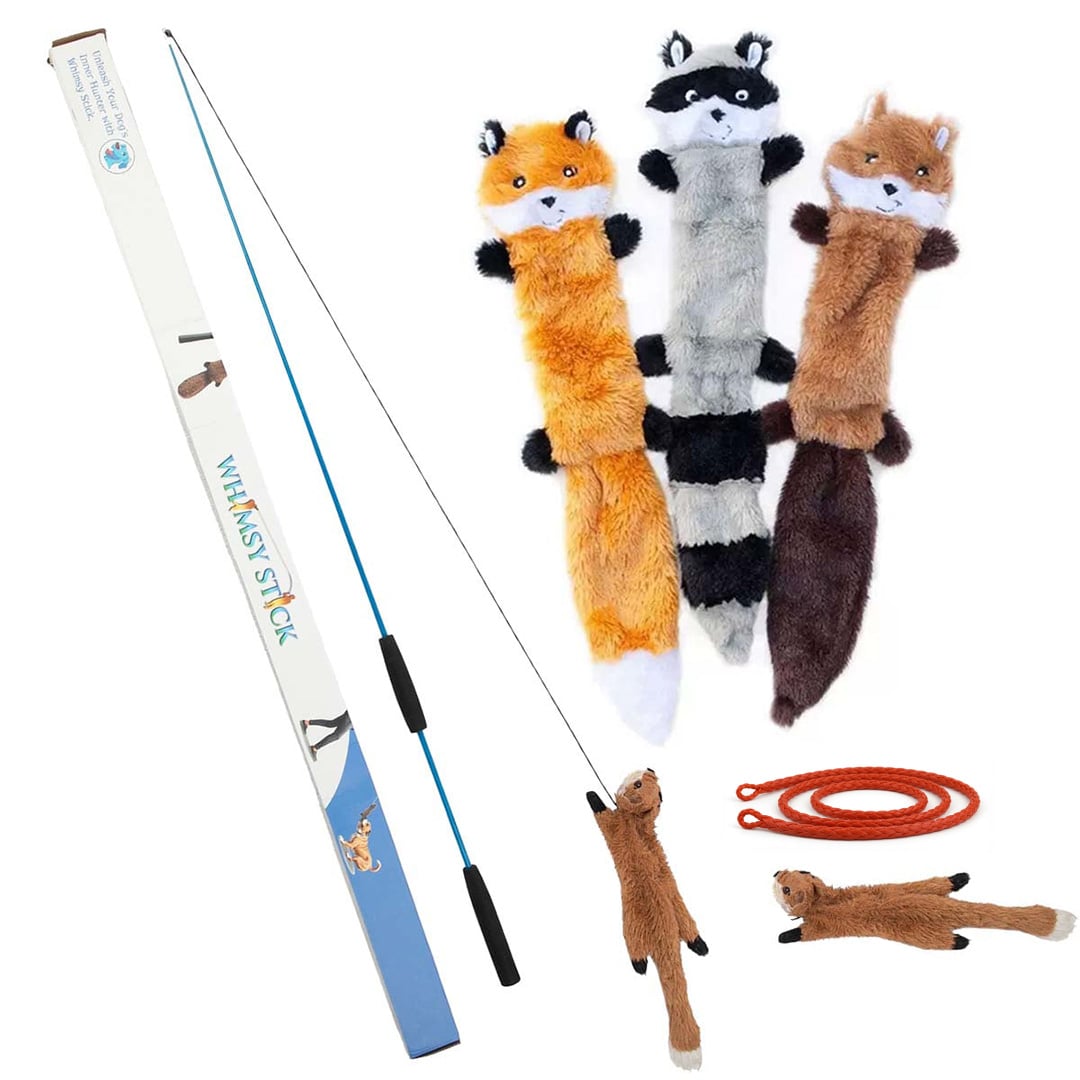
Rugged XL Pro Kit
- One-piece fiberglass pole, about 4 ft, with an 800-lb Dyneema static line
- 5 lures and a spare line, and since those are the parts that wear out you’ll use them
- About half a pound, so your arm doesn’t give out halfway through · free US shipping
30-day money-back guarantee · usually ships within 2 days
Rugged XL + 3 Lures
- Same pole and line, 3 lures
- Dogs 30 lbs and up · free shipping
If you just want the pole, the Rugged XL with 1 lure is $74.95 on the Rugged XL page.
The 5 specs that decide whether a flirt pole works
A lot of flirt pole reviews grade stuff like color and squeakers, and I don’t care about either one. What I care about is if a high-drive dog gets a real chase and then settles down after, and it comes down to five things. Every design further down gets held to them, mine too.
1. Reach
I call this the field of chase. It’s how far the lure can get from your hand, so pole plus line. Four feet of pole and four feet of line puts the lure out around 8 feet, and that’s room for a dog to open up and actually sprint. Give yourself about 20 feet of clear grass. Now the line to pole ratio matters too, I call it pole balance. If the line is a lot longer than the pole it actually shrinks the field of chase, because the lure just comes back to you, and if it’s too short the dog catches it every few seconds.
2. Line type
Static line beats bungee and I won’t budge on that one. A bungee stretches, then when the tension lets go the whole thing whips back, and there’s nothing you can do about where it goes. With a static line nothing moves till your hand does.
3. Build
I bought the flirt poles I could find and handed them out to clients, and they’d go at the joints, the thin cord, or wherever the lure ties on. My minimum is a line rated for at least 450 lbs on small dogs and a lot higher for the big dogs that grip and shake. That’s why the Standard’s Kevlar line is rated at 450 lbs and the Rugged XL’s Dyneema line is rated at 800. Those numbers are what the lines are rated for though, they aren’t a promise about the whole pole.
4. Lure behavior
Prey runs on the ground and your lure should too. Once it starts bouncing up over your head the dog is leaping and twisting to get it, and that’s how you get bad landings. A pole that’s somewhat flexible but not too flexible keeps it low, so the lure goes where your hand sends it instead of wherever it wants to go. Some people use a horsewhip, but it has a violent movement tendency as it flexes.
Spec 4 in action. The lure stays on the grass so the dog is running and turning, not jumping.
5. Weight and balance
You’re gonna be holding this thing for 10 minutes or more. If it’s heavy your arm gets tired quick, and then the sessions get shorter and sloppier. If you try to make a pole stronger with metal fittings you add weight and it’s not user friendly anymore, but if it’s too flimsy it fails spec 3. You want it light enough to last a whole session and stiff enough to keep the lure low. The Rugged XL is about half a pound.
Get all five right and you’ve got a dog that settles down after. Miss two or three and a lot of times you end up with a dog more wound up than when you started.
The 5 flirt pole designs, ranked
These are build types, not brands. I’m ranking how a pole is made cause that’s what decides if it holds up to a strong dog. And if another design beats mine at something, like packing small for travel, I’ll say so.
I ranked them by what held up and what didn’t over years of working with client dogs, using the five specs above. This is a trainer’s notes, not lab tests.
1. One-piece fiberglass, static line
Daily training toolGets right: all five. There’s nothing to loosen, nothing bouncing back at the catch, and the lure stays low. I started out with about a 5-foot fishing rod with no eyelets and no reel, cause let’s not lie, you ain’t reeling in a dog, and that’s how the Whimsy Stick ended up being built.
Honest catch: it won’t break down for travel. I’d like it longer too, but shipping over 4 feet costs a whole lot more. And if you’ve got a gentle dog that plays once a week, it’s more pole than you need.
2. Multi-section metal pole
Solid, watch the jointGets right: metal won’t splinter, and the sections pack down so it’s easy to store.
Honest catch: when you break a pole into pieces you lose strength and pole integrity, and threads can loosen up in the middle of a session. The metal adds weight too, so it gets heavy to swing.
3. Telescoping pole
Travel backupGets right: it folds down small enough to throw in a bag or the car door.
Honest catch: every section adds flex so the lure lags behind your hand, and collapsing poles lose strength and pole integrity. Keep one in the car if you want, I just wouldn’t use it every day.
4. Bungee-line pole
Not in my sessionsGets right: the stretch does take some of the jolt out of your arm when the dog catches it.
Honest catch: that same stretch flings the lure back somewhere you didn’t pick, a lot of times up in the air. So it ends up teaching jumping, and you never really know how a catch is gonna go.
5. Light plastic wand
Starter onlyGets right: it’s cheap and light, and fine for finding out if a small gentle dog even likes the game.
Honest catch: it flexes a lot, the cord is short, and a cracked plastic shaft can leave a sharp edge. Once your dog is past 30 lbs or starts playing hard, move on from it.
Best flirt pole for large dogs vs small dogs
Large dogs (30 lbs and up)
Big dogs hit the lure harder and shake it longer, so the line rating and a shaft with no joints matter most here. The field of chase matters more with big dogs too, an Irish Wolfhound takes long leaps. My pick is the Rugged XL, one-piece reinforced fiberglass on a Dyneema line rated at 800 lbs, and in my own use it holds up to a 120-lb power breed. Right at 30 lbs go XL, and same with a dog that plays rough at any weight.
Small dogs (under 30 lbs)
Little dogs need a lighter pole that still keeps the lure low. That’s the Standard, with a Kevlar line rated at 450 lbs. It’s the one I’d hand you for most small dogs under 30 lbs, seniors, and puppies past 6 months.
All 5 designs side by side
| Spec | One-piece, static | Metal sections | Telescoping | Bungee line | Plastic wand |
|---|---|---|---|---|---|
| Joints in the shaft | None | At least one | One per section | Depends | Depends |
| Line at the catch | No rebound | Depends on cord | Depends on cord | Stretches, rebounds | Light cord |
| Lure stays low | Yes, stiff shaft | Mostly | Less, shaft flexes | Less, lure rebounds | Less, shaft flexes |
| Packs small | No | Yes | Yes | Depends | Depends |
| My verdict | Daily tool | Solid, watch the joint | Travel backup | Not in my sessions | Starter only |
These rows are about each build type in general, not any one product.
Is it worth more than a budget pole?
Don’t just take my word on price, I designed the expensive one, so check the math yourself. The Rugged XL is $74.95 with one lure, $94.95 with three, and $129.95 for the Pro Kit with five lures and a spare line, and all three ship free in the US. The Standard is $55.95 plus $20 shipping cause it goes out in a longer box.
After that you’re only buying wear parts. Lures go first and they’re $12.95 each, and a replacement Dyneema line for the Rugged XL is $19.99.
When a cheaper pole is the right call
Honestly, buy the cheap one if your dog is small and gentle, if you only play once a week, or if you need something that fits in a suitcase. If your dog is over 30 lbs and grabs and shakes, or you’re gonna play most days, the one-piece build and the static line are what you’re paying for.
How to use it so your dog actually settles
A good pole only gets you halfway, the structure is the rest of it. This is the short version of the routine I use, and the whole thing is in the flirt pole training guide.
- Wait before every chase. The lure goes still, your dog holds a sit or a down for a few seconds, then you let them go with a word.
- Chase low in short bursts. About 15 to 30 seconds at a time, with the lure on the ground moving away from your dog and a few turns thrown in.
- Let them catch it every 3 or 4 rounds. Getting the catch is what makes it feel finished for the dog.
- Trade for a drop-it and go again. About 10 minutes total for most adult dogs.
- End it on purpose. Say your all-done word and put the lure away, then ask for a down and give them something to chew.
Before you start, wait till your puppy is at least 6 months old and ask your vet about growth plates. Until 12 months keep it to 3 to 5 easy minutes. Dogs with joint problems need the okay from the vet first. On a hot day play early and keep it short. And a flirt pole gives chase drive an outlet, but it’s not a treatment for reactivity or aggression.
Quick answers
What is the best flirt pole for dogs?
A one-piece fiberglass pole with a static line and a lure you can keep on the ground. For dogs 30 lbs and up I use the Whimsy Stick Rugged XL, and under 30 lbs the Standard is the same idea scaled down. I designed both of them, so weigh that against the specs on this page.
What is the best flirt pole for large dogs?
If your dog is 30 lbs or more, or a power breed, get a one-piece pole with a high-rated static line cause big dogs grab and shake hard. The Rugged XL is reinforced fiberglass on an 800-lb Dyneema line and gets the lure out about 8 feet.
What is the best flirt pole for small dogs?
Under 30 lbs I’d go with the Whimsy Stick Standard, which is a 450-lb Kevlar static line on a lighter pole. A plastic wand can tell you if a gentle little dog likes the game, but a terrier that plays hard still needs a real pole.
Is a bungee flirt pole or a static line better?
Static line. A bungee stores up energy while it stretches and then snaps the lure back when it lets go, and a lot of the bungee poles I tried were just violent. With a static line nothing moves unless you move it, so the chase stays low and the catch stays clean.
Are telescoping flirt poles any good?
For travel sure, they pack small. For every day with a strong dog I pass, cause every section adds flex and collapsing poles lose strength and pole integrity.
The pole I use every day
Try it for 30 days. If it isn’t a fit for your dog, email me for a refund, and you cover return shipping unless the pole failed. I’m a one-man company and I want you happy with it, so I’ll work with you.
Get the Pro Kit, $129.95Smaller dog? See the Standard, $55.95
Based on my own experience training dogs. Not veterinary advice. Exercise disclaimer.


