
Whimsy Stick: A Heavy-Duty Flirt Pole for Large Dogs (Product Guide)
The Whimsy Stick is the flirt pole I built for dogs that wreck flirt poles. It’s one solid 46-inch fiberglass rod with a braided line that doesn’t stretch, and a lure on the end you can swap out when it gets chewed up. The Rugged XL is for dogs 30 lbs and up and the Standard is for smaller dogs. And no, it’s not something you leave out in the yard.
By Christopher Lee Moran, working dog trainer, around 400 client dogs · Just so you know, I designed this pole and I sell it, so this is the guy who makes it talking, not some neutral reviewer. If you want every design compared side by side, that’s the 2026 ranking.
What you get, and what it costs
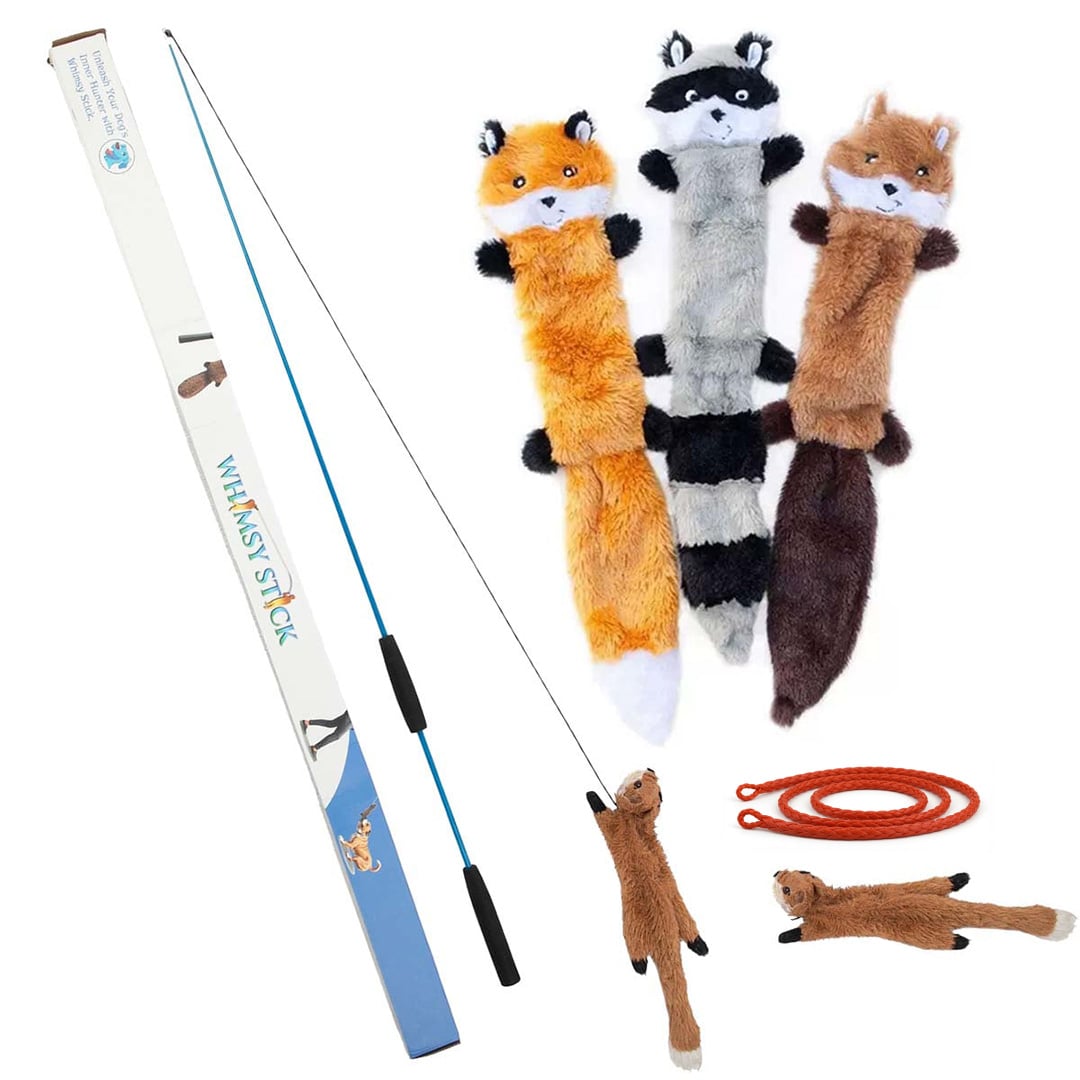
Rugged XL Pro Kit
- Rugged XL pole with an 800-lb Dyneema static line
- 5 lures plus a spare line, so a worn part never ends a session
- For dogs 30 lbs and up · free US shipping
Rated 4.9 stars across 38 product reviews · 30-day money-back guarantee · usually ships within 2 days
| Kit | For | Line | Lures | Spare line | Price |
|---|---|---|---|---|---|
| Rugged XL Pro Kit | 30 lbs and up | 800-lb Dyneema | 5 | Yes | $129.95, free shipping |
| Rugged XL + 3 Lures | 30 lbs and up | 800-lb Dyneema | 3 | No | $94.95, free shipping |
| Rugged XL | 30 lbs and up | 800-lb Dyneema | 1 | No | $74.95, free shipping |
| Standard | Under 30 lbs | 450-lb Kevlar | 1 | No | $55.95 + $20 shipping |
The Standard ships for $20 cause it goes in a longer box. Every Rugged XL kit ships free in the US.
The four things that make a flirt pole good
Most people pick a flirt pole by how beefy it looks in the picture, or by how nuts their dog goes the first time, and neither one tells you much. There are a lot of flirt poles out there that I have tried, and I handed a bunch of them out to clients and watched what broke. They were too short, bulky, had a violent bungee cord, or were just too heavy. So this is what I check on any pole now, mine too.
1. Field of chase
Field of chase is just how far out the lure can get from your hand, so pole plus line. It’s important, especially for bigger dogs and different kinds of breeds. An Irish Wolfhound takes long leaps and a herding dog is quick and agile, and if the lure never gets far from your feet a big dog ends up running into your knees instead of running a circle.
The dot is you. These are rough numbers, it changes with how you hold the pole.
On the Rugged XL the rod is 46 inches and the line with the lure is about 4 feet, so call it 8 feet of reach. A big dog can actually stretch out at that distance and take the turns wide. That covers about a 16-foot circle, so you’ll want grass about 20 feet across, more if you’ve got it. I’d like the pole longer, but the cost of shipping anything over 4 feet goes way up. And the line being about the same length as the pole is on purpose, I call that pole balance. If the line is a lot longer than the pole it actually shrinks your field of chase cause the lure comes back to you.
2. The line: static, never bungee
I won’t use a bungee line, ever. Your dog grabs the lure and the bungee loads up, and when it lets go that lure comes flying back at you or at the dog’s face. A static line is kind of boring next to that, but it goes where your hand goes, and that’s what you want.
Both Whimsy Sticks use a static braided line. It’s Dyneema rated at 800 lbs on the Rugged XL and Kevlar rated at 450 lbs on the Standard, and those numbers are what the line itself is rated for. Lines still wear out, that’s why I sell replacements.
3. Keep the lure on the ground
Watch a squirrel run sometime, it doesn’t fly. When people wave the lure over the dog’s head the game turns into leaping and twisting in the air, and that’s hard on knees and backs. Low and wide keeps them running and cutting and stalking, which is what you want anyway.
A good pole should be lightweight and somewhat flexible, but not too flexible. Some people use a horsewhip, but it has a violent movement tendency as it flexes and snaps the lure up every time you change direction. The Rugged XL has some give but not a lot, so if you sweep low the lure mostly stays low. After that it’s technique, and using a flirt pole is an art on its own. The training guide walks you through it.
4. Built for the grab and shake
The hardest moment on a pole is the catch, when a big dog clamps down and shakes its head like it’s killing something. If you break a pole down into 2 pieces or make it collapse, you lose strength and pole integrity, and if you add metal fittings to get the strength back it gets heavy and isn’t user friendly.
So the Rugged XL is one glossy blue rod with no sections and no threads. It has two black foam grips spaced apart so you can choke up with your second hand, and a 3-inch silver ferrule on the tip with a split ring that the red-orange line is knotted to. The whole thing is about 8 ounces (the Standard is about 4), so ten minutes of play won’t kill your shoulder. In my own use it holds up to a 120-lb power breed.
A real session. The lure stays on the ground, then the dog gets the catch.
Where flirt poles fail with strong dogs
I didn’t set out to make a product. I bought the flirt poles I could find, handed them out to clients and watched what broke, and it was the same handful of problems over and over.
| Spec | What failure looks like | What you want |
|---|---|---|
| Field of chase | The dog crashes into you every few seconds | Room to sprint, cut, and turn wide |
| Line | A bungee snaps the lure back unpredictably | A static line that stays where you put it |
| Lure | It bounces overhead and the dog jumps for it | It sweeps along the ground |
| Construction | A joint loosens or the pole cracks at the catch | One piece, built for a hard grab and shake |
If you want to build your own first, here’s how to make a DIY flirt pole that avoids most of these. For big dogs this buying guide goes deeper on sizing.
Who it’s for, and who it isn’t
A good fit if
- You’ve got a high-drive dog that’s still wired after walks or fetch or puzzle toys.
- Your dog is 30 lbs or more, or grabs and shakes hard at any size. Right at 30, go Rugged XL.
- Cheaper poles have cracked or bent or snapped on you.
- You’ll actually get out and play with your dog most days for about 10 minutes.
Not a good fit if
- You want a toy you can leave out. A dog left alone with any flirt pole is gonna chew it, and that isn’t covered.
- Your dog is small and gentle and plays once a week. A cheap wand will do fine.
- You need a pole that breaks down for travel. This one is one piece.
- Your dog is under 6 months old, or has joint problems and no vet clearance yet.
Breed-specific advice: German Shepherds and Malinois · pit bulls and power breeds · Border Collies.
What wears out, and what happens if it breaks
Lures get shredded and lines fray, that’s normal. It’s why I sell a lure for $12.95 and a Rugged XL line for $19.99, and why the Pro Kit comes with five lures and a spare line.
The pole is different. If your dog is over 120 lbs, or under and still breaks it playing with you, email me and I’ll work with you to fix it, replace it or refund it. If the dog got hold of it alone and chewed it up, that one’s on you.
Not working out? You’ve got 30 days to send it back for a refund (you pay return shipping unless the pole failed). Email me first though, a lot of times I can send a couple of tips that get a hesitant dog into it.
The win. After the catch the dog gets to grab the lure and hang on for a minute, and most toys never give a dog that part of the game.
How to run a sessionWhat Rugged XL owners say
These are copied word for word from the reviews page. Overall it’s 4.9 stars across 38 product reviews, not counting reviews of my training. The one 1-star review is on that page too, I didn’t hide it.
“Way more equipped to hold up to the body slamming my shepherd does. The string attachment is improved and my girl is VERY happy to have her squirrel back. Best purchase I ever made.”
Alyssa T. · Rugged XL · Shepherd · Jun 2026
“Bought two flirt poles from other manufacturers, both disappointing on quality and feel. Then I bought the Whimsy Stick XL. It is perfect. Very well built and easy to whip the lure around. I would buy it again and again.”
Perry R. · Rugged XL · Bull Terrier · Jun 2026
“He’s a working dog mix with energy to spare. We can play with him and his Whimsy for several 15-minute sessions a day. It definitely takes his high-drive edge off.”
Anna C. · Rugged XL · May 2026
“OMG! He LOVES this thing! … It’s also helping with training outside with the ‘wait’, ‘drop it’ and ‘leave it’ commands … My only issue is the rope that comes standard is far too short for such a big dog with a really big reach.”
Peri S. · 90-lb GSD mix · Website review · Aug 2026
That’s fair, and I left it up. A really tall dog with a big reach can want more line than comes standard. I keep the line close to the pole length on purpose, cause a line that’s a lot longer than the pole actually shrinks the field of chase, but every dog is different and I’ll work with you on it.
Quick answers
Is the Whimsy Stick worth it?
If your dog is over 30 lbs and plays hard and you’ll use it most days, I’d say yes. You’re paying for a one-piece pole, a static line with a high rating and wear parts you can replace. If your dog is small and gentle and plays once a week, a cheaper pole is fine. I designed it, so take my answer with that in mind.
Is the Whimsy Stick a heavy-duty flirt pole for large dogs?
The Rugged XL is. It’s built for dogs 30 lbs and up with a one-piece reinforced fiberglass pole and a Dyneema line rated at 800 lbs. The Standard is the lighter one for dogs under 30 lbs.
Which Whimsy Stick should I get?
Under 30 lbs and plays moderate, get the Standard. 30 lbs and up, or a hard player at any size, get a Rugged XL kit. Big dogs go through lures, that’s why the Pro Kit comes with five and a spare line.
What makes a flirt pole good for dogs?
You want enough reach that your dog can actually run, a line that doesn’t stretch, a lure you can keep on the ground, and a pole that won’t come apart when a big dog grabs on and shakes. Get those right and the rest is mostly how you use it.
Why are bungee flirt poles a problem?
Cause the bungee stores up energy when your dog pulls and then dumps it all at once. The lure snaps back, sometimes at you and sometimes up in the air, and you can’t control a lure like that. With a static line nothing moves unless you move it.
What happens if my Whimsy Stick breaks?
If your dog is over 120 lbs, or under and still breaks it playing with you, email me and I’ll work with you to fix it, replace it or refund it. Lures and line wear out with use and are sold separately. A dog chewing it up while it was left alone isn’t covered.
Where can I buy the Whimsy Stick?
I sell the whole lineup myself right here on whimsystick.com, every Rugged XL kit and the Standard, with the 30-day money-back guarantee.
Made for the dog that breaks everything else
Try it for 30 days. If it isn’t a fit for your dog, email me for a refund, and you cover return shipping unless the pole failed. I’m a one-man company and I want you happy with it, so I’ll work with you.
Get the Pro Kit, $129.95Smaller dog? See the Standard, $55.95
Based on my own experience training dogs. Not veterinary advice. Exercise disclaimer.


