

TL;DR
The Whimsy Stick wins this comparison on every criterion that matters for training: longer reach for wider chase arcs, Dyneema line for smooth and predictable lure control instead of springy elastic, and a replaceable lure system that outlasts anything the Squishy Face offers for daily structured work with high-drive dogs. The Squishy Face is serviceable for casual backyard play with moderate-drive dogs, but the shorter radius, springier line behavior, and limited training structure make it the wrong tool the moment sessions get serious.
If training is the goal, this is not a close call. For the full decision framework on which Whimsy Stick model fits your dog, see the buying guide.
Who This Comparison Is For
- Anyone deciding between the Whimsy Stick and Squishy Face for the first time
- Owners of high-drive working breeds who need a tool that will not snap mid-session
- Trainers running structured impulse control or reactivity protocols daily
- Anyone who already destroyed a flirt pole and is trying to buy the last one they will need
- Owners deciding whether a casual-play tool can do real training work
Signs Your Dog Needs a Better Tool
- Your current flirt pole snapped, frayed, or failed mid-session within the first few months
- Your dog lunges and thrashes instead of tracking, erratic lure behavior is rewarding chaos, not teaching prey control
- Sessions feel out of control and you are chasing your dog rather than running a rep
- Your dog is a working-line or power breed and you can feel the pole flexing or bending under load
- You replaced the whole toy twice because you could not just swap the lure
- You are trying to use the flirt pole for reactivity or impulse control work and it is not giving you the precision you need
Why the Equipment Choice Actually Matters
A flirt pole is not a flirt pole is not a flirt pole. The reach, line behavior, and how the lure moves during the chase all directly affect what the dog learns during the session. A tool with a short radius creates tight turning arcs that increase joint stress and make it harder to run a clean chase sequence. A springy, reactive line produces erratic lure movement that teaches sloppy lunging instead of deliberate prey-tracking. Over hundreds of sessions, these differences compound into meaningfully different behavioral outcomes.
This matters more for high-drive dogs than for moderate ones. A mellow Basset Hound will have a good time with almost anything. A working-line Belgian Malinois needs a tool that gives the handler enough distance and control to run a structured session, not one that turns every repetition into chaos management. The American Kennel Club’s overview of prey drive describes why high-drive breeds need structured outlets that channel instinct productively rather than amplify it. Equipment choice, at that point, stops being a shopping decision and becomes a training one.
In practice, the tool shapes the session and the session shapes the dog. If your equipment does not give you control, you are not training. You are providing entertainment at best and reinforcing chaos at worst.
Christopher Lee Moran · Working Dog TrainerQuick Comparison at a Glance
Chase Distance and Arc Quality
Distance is the variable most people do not think about until they are frustrated mid-session. A longer pole reach means a bigger working circle, which means the dog is chasing on a wider arc with fewer abrupt direction changes. That is better for joints, better for the quality of the chase sequence, and better for the handler’s ability to control where the dog is moving.
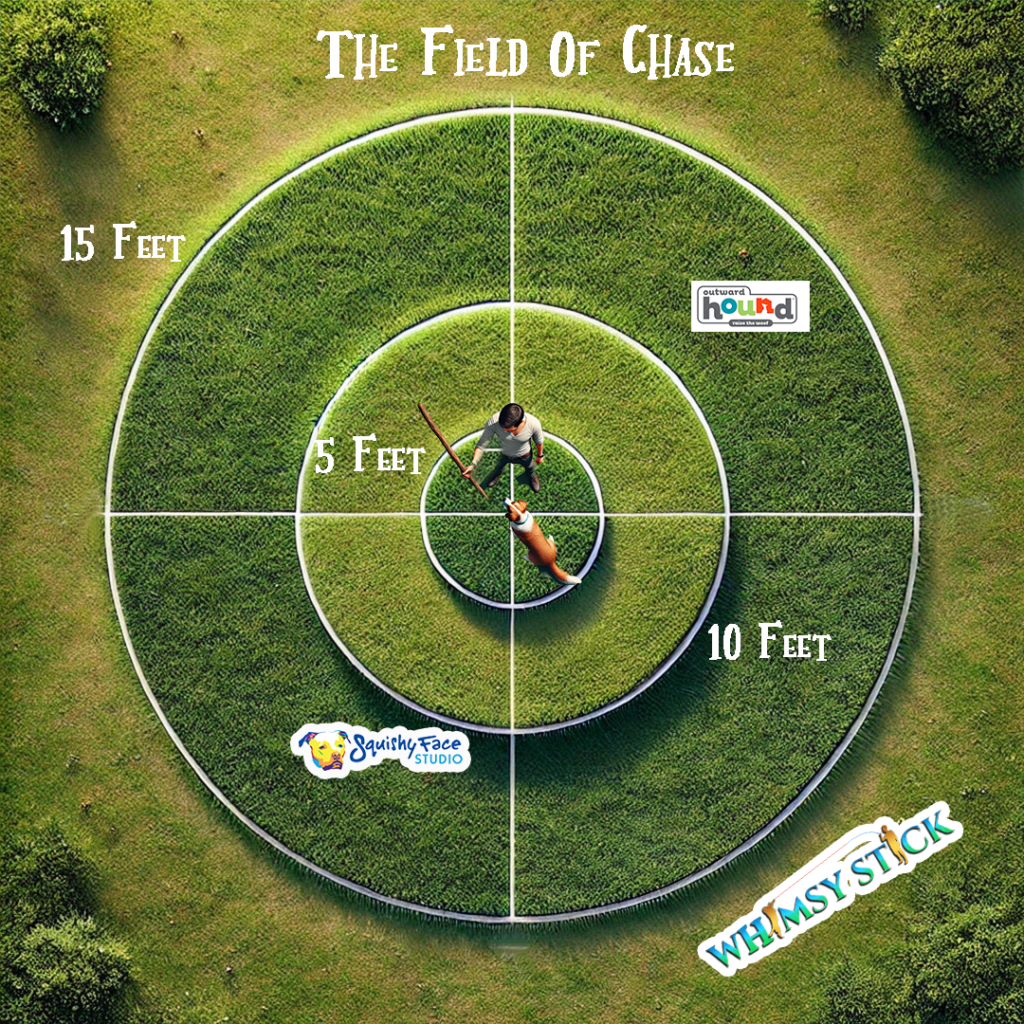
The wider arc
- Longer reach creates a wide chase circle
- More room to guide the dog’s path without crowding
- Better for open areas and dogs who cover ground fast
- Reduces tight turning stress on joints
The tighter circle
- Shorter reach means a tighter working space
- Less room to shape movement patterns
- Works fine for small spaces and lower-drive dogs
- More abrupt direction changes at speed
If you want to see how the Whimsy Stick stacks up against the budget Amazon tier rather than the Squishy Face mid-tier, the vs Outward Hound comparison in the peers block below covers the cheap-pole failure modes in detail.
Line Behavior: Smooth vs Springy
This is the difference that matters most for training outcomes. The Whimsy Stick uses a Kevlar line. Kevlar does not stretch. It transmits movement cleanly and predictably from your wrist to the lure. The lure moves the way you move it. That allows for deliberate, prey-like motion: slow creep, sudden burst, direction change, brief freeze.
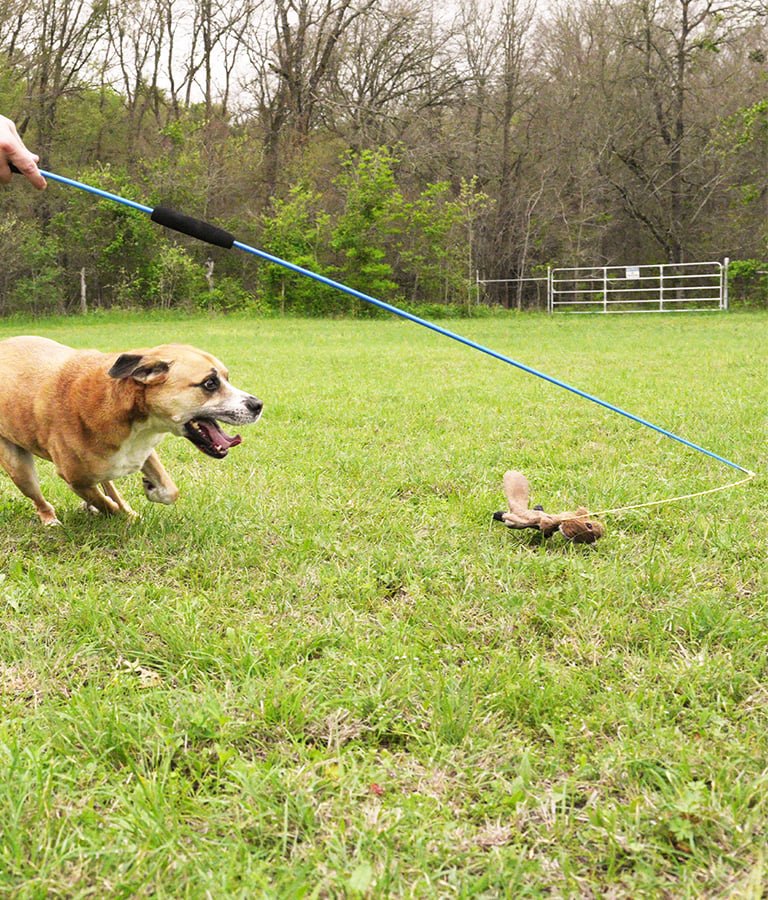
Particularly, the Squishy Face uses elastic. Elastic stores and releases energy unpredictably. When a dog hits the end of the line, the elastic absorbs and returns force in ways you cannot fully control. This produces a snappier, more reactive lure movement that excites some dogs but makes it significantly harder to produce the smooth, deliberate motion that teaches a dog to track prey rather than just lunge at anything moving fast.
For high-drive dogs specifically, erratic lure movement can amplify arousal rather than channel it. You want the lure behaving like prey: moving with purpose, pausing, changing direction deliberately. That is a training session. A lure bouncing unpredictably on elastic is entertainment, and for a reactive or high-drive dog, potentially counterproductive. The AVMA enrichment guidelines emphasize that structured predatory play needs handler control to be beneficial rather than overstimulating.
Durability and Lure Replacement
A tool that breaks under daily use with a serious dog is not a training tool. It is a toy with a short service life. The Kevlar line on the Whimsy Stick is rated for the tension loads that working breeds and power dogs generate. It does not degrade the way elastic does under repeated high-tension use, and it does not snap mid-session, which is a safety issue as much as an equipment issue. For more on what separates poles that last from poles that snap, see why fiberglass wins.
Particularly, the replaceable lure system is underrated as a feature. Lures wear out. Dogs murder them. That is expected and healthy because it means the dog is engaging with prey as prey. The question is whether you are buying a new lure or a new toy every time that happens. On the Whimsy Stick, you swap the lure. Thirty seconds, keep playing. This keeps per-session cost low and means you are never mid-training with no functional equipment because one component failed.
2-year-old Pit Bull, three poles in eight weeks
A client with a 2-year-old American Pit Bull Terrier had gone through three Squishy Face poles in eight weeks. The elastic line was fraying after 2 to 3 weeks of daily sessions, and the dog’s bite force during capture was snapping lure attachments. The owner was spending roughly $38 every 18 days on replacement poles.
Indeed, we switched to the Rugged XL with weekly lure rotations across three lures. Within 4 months: same pole, same Dyneema line, 112 sessions completed. Total added cost: two replacement lure packs at $14 each. By that point the Squishy Face had cost $114 in eight weeks. At $74.95 plus $28 in lures over four months, that’s a 47% cost reduction while doubling the training volume. Numbers like those make the durability gap impossible to argue with.
If skepticism about whether this actually works in practice is still in the way, the data on response rates is in do flirt poles really work.
Who Should Buy Which
High-drive, working-line, or reactive dogs
In short, german Shepherds, Belgian Malinois, Pit Bulls, Huskies, herding breeds, terriers. Any dog where you need distance, control, and a tool that holds up under serious play.
Daily structured training sessions
In fact, impulse control work, reactivity protocols, drive regulation. Anywhere the structure and lure control matter more than price difference.
Moderate-drive dogs, casual use
Indeed, low to moderate intensity play in a backyard setting. If you are not running structured sessions and your dog is not a freight train, the Squishy Face will do the job.
Whimsy Stick Standard vs Rugged XL
Under 30 lbs, get the Standard. Over 30 lbs or any power breed regardless of weight, get the Rugged XL. If you have decided on the Whimsy Stick, the size question is straightforward.
Generally, the Rugged XL is not just a bigger version of the Standard. It is a different construction. Reinforced fiberglass, heavier-duty pole, 8-foot working radius, 800-lb Dyneema lure loop, and 3 lures included. If you run the Standard with a 70-pound Shepherd every day, you will replace it faster than you want to. The Rugged XL is built to absorb what working breeds generate without degrading.
For example, kevlar line, replaceable lures, lighter build. Built for daily structured sessions with small to medium dogs.
Additionally, reinforced for working breeds. 8-ft radius, heavy-duty construction. Base $74.95 (1 lure) · Bundle $94.95 (3 lures) · Free US shipping on Rugged XL.
Why line behavior and durability decide it
Kevlar does not stretch. Elastic does. That single difference determines whether your lure moves like prey or bounces like a pinball. For impulse control and reactivity work, unpredictable lure movement actively works against you, it trains the dog to react fast, not think first.
A replaceable lure system is not a minor feature, it is the difference between a training tool and a consumable toy. When a lure wears out on the Whimsy Stick, you spend 30 seconds swapping it. When it wears out on the Squishy Face, you buy a new pole. Over a year of daily training with a power breed, that gap adds up to real money.
The Squishy Face is a fine casual-play toy. The Whimsy Stick is a training tool. If your goal is enrichment and entertainment for a moderate-drive dog, either works. If your goal is structured impulse control, reactivity management, or daily drive work with a high-energy or working-line dog, the equipment difference is not close.
Do not use a flirt pole as a hype machine before a stressful event. Running a high-arousal session right before a vet visit, a car ride, or exposure to a trigger does not “tire the dog out”, it spikes drive and arousal in a dog that then has no outlet for it. Structured flirt pole work builds an off-switch. Unstructured hype work removes one.

How to Run a Structured Session
In fact, the equipment choice only matters if you are running sessions with actual structure. Here is the five-step protocol used across client dogs. Every step is the same whether you are working on impulse control, reactivity management, or basic drive regulation.
The 5-step structured-session walk-through
Meanwhile, ask for a sit or down and hold the dog still for 3 to 5 seconds before the lure moves. The dog must be calm before the chase begins. If the dog breaks early, reset to still before releasing. This step is the entire impulse control lesson.
Overall, move the lure in wide, low arcs using the Whimsy Stick’s longer reach. Keep it skimming the ground, horizontal movement, not vertical. Jumping puts unnecessary stress on joints and teaches the dog to launch instead of stalk. The Kevlar line lets you vary speed and direction deliberately; use that control.
Specifically, allow the catch. Let the dog shake the lure and carry it briefly. This completes the stalk–chase–capture–win sequence. Cutting the sequence short by yanking the lure away before capture builds frustration, not satisfaction. A dog that wins occasionally is a dog that stays engaged.
Closing the session: release, reset, wind-down
Generally, ask for the lure back with a consistent verbal cue. Reward the release immediately, with a food trade, a restart, or both. Never pry the lure away or play tug of war over it. A clean out is its own trained behavior; treat it that way.
Particularly, finish with a clear all-done signal and put the pole out of sight immediately. Redirect to a calm settle or a slow sniff activity. Sessions run 10 to 15 minutes maximum. Ending on a calm note teaches the off-switch that makes the rest of your training work better, not just the flirt pole sessions.
Buy the tool that matches your training goals, not just your dog’s enthusiasm
If you are running structured sessions aimed at impulse control, reactivity improvement, or daily drive management with a high-energy dog, the Whimsy Stick is the right tool. Longer reach, smoother line, better durability, replaceable components. The Squishy Face works for casual play and will keep a moderate-drive dog engaged. It was not designed as a training tool and the difference shows when you need it to be one. For real-world owner experiences with both, see owner reviews.
Want to see how the Whimsy Stick stacks up against other competitors?
If you came here looking at Squishy Face and want to check the other flirt poles on the market, here is how the Whimsy Stick compares to the rest of the field, plus the broader 2026 roundup:
- 2026 comparison roundup · the full year-end review across all flirt poles on the market
- vs Outward Hound Tail Teaser · the budget telescoping pole most people grab on Amazon first
- DIBBATU comparison · the heavy-duty marketed option for Pit Bulls and working breeds
- vs Tug-E-Nuff Whip It · the premium static-line option from the UK training world
- Pupford Extendable comparison · the travel-focused extendable design


