Whimsy Stick

Free Shipping $60+
·
30-Day Money-Back
·
Trainer-Designed
Buyer’s Guide · Equipment

DIY Flirt Pole vs. Professional Design: Honest Comparison

A homemade flirt pole can work. The question is for which dog, at what frequency, and for how long. Here’s what the design differences actually mean for safety and training outcomes.

Christopher Lee Moran, Professional Dog Trainer
Christopher Lee Moran Professional Dog Trainer · Instinctual Balance Dog Training
8 min read
$5-15
DIY flirt pole build cost
$15-35
Gimmick / toy poles
$55-95
Professional (Whimsy Stick)
Years
Professional lifespan daily use
TL;DR

A DIY flirt pole is cheap, fast to build, and genuinely fine for low-drive dogs or occasional use. It fails predictably with high-drive dogs in daily structured training. PVC cracks, rope frays at connection points, knots loosen under load, and most homemade builds have a pole-to-line ratio that forces jumping rather than running. The $15 to $35 “toy” flirt poles on Amazon sit in the worst middle ground: better materials than PVC and paracord, but still built as gimmick toys with telescoping joints that snap, bungee cord that whips back, and lures that last one session. They look like an upgrade from DIY but fail under the same conditions. The Whimsy Stick is the only flirt pole on the market designed as a professional training tool: Kevlar line, engineered chase arc, replaceable lure system, and construction rated for daily use with high-drive dogs. If you’re testing whether flirt pole play works, build one yourself. If it works and you’re going to use it seriously, skip the toy tier entirely and get the right tool.

The DIY Flirt Pole: What It Gets Right and Where It Fails

A homemade flirt pole is genuinely easy to build and a completely reasonable first step. PVC pipe or a broom handle, some paracord, a fabric lure, and 20 minutes. The cost is basically nothing. For testing whether your dog responds to flirt pole play before committing to a purchase, building one yourself makes sense. Most dogs will chase a sock tied to a stick, and that tells you something useful before spending money.

The problems show up under two conditions: high-drive dogs and regular use. A driven dog generates significant tension loads at the pole-to-line connection point and at the lure on catch. PVC is not rated for repeated flex stress and it fatigues and cracks over sessions. Standard rope frays first at the connection knots, which are the highest-stress points in the system. Furthermore, most homemade builds end up with a pole-to-line ratio that’s too short, meaning the dog has to jump and pivot to engage the lure rather than running wide arcs, which is both a joint issue and a training problem. If your dog is already destroying things out of unresolved drive, a DIY flirt pole that fails mid-session adds frustration on top of frustration.

Homemade flirt pole advantages
  • $5 to $15 in materials, minimal financial commitment
  • Built in under 20 minutes from hardware store parts
  • Good proof-of-concept before buying professional
  • Easily customized to specific length or lure type
  • Fine for low-drive dogs used occasionally
Homemade flirt pole disadvantages
  • PVC fatigues and cracks under repeated flex stress
  • Knots loosen under load, failure is sudden
  • Poor pole-to-line ratio encourages jumping over running
  • No designed failure mode, hardware can release toward dog
  • High maintenance burden with any serious daily use
  • Most homemade builds last weeks with high-drive dogs
The homemade flirt pole failure mode nobody talks about

A DIY flirt pole doesn’t fail gradually the way worn equipment usually does. Knots that have been under load repeatedly can hold through dozens of sessions and then slip all at once, and when the pole-to-line connection fails mid-session, the hardware at that connection point goes toward the dog at chase speed. Inspect every connection point before every session. Use a secondary tie on all knots. Retire any component that shows wear at a connection point.

The $15 to $35 “Toy” Flirt Poles: The Worst Money You Can Spend

The gimmick tier is the trap most dog owners fall into after a DIY build fails. These are the telescoping flirt poles on Amazon and Chewy in the $15 to $35 range. They look like an upgrade. Better materials than PVC. A real handle. Sometimes even a fleece lure instead of a rope knot. The problem is they’re designed as toys, not training tools, and every design decision reflects that.

Telescoping poles snap at joints. Every telescoping flirt pole has 2 to 4 connection points where the sections slide into each other. Under repeated lateral force from a dog pulling sideways during capture, those joints fail. Not if, when. The failure is sudden, the pole collapses mid-session, and the remaining piece whips toward whatever is attached to it.

Bungee cord is standard at this price point. Almost every toy-tier flirt pole uses elastic or bungee line. Elastic stores energy when the dog catches the lure and releases it as unpredictable snap-back. That snap-back spikes arousal, makes the lure impossible to control deliberately, and turns every capture into a wrestling match instead of a training rep. For dogs that are already overexcited, bungee line makes the problem worse.

Lures are fixed and disposable. When the lure shreds (and it will, usually within a few sessions with any dog that has real drive), you replace the entire toy. There’s no swap system. The $25 pole becomes a $25-per-month subscription to a product that was never built to last. That’s more expensive than the Whimsy Stick within 3 months.

No training methodology. These products are marketed as toys. The packaging says “fun for your dog” not “structured prey drive training tool.” There’s no session framework, no impulse control method, no guidance on safe lure movement. You get a stick with a thing on the end. For the foundational method that actually produces behavioral results, see the Flirt Pole Training Guide.

The hidden cost of “upgrading” to a toy pole

A $25 toy flirt pole replaced every 4 to 6 weeks costs $100 to $150 over 6 months. A Whimsy Stick Standard at $54.95 or Rugged XL at $94.95 with $12.95 lure replacements costs $68 to $108 over the same period and the pole is still going years later. The toy tier costs more than professional within the first few months. Every time.

What Professional Design Actually Changes

The meaningful differences come down to three things: line behavior, pole balance, and how the equipment fails under a driven dog. These aren’t cosmetic. They compound over hundreds of sessions into meaningfully different behavioral outcomes.

Line behavior is the most important and least discussed difference. Elastic or bungee lines, common in both DIY flirt pole builds and some cheap commercial poles, store energy when the dog catches the lure and release it as snap-back. That snap-back spikes arousal unpredictably, makes the lure harder to track deliberately, and puts the handler in reactive mode. A non-elastic line like Kevlar or braided nylon transmits movement cleanly: what you do with the pole is exactly what the lure does, including when you pause to engage the stalk phase. For the full breakdown of why line behavior matters for prey drive training, see the dedicated guide.

Pole balance and reach determine the chase arc radius. A longer pole with the right flex creates a wide enough working circle for the dog to actually run and decelerate through the sequence rather than jumping and pivoting. This matters for joint health over hundreds of sessions, a problem that compounds far faster with a short homemade pole than most owners expect. The American Kennel Club’s overview of prey drive emphasizes that structured play needs to be physically safe and handler-controlled, which is exactly where pole design becomes a safety decision rather than a preference.

Designed failure modes are how the equipment behaves when it reaches end of life. Professional materials degrade in ways you can see and inspect. Kevlar shows wear visibly before it fails. Most DIY flirt pole materials don’t give you that warning. Things hold, then suddenly they don’t.

I’ve seen a lot of dogs described as “not responding” to flirt pole work. Most of the time they were responding fine, to a homemade pole that moved like a dead fish because the line was too stiff or too elastic. The tool matters more than people think.

Christopher Lee Moran, Instinctual Balance Dog Training

DIY vs. Toy Poles vs. Whimsy Stick: Head-to-Head

Factor
DIY Build
Toy / Gimmick Poles
Whimsy Stick
Price
$5 to $15
$15 to $35
$54.95 to $94.95
Lifespan (daily, driven dog)
Weeks
Weeks to months
Years
Line type
Rope or paracord
Bungee / elastic
Kevlar, no snap-back
Pole construction
PVC, cracks under flex
Telescoping, snaps at joints
One-piece fiberglass
Chase arc radius
Too short, forces jumping
Short, tight circles
Engineered wide arcs
Failure mode
Sudden, hardware toward dog
Joints snap, bungee whips
Gradual, visible before failure
Lure system
Retie manually
Fixed, replace whole toy
Quick-swap replaceable
Training design
None
None, marketed as toy
Structured method included
Best for
Testing, low-drive, occasional
Casual play, moderate dogs
Daily training, high-drive, all breeds

The Real Cost Math: DIY Flirt Pole vs. Professional Over 6 Months

The upfront cost advantage of DIY and toy poles disappears faster than most owners expect. A homemade build costs $5 to $15 per build but needs rebuilding every 4 to 8 weeks. A $25 toy pole lasts about the same before the joints snap or the bungee frays. The Whimsy Stick costs more upfront but the math flips within 3 months for any dog used daily.

DIY · 6 Months
$30-90
3-6 rebuilds at $10-15 each
Plus rebuild time every month
Toy Poles · 6 Months
$100-150
4-6 replacements at $25 each
Most expensive option long-term
Whimsy Stick · 6 Months
$68-108
$54.95 Standard or $94.95 Rugged XL
+ 1-2 lure packs at $12.95 each
Same pole, years of use ahead
From the Training Files

A client with a high-drive Belgian Malinois was building a new DIY flirt pole every 2 to 3 weeks. PVC cracking at the handle, paracord fraying at the connection knot, lures lasting 3 to 4 sessions before shredding. Over 3 months the owner spent roughly $60 in materials and significant time rebuilding.

We switched to the Rugged XL. Seven months later: same pole, same line, over 150 sessions completed. Total additional cost: two lure packs at $12.95 each. The DIY approach cost more in 3 months than the professional tool cost in 7, and the Rugged XL is still going. For the complete equipment comparison including Squishy Face, see the dedicated guide.

Who Should Build a Homemade Flirt Pole vs. Buy Professional

Build a homemade flirt pole if

Low commitment, low drive, or proof-of-concept

  • Testing whether your dog responds before purchasing professional
  • Small, low-drive dog used a few times per week
  • Supplementing an existing professional pole with extra lures
  • Budget is genuinely a constraint right now
  • Occasional casual play, not daily structured training
Buy professional if

Daily training, high drive, or serious use

  • Daily structured sessions for impulse control or drive work
  • High-drive dog or dog over 30 lbs where homemade won’t hold
  • Working breeds: GSDs, Malinois, herding breeds, bully breeds
  • Using it for reactivity work where consistency matters
  • You’ve confirmed flirt pole play works and want it to last

Safety Rules for Any DIY Flirt Pole or Professional Build

Handler technique matters more than the equipment itself. According to the VCA Animal Hospitals, structured predatory play produces the best behavioral outcomes when sessions are controlled and consistent. The AVMA’s enrichment guidelines reinforce that handler control is what separates beneficial structured play from overstimulation. These rules apply whether you’re using a DIY flirt pole or a professional build.

⬇️
Keep the lure low: ground movement only

Running is fine. Repeated jumping accumulates joint stress across hundreds of sessions. Keep lure movement horizontal throughout the session with any DIY flirt pole or professional build.

🔄
Wide arcs, not tight circles

The chase arc radius determines how much turning force goes through the dog’s joints per rep. A short homemade pole that forces tight circles is the single biggest design failure in both homemade and cheap commercial builds.

⏱️
5 to 10 minutes maximum

Driven dogs will play far past the point where fatigue makes movement sloppy and injury risk rises. You set the session length, not the dog. This is especially important with a homemade build where the equipment is also approaching its limits.

🔍
Inspect every connection point before every session

For a homemade build specifically: knots at the pole connection and lure connection, line condition throughout, and the lure itself for loose parts. With a DIY flirt pole, this inspection is not optional.

🏁
Always end with a deliberate all-done sequence

Drop-it cue, all-done verbal, toy away completely. Sessions that end mid-drive leave arousal unresolved. This applies to both homemade and professional use. For the full method, see the Flirt Pole Training Guide.

Beyond the DIY Flirt Pole: The Whimsy Stick Build

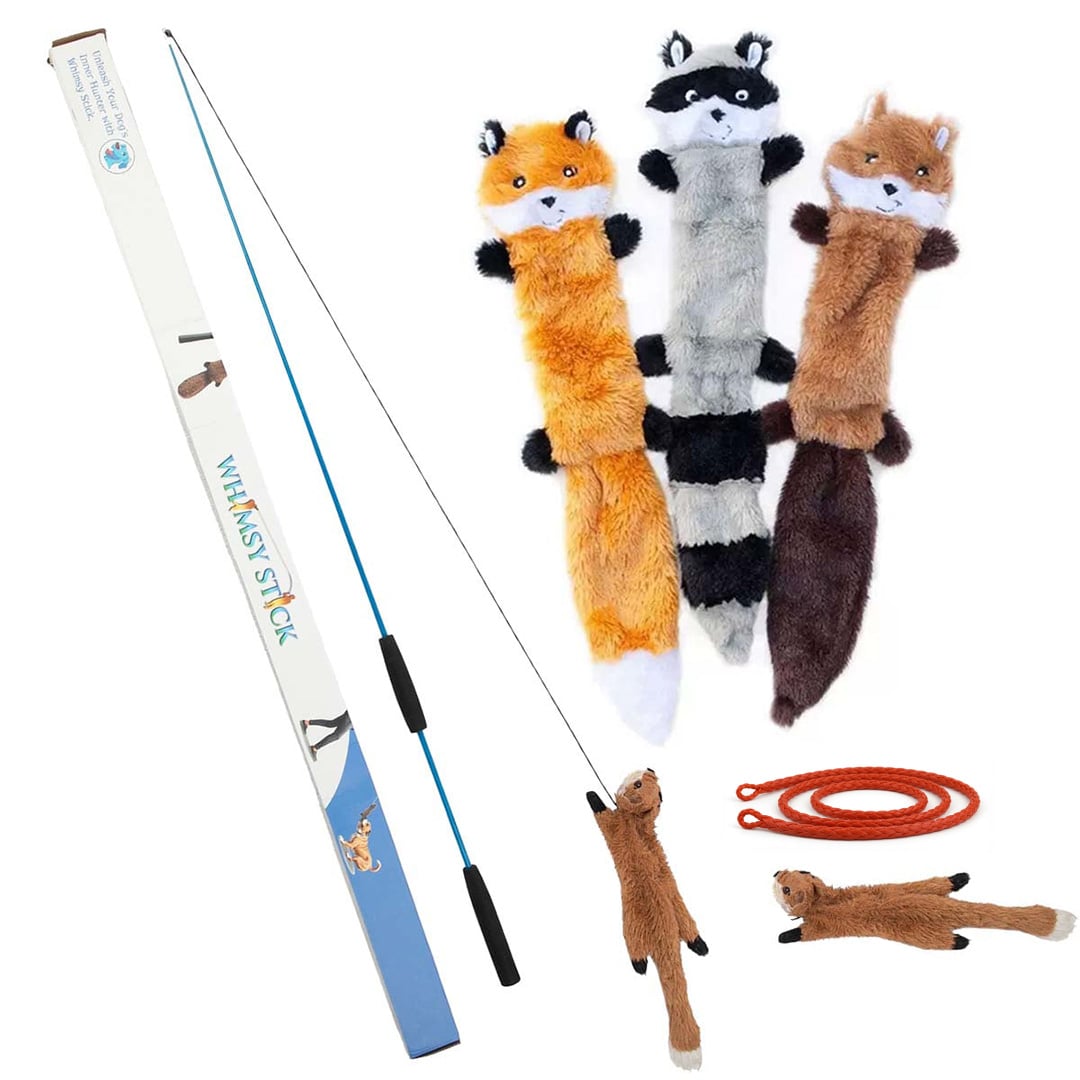
When a DIY flirt pole has done its job and confirmed that structured play works for your dog, the next question is which professional build fits. The Standard is right for dogs 30 lbs and under: most small to medium breeds, terriers, smaller herding breeds, apartment dogs. The Rugged XL is for dogs over 30 lbs or high-drive working breeds regardless of size. The construction difference isn’t just scale: the Rugged XL uses reinforced materials rated for the tension loads that power breeds generate at full chase speed, loads that would destroy any homemade build in sessions. For the full equipment decision framework, see the complete buying guide.

Whimsy Stick Standard: dogs 30 lbs and under

Kevlar line, no snap-back, quick-swap lures. Everything a homemade build isn’t. Built for daily structured sessions with small to medium dogs.

Shop Standard →
Whimsy Stick Rugged XL: dogs over 30 lbs

Reinforced for working breeds and power dogs. 8-ft radius, 3 lures included. Holds up under daily use that would destroy any homemade build.

Shop Rugged XL →

If your dog is still hyper after walks and you’re using a DIY flirt pole as the post-walk finisher, the equipment quality directly affects whether the session resolves arousal or adds to it. Erratic lure behavior from elastic line can load arousal further instead of discharging it. The same applies if your dog is generally overexcited: the tool needs to create structured resolution, not more stimulation. A professional build also deepens the handler-dog bond over time because consistent, reliable equipment produces consistent, reliable sessions.

Commonly Asked Questions

DIY Flirt Pole vs Professional: FAQ

What materials do I need to make a DIY flirt pole?
A basic DIY flirt pole requires a PVC pipe or broom handle (60 to 90 cm depending on dog size), 4 to 6 feet of sturdy rope or paracord, a fabric or fleece lure, and basic hardware to secure the connection. Avoid bungee cord. It creates unpredictable snap-back that spikes arousal. Secure all knots with a secondary tie and inspect every connection before each session.
A DIY flirt pole is safe for low-drive dogs used occasionally with supervision. For high-drive dogs in structured daily training, a homemade build has tighter safety margins. The main risks are rigid poles that cause joint stress, knots that fail under load releasing hardware toward the dog, and elastic lines that snap back unpredictably. If you build one, inspect all connection points before every session and stop immediately when any component shows wear.
Professional design improves three things that directly affect training outcomes: line behavior (non-elastic lines transmit clean movement without snap-back), pole balance (engineered chase arc radius for running not jumping), and failure modes (materials degrade visibly before failure rather than suddenly). For daily structured training these differences compound significantly. See the training guide for why these factors matter in practice.
No. Bungee creates unpredictable recoil when the dog catches the lure at speed. That snap-back spikes arousal, makes deliberate tracking harder, and puts the handler in reactive mode. Use non-elastic line. Kevlar or braided nylon transmits clean movement from your hand to the lure, which is what you want for deliberate session control.
DIY makes sense for testing whether your dog responds before committing, for small low-drive dogs used occasionally, or for extra lures for an existing professional pole. Toy-tier poles at $15 to $35 are the worst value: they fail as fast as DIY but cost more per replacement cycle. The Whimsy Stick at $54.95 to $94.95 makes sense for high-drive dogs, dogs over 30 lbs, or daily structured training. See the buying guide for the full decision framework.
Weeks to a few months with daily use. PVC cracks under repeated flex stress, rope frays at connection points, and knots loosen under sustained load. The failure mode isn’t gradual. Things tend to go all at once. Plan to replace the line and lure every four to eight weeks at minimum.
Yes. Retying a new lure when the old one shreds is straightforward. Use fleece or soft fabric strips that flutter at ground level. Avoid hard materials, metal attachments, or anything that could damage teeth or be ingested during possession.
Less than expected. A DIY flirt pole costs $5 to $15 per build but needs rebuilding every 4 to 8 weeks with a high-drive dog. Toy-tier poles at $15 to $35 last about the same before telescoping joints snap or bungee frays. Over 6 months, DIY costs $30 to $90 in rebuilds, toy poles cost $100 to $150 in replacements, while a Whimsy Stick at $54.95 to $94.95 with $12.95 replacement lures costs $68 to $108 total and lasts years.
Stop rebuilding. Start training.

The homemade build wins on price.
Professional wins on everything else that matters.

Standard for dogs 30 lbs and under. Rugged XL for larger breeds. Free shipping on orders over $60. 30-day money-back guarantee.

0
    0
    Your Cart
    Your cart is emptyReturn to Shop