
Don’t start with a full-intensity session. A lot of people pull it out of the box and go for 10 minutes straight, and the next day they’ve got a sore, wound-up dog that isn’t so sure about it anymore. Spread 5 sessions over 1 to 2 weeks instead and make each one a little longer and a little harder, and by session 5 your dog is ready for the regular thing.
All together it’s about 28 minutes of play over the 5 sessions, with a day or two of rest in between. You want your dog to like it, you’re not trying to wear them out, so end every one of these while your dog still wants more. For how to run a regular session after that, see the complete flirt pole training guide.
Sessions from first sniff to full standard protocol, about 28 minutes of play all together, spread out over 1 to 2 weeks.
Who This Is For
- Anyone who just got a flirt pole and isn’t sure how to start
- People whose first session went bad (the dog ignored it, got way too wound up, or was sore after)
- People with shy or scared dogs that need to go slower
- People with high-drive dogs worried they’ll go nuts on day one
- Anybody thinking about getting a flirt pole who wants to know what the first week looks like
- Trainers showing it to a client’s dog for the first time
Signs Your Dog Needs This
- Your dog tears through every walk and still won’t settle at home
- The bored stuff is getting worse, chewing things up, barking, charging the door
- You tried a flirt pole once, went too hard too fast, and your dog lost interest
- Your dog has high prey drive but no structured outlet for it
- Your dog takes it out on you, the other pets or the furniture
- You want a tired dog without a really long run every single day
The Pre-Session Checklist
Before session 1, go through these. A lot of problems getting started come from skipping the setup, and a few minutes now beats trying to undo a bad first impression later.
Set Up For Success
- Confirm your dog is age-appropriate. Adult dogs over 12 months can do the regular ramp. Puppies 6 to 12 months need to take it easier, and ask your vet about growth plates. I wouldn’t use a flirt pole on a puppy under 6 months.
- Choose the right surface. Grass is best and dirt is fine, but stay off concrete and asphalt and slick patio tile. Your dog is also learning where this game happens, so pick the spot you’re gonna keep using.
- Pick a fenced or enclosed space. A backyard is best and a fenced courtyard works. In an open yard your dog might take off after a missed catch, and you don’t want to be chasing your dog through the neighborhood on day one.
- Stock high-value treats. Cheese or chicken or freeze-dried liver, something your dog doesn’t usually get. You’ll use these when your dog checks it out calmly and when it settles after.
- Verify the equipment is set up correctly. Make sure the lure is on good and the line isn’t frayed. If the pole breaks in the middle of the first session that’s not a great first impression.
- Schedule when the dog is rested, not overstimulated. Not right after a long walk when they’re already tired, and not right after company leaves when they’re already amped up. Mid-morning or early afternoon on a normal day is good.
- Plan a calm cooldown activity. Have a chew or a snuffle mat or a spot to settle ready for after. Going straight from chasing to calm is hard for some dogs, so something in between helps.
Vet Considerations
If your dog has joint problems or is really reactive, talk to your vet before you start. The AVMA’s page on exercising your pet has some good basics. For flirt pole safety in particular, see is a flirt pole safe for dogs.
The 5-Session Ramp, Step By Step
Do the sessions 1 or 2 days apart and don’t rush it. Your dog needs some time in between to get used to it and to rest up from something new.
The First Sniff
Lay the flirt pole on the ground where you’re gonna play and let your dog come check it out. Don’t move it and don’t expect anything, no chasing. You can walk around slow with the pole dragging behind you if that gets their attention, just keep it on the ground and easy. Your dog is just figuring out what this thing is and whether it’s okay.
Reward calm investigation with good treats. Sniffing the lure gets a treat and pawing at it gets a treat, and looking at you all relaxed gets a treat. You want them liking it before any work starts. If your dog ignores the pole completely, that’s fine. Stop at 3 minutes either way.
- Your dog walks up to the pole on its own
- Sniffs the lure or the pole at least once
- Stays loose, no stiffening up or backing away
- You stop at 3 minutes with a curious dog, not a worn-out one
The Slow Drag
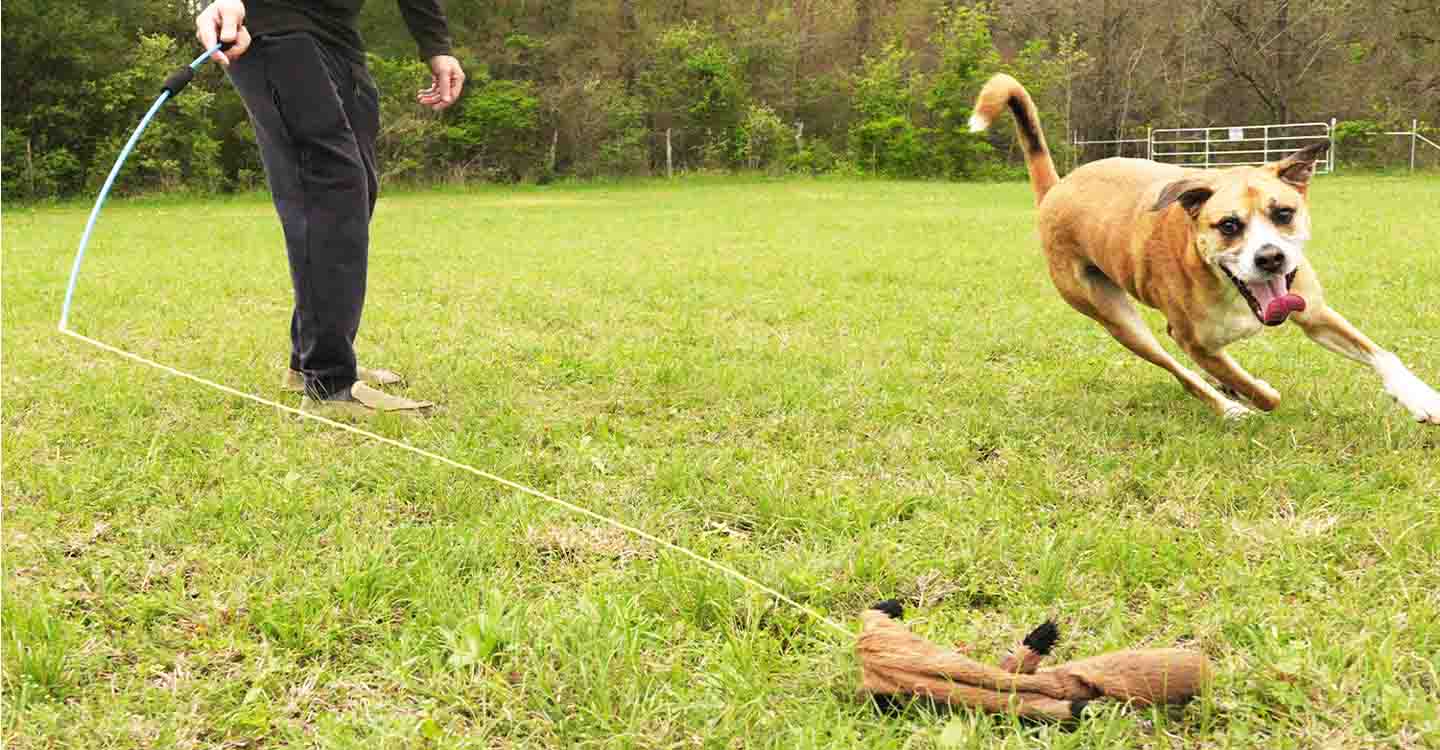
Hold the pole and drag the lure slow along the ground in a straight line, about 6 to 8 feet. Start about walking speed and then slow it down. It should move like something sneaking away, not something running for its life. A lot of dogs get interested quicker in slow movement than fast.
Let the dog catch the lure within 5 to 10 seconds. The catch matters a lot, that’s where the chase gets its finish. Tell them good job and let them hang on to it 10 to 15 seconds before you go again. Do that 3 to 5 times over 3 to 5 minutes and stop while your dog still wants more.
- Your dog watches the lure move pretty quick
- Chases it and catches it at least 3 times
- Is clearly having fun, tail up and locked in
- Panting normal at the end, not wiped out
Real Patterns
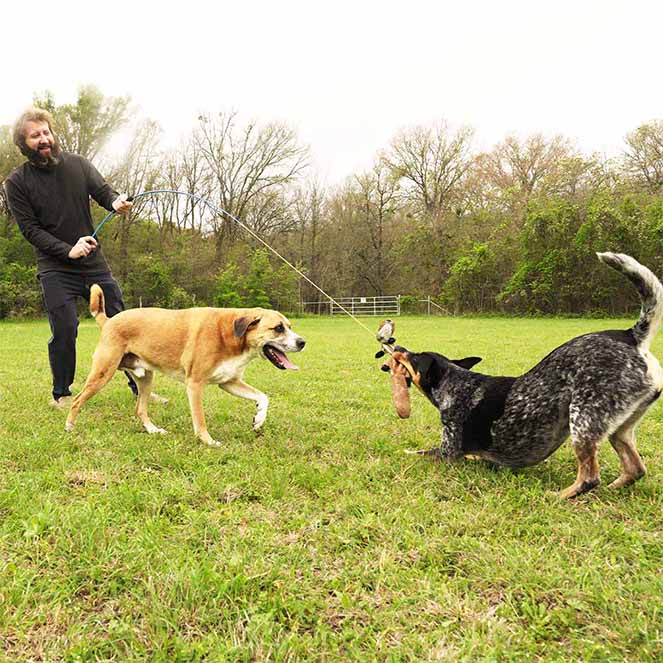
This is the first session that looks like a real flirt pole session. Now move the lure around on the ground so your dog can’t guess where it’s going, some straight runs and easy arcs and a pause here and there. Let them catch it every 20 to 30 seconds. Your dog is learning what the chase looks like with you running the pole.
Watch the dog’s body language constantly. Tail up and locked in is good. Frantic, jumping, or grabbing at the pole instead of the lure means they’re too wound up, so slow it down right away and let them catch it more. End every session on a catch, not a miss, cause a frustrated dog won’t like the game as much.
- Your dog is on it as soon as the pole moves
- The chasing is smooth, no frantic spinning or zigzagging
- A bunch of catches over the session
- Your dog is tired but happy at the end
Direction Changes
Go up to 7 or 8 minutes of play. Let them catch it about every 30 to 45 seconds now. Then start some easy changes of direction, the lure goes left, then right, then forward. Not sharp cuts yet, just smooth turns so your dog learns to follow it and adjust.
Begin practicing a release cue. When your dog catches the lure, say your word, “out” or “drop,” and trade them a good treat for it. A lot of dogs let go pretty easy for the treat. Then start the chase right back up, so they learn letting go means more fun, not less. That’s the start of the self-control work you’ll do later.
- Your dog handles the turns smooth
- Lets go of the lure when you ask about half the time or better
- Catches their breath pretty quick after
- Isn’t sore or stiff the next day
The Full Session
This is the full standard session, run for the first time. It’s 10 minutes, with a catch every 30 to 45 seconds, full speed, with direction changes and some bursts of speed and sharper turns. This is what a normal session looks like from here on.
If your dog completes this session successfully, they’re introduced. From session 6 on you can do your regular routine. If session 5 went bad, they got too wound up or sore or wouldn’t play, go back to session 4 for another 2 or 3 sessions and then try again.
- Your dog is on it right away
- Catches the lure a lot over the full 10 minutes
- Lets go when you ask most of the time
- Settles down within 15 or 20 minutes after
- Isn’t sore the next day
The 5 sessions might feel slow, but it’s the most reliable way to get a dog that’s into it right away and isn’t sore.
This takes 1 to 2 weeks. Skipping it might save you a week, but a bad first impression can take a lot longer than that to fix. A dog that gets started right likes the game from the beginning. So it’s worth taking the time.
For dogs 30 lbs and up, the Rugged XL is $74.95 (1 lure) or $94.95 (3-lure bundle), and it ships free in the US. For dogs under 30 lbs, the Standard is $55.95 plus $20 shipping cause it goes in a longer box.
Common Problems And How To Fix Them
If it isn’t going smooth, a lot of times it’s one of these six. Try the fix for 2 or 3 sessions before you decide it’s not for your dog.
My dog ignores the lure completely
Fix: The lure is probably moving wrong. Drag it slow along the ground in a straight line like something sneaking away, and don’t wave it in the air or jerk it around. A lot of dogs go for slow movement on the ground more than fast movement in the air. If slow drags still don’t get anything after 3 sessions, try a different lure, cause some dogs are picky.
My dog gets too excited and grabs at me
Fix: Your dog is too wound up. Take it way down, slower with longer pauses and easier catches, and keep the lure on the ground, never in the air. Stop and ask for a sit before you start again. Your dog needs to learn calm comes first and then the chase.
My dog is afraid of the pole
Fix: Don’t move it at all at first. Lay the pole flat on the floor in a room your dog knows and feed dinner around it for 2 or 3 days, and let them come to it when they’re ready. Once they’re okay with it sitting there inside, take it outside for session 1, still not moving. Don’t ever push a scared dog to go after a moving lure.
My dog is sore the next day
Fix: Too much too soon. Go back a session (if you were on session 3, do another session 2), play on softer grass if you weren’t, and let them catch it more often with shorter runs in between. If your dog is limping or the soreness doesn’t clear up in a day or two, call your vet.
My dog catches and won’t let go
Fix: That’s normal early on. Use the treat trade. Show the treat, say your word, and give it the second the lure drops, then start the chase right back up so letting go means more fun. A lot of dogs pick it up pretty quick. If yours is stubborn, work on letting go with a regular tug toy first.
My dog quits halfway through
Fix: Either the session is too long for them right now, so go back a session, or they aren’t catching it enough and they got frustrated. Slow the lure down and let them win more. A dog that feels like it can’t win quits, and a dog that wins a lot stays with it.
When Your Dog Is Officially Introduced
You’re looking for five things. If you see all five at the end of session 5 your dog is ready for the regular routine, and if any are missing, do another session or two like session 4 before you move on.
5 Markers Of A Conditioned Dog
- Immediate engagement. Your dog sees the flirt pole come out and is on it right away. They know what’s coming and they want it.
- Consistent catches. Over a 10 minute session your dog catches the lure most of the time, they’ve figured out how to follow it and cut it off.
- Reliable release. When you ask for the drop after a catch, your dog lets go most of the time. The treat trade did its job.
- Physical recovery within 20 minutes. The panting slows down and your dog settles and is breathing normal within 15 or 20 minutes after.
- No soreness the next day. Your dog gets up the next morning moving normal, no stiffness or limping, and still wants to play.
Once you see all five your dog is ready for the regular routine, and for most adult dogs that’s about 10 minute sessions from session 6 on. The buying guide in the sidebar goes over sizes if you ever need a backup. If your dog is a high-energy breed or you’re working on specific behavior problems like jumping, nipping or restlessness, those guides go over what to change after session 5.
Graduation is five concrete signals, not a feeling. If one is missing, stay at session 4 another round or two before you move on, your dog will let you know when they’re ready.
Ramp Protocol vs. Day-One Full Intensity
A lot of people skip the ramp cause it looks slow. This is how the first two weeks tend to go either way.
| Metric | 5-Session Ramp | Straight to Full Intensity |
|---|---|---|
| Days to standard session | 8–14 days | Day 1 (usually regretted) |
| Overarousal risk | Low | High |
| Soreness in first week | Rare | Common |
| Release cue by day 14 | 80%+ reliable | Often absent entirely |
| Positive association at day 14 | Strong | Unreliable or negative |
| Engagement quality at day 30 | High and consistent | Variable, often degraded |
The ramp lets your dog learn the game before you ask a lot of their body. The AKC’s piece on how much exercise a dog needs is worth a read, and it makes sense to build up slow with anything new, especially hard turns and stops. A week or two of easing in is time well spent.
What Will Derail the Introduction
This works when you stick to it, and these are the things that mess it up.
- ⚠ Skipping rest days. Your dog is doing something it hasn’t done before. Going back-to-back days early on is how you end up with the soreness and the wound-up dog you’re trying to avoid.
- ⚠ Letting sessions run long because “the dog wants more.” Pretty much every dog wants more at minute 8, and that doesn’t mean go 20 minutes. End on time every time. A dog that stops while it still wants more is excited to come back next time.
- ⚠ Never letting the dog catch the lure. If the lure is always out of reach the game never finishes, and you’re just winding your dog up with no payoff. Let them catch it.
- ⚠ Using a hard or slippery surface. Concrete and indoor tile aren’t the place for this. Your dog is turning hard at speed, and one bad slip can hurt them or make them scared of the game.
- ⚠ Moving too fast because the dog looks ready. Looking ready and being ready aren’t the same. A high-drive dog looks ready at session 2, but their body still needs time to catch up.
Read These Next To Go Deeper
Once your dog is through the 5 sessions, these are worth reading, in this order.
- →The complete flirt pole training guide, how to run it from session 6 on, how to move the lure, self-control drills and how things change as your dog gets better.
- →How often should I use a flirt pole, how often to play once you’re past the first 5 sessions.
- →Do flirt poles really work, a straight answer to what a lot of people ask first.
- →The predatory motor pattern explained, why the catch matters as much as the chase.
Introducing A Flirt Pole: FAQ
Protocol basics
How do you introduce a flirt pole to a dog?
Spread 5 sessions over 1 to 2 weeks. In session 1 your dog just sniffs the pole sitting still, no chasing. Session 2 is slow drags along the ground with quick catches. Session 3 is the first real chasing, 5 or 6 minutes. Session 4 is longer with changes of direction, 7 or 8 minutes, and session 5 is the full 10 minutes. That way your dog doesn’t overdo it, it learns to like it, and it doesn’t get way too wound up like a lot of dogs do when they get thrown into it on day one.
How long should the first flirt pole session be?
The first one should be 2 or 3 minutes of just checking it out, no chasing. Session 2 is the first chase, 3 to 5 minutes. It takes 5 sessions to work up to a full 10 minutes, spaced 1 or 2 days apart. Going straight to 10 minutes on day one is a really common mistake, and a lot of times you end up with a sore, wound-up dog that doesn’t like the thing much.
How many days between flirt pole introduction sessions?
One or two days between the first three sessions, then every other day for 4 and 5. Your dog needs time to rest up from something new and get used to it. Going every day this early can make them sore or too wound up. Once they’re through all 5 you can go to your regular routine.
When things go sideways
What if my dog ignores the flirt pole?
A lot of times the lure is just moving wrong. Drag it slow along the ground in a straight line like something sneaking away, and don’t wave it in the air or jerk it around. If your dog still ignores it after 3 sessions, try a different lure. Some dogs are just slow to get into it and need a few more sessions.
What if my dog is afraid of the flirt pole?
Some dogs, especially shy or scared ones, are careful around it at first. Don’t move it at all. Lay the pole flat in a room your dog knows and feed dinner around it for 2 or 3 days, and let them come to it on their own. Once they’re okay with it sitting still, do session 1 outside. Pushing a scared dog at a moving lure can make them not like it for a long time, so be patient.
Catches, location, and graduation
Should I let my dog catch the lure on the first try?
Yes. A really common mistake is keeping the lure out of reach the whole time. Let your dog catch it a lot, about every 20 to 30 seconds early on and every 30 to 45 seconds after that, so the chase gets its finish. If your dog can never catch it, you’re just frustrating them.
Can I introduce a flirt pole indoors?
The first session, where your dog just checks it out, is fine inside. From session 2 on, take it outside on grass or something soft. Inside, dogs slip on hard floors and run into furniture and don’t have room to turn. Use these first sessions to get your dog used to the spot outside you’re gonna keep using.
When can I move to daily flirt pole sessions?
After all 5 sessions, once you see the five signs. Your dog is on it as soon as the pole comes out, catches it a lot, lets go when you ask, settles within 15 or 20 minutes, and isn’t sore the next day. If you see all five you’re good to go, and if any are missing, do another session or two like session 4 or 5 first.


