
Condition Your Dog. Build the Muscle.
What are canine conditioning exercises? They’re drills that build muscle, strengthen the back end and core, and help with balance and the dog knowing where its body is. The at-home ones are sit-to-stands (puppy push-ups), static standing, balance work on something a little wobbly, and slow walks over low poles, about three times a week. A short structured chase adds the explosive power the slow drills can’t.
The AKC on why: a stretching and strengthening program “can build and maintain muscle mass, improve body awareness and balance, and provide a physical and mental workout,” and you can do it at home with “a few basic props and some motivating treats.” Get your vet’s ok first. That’s from the AKC’s conditioning guide.
By Christopher Lee Moran, working dog trainer, about 10 years and around 400 client dogs, Controlled Freedom method. I designed the Whimsy Stick. See the dog exercise guide for where conditioning fits in your week.
Who this is for
A tired dog isn’t the same thing as a strong dog. Conditioning is work you do on purpose to build up the back end, the core and the balance, and most of it you can do at home with some treats and a few things you already have laying around.
- You want a stronger, fitter dog, not just a tired one
- Your dog is losing muscle tone, topline or strength in the back end
- You’ve got a sport, working or active dog that needs real conditioning
- You’re bringing a dog back to fitness after time off (with your vet’s ok)
- You’ve got a senior and want to hang on to muscle and mobility
- You want a program at home without a bunch of gear
Signs your dog could use conditioning
- Losing muscle over the hips, the thighs or along the spine
- Slow getting up, unsure on stairs, or doesn’t want to jump up
- Wobbly or off balance on uneven ground
- Gets tired quick or moves stiff after a normal amount of activity
- A soft, sloped topline where there used to be a firm one
- Coming back from an injury, surgery or a long stretch of rest
A lot of those can also be pain or a medical problem, so have your vet look first, especially for limping, shaking legs or muscle loss.
Conditioning isn’t the same as exercise
Exercise moves a dog, conditioning changes the dog’s body. A walk keeps your dog active, but it doesn’t really go after the muscles around the joints on purpose. Conditioning does, cause it works the back end, the core and balance with controlled work that gets a little harder over time. Sport dogs get the most out of it, per the AKC, “but senior dogs also need to stay limber,” and even a couch potato gets something from it since it works the brain too.
The two halves of a program
A full program has a slow half and a fast half. Slow is your strength and balance stuff, like sit-to-stands, static holds and cavaletti. Fast is power, short bursts where the dog learns to speed up and then slow down under control. A lot of people do one and skip the other, but the way I see it you want both.
The at-home drills
You don’t need a gym. A cushion, a couple of broomsticks and a hill cover most of it, and the first three are the ones I’d start with.
1. Sit-to-stands (puppy push-ups)
This is the one I’d start with for the back legs. Ask for a clean sit, then a clean stand, and pay each one, and you want the dog pushing up through the back legs, not walking forward out of it. Ten reps is a set and two or three sets makes a good session. The AKC calls this “puppy push-ups,” a sit to a down and back to a sit, and says you can step it up by going stand to down to stand “without the sit in the middle.” Keep it slow, cause going fast lets the dog cheat with momentum, and do it on a floor that doesn’t slip.
2. Static stand and balance
Ask the dog to stand square and hold it for 10 to 20 seconds without sitting or stepping. Then put the front feet, then all four, on something a little unsteady. The AKC suggests starting with “an upside-down shallow plastic storage bin,” then moving to sofa cushions or pillows, and later front paws on one thing and back paws on another. You can’t see the muscles working, so people don’t give this one enough credit, but holding still on something wobbly makes the dog work the whole time.
3. Cavaletti and terrain work
Lay broomsticks across low supports at about ankle height and walk the dog over them slow. It has to lift each leg and put it down on purpose, which works the reach in the back legs and its sense of where its body is. Walking on grass, sand or uneven ground does the same kind of thing. Slow is the whole point, cause if the dog rushes it, it turns into a jump.
4. Figure eights, hills and backing up
The AKC likes figure eights around two cones or cans to “stretch your dog’s back and improve spinal flexibility,” and you tighten the turn by moving them closer. Walking uphill makes the back end push harder than flat ground does, and teaching a back-up on cue works the back end from the other direction. Start with easy slopes and short distances and build from there.
5. Flirt pole power intervals
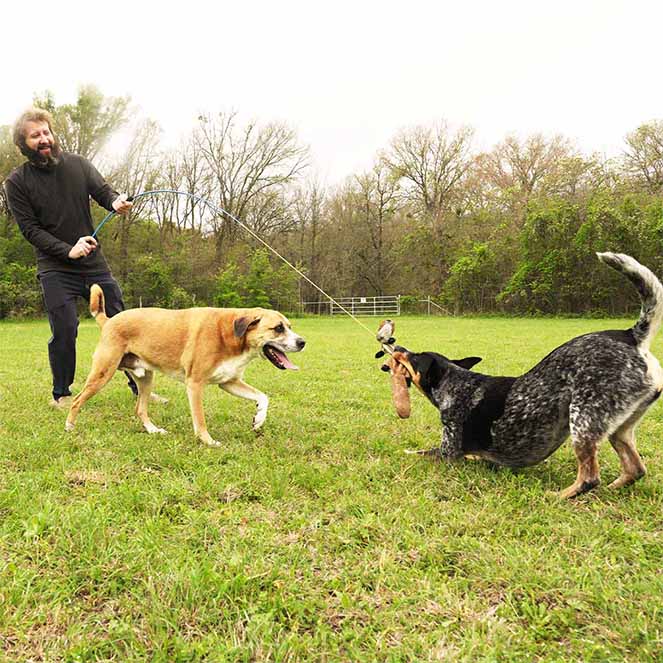
Slow drills build strength but they can’t train explosive power, and a structured chase can. The sprint, the turn, the catch and the controlled stop work the back end and core in a way a held pose doesn’t, and it’s good cardio too. Use wide turns and soft ground, keep the intervals short with real rest in between, and pair it with the impulse control drills so the dog can shut it off on cue. For why chase works a dog the way it does, see the predatory motor pattern.
The 15-minute conditioning session
I’d do this three times a week with a rest day between each one, cause the dog gets stronger on the days off. Warm up first, then the strength and balance work, then a little power at the end and a slow walk to cool down.
- Warm-up, about 3 minutes: some easy walking and a few gentle stretches. The AKC says you can even teach a stretch on cue by capturing it after a nap.
- Circuit, about 9 minutes: two rounds of 10 sit-to-stands, a 15-second static stand and some slow cavaletti passes. Good form matters a lot more than speed.
- Finisher, about 3 minutes: if your vet has cleared the dog, 4 short flirt pole intervals with wide turns, then a slow walk to cool down.
Which work builds which quality (my take)
| Activity | Hind-end strength | Core and balance | Power and cardio |
|---|---|---|---|
| Flat walking | Low | Low | Low |
| Sit-to-stands | High | Medium | Low |
| Static stand and balance | Medium | High | Low |
| Cavaletti walks | Medium | High | Low |
| Flirt pole intervals | High | Medium | High |
That’s just how I’d rate them as a trainer, not a measurement. Slow drills are for strength and balance, chase is for power and cardio, and doing both covers it.
Condition without causing injury
Working a body the wrong way gets a dog hurt, so a few rules keep this safe. Warm up every time, keep the form clean, and call it a day once the dog starts getting sloppy. Build it up slow and pay attention to how your dog moves. If it’s getting up easier and balancing better, you’re on the right track. If it’s stiff or sore the next day, that was too much, so back off and let it rest.
Before you load it up. Run it by your vet first, that’s the AKC’s first rule too. Bad arthritis, for example, “might make certain movements inappropriate.” With puppies, hold off on jumping and long balancing “until their bones have finished developing,” and the AKC’s jumping article puts growth plate closure at “at least 12 months of age,” so your vet’s the one to say when. A young dog doing slow sit-to-stands on a flat floor is fine. Jumping and hard cuts can wait. And if there’s limping, shaky legs, muscle wasting, or a diagnosis already, get your vet or a certified canine rehab pro to look at the dog before you start.
The Whimsy Stick: the power half of the program
Slow drills build the base, and structured chase adds the power and cardio on top. I bought the flirt poles I could find, handed them out to clients and watched what broke, then designed my own and tested it on high-drive client dogs for years before I ever sold one. The Rugged XL is one 46-inch piece of reinforced fiberglass with no joints and an 800-lb Dyneema line, for dogs 30 lbs and up. Under 30 lbs? That’s the Standard, with a 450-lb Kevlar line.
Rugged XL
- Dogs 30 lbs and up · 1 lure
- 800-lb Dyneema line · free US shipping
Rugged XL + 3 Lures
- Same pole and line, 3 lures to rotate
- Dogs 30 lbs and up · free US shipping
Rugged XL Pro Kit
- The XL with 5 lures and a spare line
- For dogs that shred lures · free US shipping
The Standard
- Dogs under 30 lbs · 450-lb Kevlar line
- $20 flat US shipping, cause it goes in a longer box
Every order has a 30-day money-back guarantee, and you pay return shipping unless the pole failed.
Want more of this in your Google results? Add Whimsy Stick as a preferred source.
Canine conditioning, FAQ
How do I build muscle in my dog?
Slow work, mostly. Sit-to-stands, holds, hills, three days a week with a day off between, and make it a bit harder as the dog gets stronger. Throw a few short bursts in at the end for power. Diet’s part of it too, so ask your vet.
How do I strengthen my dog’s back legs?
Sit-to-stands are where I’d start, they hit the hips and stifles every rep. After that, hills, backing up, and balance stuff. Already weak back there or got a diagnosis? Then it’s a vet or rehab pro plan, not a web page.
How often should I do canine conditioning?
Three times a week for strength, with rest days between. Little balance games other days are fine. Ten to fifteen minutes is plenty if the form’s good.
What age can a dog start conditioning?
Gentle body-awareness stuff, pretty young. Jumping and long balancing, not till the bones are done growing, and growth plates don’t close till at least 12 months per the AKC. Your vet makes the call for your dog.
Do I need special equipment for canine conditioning?
Nope. An old storage bin upside down, a couch cushion, two broomsticks, a couple of cans for figure eights. The fancy discs and wobble boards are fun but treats and showing up three days a week matter way more.
How long until I see muscle gain?
Can’t give you a number, every dog’s different. Think weeks, not days, and longer for older dogs or ones coming off an injury. Watch the stairs, honestly. A dog that starts taking them easier is getting stronger.
Can conditioning help an older dog?
Yeah. The AKC says seniors “need to stay limber,” and gentle strength and balance work helps them keep what muscle they’ve got. Low impact only, no jumping, and get the vet’s ok if there’s arthritis or anything else going on.
Is a flirt pole good for building muscle?
For a healthy dog your vet’s cleared, it covers what the slow stuff can’t, the sprint, the turn, the catch, the stop. I use it as the power part, with wide turns on soft ground, and the slow drills are still the base.
Stronger dog. Sounder for life.
Slow drills build the base, chase builds the power. The Rugged XL runs the power intervals at the end of a conditioning session. It’s for dogs 30 lbs and up, ships free in the US, and has a 30-day money-back guarantee.
Add the Rugged XL, $75Under 30 lbs? See the Standard, $56
Based on my own experience training dogs. Not veterinary or rehab advice. Exercise disclaimer.


