
Dog Exercise Toy
This Builds
an Athlete.
This Builds
an Athlete.
What dog owners say.
Already know which one you need?
Your dog is an athlete stuck on a walking plan.
A lot of owners only have one workout for their dog and it’s the walk. That’s good for his heart but not much else, so I wrote a whole flirt pole training guide around the moves he never gets to make on a leash.
Miles only build miles.
A walk is one speed going one direction. Your dog never takes off or stops hard or turns sharp, and those are the moves an athletic dog is built for. It’s kind of like putting a sprinter on a treadmill at a jog.
Fetch is one rep, repeated.
You throw the ball, he runs a straight line, and then he does that same straight line forty more times. There’s no stalking or cutting and he doesn’t have to decide anything at speed. Doing the same thing over and over isn’t the same as mixing it up.
Tired is not trained.
You can wear a dog out and not really build anything, cause tired just means he used it up, and a dog that’s worn out and a dog that’s in shape are two different things.
Ten minutes. Short bursts, then a break.
The lure moves like prey so his drive shows up on its own. What turns that into a workout is giving it some structure, and the AKC’s piece on channeling prey drive talks about games that give it an outlet.
Warm up with slow stalk drags. Drag the lure at a walking pace for the first couple minutes, cause going straight into sprints cold is how dogs get hurt. The slow stalk gets his head in the game too.
Sprint and cut. Snap the lure one way and then the other so he has to take off and stop and turn to keep up, and your wrist does the driving while he does the work.
Capture, then reset. Let him win every third or fourth pass and ask for a drop before you go again, and that pause is his break, plus it’s him learning to listen when he’s all fired up.
Cool down with a final win. I’d finish with some slow drags and one last catch he gets to keep. A hunt that gets finished settles him, and one that gets cut off a lot of times leaves him wired.
Four ways to condition a dog, side by side.
| Method | Movement trained | Reaction demand | Owner cost | Session |
|---|---|---|---|---|
| Walking | One speed, straight lines | None, the sidewalk never dodges | An hour of your day | 45+ min |
| Fetch | Straight-line sprints only | Low, the ball dies where it lands | Your rotator cuff | 20-30 min |
| Dog treadmill | Steady trot, zero turns | None | Serious money and a spare room | 20 min |
| Whimsy Stick intervals | Acceleration, cutting, braking, stalking | High, the lure changes on every pass | You stand in an 8-foot radius | 10 min |
“He’s a working dog mix with energy to spare. Several 15-minute sessions a day with the Whimsy and it definitely takes his high-drive edge off.”
“This thing is a game changer. He’s a border collie, so lots of energy. He loves this thing, and it wears him out. The look on his face every time we bring it out is pure happiness.”
Who this is for. And who it isn’t.
Get one if…
- Your dog does sports or agility or works, and you want something structured for the off-season
- You’ve got a high-drive breed and the daily walk never gets him tired
- You don’t have much space, but you’ve got about 8 feet around you
- Weekend hikes wipe your dog out and you want to get him in better shape during the week
Skip it if…
- Your dog has joint problems and your vet hasn’t OK’d sprinting
- You’ve got a young puppy. Growth plates come first, so it’s slow stalk games only for now
- You want a toy he plays with alone. This one needs you holding it
- You’re not gonna add any structure. Swinging a lure around with no rules just gets a dog cranked up
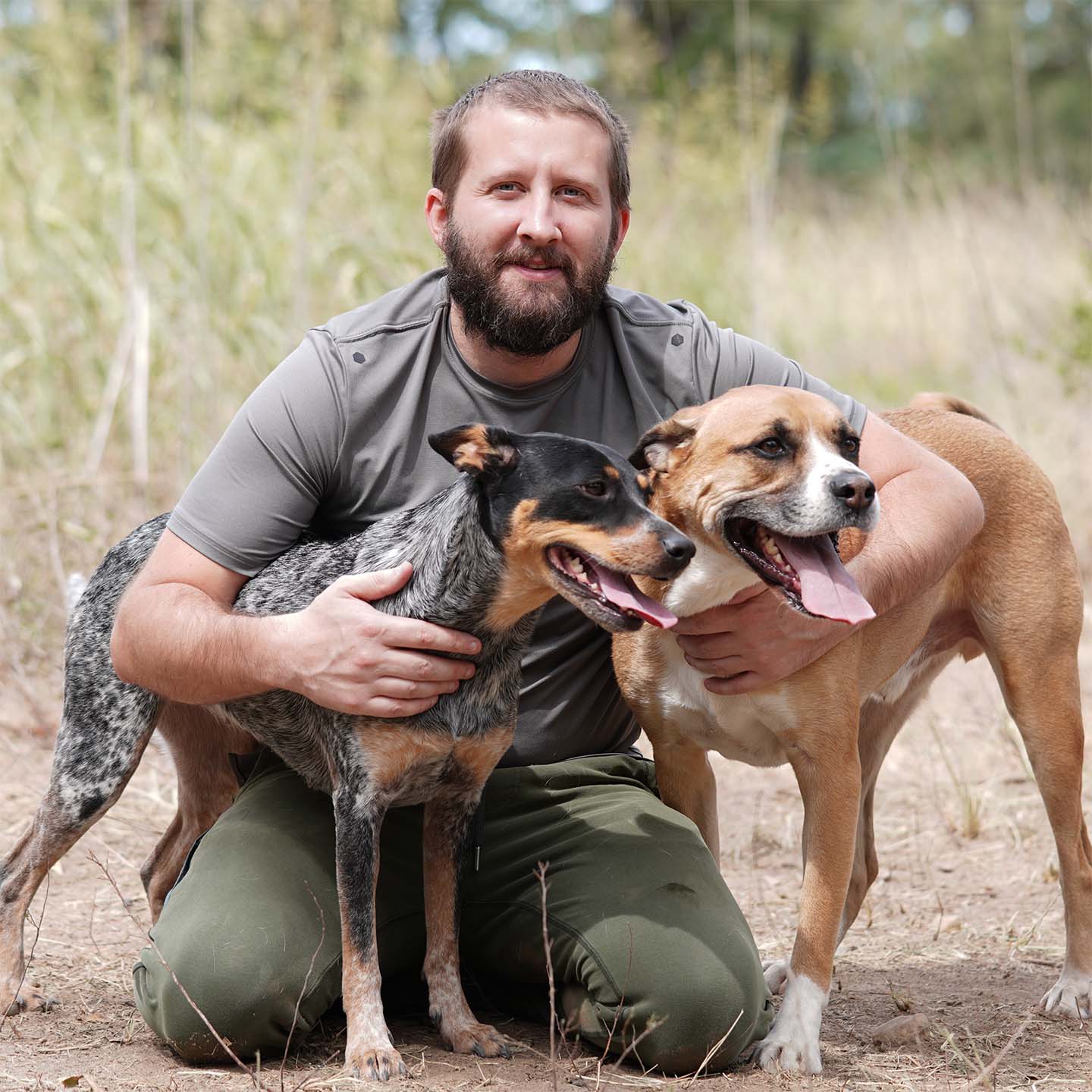
There’s a difference between tired and in shape.
I’m Chris, a working dog trainer. It’s been about ten years and around 400 client dogs, and a lot of those were dogs other trainers had failed with. I don’t have any certifications or vet credentials.
The way I see it, a dog that got exercised and a dog that’s actually in shape aren’t the same thing.
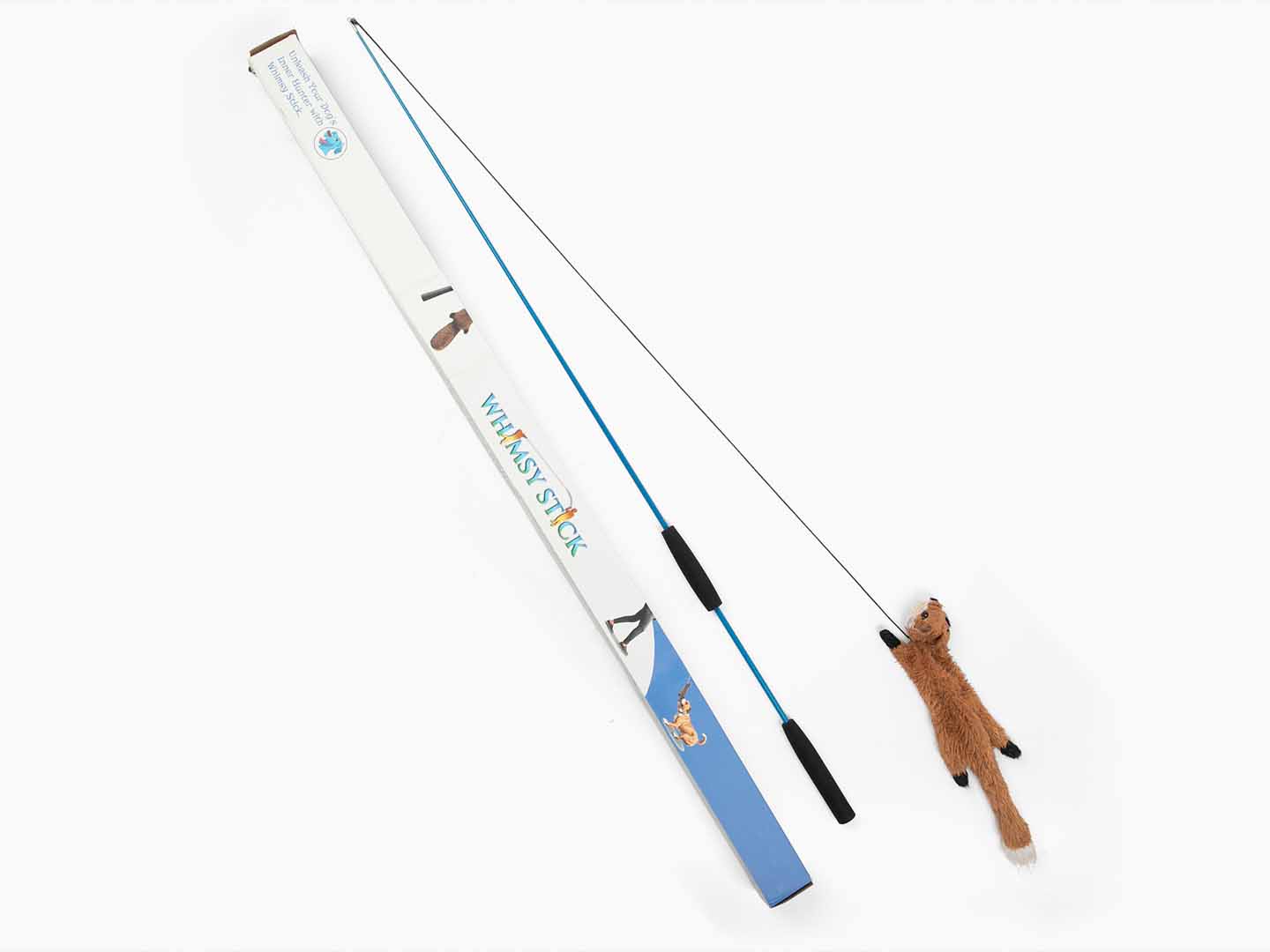
I built the Whimsy Stick cause a lot of the poles I tried were too short, bulky, had a violent bungee cord, or were just too heavy. A good flirt pole should be lightweight and somewhat flexible but not too flexible, and it has to hold up to the dog using it. More about Chris and the method →
Two poles. One conditioning method.
Go by size and how hard he bites, not price. Under 30 lbs gets the Standard, and 30 lbs and up or any power chewer gets the Rugged XL.
- Lightweight springy fiberglass pole
- 1 prey lure (Unlucky the Squirrel)
- 450-lb Kevlar braided cord, no bungee
- Light, about 4 oz
- 30-day money-back guarantee
- Heavy-duty one-piece fiberglass
- 3 prey lures (squirrel, fox, raccoon)
- 800-lb test Dyneema braided lure loop
- Static line, no bungee snap-back
- 30-day money-back guarantee
- Everything in the Rugged XL
- 5 prey lures, so you’ve got spares
- Spare 800-lb Dyneema line included
- For dogs that play hard every day
- 30-day money-back guarantee
What you read here reflects my own experience training dogs. Not veterinary or behavioral medical advice. See the full exercise disclaimer →
30-Day Fitter Dog or Your Money Back.
Do it for 30 days. If your dog isn’t moving better or settling down quicker, email me and I’ll refund you. The only thing on you is return shipping, unless the pole failed. I’m a one-man company and I want you happy with it, so I’ll work with you.
Conditioning questions, straight answers.
How do I condition my dog at home without equipment?
Short sprints in about an 8-foot circle get at the stuff most home setups miss, like taking off fast and cutting and stopping hard. A flirt pole is pretty much all you need, cause the lure moves and you decide how. I’d do a couple minutes of slow drags to warm up and a few minutes of sprints with breaks, and then a couple minutes slow to cool down.
Is flirt pole exercise good conditioning for dogs?
I think so, it’s why I built one. The lure changes direction every pass, so he’s turning and stopping hard and using his back end instead of running the same straight line. A walk is one speed, but the pole makes him use all of them.
How long should a dog conditioning session be?
Ten minutes is plenty for a lot of healthy adult dogs, with a warm-up and some sprints and a cool-down. For puppies or older dogs or a dog coming back from surgery, keep it short and easy and ask your vet, and I’d stop while he still looks sharp instead of when he’s dragging.
Is sprint and cutting work safe for my dog’s joints?
For a healthy adult dog on flat ground, with a real warm-up and building up slow over the first few weeks, it’s generally fine. Grass or dirt is better than concrete, and if he has any joint history, get your vet’s OK before any sprinting at all.
Can puppies do conditioning work?
Not the hard cutting kind, cause their growth plates are still open, so puppies just get slow stalk-and-pounce games at a walking pace, short and easy. The AKC guide on puppy exercise covers the growth plate part pretty well.
What age can a dog start flirt pole conditioning?
Under 6 months I’d skip it. At 6 months it’s easy intro sessions only, slow and low to the ground, and let your vet tell you when he can go full speed, cause bigger breeds a lot of times take longer to get there.
How many conditioning sessions a week does a dog need?
I’d start with three or four short sessions a week and watch how he does the next day, and a lot of healthy adult dogs can work up to every day since the sessions are short. For how much activity he needs overall, the AKC’s exercise guidelines are a good starting point.
Do I need a big yard to condition my dog?
Nope, cause the lure goes around you instead of across a field, so you only need about an 8-foot circle and a patch of lawn or a garage works. If you’re inside, push the coffee table out of the way and make sure the floor isn’t slippery.
Start tomorrow and see how he moves.
Ten minutes a day lets him move the way he was built to. You’ve got 30 days to try it on your own dog, and if it’s not working you can send it back.


