
Gassed at Mile One. Let’s Fix It.
How do you build a dog’s stamina? Slowly, kind of like a person getting back in shape. I’d get a vet check first, then start with what your dog can handle comfortably and add a little distance or time each week, and a common rule of thumb is around ten percent. Watch how they recover. Throw some short hard bursts in with the steady cardio and give them real rest days, cause rushing it is how dogs get hurt.
Why bother doing it right: the AKC puts it simply, “well-conditioned dogs are less likely to be injured than ‘weekend warriors’ who lounge around most of the time, then play hard on occasion.” That weekend-warrior dog is the one limping on Monday.
By Christopher Lee Moran, working dog trainer, about 10 years and around 400 client dogs, Controlled Freedom method. I’m a trainer, not a vet, and I designed the Whimsy Stick. The dog exercise guide has the big picture, and for strength to go with the cardio there’s canine conditioning exercises.
Who this is for
You want a dog that’ll hike and run with you, and instead yours quits after a mile and is limping around the next day. Endurance has to be built, and if you rush it, that’s how dogs get hurt. So you start where your dog actually is right now and add a little each week.
- You hike on the weekends and your dog runs out of gas on the trail
- You run and you want your dog out there with you
- Your dog’s out of shape but you know it’s got it in it
- You’ve got a young dog you want ready for an active life
- Your dog had some time off and needs to get back in shape
- Your dog is sore the day after a big outing
Signs your dog needs conditioning
- Quits or slows way down after a mile or two
- Sore, stiff or limping the day after a big outing
- Pants a lot longer than the effort should cause
- Lags behind on hikes it used to handle fine
- Soft muscle tone
- Overheats or fades out on easy activity
A lot of those can also be a medical thing, a sore joint or a heart issue nobody’s caught, so that’s another reason the vet check comes first.
Build the engine gradually
A dog builds endurance pretty much like you would, a little more over time, and each week the body gets used to a bit more, so you nudge the work up slow. I’d start from where your dog actually is and not where you wish it was.
The ten percent rule of thumb keeps it safe: add around ten percent to the distance or time each week, and back off if your dog isn’t recovering well. It’s not a law, it’s just a nice slow pace that’s hard to get hurt on.
Watch recovery, not just effort
How your dog moves the next day tells you more than the workout does. Stiff or sore? You went too far, so ease off the next week instead of pushing on. The AKC also says to do a real cool-down, like some easy walking or gentle trick training after a hard run, “instead of putting them back into a crate and driving home,” so the heart rate and breathing come back down and the muscles don’t get as sore.
Cardio, power and rest
A good week has steady cardio in it, some short hard bursts, and real rest. The body gets stronger in the downtime between workouts, so the rest days count as training too. Most of the early weeks are just building that steady base, cause everything else sits on top of it.
Steady cardio for the base
Build the base with steady trotting, so brisk walks, light jogs and hikes that get a little longer over time. Keep the pace easy at first, like you could hold a conversation the whole way. The AKC also likes swimming as a lower-impact option.
Short power intervals
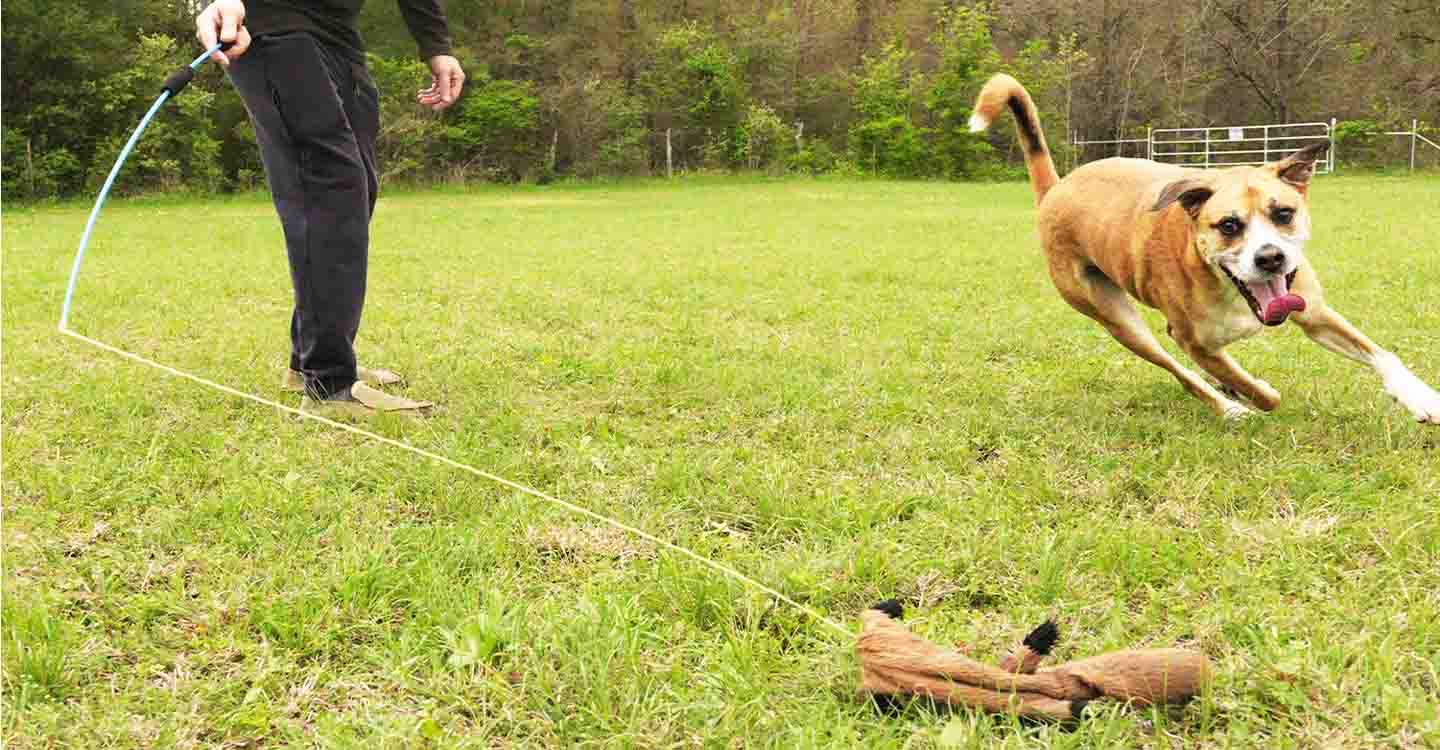
Then add short bursts of hard effort on top. A flirt pole session gets your dog sprinting, cutting and taking off fast, and flat miles never do that. A little of that each week fills in what the walks and jogs leave out.
The power half. Short, hard sprints with the lure kept low, the part steady miles never touch.
Flirt pole training guideRest days are training
The body catches up in the rest, not in the workout, so put real rest days on the calendar and don’t stack hard days back to back on a dog that’s still building up.
The weekly build: base, power, rest
- Base, 3 to 4 days: brisk walks and easy jogs that get a little longer every week.
- Power, 1 to 2 days: short flirt pole bursts on top of that for the sprinting and cutting.
- Rest, 2 days: real rest so the body can catch up and get stronger.
Key takeaway: you can’t cram fitness. Add about ten percent a week, mix the steady stuff with the fast stuff, take the rest days seriously, and give it time.
Train without breaking the dog
Getting hurt sets a dog back more than anything, and heat, hard surfaces and young joints all make it more likely. The AKC says “it’s always a good idea to visit your veterinarian for a full physical” before getting more active, and to talk over your plans with them.
Watch the conditions too. Hot pavement burns paws and can overheat a dog, so train in the cool hours and carry water. Soft ground, decent weather and a grown dog is how the miles add up without anybody getting hurt.
Trail-ready takes weeks
An out-of-shape dog needs weeks to get up to real distance, and how many depends on the dog. If you’ve got a big trip coming, I’d plan backward from it and not try to cram it into one week.
Build safely. Get a vet check before you start, cause a joint or heart problem nobody knows about can make hard exercise dangerous. Watch for limping, not wanting to go, or a slow, hard recovery, and back off when you see any of it. With puppies, the AKC says their bones and joints are fragile while they’re growing, that giant breed puppies “are still growing for the first 12 to 18 months of life,” and that you should wait for the growth plates to close before any structured conditioning routine. So keep young dogs on light, mixed activity, and ask your vet when yours is ready.
The Whimsy Stick: the power half of fitness
Steady miles build the base, but they never get a dog sprinting or taking off fast. A flirt pole adds that part, and it gives your dog a chase to go with all the miles. The Rugged XL is one 46-inch piece of reinforced fiberglass with no joints and an 800-lb Dyneema line, about 8 ft of reach with the line and lure, for dogs 30 lbs and up. Under 30 lbs? That’s the Standard, with a 450-lb Kevlar line. I bought the flirt poles I could find, handed them out to clients and watched what broke, then designed my own and tested it on high-drive client dogs for years before I ever sold one.
Rugged XL
- Dogs 30 lbs and up · 1 lure
- 800-lb Dyneema line · free US shipping
Rugged XL + 3 Lures
- Same pole and line, 3 lures to rotate
- Dogs 30 lbs and up · free US shipping
Rugged XL Pro Kit
- The XL with 5 lures and a spare line
- For dogs that shred lures · free US shipping
The Standard
- Dogs under 30 lbs · 450-lb Kevlar line
- $20 flat US shipping, cause it goes in a longer box
Every order has a 30-day money-back guarantee, and you pay return shipping unless the pole failed.
Want more of this in your Google results? Add Whimsy Stick as a preferred source.
Building a dog’s stamina, FAQ
How do I build my dog’s stamina?
Slowly. I’d get a vet check before any hard work, then start with what your dog handles comfortably and add about ten percent to the distance or time each week, watching how it recovers. A good week mixes steady cardio, a few short hard bursts and some real rest days.
How long does it take to get a dog fit for hiking?
Weeks, for a dog that’s out of shape, and how many really depends on where it’s starting and how big the hike is. If you’ve got a date in mind I’d plan backward from it, cause rushing it just trades a slow safe build for a quick injury.
How many miles can a dog hike?
There’s no one number. Breed, age, fitness and the weather all change it, and a fit athletic dog can go a long way while a soft or short-nosed dog is gonna tire out fast, so build up slow and go by how it recovers, especially when it’s hot.
Should I run with my dog every day?
Not hard runs every day, no. Easy movement daily is fine, but while your dog is still getting in shape the hard days need rest days in between, and stacking runs back to back is kind of asking for an injury, so I’d go back and forth, a harder day and then an easy one.
How do I know if my dog is overexercised?
The next day tells you. If it’s sore or limping, lagging behind, doesn’t want to go, or the heavy panting just keeps going long after, that was too much, so back off and build back slower. A limp that doesn’t go away is a vet visit.
Can any dog build endurance?
Most healthy adult dogs can get a lot better with slow, steady work. Their build still sets a ceiling though, and athletic breeds can go a long way while flat-faced and giant breeds have real limits, so work with the dog you’ve actually got and put its safety ahead of your goals.
Does a flirt pole help build fitness?
Yeah, it does. Steady miles don’t give a dog any sprinting or cutting or catching, and a flirt pole does, so pair it with a cardio base and rest days and you’ve got both sides covered.
When can a puppy start endurance training?
Not till the growth plates close, and the AKC says giant breeds can still be growing for 12 to 18 months, cause long-distance and high-impact work before then can hurt joints that are still developing. Keep young dogs on light, mixed-up activity and ask your vet when yours is ready.
Gassed at mile one. Trail-ready in weeks.
Miles build the base and the Rugged XL adds the sprinting. It’s for dogs 30 lbs and up, ships free in the US, and has a 30-day money-back guarantee.
Add the Rugged XL, $75Under 30 lbs? See the Standard, $56
Based on my own experience training dogs. Not veterinary advice. Exercise disclaimer.


