
TL;DR
I’d get a long tug with a handle on both ends and something your dog can bite down on without tearing it to pieces. Then put a few rules on it. The dog only grabs when you tell it to, it lets go when you ask, and if teeth touch skin the game’s over, period. The way I see it, woven jute and fire hose hold up a lot better than plush or loose rope.
Tug is the catching half of play and a flirt pole is the chasing half, and a pole covers both once you let the dog catch the lure and tug on it to win. If you’re still picking the main toy for a big dog, start with the best interactive toy for large dogs.
Who This Is For
- Owners whose big dog kills a rope toy in days
- Anyone who heard tug makes dogs aggressive and wants the real answer
- Flirt pole users whose dog needs something solid to catch and win
- Mouthy adolescents that grab sleeves when they get excited
- People comparing rope, rubber, jute, and fire hose ahead of buying
Tug Toy Types for Big, Strong Dogs, Compared
With a big dog, what the tug’s made out of decides how it grips and how long it lasts, and what happens when it finally gives out. Rope frays into strings a dog can swallow, and rubber can end up too hard or too slippery to hang onto. Jute and fire hose give a big mouth something firm to hang onto that lasts, but honestly the length and the handles matter just as much as what it’s made of.
| Type | Grip | Durability | Safety watch-outs | Cleaning | Who it suits |
|---|---|---|---|---|---|
| Rope (braided cotton) | Easy to grab, soft on the mouth | Frays fast under a hard grip | Loose strands can be swallowed | Holds grime in the braid | Gentle tuggers, supervised |
| Rubber tug | Firm, can turn slick when wet | Good if thick; chunks can tear off | Overly hard rubber can chip teeth | Easiest: soap and water | Dogs that chomp and re-grip |
| Fire hose / woven nylon | Flat and firm, easy to bite | Tough layers; seams wear out soonest | Check stitching every session | Wipes or rinses clean | Hard pullers who shred fabric |
| Jute bite pad | Textured weave the dog sinks into | Takes a hard grip; surface wears slowly | No hard core inside the bite | Rinse and dry fully | Structured tug and the catch after chase |
| Bungee-handle tug | Depends on the bite end | Bungee wears over time | Stretch softens the jolt | Depends on material | Owners with sore shoulders |
These ratings are just my general take, I didn’t lab test anything. If you’re on your phone, scroll the table sideways.
Rope: fine for gentle tuggers, risky for shredders
Rope is cheap and soft, and that’s why every pet aisle sells it. The trouble starts once a strong dog works it apart. PetMD warns that rope toys that fray can hurt puppies that swallow long strands, cause those can block the stomach or intestine. A big adult dog is gonna pull strands loose even faster.
Rubber: easy to clean, but check the hardness
Rubber tugs rinse clean in seconds and thick rubber takes a lot of chomping. The catch is how hard it is. VCA Animal Hospitals says a toy should be soft enough to dent with a fingernail, cause toys that are too hard can chip or break teeth.
Jute and fire hose: built for a hard mouth
Jute is a good pick for hard biters cause it takes a full grip and there’s nothing hard buried in it. It’s also a plant fiber if you’d rather skip plastic. Fire hose is pretty much the same deal, flat and tough and stitched in layers, so the seams are the part to watch. For a big dog that pulls with its whole body, those two usually last the longest.
How to Size a Tug Toy for a Large Dog
Size a tug toy by length first. It should be long enough that when your dog re-grips, the teeth land on the toy and not your hand. The American Kennel Club recommends a tug with some length for that exact reason, made of something that’s easy on teeth and gums. Handles give you more distance too.
Then width. VCA warns a toy should never be small enough to fit all the way in a dog’s mouth, cause that raises the choking risk. On a big dog, a wide flat bite surface lets it sink in a full grip instead of gnawing on a thin strand.
Big breeds and power pullers
Shepherds, Malinois and bully breeds a lot of times pull with everything they’ve got. So get a tug with a handle on each end and hold the far handle so both your hands stay out of the bite zone. The chase side for those dogs is in flirt pole training for German Shepherds and Malinois and the flirt pole guide for pit bulls and power breeds.
How to Play Tug With Your Dog the Right Way
Good tug has a start cue and a release cue, short rounds, and one hard stop rule. The AKC says to keep tug rounds to about 10 to 15 seconds with a trained out or drop built in, and to make tug something the dog gets invited to do with you. Keep the toy low and pull side to side, not up and down.
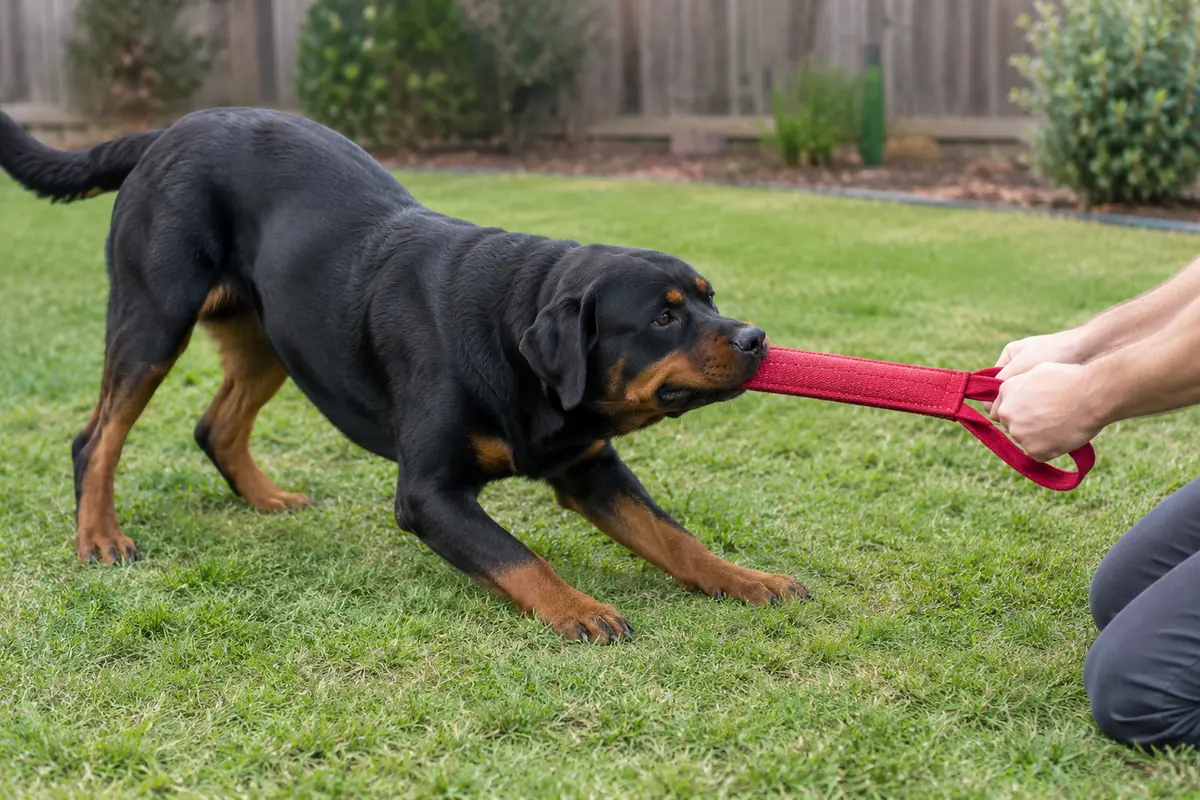
Invite, pull, out, reset
Invite
Hold the tug low and still. Say your start word, and the dog only gets to bite after that.
Pull
Pull side to side at the dog’s height for 10 to 15 seconds.
Out
Freeze, say your release word and wait for the dog to let go.
Reset
Ask for a sit, and another round is the reward.
Start and stop cues
Pick two words and don’t ever mix them up, like “take it” and “out.” The start word is permission, not a suggestion, so the dog waits till it hears it. The AKC says a dog that will wait to go for the toy, or drop it when you ask, is a big part of the game.
Teach the out with a trade
Most dogs learn to let go fastest with a trade. The AKC’s drop-it method gives the dog something else in exchange and then hands the first thing back. In tug, the next round of the game is the best trade you’ve got.
Keep the tug below shoulder height
A certified canine fitness trainer quoted by the AKC recommends keeping the dog’s spine in a neutral line. The same trainer describes owners yanking the tug up and down till the dog’s feet come off the ground and the neck twists. So keep the tug low, somewhere between the dog’s chest and the floor, and pull side to side.
If your dog will not grab the tug
Make the toy act like prey. Drag it along the floor away from the dog in short jerky moves and let the dog catch it within a few seconds. Keep the first sessions to a minute or two and quit while the dog still wants more.
Teeth on skin means game over
This is the one rule I won’t bend on. If teeth touch skin, even by accident, the toy goes still and goes away for a short break. The dog learns the game only keeps going while its mouth stays on the toy, and it takes a few sessions to sink in.
Is Tug of War Bad for Dogs?
No, tug with rules isn’t bad for dogs and it doesn’t make them aggressive. The AKC notes that studies have found tug games played with rules don’t promote aggressive or dominant behavior, and it says tug can help impulse control, build confidence and make the bond stronger. Where it goes wrong is tug with no rules and no release, and somebody yanking on it the whole time.
Letting your dog win is fine
The old advice said a dog that wins at tug starts thinking it outranks you. The AKC calls that a mistaken belief and says letting your dog win builds a good relationship, not dominance. So go ahead and let your dog win now and then, it doesn’t mean your dog is running the show.
When to skip or pause tug
- If your dog is already hurt, skip it. The fitness trainer in the AKC article reports a lot of injuries from bad technique or from tugging with a dog that was already hurt.
- With young puppies and seniors, AKC says to only pull back lightly.
- A dog that stiffens up or freezes over toys needs the plan in resource guarding in dogs before any tug.
- And if the dog is still grabbing sleeves after the game is over, build the off switch with impulse control drills before you bring tug back.
Tug by itself won’t make a dog aggressive, but tug with no rules can teach a dog to grab stuff and hang on. If you keep the invite and the out and the teeth-on-skin rule, it ends up being a pretty good training tool.
Flirt Pole vs Tug Toy: Chase, Then Capture
A flirt pole and a tug toy aren’t competing, cause they cover different halves of the same game. The pole gives the dog the stalk and the chase, and that’s the part a big dog never gets on a leash walk. The tug gives it the grab and the pull and the win. Run the chase first, then let the dog catch something solid.
That order follows the predatory motor pattern, the stalk, chase and grab-bite that’s wired into dogs. Tug by itself skips the sprint. A pole finishes the whole thing when you let the dog catch the lure and pull on it to win, and that’s why a lot of times a dog that ignores fetch lights up for this, like I go over in flirt pole vs fetch.
If the dog chases and never gets to catch anything, it’s only half done. So let it win the lure and tug on it for a few seconds, then ask for the out, and now your flirt pole is a chase game and a tug game at the same time.
The Whimsy Pick: Chase, Catch, and Tug the Lure
For a large dog that loves tug, I’d pick a flirt pole, cause it gives you the chase and the tug in one game. The dog stalks and sprints after the lure, catches it and pulls on it to win. Then you ask for the out, the lure goes still and the next round starts.
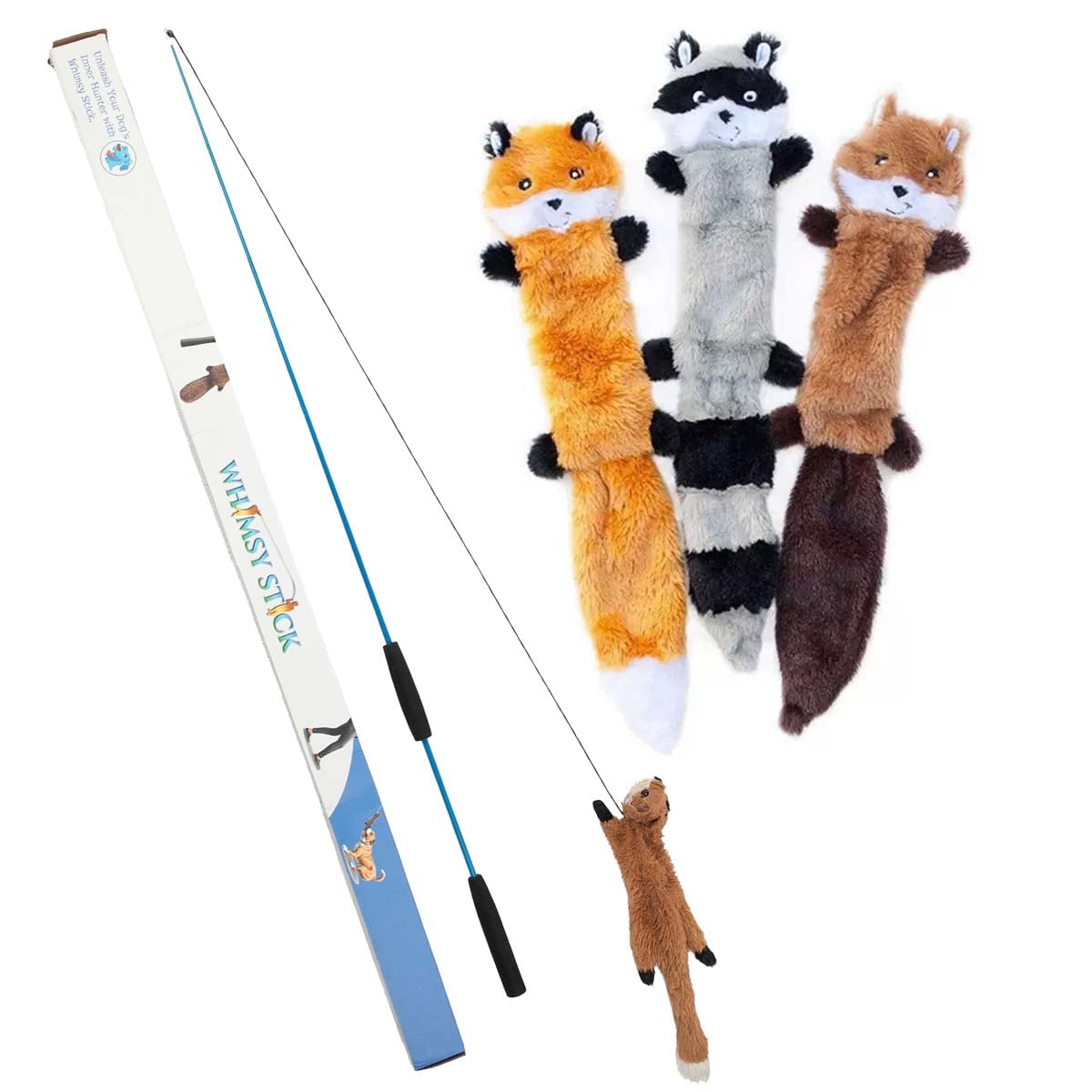
Whimsy Stick Rugged XL
- Built for dogs 30 lbs and up
- 800-lb Dyneema line that takes a hard pull on the catch
- The lure is the catch-and-tug object at the end of every chase
- Bundle with 3 lures for $94.95, so one worn-out lure doesn’t end the session
4.9 stars on 38 product reviews, and 306 reviews across 7 platforms in all.
Get the Rugged XL →Why a pole, and not one more tug toy
A tug toy only works when you’re holding the other end, and it’s never gonna make a big dog sprint. The pole gets you both. The tradeoff is the lure, cause lures and line are wear parts and a dog with a hard mouth is gonna wear the lure down over time. Swap it out when it frays, same as you’d toss any tug.
Smaller dog? Use the Standard
Dogs under 30 lbs get the same chase, catch and tug game on the Standard, which has a 450-lb Kevlar line and costs $55.95. Here’s the Standard flirt pole. For a really hard puller that shreds plush, keep a jute or fire hose tug on the shelf for the heavy grip work.
Throw out worn toys. VCA says once the rope is frayed, the rubber is broken or the stuffing shows, that toy is done, so broken bits don’t get swallowed.
Stay with them the whole time. A tug toy is something you play together, so when the game’s over it goes back up on the shelf, it doesn’t go in the crate.
More Guides for Tug and Chase
Tug Toys and Tug of War: FAQ
What is the best tug toy for a large dog?
I’d go with a long tug with a handle on each end and something to bite that won’t fray, like woven jute or fire hose. The length keeps your hands out of the way when the dog grabs again, and a wide bite area lets a big mouth get a full grip. Rope’s fine for gentle dogs, but a hard puller is gonna fray it.
Is tug of war bad for dogs?
No. The AKC notes that studies have found tug played with rules doesn’t promote aggressive or dominant behavior, and that tug can build impulse control and confidence. Where it goes wrong is tug with no rules, no release cue, no stop rule, and somebody yanking the dog off its feet.
Does playing tug make a dog aggressive?
Not if there’s rules. A dog that only grabs when you invite it and lets go when you ask is practicing control while it’s all fired up. If your dog guards toys or grabs at people after play, I’d work on that first with a trainer or an impulse control plan.
Should I let my dog win at tug?
Yes, a lot. The AKC says letting your dog win doesn’t mean it’s dominating you, it builds your relationship. So let the dog win, ask for the toy back and start another round, cause that’s what makes letting go worth it to the dog.
Rope or rubber: which tug toy is better for a big dog?
Honestly neither one is great for a hard puller. Rope frays into strings a dog can swallow, and rubber that’s too hard can chip a tooth. For a big strong dog I’d go jute or fire hose, and whatever you get, throw it out once it frays or breaks.
How long should a tug toy be for a large dog?
Long enough that your dog can re-grip without catching your hand, and that’s the reason the AKC gives for picking a tug with some length. A handle on each end helps too. And it should never be small enough to fit all the way in the dog’s mouth.
How do I clean a jute or rope tug toy?
Just rinse the slobber and dirt off after you play and let it dry all the way before you put it up. Rubber tugs are fine with soap and water. While you’re cleaning it, look it over for fraying, and if it’s coming apart throw it out.
Is tug safe for puppies?
Yes, gently. AKC says to only pull back lightly with young puppies. Keep the tug low, let the puppy do most of the pulling and keep it short. If the puppy is mouthing hands, do tug along with a puppy biting plan so it learns where that mouth goes.
Flirt pole or tug toy: which one does my dog need?
Most high-drive dogs need both halves of the game, and a flirt pole covers both of them. The dog chases the lure, catches it and tugs on it to win before you ask for the out. If your dog wants something heavier to grip, a jute or fire hose tug is worth having too.
Can tug hurt my dog’s teeth or neck?
It can if you play it wrong. Keep the tug low so their back stays straight, pull side to side and don’t ever lift the dog off its feet. Get something that’s easy on the teeth, and if your dog is already hurt, skip tug.
This guide reflects my experience training dogs and is not veterinary advice. Check with your vet before hard play with a dog that has an injury or dental problem.


