Whimsy Stick

Free Shipping $60+
·
30-Day Money-Back
·
Trainer-Designed
Breed Guide · Working Dogs

Flirt Pole for German Shepherds & Belgian Malinois

These breeds weren’t built for the couch, and they’re not going to pretend otherwise. A 10-minute structured flirt pole session builds impulse control into the drive system so the same arousal that used to create reactivity and destruction becomes a tool for training.

Christopher Lee Moran, professional dog trainer
Christopher Lee MoranProfessional Dog Trainer · 10 Years · Instinctual Balance
10 min read · Updated April 2026
10 to 15
Minutes per session
12 mo
Minimum age to start
2 to 3 wk
To see behavioral change
10 yrs
Working with these breeds
TL;DR

German Shepherds and Belgian Malinois are working dogs with prey and protection drive that doesn’t disappear because they live in a house. A structured flirt pole session channels that drive through a handler-controlled sequence rather than letting it overflow into problem behavior.

Unstructured use makes these breeds worse. Structured use with mandatory impulse control gates (wait before every release, drop-it after every catch, clean all-done cue) builds real control while completing the predatory sequence for genuine calm.

Both breeds need the Rugged XL. They’re too large and too powerful for any other build to hold up under daily use. According to the AKC, these breeds require daily structured mental and physical work to remain behaviorally stable. VCA Animal Hospitals confirms that handler-controlled drive play produces measurably better outcomes than unstructured exercise for high-drive dogs. Most owners see measurable improvement in 2 to 4 weeks.

Who This Guide Is For

Owners of German Shepherds (working-line, show-line, or mixed) and Belgian Malinois who are dealing with reactivity, destruction, inability to settle, persistent arousal, or a dog whose drive level exceeds what walking and fetch can address. Also for owners of GSD or Malinois puppies approaching the age for structured drive work and wanting to start correctly.

Signs Your GSD or Malinois Needs This Protocol

Reactive on leash to dogs, people, or movement despite regular exercise. Still wired and pacing after long walks. Destructive chewing or digging that doesn’t respond to enrichment toys. Fixation on squirrels, bikes, or anything that moves. Difficulty settling in the house even after physical activity. Nipping, jumping, or mouthing that escalates rather than improves. Increasingly hard to manage rather than easier as the dog matures. If your dog matches any of these, the issue is unmet drive, not lack of exercise.

Why German Shepherds and Belgian Malinois Need This Specifically

Both breeds carry high prey drive, strong working drive, significant arousal capacity, and relatively low natural off-switch. That combination makes structured flirt pole work the most efficient daily tool for these dogs. It engages all four drives simultaneously in a single structured session.

German Shepherds and Belgian Malinois were selectively bred for generations to perform demanding work: protection, detection, herding, search and rescue. They carry the physical and neurological hardware to do it. The problem isn’t the dog. It’s the mismatch between what the dog was built for and what most households actually provide.

The behavioral problems these breeds are known for aren’t character flaws. They’re unfulfilled instinct doing what unfulfilled instinct always does: finding its own outlet. Structured flirt pole work addresses this directly by giving the working instinct a legitimate daily channel that passive exercise cannot provide. For the universal framework on training high prey drive dogs, that guide covers the principles that apply across all breeds. For the full neurological explanation specific to prey drive, see Prey Drive Training for Dogs.

🐕

German Shepherd

  • High prey drive with strong protection instinct
  • Highly biddable, wants to work with the handler
  • Significant variation between working and show lines
  • Working-line GSDs have considerably higher drive requirements
  • Need consistent daily structure to remain manageable
  • Excellent response to reward-based drive training

Belgian Malinois

  • Among the highest-drive working breeds in existence
  • Less natural off-switch than GSDs, harder to deactivate
  • Extremely fast, reactive, and sensitive to handler cues
  • Drive requirements significantly exceed most owner expectations
  • Require more structured outlet than almost any other breed
  • Outstanding working ability when drive is properly channeled

Every Malinois I’ve worked with who was described as “unmanageable” was a dog whose drive had nowhere legitimate to go. Give it somewhere to go and you’ve got a different dog inside two weeks.

Christopher Lee Moran, Instinctual Balance Dog Training

What the Flirt Pole Does Neurologically

The flirt pole engages the predatory sequence, the hardwired behavioral chain that working dogs are bred to execute. This full-sequence engagement is exactly why it outperforms running, fetch, and tug for producing genuine behavioral settlement in GSDs and Malinois.

Orient
Lock onto target
Stalk
Hold position, build tension
Chase
Full pursuit at speed
Catch
Grab and grip
Possess
Hold and shake
Release
Drop on cue, calm

When this sequence completes fully, including the deliberate drop-it and all-done cue at the end, cortisol drops and dopamine releases at the completion point. The dog experiences genuine neurological calm, not just physical fatigue. A dog who has completed the sequence is in a genuinely different behavioral state than a dog who has been exercised to exhaustion.

This is why ten minutes of structured work produces better behavioral outcomes than an hour of fetch or a long run. The physical exercise addresses the body. The completed predatory sequence addresses the drive system that’s actually generating the behavior problems.

Key Takeaway

A dog who runs for an hour has tired legs. A dog who has completed a structured drive session has a satisfied nervous system. The behavioral difference (ability to settle, reduced reactivity, handler orientation) is significant and consistent.

German Shepherd vs Belgian Malinois: Key Differences

The principles are the same for both breeds but the practical differences are significant enough to address directly.

German Shepherd

Training adjustments

  • Working-line dogs need longer sessions and more frequent outlets than show-line
  • Generally more handler-oriented, wait and drop-it usually train quickly
  • Responds well to clear structure and consistent cue sequences
  • Can handle 10 to 15 minute sessions comfortably once conditioned
  • Watch for hip stress, keep lure low, avoid repetitive jumping
  • Off-switch develops relatively well with consistent work
Belgian Malinois

Training adjustments

  • Drive requirements are substantially higher, twice-daily sessions often necessary
  • Less natural off-switch, expect to work harder on the all-done transition
  • Extremely sensitive to handler arousal, stay calm and deliberate throughout
  • More likely to escalate if sessions end without clean resolution
  • May need shorter sessions more frequently rather than one long session
  • Handler focus builds fast once trust is established through consistent sessions
Malinois owners specifically

A Malinois used with an unstructured flirt pole (no wait cue, no drop-it, sessions ending mid-drive) becomes significantly more difficult to manage, not easier. The drive gets practiced without the impulse control overlay and you end up with a more aroused, less controllable dog. Structure is not optional with this breed. Every rep needs a wait before the release and a drop-it before re-engagement.

The Session Structure for German Shepherds and Malinois

This is the same foundational sequence used for all working breeds. The full method is in the Flirt Pole Training Guide. For GSDs and Malinois the structure is especially non-negotiable.

1
Warm up, 2 to 3 minutes

Easy movement before anything explosive. Both breeds can go from zero to full speed with no warm-up, and both breeds have the joint and muscle mass to pay for that over time. Two minutes of easy movement is not optional for dogs this size and intensity.

2
Wait, build the stalk

Lure still on the ground. Dog locks on. Ask for a sit or stand-wait. Hold for 8 to 10 seconds minimum before releasing. This is not a formality. This is where the impulse control gets built. For GSDs and Malinois who haven’t done structured drive work before, the wait phase will be the hardest part in the first week. That difficulty is exactly why it matters.

Cue: “Wait”
3
Release and controlled chase

Release cue, lure low and smooth. Keep it horizontal: side sweeps, direction changes, brief pauses. Both breeds move fast enough that vertical jumping creates joint stress you don’t want accumulating over hundreds of sessions. The Rugged XL’s 8-foot reach gives enough working radius for these dogs to actually run without tight turns at speed.

Cue: “Get it”
4
Catch and possession

Every three to four reps, let the dog catch and hold the lure. Allow full possession for 3 to 5 seconds before cueing the out. Working dogs who are denied possession entirely during drive work become frustrated and harder to manage. The possession phase is where the sequence pays off neurologically.

5
Drop-it and reset

Cue out, reward the release, immediately restart from the wait phase. This loop (wait, chase, catch, drop-it) is the training protocol. For the full impulse control progression, see Impulse Control Drills.

Cue: “Out”
6
All-done cue and cooldown

Verbal all-done, toy away completely, 5-minute easy walk or place cue. For Malinois especially, the cooldown is mandatory. Ending a session without the transition period leaves drive unresolved and the dog will take it out on the next thing it encounters.

Cue: “All done”
From the Training Files

2-year-old working-line GSD, reactive on leash, destroying furniture daily

The owner was walking 90 minutes a day plus 30 minutes of backyard fetch. The dog was still pacing the house, resource guarding toys, and lunging at every dog on walks. Two trainers had already recommended an e-collar for the reactivity.

We added a 10-minute structured flirt pole session before the morning walk and a 7-minute evening session before dinner. Walks were reduced to one 30-minute decompression sniff walk. No other changes to the dog’s routine or training.

By day 8, the morning walk was noticeably calmer. Reactive threshold widened from 15 feet to 40+ feet for dog triggers. By week 3, furniture destruction stopped entirely. By week 4, the owner described the dog as “a completely different animal in the house.” Total daily exercise time dropped from 120 minutes to 47 minutes. The variable that changed was the type of exercise, not the amount.

How Often to Run Sessions

For German Shepherds: once daily, 10 to 15 minutes. This produces consistent behavioral results for most working-line and sport-line GSDs. Working-line GSDs may benefit from a second shorter session (5 to 7 minutes) in the evening, particularly in the early weeks when baseline arousal is still high.

For Belgian Malinois: twice daily is often the right starting point. One full 10 to 15 minute session and one shorter 5 to 7 minute session. The Malinois drive system is simply larger than what once-daily sessions can fully address, particularly in dogs who’ve had no structured outlet up to this point. Reduce to once daily as behavioral stability improves.

If you bought a Malinois because you wanted an intense dog and now you’re overwhelmed by the intensity, that’s fixable. But it requires matching the output to the input. One walk a day and a Kong is not going to move the needle. Twice-daily structured drive work will.

Safety Rules for GSDs and Malinois

Do
  • Warm up 2 to 3 minutes before every session
  • Keep lure low, horizontal movement only
  • Use a pole with enough reach for wide arcs, not tight turns
  • Play on grass or soft ground
  • Cap sessions at 15 minutes regardless of dog willingness
  • Always end with drop-it, all-done cue, and cooldown walk
  • Watch for limping, stiffness, or abnormal gait as stop signals
  • Wait until 12 to 14 months for structured sessions (14 to 18 months for larger working-line GSDs)
Don’t
  • Skip the warm-up, these dogs generate serious force
  • Raise the lure to encourage jumping
  • Use a short-radius pole that forces tight turns at speed
  • Play on concrete or hard surfaces
  • Let Malinois sessions run until collapse
  • End sessions abruptly without the all-done sequence
  • Use elastic cord poles, snap-back at this size is dangerous
  • Start structured work before growth plates are closed

Why Equipment Matters for These Breeds

A 70-pound working-line GSD or a Malinois at full speed generates forces that will destroy a standard flirt pole inside a few sessions. Elastic-cord poles snap back unpredictably under that load, which is a safety issue, not just an inconvenience. Short poles force tight working circles that put cumulative stress on joints. Standard construction wasn’t rated for this use case. For a detailed comparison of why, see DIY vs. Professional Flirt Pole Design.

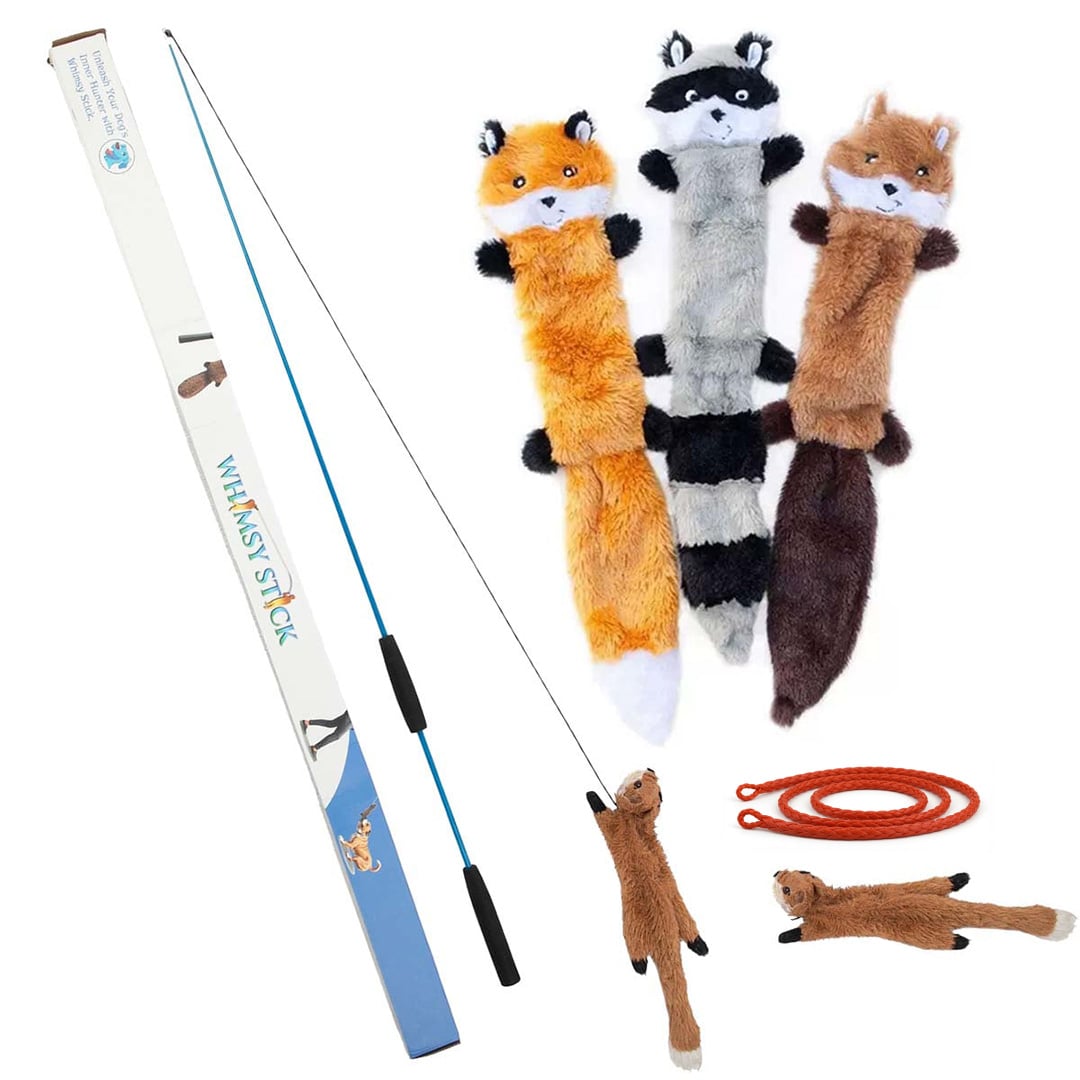
The Rugged XL is the specific build for these breeds. Reinforced for the tension loads working dogs generate, 8-foot working radius for wide chase arcs, heavy-duty construction that holds up under daily use. For the full equipment comparison, see Whimsy Stick vs Squishy Face and the Buying Guide.

Whimsy Stick Standard, dogs under 30 lbs

Appropriate for GSD and Malinois puppies during low-intensity introductory work, and for smaller mixed breeds with working-line drive. Kevlar line, replaceable lures. $54.95, free shipping, 30-day guarantee.

Shop Standard →
Whimsy Stick Rugged XL, the only option for adult GSDs and Malinois

Reinforced construction for working dogs. 8-ft radius for wide chase arcs, 3 lures included, no elastic snap-back. Built to hold up under daily sessions with these breeds. Starting at $74.95, free shipping, 30-day guarantee.

Shop Rugged XL →

Flirt Pole Training for GSDs and Malinois With Reactivity

Reactivity in GSDs and Malinois is almost always partly a function of unmet drive and high baseline arousal. A dog operating at chronically elevated arousal has a narrow threshold: the trigger doesn’t have to be close or intense to produce a reaction. Daily structured drive work lowers that baseline, which widens the threshold window and gives the dog more space before reacting. For the foundational reactive dog training framework that applies across all breeds, that guide covers the full protocol.

The impulse control skills built during sessions (wait before release, drop-it under drive) transfer directly to on-leash reactive situations. Running a structured session before trigger-exposure walks produces measurable threshold improvement within two to three weeks. The full reactivity protocol is at Flirt Pole for Reactive Dogs. For dogs that are specifically hyper after walks, this pre-walk session is often the missing piece.

Commonly Asked Questions

Flirt Pole for German Shepherds & Malinois: FAQ

Is a flirt pole good for German Shepherds?
Yes. German Shepherds have high prey and working drive that needs a structured daily outlet. Without one, that drive surfaces as reactivity, destructive behavior, and inability to settle. A structured flirt pole session engages and completes the full predatory sequence, producing genuine neural calm that physical exercise alone doesn’t achieve. For working-line GSDs especially, daily structured drive work is one of the most effective tools available for producing a balanced, manageable dog.
Yes, when used with structure and appropriate equipment. Keep the lure low and horizontal, use a pole with enough reach for wide arcs, cap sessions at 15 minutes, and always finish with a deliberate drop-it and all-done cue. For Malinois specifically, using a flirt pole without structure creates more arousal-addicted, harder-to-manage dogs. Structure is what makes the tool work.
More than most people can provide through physical exercise alone, and physical exercise is the wrong frame anyway. Malinois need drive fulfillment, not just exhaustion. Ten to fifteen minutes of structured flirt pole work twice daily, combined with obedience training and handler engagement, does more for a Malinois’s behavioral stability than several hours of unstructured physical activity. The drive system and the physical energy system are neurologically distinct.
Working-line GSDs (Czech, DDR, West German working lines) carry significantly higher drive than show-line or American-line dogs. They have more prey drive, more persistence, higher arousal ceilings, and less natural off-switch. The training principles are the same but the intensity and consistency requirements are higher. If your GSD shows high reactivity, difficulty settling, and intense engagement with moving objects, those are indicators of higher working drive and proportionally higher outlet requirements.
Yes. Reactivity in high-drive working breeds is almost always partly a function of unmet drive and elevated baseline arousal. Daily structured flirt pole work lowers that baseline and builds the impulse control skills that transfer directly to reactive situations. Most owners see measurable reduction in reactive behavior within two to three weeks. See the full step-by-step method at Flirt Pole for Reactive Dogs.
Full-speed structured sessions should wait until at least 12 months, and for larger working-line German Shepherds ideally 14 to 18 months when growth plates are reliably closed. Both breeds grow fast but mature structurally more slowly than their size suggests. Puppies from 6 months can do gentle lure work: slow drag on the ground, no jumping, 2 to 3 minutes maximum. This builds foundational engagement and the drop-it cue without joint stress.
Because physical exercise addresses muscle fatigue and nothing else. Both breeds were built for work requiring drive, focus, and problem-solving, not just physical output. The drive system is neurologically distinct from the physical energy system. A dog who runs for an hour has tired legs. A dog who has completed a structured drive session has a satisfied nervous system. The behavioral difference is significant and consistent. See How to Bond With Your Dog for more on how structured play builds the handler relationship these breeds need.
If the dog cannot hold even a 3-second wait, won’t release the lure, or is moving frantically with no tracking behavior, end the session immediately with all-done and settle. Do not add more reps. For the next session, cut duration in half and slow lure movement down. The dog is telling you the intensity exceeded their current capacity. Also check your own energy: handler arousal directly amplifies dog arousal in these breeds. Stay calm and deliberate.
For adult German Shepherds and Belgian Malinois, the Rugged XL is necessary. Both breeds exceed 30 lbs and generate forces during structured chase that standard construction cannot handle under daily use. The Standard model is appropriate for GSD and Malinois puppies during low-intensity introductory work, and for smaller mixed breeds with working-line drive.
Christopher Lee Moran, professional dog trainer
Christopher Lee Moran
Professional Dog Trainer · Founder, Instinctual Balance Dog Training

Christopher is the creator of the Controlled Freedom training philosophy and the Whimsy Stick flirt pole. He has spent 10 years specializing in drive-based behavioral modification with German Shepherds, Belgian Malinois, and other high-drive working breeds across approximately 400 client dogs.

This article is for educational purposes only and is not veterinary advice. For severe reactivity, aggression, or behavioral issues beyond what this protocol addresses, consult a professional behaviorist.

Give the drive a legitimate outlet.

These breeds don’t need less intensity they need more structure

The Rugged XL was built for this. Reinforced construction, 8-ft radius, 3 lures, no elastic snap-back. Daily sessions, real results. Ships free with a 30-day money-back guarantee.

0
    0
    Your Cart
    Your cart is emptyReturn to Shop