
TL;DR
Canine conditioning is deliberate strength, balance, and body-awareness work, not just tiring a dog out. The core at-home drills are sit-to-stands for the hind end, static standing for the core, balance work for stability, and slow cavaletti walks for coordination. Run them three times a week with rest days, and most dogs show visible tone in 6 to 8 weeks. Because slow drills cannot train explosive power, a short chase finisher rounds out the program.
Zoom out with the dog exercise guide to see where conditioning fits the week. Structured chase trains acceleration and controlled deceleration that build rear drive and core stability. The technique lives in the flirt pole training guide, and the full reference sits in the canine flirt pole guide.
Who This Is For
- Owners who want a stronger, fitter dog, not just a tired one
- People whose dog is losing muscle tone, topline, or rear-end strength
- Owners of sport, working, or active dogs who need real conditioning
- People rehabbing a dog back to fitness after time off (with vet sign-off)
- Owners of seniors who want to preserve muscle and mobility
- Anyone who wants an at-home program without a gym full of gear
- Owners who want to protect their dog’s joints by building support muscle
Signs Your Dog Needs Conditioning
- Losing muscle over the hips, thighs, or along the spine
- Slow to rise, hesitant on stairs, or reluctant to jump up
- Wobbly or unbalanced on uneven ground
- Tires fast or moves stiffly after moderate activity
- A soft, sloped topline where there used to be a firm one
- Coming back from injury, surgery, or a long stretch of rest
- A young athlete you want to build up safely for sport or work
Conditioning Is Not the Same as Exercise
Exercise moves a dog. Conditioning changes a dog’s body. A walk keeps your dog active, but it does not deliberately load the muscles that hold a joint together. Conditioning does, because it targets the hind end, the core, and balance with controlled, progressive work.
That distinction matters most for three groups: active and sport dogs that need real strength, seniors losing muscle to age, and dogs rebuilding after injury. For all of them, targeted drills protect joints and keep the dog sound. Per the American Kennel Club’s guide to canine conditioning, simple home exercises build and maintain muscle while improving balance and body awareness.
The two halves of a program
A complete program has a slow half and a fast half. Its slow half is strength and balance: sit-to-stands, static holds, cavaletti. Power is the fast half, meaning short explosive bursts that teach a dog to accelerate and then decelerate under control. Most owners do one and skip the other, though both are needed for a truly conditioned dog.
A tired dog and a strong dog are not the same animal. You can run a dog into the ground and still leave it weak. Conditioning is the work that actually changes the body underneath.
Christopher Lee Moran · Working Dog TrainerThe At-Home Drills, Ranked by Payoff
You do not need a gym. A cushion, a couple of broomsticks, and a hill cover most of it. Below are the drills I use with client dogs, starting with the three that give the most return for the effort.
The best single drill for the back legs. The dog sits, then stands, over and over, loading the hips and stifles through a full range of motion.
A held, square stand on a cushion fires the core and stabilizers. Quiet, simple, and brutal on the muscles that hold a dog steady.
Slow, deliberate steps over low poles. Builds body awareness, rear-leg reach, and the coordination that prevents stumbles.
These three cover the base: hind-end strength, core stability, and coordination. Add the power finisher and you have a full program in fifteen minutes.
Sit-to-Stands
Ask for a clean sit, then a clean stand, and reward each one. The dog should push up through the back legs, not walk forward out of it. Ten reps is a set, and two to three sets builds real hind-end strength over a few weeks.
Keep the reps slow and controlled, because speed lets the dog cheat with momentum. Do them on a non-slip surface so the rear legs get traction. This one drill does more for a weak back end than any amount of walking.
Static Stand and Balance
Ask the dog to stand square and hold it for 10 to 20 seconds without sitting or stepping. Put the front feet, then all four, on an unstable surface like a firm cushion or an upside-down storage bin, and the core has to work overtime to hold steady.
Because the muscle work is invisible, owners underrate this drill. Do not. A held stand on an unstable surface lights up the stabilizers that protect the spine and joints better than most moving exercises.
Cavaletti and Terrain Work
Lay broomsticks across low supports at ankle height and walk the dog over them slowly. The dog has to lift each leg and place it with intent, which builds rear-leg reach and body awareness. Walking on grass, sand, or gravel does the same job by challenging balance.
Slow is the whole point here, since rushing turns it into a jump instead of a coordination drill. Keep the poles low and the pace deliberate.
Hill Walks and Backing Up
Walking uphill forces the rear end to drive harder, which loads the hindquarters far more than flat ground. Teaching a dog to back up on cue works the same muscles in reverse and sharpens rear-leg awareness at the same time.
Start with gentle slopes and short distances, then build. These two together are a simple, gear-free way to add resistance once the foundation drills feel easy.
Flirt Pole Power Intervals
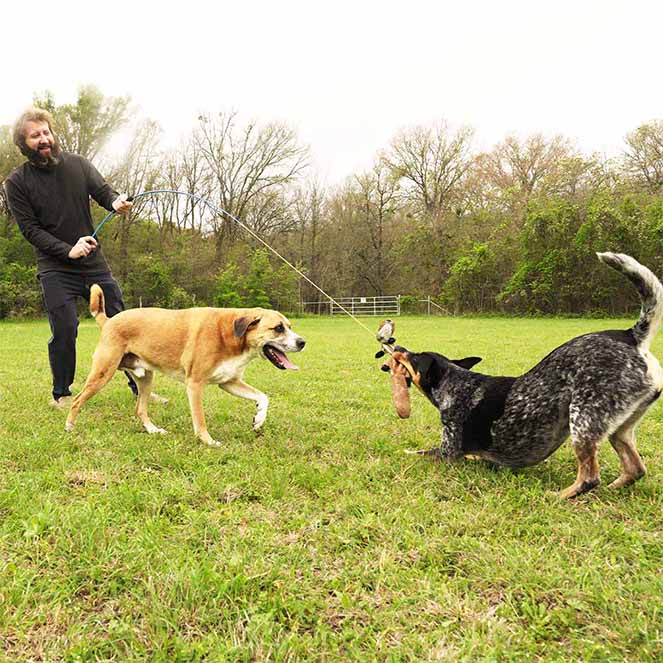
Slow drills build strength, but they cannot train explosive power. Structured chase can. The sprint, the hard cut, the catch, and the controlled stop load the rear drive and core in a way no held pose matches, and they build the cardio base too. This is the fast half of the program.
Use wide turns and soft ground to protect the joints, and keep intervals short with real rest between them. For the mechanics behind why chase conditions a dog so well, see the predatory motor pattern, and pair it with impulse control drills so the dog can switch the power off on cue.
The 15-Minute Conditioning Session
Run this three times a week with rest days between, because muscle builds during recovery, not during the workout. Warm up, work strength and balance, finish with power, cool down.
Warm up, work, finish strong
Easy Walk
Loose walking and a few gentle stretches to raise the heart rate before any loading.
Strength and Balance
Two rounds of 10 sit-to-stands, a 15-second static stand, and slow cavaletti passes. Good form over speed.
Power and Cooldown
For vet-cleared dogs, 4 short flirt pole intervals with wide turns, then a slow walk to cool down.
Which Work Builds Which Quality
No single activity does everything. Here is how the common options compare for the three qualities a conditioned dog needs.
| Activity | Hind-End Strength | Core / Balance | Power / Cardio |
|---|---|---|---|
| Flat walking | Low | Low | Low |
| Sit-to-stands | High | Medium | Low |
| Static stand / balance | Medium | High | Low |
| Cavaletti walks | Medium | High | Low |
| Flirt pole intervals | High | Medium | High |
Slow drills own strength and balance. Chase owns power and cardio. Stack both and you cover every quality a sound dog needs.
Condition Without Causing Injury
Loading a body the wrong way builds injuries, not muscle. A few rules keep conditioning safe, and the Cornell Riney Canine Health Center is a solid reference for joint-friendly fitness.
Skip heavy loading and high impact until the growth plates close. That is roughly 12 to 18 months depending on breed. Young dogs can do slow sit-to-stands and flat-ground balance, but jumping and hard cutting wait for a mature skeleton.
Get professional eyes on a weak or injured dog. For any limping, shaking legs, muscle loss, or a diagnosis, see your vet or a certified canine rehab professional before loading the body. Warm up first, keep form clean, and stop the moment quality drops.
Build slowly and track function. A dog that rises easier, balances better, and holds a firmer topline is progressing. A dog that gets stiff or sore needs less volume, so back off and let recovery catch up.
Real Results: Rebuilding a Weak Rear End
The Whimsy Stick: The Power Half of the Program
Slow drills build the base, and structured chase adds the explosive power and cardio on top. This is the flirt pole I use to run the power finisher with client dogs.
Read These Next to Go Deeper
Canine Conditioning: FAQ
How do I build muscle in my dog?
Muscle grows from progressive, controlled loading plus enough protein and rest. Use slow, deliberate drills like sit-to-stands, static holds, and hill walking three times a week, with rest days between. Add short explosive bursts for power, and feed a complete diet, because muscle builds during recovery, not during the workout.
How do I strengthen my dog’s back legs?
Sit-to-stands are the single best at-home drill for the hind end, since they load the hips and stifles through a full range of motion. Add slow hill walking, backing up on cue, and weight-shifting work. For a dog with weakness or a diagnosis, get a plan from your vet or a certified canine rehab professional first.
How often should I do canine conditioning?
Three sessions a week is a solid target for building strength, with rest days so muscle can recover and grow. Short daily balance work is fine, but hard strength and power sessions need recovery days. Ten to fifteen minutes per session is plenty when the form is good.
What age can a dog start conditioning?
Gentle balance and body-awareness work is fine for young dogs, but skip heavy loading and high impact until the growth plates close, roughly 12 to 18 months depending on breed. Slow sit-to-stands and flat-ground balance are safe early. Jumping and hard cutting wait for a mature skeleton.
Do I need special equipment for canine conditioning?
No. A stable cushion or upside-down storage bin works for balance, broomsticks on low supports make cavaletti, and a hill or stairs adds resistance. Balance discs and inflatable gear are nice but optional. Treats and consistency matter more than equipment.
How long until I see muscle gain?
With consistent work three times a week and good nutrition, most owners see better tone and movement in 6 to 8 weeks. Strength and stamina improve before appearance does. Older dogs and dogs returning from injury progress slower, so track function like easier stairs, not just looks.
Can conditioning help an older dog?
Yes, and it is one of the best things you can do for a senior. Gentle strength and balance work preserves muscle, supports aging joints, and keeps a dog mobile. Keep it low-impact, skip jumping and hard cutting, and get vet clearance first if your dog has arthritis or any diagnosis.
Is a flirt pole good for building muscle?
For a healthy, vet-cleared dog, structured chase trains explosive power and controlled deceleration that slow drills cannot. The sprint-cut-catch pattern loads the rear drive and core hard. Treat it as the power and cardio piece, pair it with slow strength drills, and use wide turns on soft ground to protect the joints.


