
How to Tire Out a Dog When You Work Full Time
How do you tire out a dog when you work full time? Make the time you do have harder instead of trying to find time you don’t. A short session of real chase and some brain work before you leave, something to work on while you’re gone, and another short hard session when you get home. Puzzle-fed meals help with the boredom, and a midday walker or daycare helps if you can swing it. Every day beats a big weekend.
Why a quick walk doesn’t cut it: the AKC’s article on bored dogs says “a 10-minute stroll around the block is unlikely to tire any dog,” and recommends adding vigorous exercise like chasing a ball or flying disc, plus brain work before you head to work.
By Christopher Lee Moran, working dog trainer, about 10 years and around 400 client dogs, Controlled Freedom method. I designed the Whimsy Stick. The dog exercise guide has the bigger picture.
Who this is for
You’re out the door early and drag yourself home with nothing left, and your dog has been waiting on you all day and it shows. I’m not gonna tell you to find an hour you don’t have. You need the minutes you’ve got to actually count.
- You work a full day and have a high-energy dog at home
- You’re too wiped after work for a long walk
- Your dog tears stuff up while you’re gone
- Your dog explodes the second you walk in the door
- You feel guilty about how long your dog is alone
- You work shifts and your hours are all over the place
The problem is intensity, not time
A lot of people who work all day figure they need an hour they don’t have. A slow leash walk is easy work, so even a long one barely takes the edge off a high-drive dog. Short bursts of hard work are a different deal, a dog that gets to sprint, cut and catch is actually burning something. The AKC exercise guide says high-energy breeds need a lot more than lower-energy ones, and that a walk around the block might be enough only for breeds with lower needs.
Body and brain, both
Tired legs with a bored brain still gets you a restless dog. The AKC says giving your dog’s brain a workout is as important as exercising its body, and “it’s equally exhausting.” So I pair a short hard burst with something the dog has to figure out, and between the two you’ve covered a lot in a little time.
What the alone time looks like
The AKC article says a bored dog left alone “will make their own fun,” chewed shoes, shredded pillows, the trash, and that big messes when you get home are “a clear sign of a dog with nothing to do.” PetMD’s vet lists the same kind of destructive stuff as a common result of not enough exercise. That’s usually the dog telling you the morning didn’t do enough.
A work day that actually works
The way I look at it you’ve got three shots at it, before you go, while you’re gone and after you get back, and if you hit all three the long boring stretch in the middle stops being the whole dog’s day.
Before you leave
I’d get out in the yard with the pole for a short hard session while the coffee’s going, then hand over breakfast in a puzzle toy instead of a bowl. The AKC even suggests interactive games before you head to work, and like it says, a tired dog is more likely to nap than get into trouble, so you’re kind of setting up the whole day right there.
While you’re gone
Leave it something to work on, a frozen stuffed toy or a puzzle feeder, cause a meal that’d normally disappear in about four bites now takes real effort. The AKC mentions puzzle toys, treat toys and snuffle mats and says swap them around so they don’t get stale. And if the budget’s there, PetMD’s vet brings up doggie daycare, where they run the dog all day and hand it back tired, or a walker at lunch, or you just running home if you live close.
When you get home
I know you want the couch, I do too, but give it one more short hard round first, cause otherwise that dog’s been saving up all day and you’re the only entertainment it’s got. Do the chase, let it cool off, and then you both get your evening. For the brain side, see enrichment and mental stimulation.
| When | Body | Brain |
|---|---|---|
| Before work | Short hard chase session | Breakfast in a puzzle toy |
| During the day | Walker, daycare or a lunch visit if you can | Frozen stuffed toy, rotated puzzles |
| After work | Short hard chase session | A few minutes of training or a sniff game |
| Wiped-out days | Keep the chase short | Lean on the puzzle feeder |
Why chase beats a rushed walk
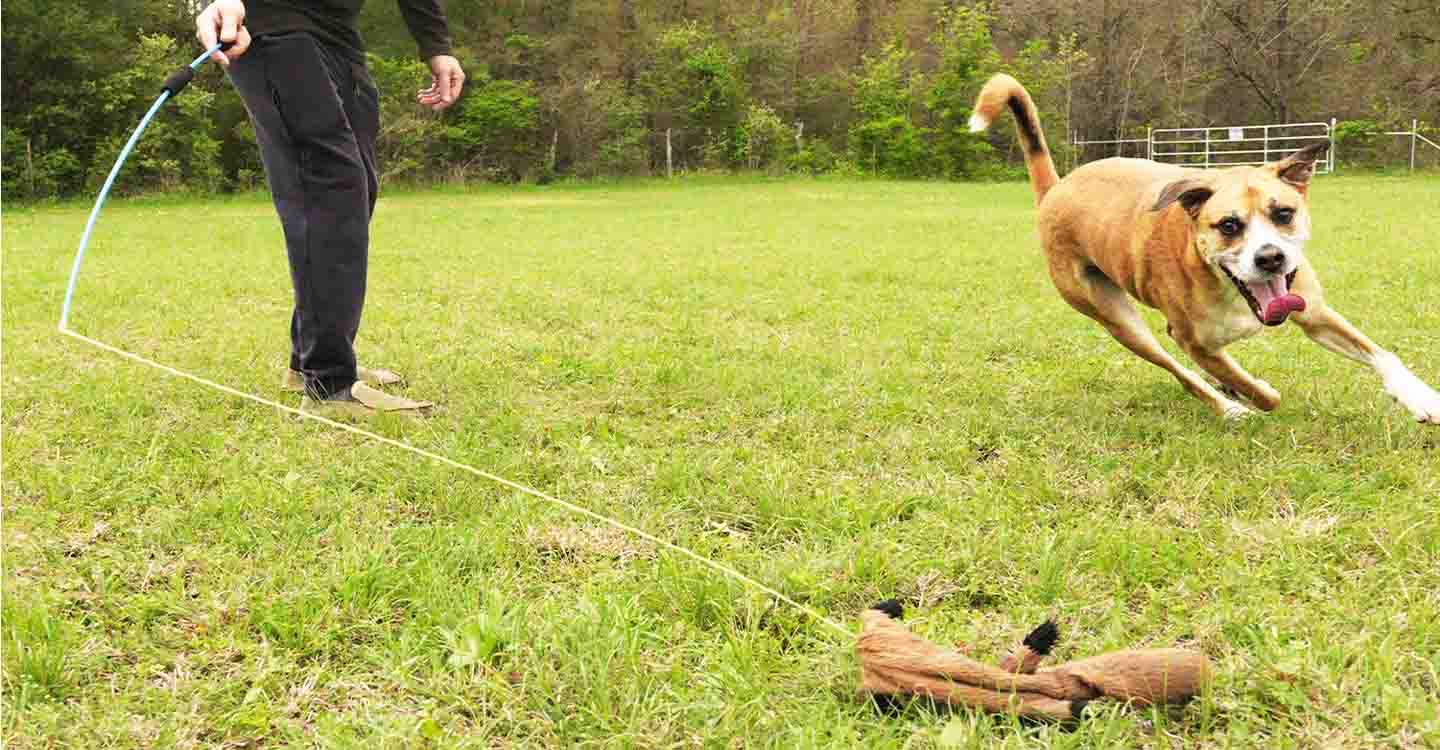
When you’re short on time, a flirt pole gets a lot done fast. The dog sprints, cuts and catches in a small space, and with the right length pole the dog does the running and you mostly stand there. You can even do it worn out after a long shift.
It also finishes the predatory motor pattern a walk leaves hanging, stalk, chase, catch. So your dog ends up satisfied instead of still looking for something to do. What clients tell me in general is their dogs are a lot more relaxed and calmer and seem more satisfied.
The session
- Warm up. A couple easy sweeps of the lure or a slow jog around the yard first. Going all out cold, especially first thing in the morning, is how a dog gets hurt.
- Go hard, in bursts. Short chases with a rest in between, lure low on the ground and turns wide, and let the dog catch it. Ask for a drop and a wait between rounds, the impulse control drills show how.
- Cool down. Toss a little food in the grass and let the dog sniff it out and come down before you leave or sit down.
Stop while the dog still wants more. On the days you’re fried, keep it short and let the puzzle feeder carry more. The habit matters more than any one session. The flirt pole training guide covers the first ones.
Puppies and health. Growing puppies should skip the high-impact bursts while their growth plates are still open, so keep young dogs on gentle play and puzzles and ask your vet when they’re ready for more. Same goes for older dogs or any dog with joint problems.
Is it ok to leave a dog while you work?
Lots of dogs handle being alone fine when they get real exercise before and after, and something to work on during the day. The trouble is the dog that’s alone all day and never got used up. How long is too long depends on the dog’s age and health, and puppies and older dogs need breaks more often, so ask your vet about yours.
When it’s not boredom
The AKC says to rule out separation anxiety if you’re seeing destructive behavior along with a clingy attitude. If the damage is around doors and windows and starts right after you leave, or the dog panics when you grab your keys, talk to your vet or a behavior pro. Exercise helps, but it won’t fix real separation anxiety by itself.
The pole I built for short, hard sessions
I bought the flirt poles I could find, handed them out to clients and watched what broke, then designed my own and tested it on high-drive client dogs for years before I sold one. The Rugged XL is one 46-inch piece of reinforced fiberglass with no joints and an 800-lb Dyneema line, for dogs 30 lbs and up. Under 30 lbs? That’s the Standard, with a 450-lb Kevlar line.
Rugged XL
- Dogs 30 lbs and up · 1 lure
- 800-lb Dyneema line · free US shipping
Rugged XL + 3 Lures
- Same pole and line, 3 lures to rotate
- Dogs 30 lbs and up · free US shipping
Rugged XL Pro Kit
- The XL with 5 lures and a spare line
- For dogs that shred lures · free US shipping
The Standard
- Dogs under 30 lbs · 450-lb Kevlar line
- $20 flat US shipping, cause it goes in a longer box
Every order has a 30-day money-back guarantee, and you pay return shipping unless the pole failed.
Want more of this in your Google results? Add Whimsy Stick as a preferred source.
Full-time schedule, FAQ
What can I do before work to tire my dog out?
A short hard chase session in the yard, then breakfast out of a puzzle toy, so it burns some energy and has to work for its food and starts the day spent instead of looking for trouble.
Do puzzle feeders help while I’m at work?
They do, mostly cause a dog that has to push and lick and nose its breakfast out for a while is using its head the whole time, and that wears on it. I’d keep two or three different ones and swap them so it doesn’t figure one out and get bored.
Is a quick walk enough for a high-energy dog?
Not usually, the AKC flat out says a 10-minute stroll is unlikely to tire any dog. You’d be better off taking that same little window and spending it on hard chase and a puzzle.
How long can I leave my dog alone?
There isn’t one answer for every dog, it really comes down to how old it is and how healthy, and young puppies and old dogs need to get out a lot more often. Your vet can tell you for yours, and if your days run long a walker or a lunch visit takes a lot of pressure off.
Should I get a dog walker or daycare?
If you’ve got the money and your dog’s by itself for long days, I’d say it’s worth it, and PetMD’s vet brings up daycare as a way to get a dog home tired. But if you’re really doing the morning and evening sessions you don’t have to, it’s nice to have, not something you can’t live without.
How do I exercise my dog when I get home exhausted?
Let the dog do all the running. You can stand in one spot, or honestly sit on the back steps, and work the pole while it tears around, and on the really bad days just hand it a stuffed puzzle and call it good.
Why does my dog wreck the house while I’m gone?
A lot of the time it’s boredom and leftover energy. But if it’s around doors and windows and starts right when you leave, it might be separation anxiety, so check with your vet or a behaviorist.
Is it cruel to have a dog and work full time?
No, not if you take care of what it needs around your hours, I know a lot of people working full days with happy dogs. What it takes is a routine you actually keep doing, even on the days you don’t feel like it.
Full schedule. Tired dog anyway.
Short and hard before work, something to chew on during, short and hard after. The Rugged XL is made for dogs 30 lbs and up, it ships free in the US, and you’ve got 30 days to send it back.
Add the Rugged XL, $75Under 30 lbs? See the Standard, $56
Based on my own experience training dogs. Not veterinary advice. Exercise disclaimer.


