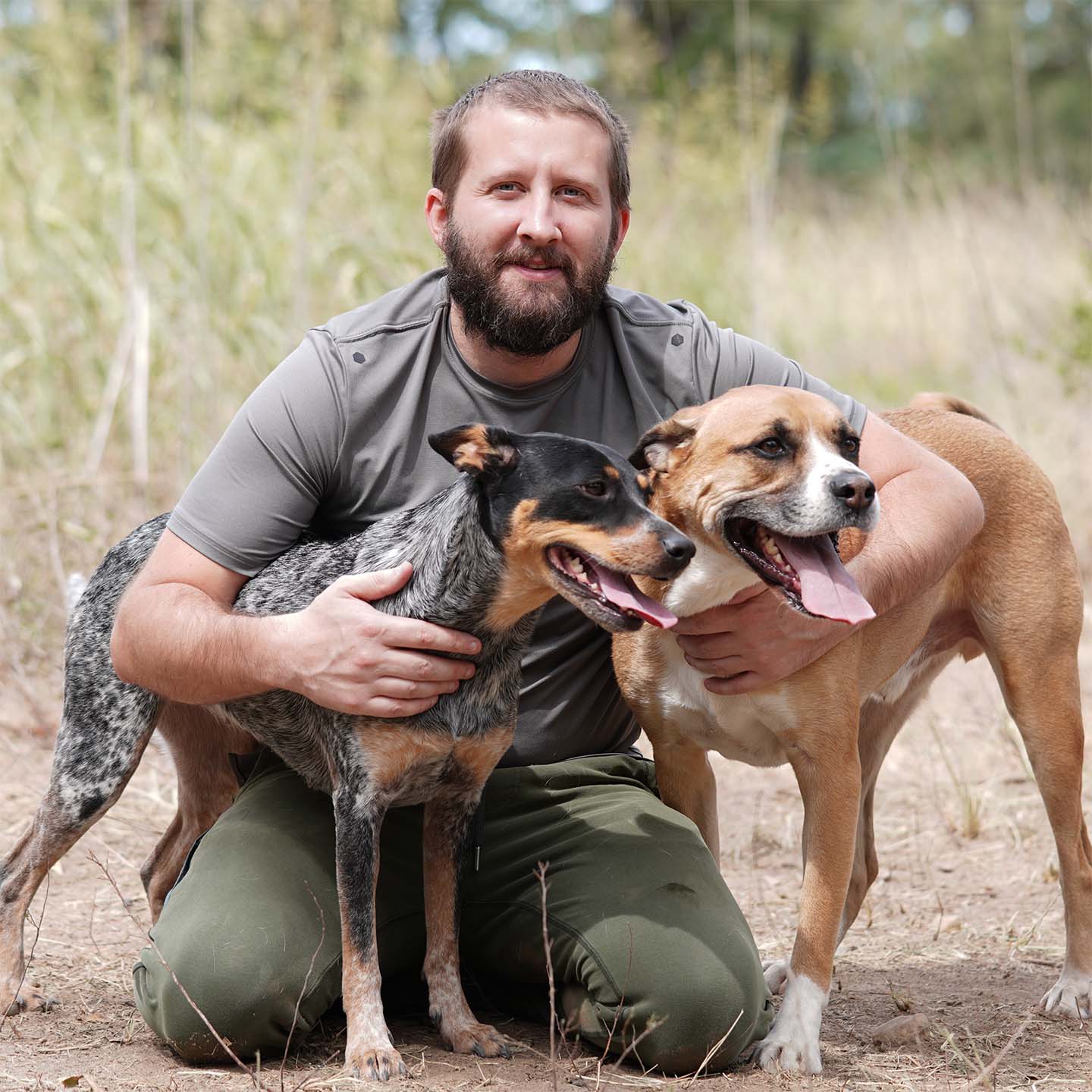
Pit Bulls, Staffies, Amstaffs, and bully mixes wreck most flirt poles for two reasons: bite force and grab-and-shake intensity. A pole that survives a Border Collie chase often fails within a week of pit bull use.
The spec that survives
The best flirt pole for pit bulls has a static high-tensile line, a one-piece reinforced fiberglass pole, and a lure attachment built for shake forces. Run 5 to 8 minute structured sessions four to five times per week and the destructive chewing, leash reactivity, and post-walk pacing most owners deal with start to resolve. This is the Controlled Freedom method I run across roughly 400 client dogs in my training work, and pit-class breeds make up the largest share. See the flirt pole training guide for the full session protocol.
Who This Guide Is For
- Owners of American Pit Bull Terriers, Amstaffs, Staffies, and bully breeds
- Owners of pit bull mixes and bully mixes over 30 lbs
- Anyone whose dog has destroyed multiple flirt poles or chase toys
- Owners dealing with destructive chewing, leash reactivity, or post-walk pacing
- Owners of American Bulldogs, Cane Corsos, and similar power breeds
Why Most Flirt Poles Fail Pit Bulls and Power Breeds

A pit bull does not chase a flirt pole the way a Border Collie does. Herding breeds orient, stalk, and pursue with precision. Power breeds orient, sprint, catch, and immediately initiate grab-and-shake. That difference is everything when it comes to gear failure. As a result, the grab-and-shake phase puts forces on a flirt pole that most poles are not engineered for. For instance, according to the American Kennel Club Staffordshire Terrier breed profile, catch-and-shake behavior is hardwired in breeds developed for the kill-bite phase, which is the phase that demolishes weak gear. For the broader behavioral framework, see prey drive training for dogs.
Static Dyneema Line
Bungee lines store elastic energy that snaps back during the catch-and-shake phase. A static high-tensile line rated for 800 lbs is the only line that survives pit bull grab forces and gives consistent, predictable feedback in both directions. Therefore, the Rugged XL runs an 800-lb Dyneema static line for this reason.
800-lb Dyneema static lineOne-Piece Fiberglass Pole
Telescoping poles shear at the joint under torque. A pit bull pulling laterally during the catch puts shear load on that joint the pole is not rated for. One-piece reinforced fiberglass eliminates the failure point entirely and survives daily heavy use.
Reinforced fiberglass, 4 ftReinforced Lure Attachment
Cheap clips and stitched fleece tear loose during the grab-and-shake phase. As a result, the dog ends up with the lure in its mouth and the session collapses into object guarding. Instead, a reinforced attachment survives the shake and lets the session end on a structured release.
Replaceable reinforced luresPower Breed Sizing
A flirt pole rated for a 25-lb dog can fail under a 60-lb staffy. The Standard size is for dogs 30 lbs and under. However, the Rugged XL is engineered specifically for dogs over 30 lbs including pit bulls, amstaffs, and all power breeds.
Rugged XL: rated 30+ lbsI have worked with hundreds of pit bull and power breed owners across 10 years. The pattern is identical every time. They cycle through three or four flirt poles, give up, and conclude their dog is unstoppable. The dog is not unstoppable. The gear was never built for the breed.
Christopher Lee Moran · Founder · 10 years training high-drive dogsThree Failure Points That Wreck Power Breed Sessions

The three failure modes below account for nearly every broken flirt pole I see in power breed homes. In particular, each one is structural, not a use error. As a result, the gear is rated for the wrong dog. The AVMA enrichment guidelines emphasize structured predatory play, but structured play requires gear that can survive the breed it is used with. For owners dealing with the underlying behavior, see dog destroying things when bored.
Bungee elastic failure
Bungee stores energy. When a power breed locks on and shakes, that stored energy snaps back at the handler or snaps the line at the attachment point. As a result, most bungee flirt poles fail within 2 to 4 weeks of pit bull use.
Telescoping joint shear
Telescoping poles flex at the joint under torque. In practice, a pit bull pulling laterally during the catch puts shear load on the joint the pole is not rated for. Eventually, the joint splits within the first month of heavy use.
Lure attachment tear
Cheap clips and stitched fleece lures tear loose during the grab-and-shake phase. Eventually, the dog ends up with the lure in its mouth, the line dangling, and the session ends in object guarding instead of structured release.
Five non-negotiables for power breed poles
- One-piece fiberglass pole, telescoping sections shear under grab-and-shake torque from a 60-lb dog
- Static Dyneema or equivalent 800-lb line, paracord twists and snaps; the line is your control point mid-session
- Replaceable lures, power breeds shred lures; a pole without replaceable lures becomes disposable
- Minimum 30-lb rated weight class, undersized poles fail under the lateral force of a direction-change at full sprint
- Grass or turf surface only, hard surfaces compound joint impact forces at every direction change
Worth a separate note for power breed owners: the heavy-duty marketed flirt poles do not solve this problem either. The category that bills itself as built for pit bulls and aggressive chewers, with DIBBATU as the dominant Amazon listing in that tier, uses threaded multi-piece construction that addresses pole snap but not the underlying joint-shear physics. The threads loosen progressively under repeated lateral catch force, and within several months of daily power-breed use, the joints develop play that ruins the lure feedback even before the pole fails outright. For the full breakdown of why heavy-duty marketed flirt poles still fail power breeds, see the comparison.
“Most flirt poles sold to pit bull owners fail within two weeks. Not because the dog is too much, because the pole was built for a Pomeranian. Rugged XL is built for the dog, not the marketing photo.”
Christopher Lee Moran · Controlled Freedom Method · my private training practiceThe Breeds That Need Power-Breed Grade Gear

The pit bull category is broader than most owners realize. Several breeds share the bite force, drive intensity, and grab-and-shake behavior that wrecks general-market flirt poles. If you own one of these, the best flirt pole for pit bulls is the right tool for your dog. Therefore, the table below compares power-breed-grade gear vs everything else across every spec that matters. For the working-breed comparison, see flirt pole training for GSDs and Malinois.
The Structured 5 to 8 Minute Session That Works


The right tool only matters if the session is structured. In practice, power breed owners who let their dog run flat-out for ten minutes on a flirt pole produce one of two outcomes: an overheated dog and a torn-up lure, or a wired dog whose drive escalated instead of resolved. The structured session below runs the full predatory sequence with rest built in. For owners dealing with the underlying behavior, see dog hyper after walks. For owners who want to compare line behavior specifically (because the wait-and-release impulse control phase depends on consistent line feedback), the static line precision comparison covers why bungee inconsistency disrupts the wait phase even on otherwise capable tools.
Before your first session
Heat load, the real ceiling on pit bull sessions. Pit bulls, staffies, amstaffs, and bullies carry more muscle mass than working breeds and several lines have a shorter muzzle. That combination is a thermoregulation disadvantage. Stop the session the moment the tongue widens and flattens, the dog starts gulping air, or recovery between rounds stretches past 30 seconds. Run sessions on grass in the cool side of the day, never midday in heat or humidity, and keep water on hand.
Growth plates, under 12 months, no full sessions. Under 6 months: investigation reps only with a motionless lure, no chase. 6 to 12 months: short ground sweeps, 2 to 3 minutes max, no high-impact direction changes. Full 5 to 8 minute structured sessions begin after 12 months once growth plates have closed. The 8-week puppy in the hero clip is in a brief investigation rep, not a full session.
Prey drive is not aggression. Structured chase work resolves prey drive on a lure. It does not produce or rehearse human-directed aggression. Owners with a dog showing genuine aggression toward people or other dogs need a qualified behaviorist, not a flirt pole. The protection-dog clip lower on this page is a build-test of the gear under bite-and-shake load, not protection-sport instruction.
The four phases, in order
Lure motionless on the ground. Dog holding position. Then wait 5 to 10 seconds before releasing. This is the impulse control rep. In particular, for power breeds this is the most important phase of the session because it transfers directly to real-world reactivity and leash pulling.
Impulse ControlRelease and move the lure in ground arcs with cuts and unpredictable pauses. Keep the lure low. As a result, ground movement produces the sprint pattern that taxes the dog physically without producing jumping injuries. Power breeds are not built for repeated high jumps, so ground arcs only.
Chase PhaseStop the lure completely and let the dog catch and possess for 3 to 5 seconds. This is the critical phase for power breeds. Without catch-and-shake completion, the session loads drive without discharging it. Therefore, the catch is what resolves the prey drive sequence. For the underlying mechanics, see predatory motor pattern explained.
Catch PhaseThe grab-and-shake protocol
Activate the chase
Drag lure erratically, let drive build for 3–5 reps before allowing the catch
Allow the capture
Drop tension on the line, let jaws close on lure fully
Let them shake it
5–10 seconds of shake-and-hold; this is the neurological win phase
Cue the out
Give drop-it cue; the moment they release, restart the chase immediately
Cooldown and locking in change
Verbal all-done cue, lure put away out of sight, then down or place with calm reward. Next, follow with a chew or puzzle feeder for 15 minutes. This deliberate ending teaches the dog that sequence completion means rest. Lastly, this is the part most owners skip, and it is the part that locks in the behavioral change.
Session End
The Tool Built for Power Breeds

For pit bulls, staffies, amstaffs, bullies, and any dog over 30 lbs, the Rugged XL is the only option. The Standard size is rated for dogs 30 lbs and under. Using the wrong size is a structural safety issue, not just a durability question. For the deep-dive on the brand comparison, see the best flirt pole for dogs page.
If your pit bull mix is on the smaller side or you have a smaller terrier-type breed, the Standard is the right size. 4-ft balanced pole, 500-lb Kevlar static line, Unlucky the Squirrel lure. $20 flat shipping.
800-lb Dyneema static line, one-piece reinforced fiberglass pole, 3 reinforced lures. Built for the catch-and-shake forces that snap general-market flirt poles in half within weeks. Free US shipping on all Rugged XL orders.
The Rugged XL is not theoretical durability. The build started as a DIY rig I ran with protection-trained pit bulls under bite-and-shake load, the exact failure scenario every general-market flirt pole breaks under. The current production version is the same engineering, refined.

Pit Bull Flirt Pole FAQ
Gear and safety basics
Session length and durability
Behavior and sizing
Routine and getting started
Picking the right model

One more, just for you. Power breed personality, unedited. Hose, lure, leaf, light, the prey wiring fires the same way every time.


