
How to Stop a Dog From Digging Up the Yard
How do you stop a dog from digging? You figure out why it’s digging and fix that reason, cause filling the holes just moves them. Most yard digging is boredom and energy with nowhere to go, so a real outlet every day plus some brain work does the most. Then you cool off the hot dog, block the fence line on the escape artist, and give a born digger one spot where digging is allowed.
The one line I’d tape to the back door: veterinary behaviorists Debra Horwitz and Gary Landsberg write for VCA that “inhibiting or preventing all digging, without understanding and dealing with the dog’s motivation, could result in new behavior problems.” Stop the holes without fixing the reason and you get chewing or barking instead.
By Christopher Lee Moran, working dog trainer, about 10 years and around 400 client dogs, Controlled Freedom method. I’m a trainer, not a vet. I make the Whimsy Stick.
Who this is for
Your yard looks like a minefield, the flower bed’s gone, and every time you fill a hole a new one shows up somewhere else. Your dog’s not doing it to get back at you. Usually it found itself a job cause nobody gave it one.
- Your yard is full of holes
- Your garden keeps getting torn up
- You’ve got a terrier, a husky or another breed known for digging
- Your dog digs under the fence
- You’ve tried yelling and it didn’t do anything
- Your dog spends a lot of time out in the yard by itself
Why dogs dig: read the holes
Where your dog digs and when it digs tells you why, and the why decides the fix. The Humane World for Animals guide (the group that used to be the Humane Society of the US) lays out the clues pretty clearly, so here’s how I’d read your yard.
| Where the holes are | Likely reason | What I’d do first |
|---|---|---|
| All over, while the dog’s out alone | Boredom, energy, fun | Daily hard exercise and brain work |
| One area, tree roots, in a “path” | Hunting something underground | Find the critters and humanely keep them out |
| By the house, shade trees or water, dog lies in it | Cooling off or shelter | Shade, water, bring the dog in on hot days |
| Under or along the fence | Escape | Secure the fence line, then find out what it’s going after |
| Right in front of you | Attention | Don’t react, and give more real time together |
Boredom and energy
This is the big one. Humane World says dogs may dig for entertainment when they learn the dirt and roots “play back,” and lists dogs left alone in the yard for long periods, a barren yard with no toys, puppies and adolescents with no other outlet, and active breeds that need a job. The VCA behaviorists put play and exploration near the top of the list of reasons, and that it’s like destructive chewing when a dog is left alone without enough stimulation. If the holes show up every time your dog’s out alone, start here.
Breeding
Some dogs were built for it. The AKC article on digging says many hunting dogs, like terriers and small hounds, were bred to dig quarry out of dens. VCA adds that northern breeds like huskies and malamutes dig cooling holes and lie in them. With these dogs the AKC goes as far as saying it’s “often unfair to ask the dog to stop doing it,” so you manage it and give it a spot.
Hunting, heat and escape
If you’ve got moles or voles, a dog with a good nose and good ears is gonna go after them, and VCA says those dogs will keep at it unless you get rid of the prey. A dog digging by the foundation or under a shade tree and lying in the hole is usually just hot. And a dog digging along the fence is trying to get somewhere, which the AKC says is more often than not boredom or anxiety too.
When it’s stress, not boredom. The AKC says most active diggers are either very bored or have separation anxiety, and that anxious dogs can get obsessive about it. If the digging only happens when you leave, or it shows up along with other anxious changes, talk to your vet or a behavior pro. Exercise alone won’t fix real separation anxiety.
Fix #1: get the energy out before the dog goes outside
For a bored digger, this is where most of the fix is. A dog with a tank full of energy and an empty yard is gonna make its own fun, and the dirt’s right there. VCA says additional play, training and exercise may be needed, “especially if your dog is young and very active,” and that a dog left outside unsupervised should go out after it’s had enough social time and exercise.
So the order matters. Exercise first, then the yard, not the other way around. Humane World also says to walk your dog at least twice a day, play with active toys and practice a few commands or tricks for five to 10 minutes daily. The enrichment and mental stimulation page has more brain games.
Why I use chase for a digger
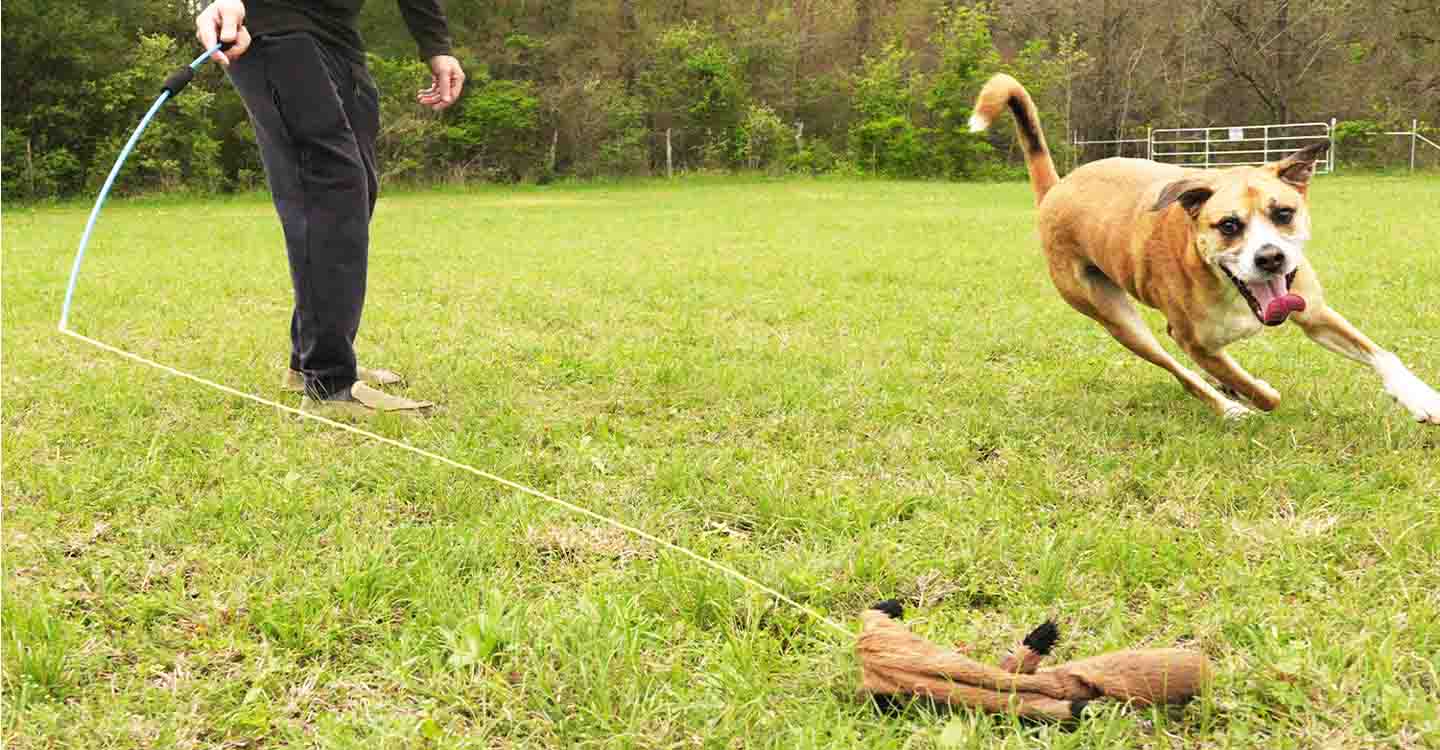
A lot of diggers are using up hunting drive in the dirt, so I’d rather give that drive a real target. With a flirt pole the dog gets to stalk, sprint, cut and catch the lure, the whole predatory motor pattern, and a few hard rounds of that use up what would’ve gone into the flower bed. What clients tell me in general is their dogs are a lot more relaxed and calmer and seem more satisfied. Keep the lure low, rest between rounds, and quit before the dog’s wiped out. The flirt pole training guide covers the first sessions.
Leave something to do out there
If your dog has to be out there without you, VCA suggests food puzzle toys so it works for food instead of digging, and Humane World says to keep interesting toys in the yard and rotate them. A stuffed rubber toy buys you a lot more than an empty lawn does.
Fix #2: give a real digger one spot where it’s allowed
You’re not gonna train the dig out of a terrier, so give it somewhere to go. All three sources say the same thing here, set up a spot where digging is ok and make it the best spot in the yard.
- Pick the spot. A corner with loose soil or sand, or a kid’s sandbox. VCA suggests marking it off with railroad ties.
- Load it up. Bury toys and treats in it. VCA says to start with food just barely covered, then go deeper, and bury things when your dog isn’t watching.
- Reward it. When the dog digs there, praise it big.
- Redirect the rest. Catch it digging somewhere else, interrupt it and walk it over to the pit, which is what Humane World recommends.
- Close the old spots. Rocks or chicken wire over the favorite holes, at least for a while.
Secure the fence line
Digging out is a safety thing, cause a dog that gets under the fence can get hit or lost. Humane World suggests burying chicken wire at the base of the fence with the sharp edges rolled away from the yard, partly burying big rocks along the bottom, or burying the bottom of the fence 1 to 2 feet down. Then work on why the dog wants out.
Fix the comfort problem
If the dog’s digging to cool off, give it shade, a cool spot and water it can’t tip over, and on really hot days VCA says it may be best to just bring the dog inside.
What doesn’t work
Punishing after the fact. Humane World is clear that it won’t address the cause and “will worsen any digging that’s motivated by fear or anxiety.” Your dog can’t connect you yelling at a hole to the digging it did an hour ago, it just learns you’re scary around holes.
Filling the holes with water or staking the dog next to one, which Humane World lists under what not to do. And just blocking every spot without touching the reason, cause like the VCA behaviorists said, you’ll likely just get a new problem somewhere else.
When nothing’s working
If you’ve tried all of it and the yard’s still getting dug up, Humane World and VCA both say to keep the dog inside with you and supervise yard time until it’s learned. That isn’t giving up, it’s management while the training catches up. A behavior pro can help if you’re stuck.
The pole I built for dogs with this much drive
I bought the flirt poles I could find, handed them out to clients and watched what broke, then built my own and tested it on high-drive client dogs for years before I sold one. The Rugged XL is one 46-inch piece of reinforced fiberglass with no joints and an 800-lb Dyneema line, for dogs 30 lbs and up. Under 30 lbs, like a lot of terriers? That’s the Standard, with a 450-lb Kevlar line.
Rugged XL
- Dogs 30 lbs and up · 1 lure
- 800-lb Dyneema line · free US shipping
Rugged XL + 3 Lures
- Same pole and line, 3 lures to rotate
- Dogs 30 lbs and up · free US shipping
Rugged XL Pro Kit
- The XL with 5 lures and a spare line
- For dogs that shred lures · free US shipping
The Standard
- Dogs under 30 lbs · 450-lb Kevlar line
- $20 flat US shipping, cause it goes in a longer box
Every order has a 30-day money-back guarantee, and you pay return shipping unless the pole failed.
Want more of this in your Google results? Add Whimsy Stick as a preferred source.
Dog digging, FAQ
Why is my dog suddenly digging?
Look at what changed. Less exercise, more time alone, hot weather, or critters moving into the yard are the usual ones. If it came on with other anxious stuff, like pacing or trouble when you leave, check with your vet.
Does filling the holes stop digging?
Not on its own, the dog just digs a new one. Filling them is fine as part of the plan, but the reason it dug is what you’ve got to fix.
What breeds dig the most?
Terriers and small hounds were bred to dig out prey, per the AKC, and huskies and malamutes dig cooling holes, per VCA. With those dogs a dig pit works better than trying to stop it completely.
Will more exercise stop my dog digging?
If it’s boredom digging, it usually helps a lot. It won’t fix heat digging, hunting moles or real anxiety, so match the fix to the holes.
How do I stop my dog digging under the fence?
Block it first, buried chicken wire, partly buried rocks or a fence that goes 1 to 2 feet underground. Then figure out what it’s trying to get to and supervise until it quits.
Should I punish my dog for digging?
No. Punishing it after the fact doesn’t teach it anything and can make anxious digging worse. Catch it in the act, interrupt calmly and walk it to the spot where digging’s allowed.
How do I make a dig pit?
Loose soil or sand in one corner or a sandbox, with toys and treats buried in it, shallow at first. Praise the dog every time it digs there.
Can a flirt pole help with digging?
For a bored, high-drive digger, yeah, it gives the hunting drive a real target before the dog goes out. It’s one piece of the plan, not a fix for heat, prey or anxiety digging.
Save the yard. Spend the drive.
Find the reason, fix the reason, give a born digger its own spot, and run the energy out before the dog goes outside. The Rugged XL is made for dogs 30 lbs and up, it ships free in the US, and you’ve got 30 days to send it back.
Add the Rugged XL, $74.95Under 30 lbs? See the Standard, $55.95
Based on my own experience training dogs. Not veterinary or behavioral advice. Exercise disclaimer.


