
Are Laser Pointers Bad for Dogs? What a Chase With No Catch Does
Are laser pointers bad for dogs? I would not use one on a dog, and the reason is that the dog gets to chase the dot as hard as he wants and he never one time gets to catch it, cause there is nothing there to put his mouth on. The American Kennel Club says a game of laser pointer chase “can be very dispiriting for a dog and can lead to behavioral problems.” Now not every dog that has chased a red dot is going to end up with a problem, and I will get into how strong the evidence is further down, but I do not see what the dog gets out of it that he could not get from chasing something he is allowed to grab.
Is your dog already doing it? If he has got to where he stares at the walls or he is hunting around for reflections and shadows, then how to stop is the part of this page you want. And if he is skipping his meals over it I would not sit on that, I would be on the phone with the vet today.
By Christopher Lee Moran, working dog trainer, about 10 years and around 400 client dogs. No certifications or vet credentials, I learned by doing the work. I make the Whimsy Stick, which is a chase toy, so I’m not neutral about any of this.
Why a dog chases the dot in the first place
Your dog is not chasing that dot because he thinks it is a toy, he is chasing it because it is little and it is quick and it keeps darting off away from him, and that is pretty much how anything he could hunt is going to move. The American Kennel Club puts it this way, “The movement of a laser pointer triggers a dog’s prey drive, which means they want to chase it.”
So that dot is doing the same job on him that a squirrel would do or a rabbit or the lure on the end of my flirt pole, and I think that is why it works as good as it does and why people like it, cause you can be sitting on the couch moving your wrist around and the dog is flying all over the living room.
The chase is only one part of it
Now the chasing is just one piece out of a longer string of things a dog is built to do, where he is going to look at it and stalk it and chase it and then at the end of all that he gets to grab it and bite down on it. I went through that whole string on the predatory motor pattern if you want to read all of it, but what you need to know for this page is a laser gets the front half of that going and then there is not a back half for him to get to.
What goes wrong when there is no catch
The AKC calls it “an unending game with no closure for the dog since they can’t ever catch that beam of light,” and closure is the word I would have picked for it too. If it is a ball or a tug or a lure then there comes a point where he has got it in his mouth and he knows he got it, but with a dot of light he goes and puts his paw down on it and now it is sitting on top of his paw, and then you let off the button and it is gone and he does not have any idea where it went to.
Debby McMullen, a certified dog behavior consultant, wrote in Whole Dog Journal that “chasing a laser pointer is prey drive without the prey,” and I have tried and I can’t come up with a shorter way to say it than she did.
He keeps looking after you put it away
Out of all of it this is what I would worry about the most, because the AKC says “many dogs continue looking for the light beam after the laser pointer has been put away,” and that it can turn into a dog “frantically looking around for the light” or reacting to any flash, and the example they give is your watch face catching the sun. So you might be done with the game but that does not mean he is, cause as far as he can tell that thing is still in the house somewhere and he has not got it yet.
And it can wind a dog up
Karen London is a certified applied animal behaviorist and she did a piece on this for Adopt a Pet where she comes right out with “I recommend against the use of laser pointers with dogs.” Why she says it is that “constant chasing without ever being successful at catching the moving object can frustrate dogs, leading to obsessive and destructive behaviors.” And she has the eyes in there too, that there is the potential for eye damage if the laser shines right in the dog’s eyes by accident, which is the same as it would be with you or me, so I would just leave the thing in the drawer.
How strong the evidence is
You are going to see “laser pointer syndrome” written all over the place, and when I hear that it sounds to me like it came out of a medical book, so I went looking for the study on dogs that proves a laser pointer is what causes it and I never did find one. All I could find was behaviorists and trainers and the kennel club telling what they have watched dogs do, and I will say that just about every one of them ended up telling you don’t do it. Now it is not that nobody has seen it happen, cause London says “there are many cases of dogs who were diagnosed with obsessive-compulsive disorder after (and perhaps partly as a result of) this activity,” and the AKC says it “can create obsessive compulsive behaviors,” it is that what they have got is cases, and I could not find the study on dogs that shows the one caused the other. The closest I came to one was a survey of people that own cats and I put that down in the questions at the bottom.
What I can and cannot tell you
That is why you are not going to hear me say five minutes with a red dot went and ruined your dog, cause I can’t prove that to you and I have not seen where anybody else can, and I would bet there are a lot of dogs out there that chased one a few times and nothing ever came of it. Still, these are people that work with dogs for a living and they keep saying the same thing, and quitting it is free. And if my dog was one of those that already locks on hard to anything that moves, I would not want him to be the one I tried it out on.
Which dogs I would be the most careful with
I did not see a list of breeds in any of those and I am not going to sit here and make one up for you. If I go by what the dot is turning on in the dog, then the ones I would be the most careful with are dogs that already do a lot of staring and stalking, or a dog that is already hung up on something. If yours is that way about a ball then I have a page on a dog that is obsessed with the ball and a lot of it carries over. McMullen says the same thing about games where the dog does get to catch, that there are “some OCD concerns with some dogs to be aware of,” so a catch is better than no catch but I would still keep an eye on a dog like that.
Signs the laser is becoming a problem
I got these from what Whole Dog Journal and the AKC have listed, and if you are seeing any one of them out of your dog then I would quit with the laser that same day. Now a dog can do any one of these for some other reason too, so you seeing it does not prove the laser is what did it, and that is one more reason I would let the vet have a look if it keeps up.
- He keeps on going back to the spot where he saw the dot last and searching it, and he will do that over and over.
- He has started going after sunbeams and lights on the wall and reflections off of things, and McMullen tells about one dog that went wild when his owners got the aluminum foil out cause the sun was coming in the kitchen window and hitting it.
- You will see him get to spinning in circles because of how frustrated he is.
- When you put it up he is looking all around the room for it and he is frantic about it.
- He is so stuck on lights and shadows that nothing else matters to him, and how far that can go is a dog that won’t even quit to eat his dinner.
And then London says to watch what his body is doing while he is playing it, cause she calls it “frantic pouncing on the dot” and says it can be “filled with tension” for the dog, and to me that does not look anything like a dog that is loose and having himself a good time.
How to stop if you already started
Whole Dog Journal does not dress it up any, they tell you to stop playing it and that you do not ever pick the laser pointer up again. I would go one more than that and get it out of the house, cause if it stays in the junk drawer then somebody is going to dig it out of there one day and think it would be funny.
Give him something else to do with it
He is still going to have all of that want-to in him after the laser is gone and it needs somewhere to go. McMullen has a list of things and on it is scent work and tug and walks where he gets to sniff and some training every day, and a flirt pole is on there too. She says with a flirt pole or a game of catch “the completion is there,” and if you do it right he can let the game go when it is over.
If somebody in the house will not give it up
Now if you are bound to keep on using one anyway, London has kind of a halfway step for that, and how it goes is you take the dot and walk the dog over to some treats with it or to a toy, and that way when the chase is done there is something sitting there he can put in his mouth. That is for cutting the risk down while you are still playing it, and she says it only “slightly lowers the risk,” so I would not take it for a way to fix a dog that is already out hunting lights, and with that dog I would quit the laser altogether.
Will it go away
If what you want to know is will it go away, I can’t give you a number of days on that, cause not one of these sources gives one and I am not going to sit here and make one up. What McMullen tells you is that you have to “patiently engage your dog in other activities,” and that how you go about redirecting him depends on the individual dog. And you do not have to wait until he is skipping his meals before you get some help with it, cause she says right in there that there is nothing wrong with getting a behavior professional to help you, so if the laser has been gone a while and he is still at the walls and it is not letting up any or it is getting worse, I would go on and call the vet.
When it has got past what you can fix at home. Whole Dog Journal says if your dog regularly ignores basic needs such as meals then he needs help and he needs it quick, so that is the vet first, and then once the vet has seen him a rewards-based behavior consultant that will work with your vet on it. I train dogs and I am not a vet, and once it has got that far I would be sending you to your vet anyway.
What to chase instead
What people like about a laser is the dog is doing all of the running and they are not doing any, and I am not going to get on anybody for wanting that, and you can keep that part of it. The funny thing is the AKC warns you off of lasers and then right there in that same article they tell you what to pick up in place of it, and what they tell you is “try a flirt pole,” cause you can stand in one spot with it and sling the toy around and you hardly have to move.
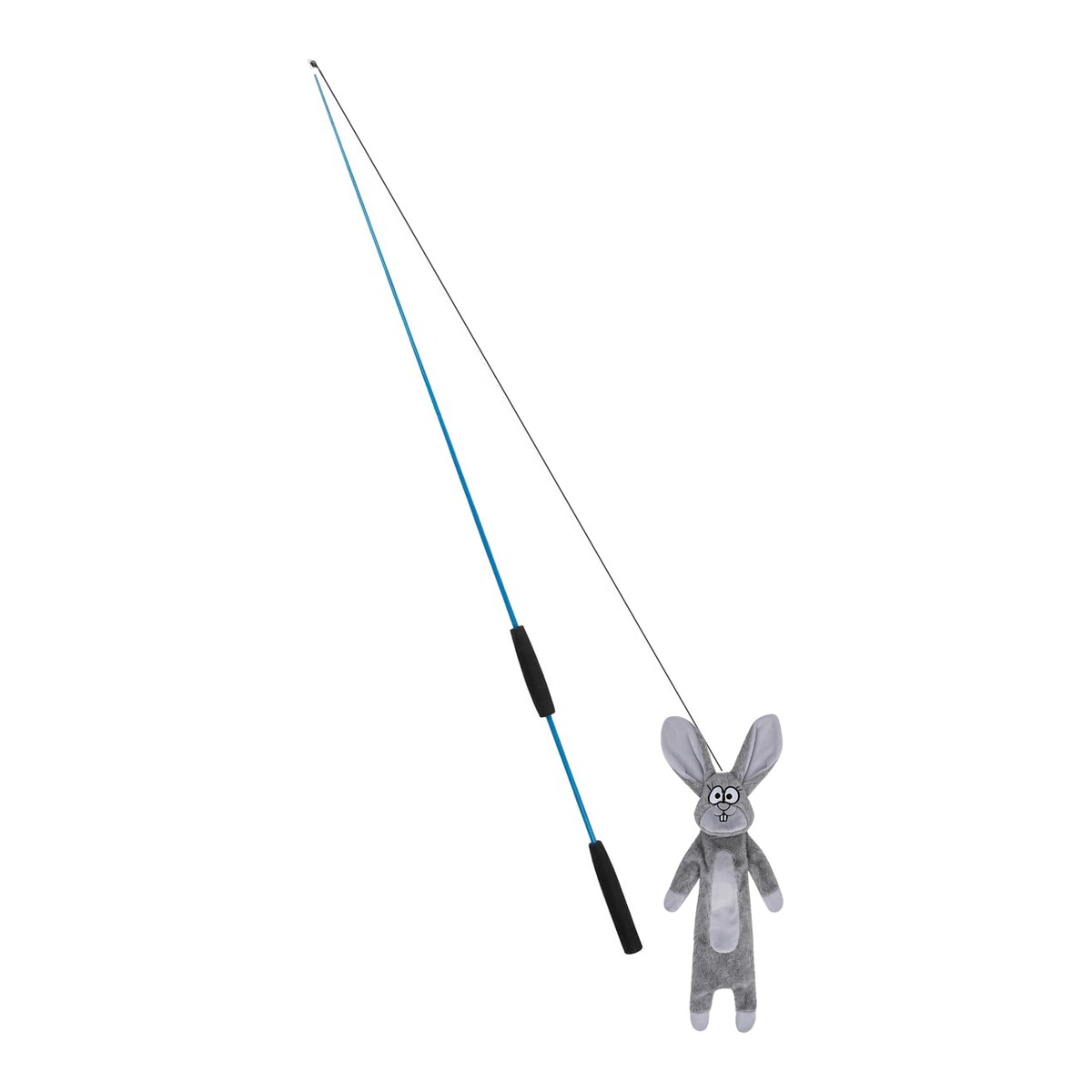
If you have not seen one, a flirt pole is a pole with a line tied on it and then a lure on the end of that line, and the lure moves a whole lot like the dot does, quick and low to the ground and going away from the dog, only this time when he gets to it there is something there for him to bite. I have a page on what is a flirt pole that goes through all of it.
Let him catch it, and a lot
Now if you go and buy a flirt pole and then you never let your dog get a hold of the lure, all you did was build yourself a laser pointer that has a handle on it, so I would let him win and I would let him win a lot. He gets to chase it and catch it and hold on to it and tug on it some, and then you ask him to drop it and you go again, and that drop it part is where most of the training is at. I have that laid out step by step in the flirt pole training guide and the impulse control drills.
Keep it short and end it on purpose
The other thing you do not ever get with a laser is an ending to it. With the pole I would let the last thing that happens be him catching it, and then I would trade him out of the lure and put the pole up somewhere he can’t get to it, so there is an end to the game that he can see, and an end is the one thing that dot was never going to give him. If this is all new to you then how to introduce a flirt pole is the first page I would read.
And I am not telling you it has to be a flirt pole, because fetch will do it and so will tug or hiding treats around the house for him to find, and what all of those have going for them is he gets to finish. I am partial to the pole when it is a dog with a lot of chase in him, and I get into why on how to train a high prey drive dog.
Which Whimsy Stick to get
I tried a lot of flirt poles before I ever made mine and they were too short or too bulky or just too heavy, and so I ended up building my own. There are two sizes and you go by what your dog weighs. Under 30 lbs gets the Standard and 30 lbs and up gets the Rugged XL, and if he is right at 30 or still growing I would go with the XL.
Rugged XL + 3 Lures
- Dogs 30 lbs and up · one-piece 46-inch fiberglass pole · 800-lb Dyneema line
- Free US shipping · pre-order, ships by December 10
Rugged XL Pro Kit
- Same pole, five different lures (Meerkat, Rabbit, Fox, Coyote and Sloth) and a spare 800-lb line
- Free US shipping · pre-order, ships by December 10
Rugged XL
- Same pole and line, 1 lure
- Free US shipping · pre-order, ships by December 10
The Standard
- Dogs under 30 lbs · 1 lure · 450-lb Kevlar line
- $20 US shipping, cause it goes in a longer box · usually ships within 2 days
Every order has a 30-day money-back guarantee on it, and you would pay the shipping to send it back unless the pole failed. Extra lures are $13 for when your dog wears one out.
Want more of this in your Google results? Add Whimsy Stick as a preferred source.
Laser pointer questions
Are laser pointers bad for dogs?
I would not use one. The dog chases a dot he can never catch, and the AKC says that can be very dispiriting for a dog and can lead to behavioral problems.
What is laser pointer syndrome in dogs?
It is the name people use for a dog that got hooked on chasing lights after laser play, so he hunts for reflections, shadows and sunbeams. It is a description that trainers and behaviorists use and I did not find a controlled study on dogs that proves the laser is what causes it.
Why does my dog keep looking for the red dot?
Because he never caught it. The AKC says many dogs continue looking for the light beam after the laser pointer has been put away.
Can a laser pointer hurt a dog’s eyes?
Karen London, a certified applied animal behaviorist, says there is the potential for eye damage if the laser accidentally shines directly in the dog’s eyes. For anything going on with your dog’s eyes I would ask your vet.
Is it okay if I end the laser game on a treat?
It is better than not doing it, and London says leading the dot to a treat or a toy only slightly lowers the risk. I would just use a toy he can catch.
My dog chases shadows now. What do I do?
Stop the laser and do not pick it back up, and give him chase games that end with a catch. If he is ignoring his meals over it, Whole Dog Journal says that is a prompt trip to the vet.
What can I use instead of a laser pointer for my dog?
Something he can put his mouth on. The AKC suggests a flirt pole for a dog that loves to chase, and fetch, tug and hiding treats all work too.
Are laser pointers bad for cats too?
I train dogs and not cats, so I would ask your vet about your cat. There is a 2021 survey of 618 cat owners in the journal Animals that tied more laser play to more chasing of lights and shadows, and the authors say that is a correlation and not proof. I do make a flirt pole for cats, and that one has a lure on it the cat can catch.
Can a laser pointer give a dog OCD?
Karen London writes that there are many cases of dogs who were diagnosed with obsessive-compulsive disorder after, and perhaps partly as a result of, laser play, and the AKC says it can create obsessive compulsive behaviors. I did not find a controlled study on dogs that proves it, and a diagnosis like that is one for your vet to make.
Can laser pointer syndrome be reversed?
None of the sources I read give a timeline for it and I am not going to make one up. Whole Dog Journal says to patiently engage the dog in other activities, and that a dog with an extreme case may need professional intervention.
Now I am a dog trainer and not a vet, so if you have a puppy that is still growing or an older dog or one with something going on in the joints, back or heart, I would ask your vet before you start any chase game. I have a page on who should skip the flirt pole and another one on using a flirt pole with a puppy.
Give him a chase he can finish.
Put the laser away and let him catch something, and you have 30 days to try mine.
Pre-order the Rugged XL + 3 Lures, $95Under 30 lbs? See the Standard, $56
Based on my own experience training dogs and the sources linked above. Not veterinary advice. Exercise disclaimer.


