

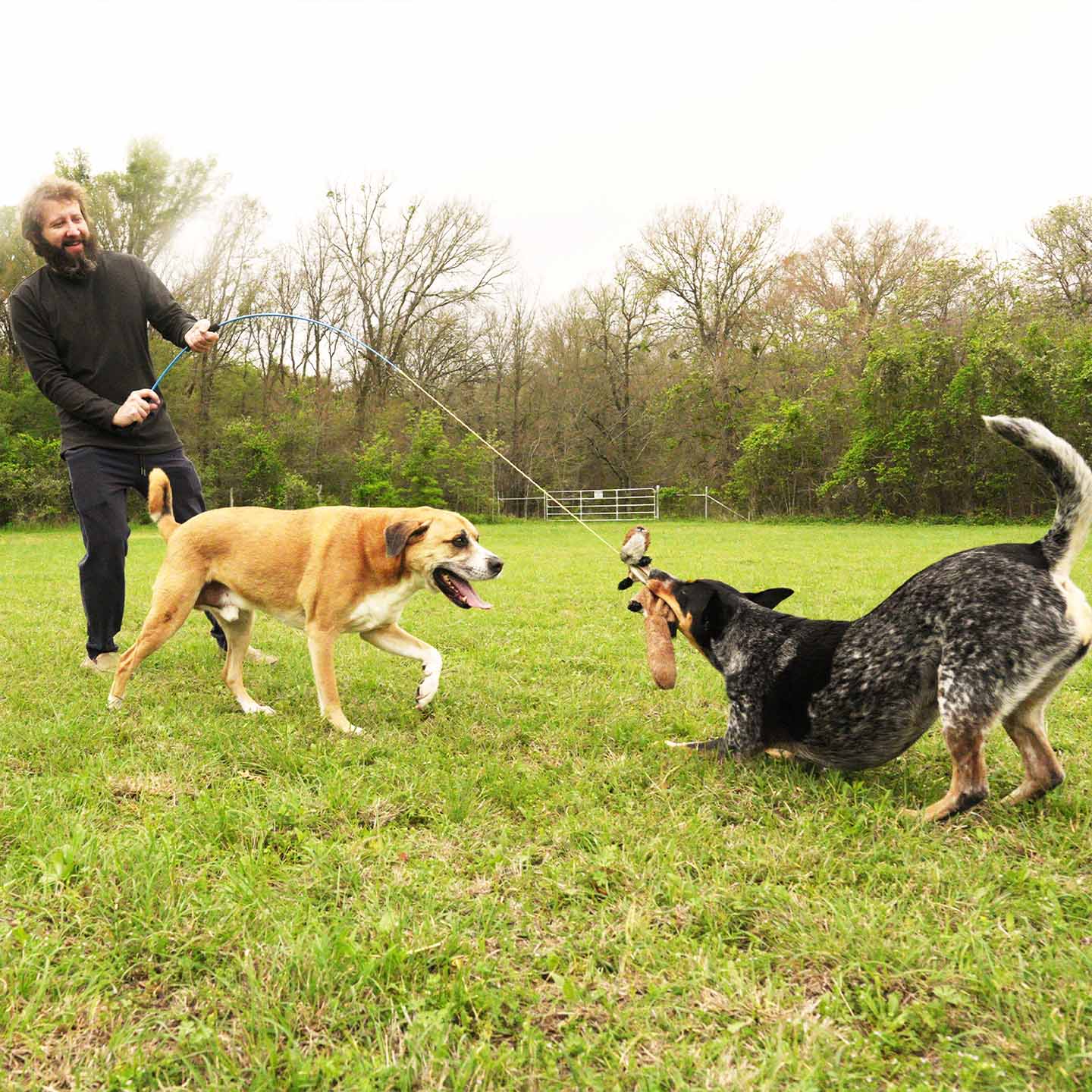
Quick summary
A lot of people focus on the toy, which ball or which rope or which squeaky plush. What decides if a chase toy works is movement type. Does he get to do the whole hunt with it, or only part?
Flirt poles and lure wands let him go all the way through it, spot it, stalk it, chase it, catch it, win and let go. Fetch and squeaky toys and tug only give him pieces of that, so you tend to get part of the result.
Who This Guide Is For
- Owners who want to know what kind of chase toy actually works.
- People whose dog gets bored with fetch and squeaky toys in a couple minutes.
- Owners of high-drive dogs whose toys get them going but never really satisfy them.
- Anybody trying to turn chasing into training with some structure to it.
- Trainers picking out gear for high-drive client dogs.
Signs the Current Toy Isn’t Working
- He plays for a couple minutes and walks away from it.
- He plays hard but ends up more wired, not tired.
- He goes from the toy straight to chewing furniture or stealing stuff.
- He tries to chase it but it doesn’t move like prey.
- Play’s over and he still won’t settle.
- The toy only gets part of the chase going, never the whole thing.
The Predatory Sequence: What a Chase Toy Should Actually Do
When a dog hunts it usually goes in six steps, so he spots it, stalks it, chases it, catches it, hangs on to it and lets go, and when he gets to do all six a lot of times he finishes settled. When he only gets some of them the drive gets turned on and never gets finished, and that’s why some toys leave a dog more wound up than when you started.
So what steps a toy lets him do has a lot to do with whether you get a calm dog or a crazy one. There’s more on the science side in predatory motor pattern, and the flirt pole training system covers how to run it as a training session.
The six phases in order
What a lot of reviews miss is that the steps that get skipped are where the problems come from. Chasing without ever catching leaves a dog frustrated and catching without the stalk can leave him over the top, and if he never gets to hang on to it there’s nothing that tells him it’s over. For more on that, see the 2026 flirt pole comparison.
So chase toys aren’t all the same. One that lets him finish the whole hunt tends to leave you with a calmer dog, and one that only gives him part of it can leave him amped up and unsatisfied. How it moves matters more than what it is.
The Four Chase Toy Categories (Ranked Honestly)
You can put pretty much every chase toy into one of four groups, based on how much of the hunt it lets your dog do. For more on the tool itself, see what a flirt pole actually is.
Flirt poles & lure wands
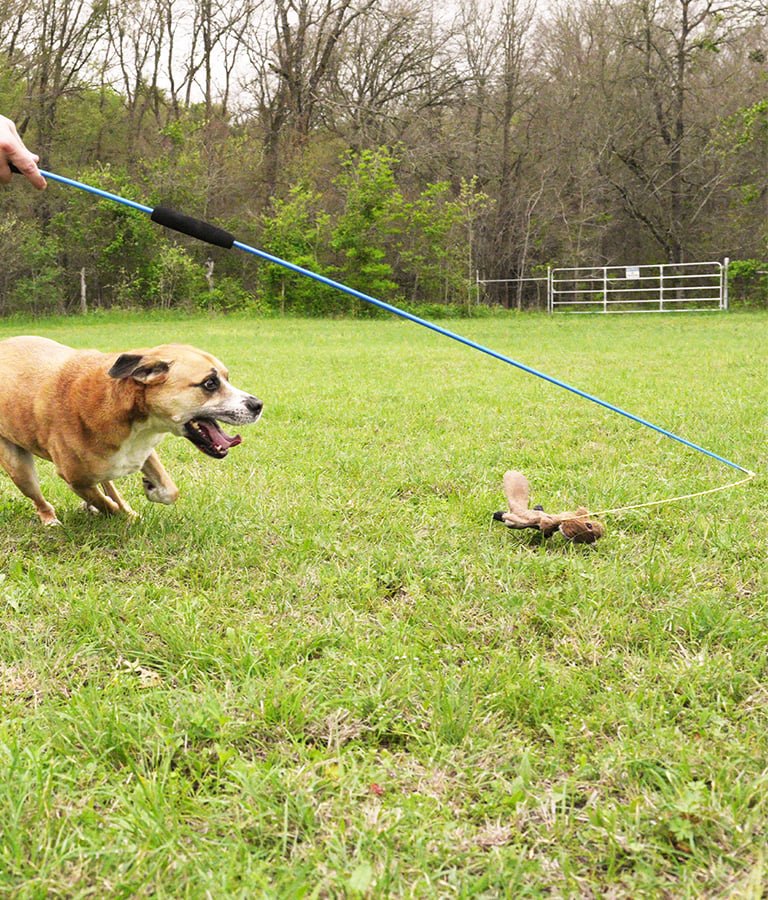
It’s a pole with a line and a lure that you control, and it moves along the ground where he can’t guess what it’s gonna do, stopping and changing direction and taking off again, and you decide when he gets to catch it and when you ask him to let go.
Fetch balls & toys
Something that flies the same way every time, and he runs to get it and does it again. It’s good exercise, but there’s no stalking and he hardly ever gets to keep the catch before he has to bring it back.
Squeaky plush & toss toys
Something he grabs and shakes, and the squeak gets his prey drive going for a second but there’s no real chase, so it can work as a reward inside a session but by itself it’s not much of a chase toy.
Tug ropes & bite tools
A pulling game with you on the other end, and it starts at the catch, so there’s no spotting or stalking or chasing. It’s a good thing to add for working breeds along with flirt pole work, but it’s not a chase toy on its own.
Side-by-Side: Which Phases Each Runs
The American Kennel Club has a good piece on giving prey drive an outlet instead of trying to shut it down, and PetMD’s enrichment guidance is worth a read too. What clients tell me in general is their dogs are a lot more relaxed and calmer after using the flirt pole.
The Chase Toy Decision Matrix
Why Movement Type Matters More Than the Toy
What makes a flirt pole work is how it moves. If it moves like prey he gets to go through the whole hunt. These three things are what make the difference. For why the pole is built the way it is, see why fiberglass wins on durability.
Low and horizontal
Prey moves on the ground and not in the air, so a lure that stays low gets a real chase going, and a toy that flies through the air just gets him jumping, which is hard on his joints and there’s no stalking in it.
Unpredictable direction
Prey changes direction all of a sudden to get away. When the lure cuts and stops, he has to keep watching it and guessing and adjusting, and that’s what makes a short session tiring for his brain and not just his legs.
Handler-controlled
You decide when he wins and when he lets go, and that’s what turns a chase into training, cause without it it’s just entertainment and he’s not learning any self-control.
That’s why a dog can get bored of fetch pretty quick and still be locked in on a flirt pole session, cause his brain is doing a lot more. For big dogs, the one I built to hold up to that is the Rugged XL flirt pole. For dogs that are still hard to tire out, see chase toys for high-energy dogs.
So I’d get a chase toy that moves like prey and not one that just sits in his mouth, something low along the ground and hard to predict, with you being the one moving it.
Size and Construction: Matching the Tool to the Dog
Once you know you want a flirt pole, it has to fit your dog and hold up. A lot of the poles I tried were too short, bulky, had a violent bungee cord, or were just too heavy. If it’s too light for your dog it can break, and if it’s too short there’s no real field of chase, and either way he doesn’t get to finish the hunt.
It’s pretty simple. Dogs under 30 lbs get the Standard, and dogs 30 lbs and up and high-drive working breeds get the Rugged XL. For more on what makes a good flirt pole, see best flirt pole for dogs.
Standard ($55.95): Dogs under 30 lbs. It’s about 4 oz with a 450-lb Kevlar static line, and it ships for $20 cause it goes in a longer box.
Rugged XL ($74.95 Base / $94.95 Bundle): Dogs 30 lbs and up. One 46-inch piece of reinforced fiberglass with an 800-lb Dyneema static line, about 8 oz. In my own use it holds up to a 120-lb power breed. Free US shipping.
The Standard
The everyday chase toy for smaller dogs under 30 lbs. It’s got a 450-lb Kevlar line and replaceable lures, and it’s light, about 4 oz.
The Rugged XL
The heavy-duty one for working breeds and power dogs. The line and lure are about 4 ft, so you get around 8 ft of reach, and the line is 800-lb Dyneema.
Standard $55.95, dogs under 30 lbs, $20 shipping. Rugged XL Base $74.95, dogs 30 lbs and up, one lure, free US shipping. Rugged XL Bundle $94.95, three lures, free US shipping. The XL has the Dyneema line, and the lures on both are replaceable.
Chase Toy for Dogs: FAQ
Basics · what it is
What is a chase toy for dogs?
It’s a toy that gets your dog chasing, and the good ones are moved by you and move like prey, low to the ground, changing direction, stopping and then taking off, so he has to track it and guess. Flirt poles and lure wands give him the whole hunt, but fetch toys, squeaky plush and tug only give him part of it.
Why do most chase toys fail high-drive dogs?
A lot of them only give a dog part of the hunt. Fetch is running and bringing it back with no stalk and no real catch, squeaky toys get his attention but there’s no real chase, and tug starts at the catch. A high-drive dog wants to do the whole thing, and when he never gets to finish it he can end up more wired than when you started.
Chase toy vs flirt pole
Is a chase toy the same as a flirt pole?
A flirt pole is one kind of chase toy, so every flirt pole is a chase toy but not every chase toy is a flirt pole. It’s a pole with a line and a lure, and you move the lure so he can’t guess what it’s gonna do. Fetch balls, squeaky toys and tug ropes only give him part of the hunt.
Sizing · frequency
What size chase toy do I need for my dog?
If he’s under 30 lbs I’d get the Standard, and if he’s 30 lbs and up or a high-drive working breed, get the Rugged XL, which is one piece of reinforced fiberglass with an 800-lb Dyneema line and about 8 ft of reach. A pole that’s too light for a big dog is the one that’s gonna let you down.
How often should I use a chase toy with my dog?
Short sessions of about 5 to 10 minutes most days is a good place to start, and doing it regularly matters more than doing it long, cause he gets an outlet he can count on. If you skip a bunch of days, don’t be surprised if the old behavior starts creeping back.
Puppies · outcomes
Are chase toys safe for puppies?
I don’t start a flirt pole before 6 months, and at 6 months it’s easy intro sessions only, a few minutes with the lure on the ground and no jumping or hard turns or sudden stops, and let your vet tell you when he can go full speed. The wait before the release and the drop it after the catch are the part that matters at that age anyway.
Can chase toys help with destructive chewing?
It can, when the chewing is coming from drive that never gets used, which happens a lot with high-drive dogs, cause a chase toy session gives him somewhere to put that besides your furniture. If the chewing only happens when you leave, that might be anxiety, and that’s a different problem, so talk to your vet or a trainer.


