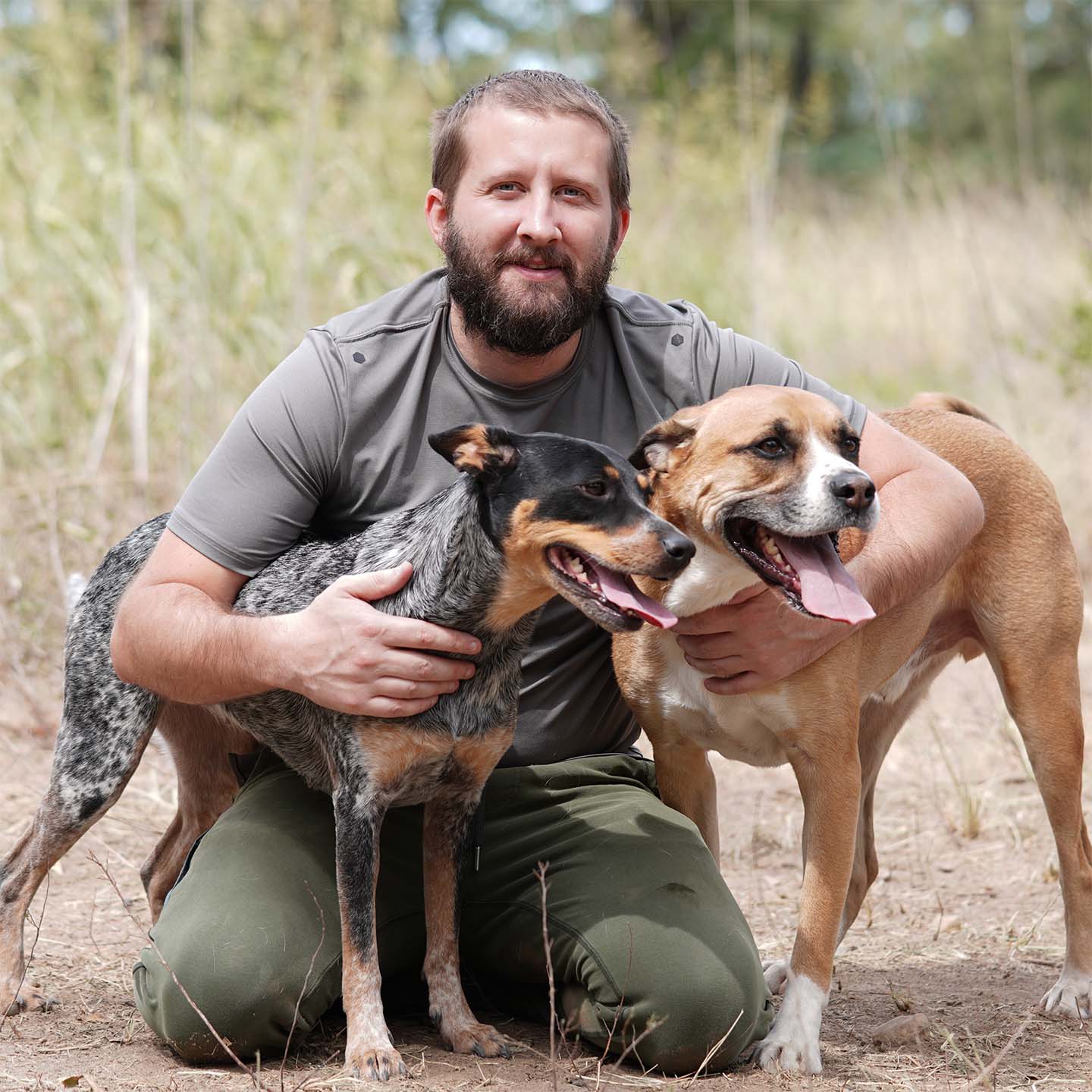
The best flirt pole for herding breeds lets the dog complete the predatory motor pattern it was bred to perform: eye, stalk, chase, capture, win. Every herding breed shares this sequence. When it resolves, you get a calm dog. When it doesn’t, you get nipping, circling, shadow chasing, and a dog that won’t settle no matter how far you walk it.
This guide covers Corgis (with spinal safety rules), Border Collies, Australian Shepherds, Cattle Dogs, Shelties, Kelpies, and the universal session framework that applies to the entire group.
Signs Your Herding Dog Needs Structured Chase Work
- Nips at ankles, children, or guests during movement
- Circles people or other animals obsessively
- Fixates on cars, bikes, joggers, shadows, or light reflections
- Still wired and restless after a long walk or run
- Destroys toys or household items when understimulated
- Cannot settle indoors despite plenty of physical exercise
If two or more of these apply, unresolved herding drive is typically the root cause. See the overexcited dog protocol or the behavioral problems guide for the full framework.
Why Herding Breeds Need a Flirt Pole
A flirt pole engages the predatory motor pattern every herding dog’s brain is wired to complete: eye, stalk, chase, capture, win. A 2024 study in Applied Animal Behaviour Science proposed the first formal ethogram for this predatory sequence in domestic dogs, confirming what trainers have observed for decades: dogs progress through distinct functional phases of searching, approaching, chasing, and capturing.
Herding breeds were selectively shaped across generations to run this sequence all day. According to the American Kennel Club’s herding group overview, all breeds in the group share an instinctual ability to control the movement of other animals, and that instinct is so strong it often manifests as herding family members, especially children. When the sequence has no legitimate target, the drive leaks out as behavior problems.
Heel nipping children and guests
Circling, blocking, and body-slamming
Light chasing and shadow fixation
These behaviors aren’t quirks. They’re a herding dog trying to complete a sequence that has no legitimate target. For the foundational method that applies to every breed, see the complete training guide. The AVMA’s guide to pet enrichment confirms that structured predatory play is among the highest-value activities for working and herding breeds.
Quick Reference: Herding Breeds at a Glance
| Breed | Drive Style | Session | Key Rule | Risk if Ignored | Equipment |
|---|---|---|---|---|---|
| Corgi | Low-stalk, heel nip | 8-10 min | Lure never leaves ground | IVDD / disc herniation | Standard, soft surfaces |
| Border Collie | Eye-stalk, intense focus | 10-12 min | Let them win often | OCD-like fixation | Standard or Rugged XL |
| Aussie | Chase-and-cut, high stamina | 10-12 min | Vary direction constantly | Destructive frustration | Standard or Rugged XL |
| Cattle Dog | Heel-drive, grip-and-hold | 10 min | Strong drop-it required | Escalating bite pressure | Rugged XL |
| Sheltie | Chase-and-bark, vocal drive | 8-10 min | Reward quiet captures | Excessive alarm barking | Standard |
| Kelpie | Endurance chase, relentless | 10-15 min | Handler ends, not dog | Pacing, restlessness | Standard or Rugged XL |
Corgis, Shelties, and smaller herding breeds: Standard (dogs 30 lbs and under). Larger or higher-drive herding dogs: Rugged XL (dogs over 30 lbs). See the buying guide for the full comparison.
Corgis: Herding Drive in a Long-Backed Body
Corgis have genuine herding drive trapped in a body that’s structurally vulnerable to spinal injury. Pembroke and Cardigan Welsh Corgis were bred to herd cattle by nipping at heels, ducking under kicks, and running all day. The behavioral fallout when that drive has no outlet is real: nipping, barking, circling, obsessive movement tracking, and a general inability to settle.
A structured chase tool is one of the most effective ways to channel that drive. But Corgis have a structural vulnerability that changes how you use it.
The Corgi Spinal Problem
Corgis are chondrodystrophic, meaning they carry a genetic mutation that produces disproportionately short legs relative to body length. This puts them at elevated risk for intervertebral disc disease (IVDD). As Cornell University’s College of Veterinary Medicine notes, activity management is essential for IVDD-prone breeds. One absolute rule: the lure never leaves the ground. For small spaces, the apartment guide covers adapting sessions for limited room.
- Keep the lure flat on the ground at all times
- Use slow, sweeping S-curve drag movements
- Play on grass, carpet, or soft dirt
- Limit sessions to 8 to 10 minutes
- Let them catch and possess the lure often
- Use gentle direction changes, not hard cuts
- Allow any jumping whatsoever
- Lift the lure above ground level
- Use sharp vertical flicks or bounces
- Play on hard or slick surfaces
- Run sessions beyond 10 minutes
- Let the dog twist or torque mid-air
A client’s 4-year-old Pembroke Welsh Corgi was nipping children’s ankles and circling guests obsessively. The owner had tried “ignore it” and “redirect with treats” for months with no improvement.
We started a daily 8-minute ground-level chase session with impulse control gates at every phase. Lure strictly on the ground. Slow S-curves on grass.
Week 2: Ankle nipping dropped by roughly half. Week 3: The Corgi started offering a sit when guests arrived instead of circling. The herding drive had a legitimate outlet, so the children’s ankles stopped being the default target.
Corgis were built to stay low. Their herding style is all lateral movement at ground level. A Corgi flirt pole session should mirror that: fast horizontal lure movement, lots of pouncing and grabbing, zero jumping. If your Corgi is destroying things when bored, unresolved herding drive is typically the culprit.
Border Collies: Managing the Most Intense Eye in Dog Training
Border Collies don’t just chase. They lock on with an intensity that can become obsessive if it has no structured outlet. The “eye” behavior that makes them exceptional at herding sheep is the same behavior that turns into light chasing, shadow fixation, and an inability to disengage from movement when the drive has nowhere productive to go.
A flirt pole gives them the full sequence: lock on (eye), approach (stalk), pursue (chase), and catch (capture). For a complete Border Collie session structure, see the dedicated Border Collie routine.
The biggest mistake with Border Collies is never letting them catch the lure. If the sequence never resolves, the drive escalates instead of settling. Let them win every 3 to 4 reps, practice drop-it after every capture, and end the session while they still want more.
A 3-year-old Border Collie was shadow chasing 8 or more times daily, fixating on light reflections for minutes at a time, and unable to settle indoors even after a 90-minute walk.
We introduced a structured 10-minute flirt pole session every morning with heavy emphasis on letting the dog complete the capture phase. Sit before every chase. Catch every 3 reps. Drop-it with a food trade. Structured settle with a frozen Kong immediately after.
Week 1: Shadow chasing dropped from 8+ episodes to 3 to 4 daily. Week 3: Down to 1 episode or fewer most days. The dog started settling on a mat after sessions without being asked.
Australian Shepherds: Chase-and-Cut Energy That Never Stops
Australian Shepherds were bred to work livestock by cutting and redirecting, and that relentless stamina translates directly to how they interact with a flirt pole. Where a Border Collie locks on and stalks, an Aussie sprints and cuts. They cover more ground per session and handle faster, more erratic lure movement well.
The challenge with Aussies isn’t getting them to engage. It’s getting them to stop. Keep sessions to 10 to 12 minutes, vary direction constantly, and enforce a structured settle afterward with a chew or enrichment activity.
If your Aussie is still hyper after walks, this is typically why. Walking burns calories. A structured chase session resolves drive. Different systems, different solutions.
Cattle Dogs, Shelties, Kelpies, and the Rest of the Group
Every breed in the herding group benefits from structured flirt pole work because they all share the same core behavioral sequence.
Australian Cattle Dogs bring grip-and-hold intensity to the capture phase. They bite hard and don’t want to let go. A strong drop-it cue is non-negotiable. Work impulse control drills into every session from day one.
Shelties tend to vocalize during the chase. That’s normal drive expression, but if you want to reduce alarm barking in daily life, reward quiet captures specifically.
Australian Kelpies have endurance that rivals Border Collies but with less obsessive eye behavior. Sessions can run slightly longer (10 to 15 minutes) but the handler must end the session, not the dog.
German Shepherds straddle the line between herding and working breeds. For GSD-specific drive management including bite force considerations, see the GSD and Malinois training guide.
Quick-swap lures, reinforced construction, designed around the predatory sequence your herding dog needs to complete. Standard for dogs 30 lbs and under. Rugged XL for dogs over 30 lbs.
Shop the Whimsy Stick →The Universal Herding Breed Session Framework
Two minutes of loose walking, sits, and hand touches. Herding breeds go from zero to full speed instantly, and cold muscles plus explosive movement equals injury risk.
Hold the lure still. Ask for a sit or down. Release with a verbal cue. This impulse control component separates training from unstructured play.
20 to 40 seconds of fast, low lure movement with lots of direction changes. Keep the lure on the ground to protect joints and engage the correct motor pattern.
Catching completes the predatory sequence. No catch means no resolution. This is the most commonly skipped step with herding breeds.
Trade up with a treat, ask for a drop, then release again. That repetition builds real-world impulse control that transfers to daily behavior.
All-done cue, lure disappears, then a calm settle with a chew or snuffle mat. This converts physical fatigue into genuine behavioral calm.
Herding breeds don’t need more exercise. They need the right kind. A dog that can walk for two hours and still not settle is telling you the physical system is tired but the neurological drive hasn’t been addressed. Ten minutes of structured chase work completes the sequence their brain has been trying to run all day. That’s the same reason a flirt pole deepens the handler-dog bond faster than any other single tool.
Flirt Pole vs Other Enrichment for Herding Dogs
Walks burn calories but don’t resolve prey drive. A dog that walks for two hours and still won’t settle is telling you the drive hasn’t been addressed.
Fetch engages chase and retrieval but skips the stalk and structured capture. For many herding breeds, repetitive throwing escalates arousal rather than resolving it.
Puzzle toys are good for mental stimulation but don’t engage the physical drive sequence. They work best as a post-session settle tool.
Tug-of-war engages the grip-and-possess phase but skips the entire stalk-chase component. It’s complementary, not a replacement.
A flirt pole is the only common tool that runs the full sequence: stalk, chase, capture, possess, and release. For a deeper comparison, see the chase toy comparison and the in-depth Whimsy Stick review.
How to Choose the Right Flirt Pole for Your Herding Dog
Pole construction. Thin-walled PVC works for small, low-drive dogs. For herding breeds with real chase intensity, you need construction that resists lateral flex when the dog pulls sideways during capture.
Cord type. Bungee cords stretch and snap. Paracord frays under sustained bite force. You need reinforced cord rated for repeated high-force impacts.
Lure attachment. A simple knot concentrates all force on one point. A connection system that distributes force across the attachment survives longer.
Replaceable lures. If your herding dog has any meaningful prey drive, the lure is a consumable. A quick-swap system means replacing an $8 component instead of a $30 pole. See the DIY vs professional comparison for why cheap alternatives fail with active breeds. For the broader equipment comparison, see the high-energy dog breakdown and the Whimsy Stick vs Squishy Face comparison.
Quick-swap lures, reinforced construction. Standard for dogs 30 lbs and under. Rugged XL for dogs over 30 lbs.
Shop the Whimsy Stick →The Bottom Line
Every herding breed shares the same neurological need: complete the predatory motor pattern. What changes between a Corgi and a Kelpie is the body the drive lives in, the intensity it expresses at, and the specific phase of the sequence that dominates their behavior.
Match the tool to the dog. Match the technique to the breed. Use it consistently. For the complete methodology, see the training guide. For how this fits into a broader enrichment strategy, see the prey drive training guide.
Herding Breed Flirt Pole FAQ