
The Short Version
A lot of times the barking, chewing stuff up, evening zoomies and not being able to settle come from a dog with drive and nowhere to put it. A 5 to 10 minute flirt pole session inside every day, with some structure to it, gives that drive somewhere to go. Picking the right pole and using it right matter about the same. Everything on picking a pole is in the flirt pole buying guide.
What you need: about 8 by 8 feet of open floor, a non-slip mat if you’ve got hard floors, and an all-done at the end. That’s it.
Who This Guide Is For
- You live in an apartment or condo and your dog chews stuff up or barks even with walks
- Your dog can’t settle, paces, or gets the zoomies at night
- You work from home and need a way to calm your dog down without leaving
- You’re getting noise complaints or worried about the neighbors
- Any size dog, any breed, any floor plan
Signs Your Apartment Dog Needs This
- Chewing stuff up even with chew toys around
- Barking at every sound through the walls
- Zoomies at night that won’t quit
- Jumping on people the second the door opens
- Can’t stay on a bed or mat more than a few minutes
- Pacing around the apartment
- The neighbors are complaining
- Getting worse as they get older instead of better, even with daily walks
What Is Actually Going on With Your Apartment Dog
The stuff that makes an apartment dog hard to live with usually isn’t a bad dog. A lot of times it’s a dog with drive and no way to get it out in a small space where they can’t just go run around.
A dog with a yard gets to go out a bunch of times a day and sniff the fence line, trot across the grass, and bark at something. That lets off a little at a time all day long. In an apartment none of that happens, so it just builds up until it comes out somewhere, usually on your furniture, your sleep or your neighbors. It’s the same thing behind destroying things while you are away, it just shows up a different way.
A flirt pole session inside goes right at that. Unlike a long walk or the dog park, it lets your dog do the whole chase, spot it, stalk it, chase it, catch it, win it and let go, and actually finish. I have found that a dog with a satisfied animal instinct is much better behaved. For how to run a full session, see indoor flirt pole training. If your dog’s also jumping on guests and attention-seeking, the same routine helps with that too.
Wants to chase something and there’s nothing to chase
The urge to grab and chew lands on whatever’s around
Everything that built up all day coming out at once
Gets all worked up with no off-switch
Still wound up with nowhere to put it
A little wound up all the time
Why a Flirt Pole Works in Small Spaces
Since you control everything with a flirt pole, it works inside better than most things. A lot of people think you need to be outside for this, but inside can actually be easier for the wait and the drop-it, cause there’s nothing else going on to pull your dog’s attention away. The one thing that matters even more inside is no bungee or stretchy line, cause you don’t want the lure bouncing back at a wall or a lamp or a window.
You Control Every Movement
With fetch your dog is sprinting all over the room, but with a flirt pole the whole session happens in a circle around you, cause they’re chasing a lure you’re moving where you want it. That’s why it works in tight spaces.
Mental Load Is High
Your dog has to watch the lure and time the pounce and hold a wait and let go when you ask, so they’re thinking the whole time they’re chasing, and a few minutes of thinking hard can tire a dog out more than you’d expect.
Impulse Control Transfers
The wait before every release and the drop-it after every catch are the same things that make apartment life easier. Every session, you’re working on manners at the door, calming down with guests, and staying put. See impulse control commands for the full progression.
No Elastic Snap-Back
A cheap pole with a stretchy line bounces all over and can knock stuff off tables inside. The Kevlar line on the Standard doesn’t stretch, so the lure goes exactly where your hand goes with no bounce back, and that’s what you want when there’s not much room. More on how it’s built is in DIY vs professional flirt pole design.
An apartment doesn’t hold a flirt pole back much. You’re the one controlling it, so the space is as big as you make it. Standing in one spot and turning works in about 8 by 8 feet, and that’s smaller than most living rooms. You do give up some field of chase inside, so just keep it slow and controlled.
Setting Up Your Apartment Space
You don’t need to rearrange the whole place. You just need about 8 by 8 feet of open floor, and most living rooms have that in front of the couch or in a corner. Push the coffee table back a foot, look up for ceiling fans, and you’re ready.
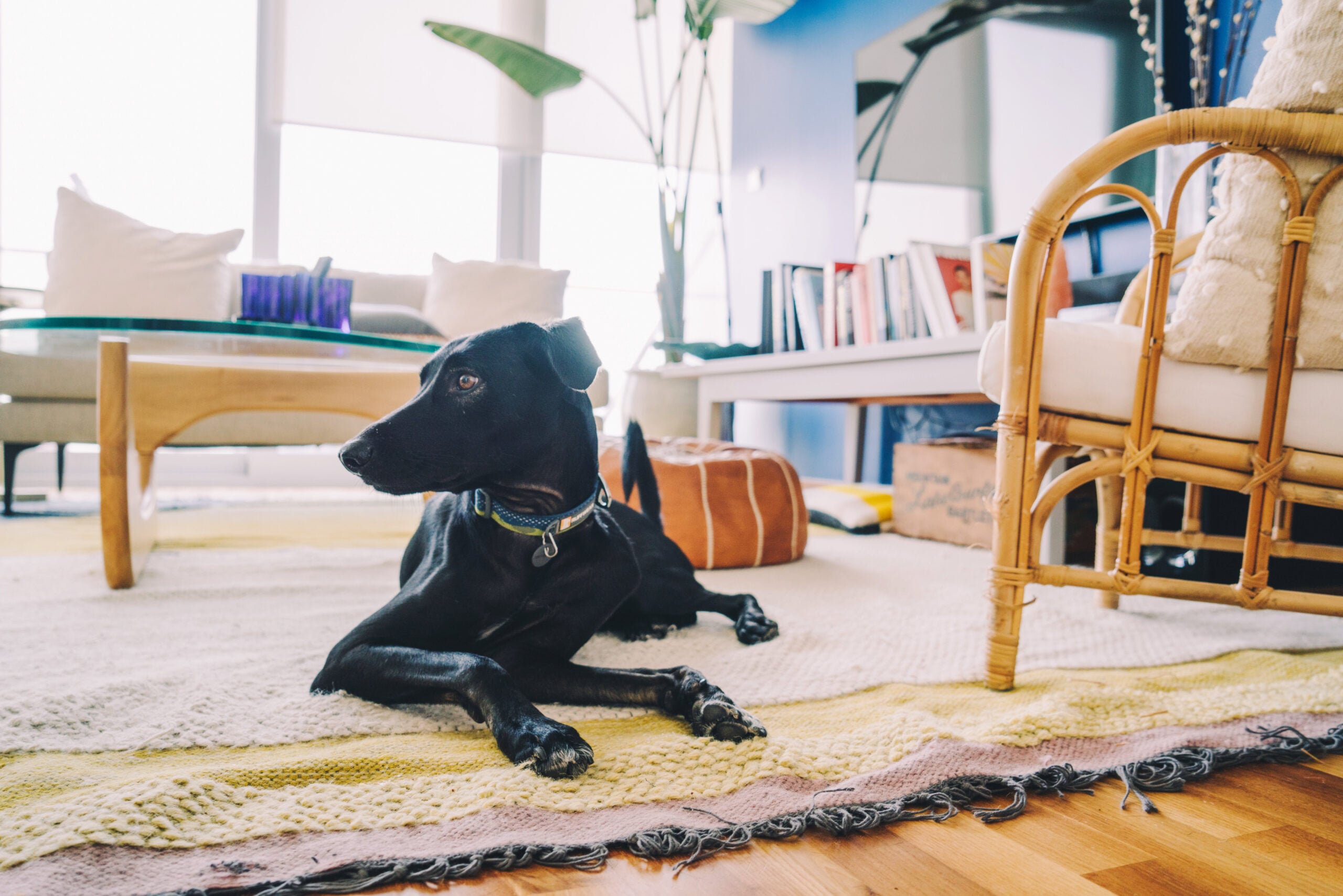
If you’ve got hardwood or tile, put a yoga mat or a non-slip rug down where you’re gonna play first. Hard floors get slippery fast, and a dog that can’t get any grip won’t really go for it, so you lose the whole point. Foam tiles work too and they stack up when you’re done. If you only do one thing to set up, do this one, cause a lot of people skip it.
If your dog likes to jump, keep the lure on the floor the whole time, low and flat. That keeps the session in your open space and it’s easier on their joints.
Quick setup checklist
- Minimum space: About 6 feet of open floor for a small dog under 30 lbs, and 8 feet for a medium dog. Push the coffee table out of the way and almost any living room works.
- Hallway dash pattern: Run the chase back and forth in a straight line, and since the walls keep everything in, it’s good for a narrow place without much living room.
- Figure-8 pattern: Pick two spots, like two chairs, the couch corners, or a water bowl and a table leg, and run the lure in a figure-8 around them. Every time it crosses over, your dog has to stop and stalk it again, and that’s where a lot of the good stuff happens in a small space.
- Sound floor tip: I’d put a yoga mat or a rug down where you play, cause it keeps your dog from sliding and soaks up the noise for the people downstairs, so you fix two things at once.
Indoor Techniques That Work in Any Apartment
These four work good in a small space. Each one gets your dog chasing without needing much room.
Stand in one spot and don’t move your feet, and swing the lure around you in a controlled circle so your dog runs the outside while you stay in the middle. This one takes up the least room, cause the whole session happens about as far as you can reach with the pole. It’s good for really small apartments and dogs new to playing inside.
Move the lure in a figure-8 on the floor, and that keeps your dog turning and guessing so they have to think more than they would going in a circle. Every crossover is a quick stalk, and that’s where a lot of the work happens.
Stand at one end of the hallway and drag the lure slow toward you, then flick it back out. Your dog chases one way, you bring them back, and you do it again. The walls keep it all in, and every time it changes direction your dog has to stop and go again, kind of like an animal stopping to look around.
Barely move the lure for a few seconds and then take off in a fast sweep. The slow part gets them stalking, which most toys skip completely, and then the fast part gets them chasing. Going back and forth between the two does more than just going fast the whole time, and it fits a small space cause the slow part hardly takes any room.
The Indoor Session Structure
It’s the same five steps as outside. The whole method is in indoor flirt pole training. Inside, the all-done and the cool-down matter even more, cause there’s no backyard for your dog to go wind down in after.
Keep the lure still and let your dog lock on, then ask for a sit or a stand and have them wait several seconds before you let them go. This is where the self-control gets built, so I wouldn’t rush it.
Cue: WaitGive the release word and move the lure with one of the ways up above, and keep it low and flat the whole time. Creep it slow and then take off fast, change direction, stop for a second, just mix it up so your dog has to think instead of just reacting.
Cue: Get itEvery few rounds, let your dog catch the lure and hold it for a few seconds, and don’t ask for the drop right away. Getting to hold it is how they finish the chase, and finishing it is what gets you a calm dog.
Ask for the out and reward them for letting go, then start over at the wait, and keep that going for 5 to 10 minutes. If the drop-it isn’t solid yet, trade them a really good treat for it, and after a while the next chase becomes the reward for letting go, that’s what makes the drop-it stick.
Cue: OutSay all-done and put the lure all the way away, then ask for a place or a down-stay and reward them for being calm. In an apartment the settle does the job a backyard would, so don’t skip it or your dog never really comes down.
Cue: All done → PlaceBreed-Specific Notes for Indoor Training
The basics work for every breed, but some kinds of dogs need a few changes. These are the apartment dogs that come up a lot and what I’d watch for with each one.
Breeds
Power and small breeds
Breeds
Breeds
Breeds
Keeping Sessions Quiet for Neighbors
A flirt pole session with some structure is already quieter than most play inside, cause your dog is focused and going in short bursts, not sprinting and sliding all over. These five things cut the rest of the noise way down.
- A yoga mat or a rug soaks up the paw noise for the people below, and it’s the biggest noise fix there is
- Keep the lure low all the time, cause no jumping means no thumping when they land, and that’s the loudest part
- Use soft lures, fleece or rope, in the early morning and at night, with no squeakers and no hard plastic going through the walls
- Be done by about 9pm in most buildings, cause a session earlier in the evening can help head off the 10pm zoomies that wake people up
- A flirt pole is quieter than a bouncing ball, fetch in the house or tug, cause it stays in one spot and goes at your pace
Honestly noise is mostly about how you do it, so keep the lure low and play on something soft and don’t do it at crazy hours. With short bursts, resets and a hard stop at the end, a flirt pole is about as neighbor-friendly as it gets for a high-drive dog inside.
Flirt Pole vs Other Indoor Exercise Options
A lot of apartment people try a bunch of things before they get to a flirt pole. This is how I’d compare them when you’ve got neighbors below you and no yard.
| Method | Drive resolved? | Space needed | Noise level | Time to calm |
|---|---|---|---|---|
| Flirt pole (structured) | Yes, full sequence | 6–8 ft cleared | Low (lure stays low) | 10 min |
| Long walk only | Partial, cardio only | Outdoors required | N/A | 45–90 min |
| Indoor fetch / ball | Partial, no stalk phase | Long hallway | High (ball bounce) | Inconsistent |
| Puzzle feeders | Mental only, no chase | Minimal | Very low | 20–40 min |
| Tug (unstructured) | Arousal raised, not resolved | Minimal | Medium | Can worsen |
| Dog park | Variable, often overstimulating | Outdoors required | N/A | Unpredictable |
A walk tires out the body, but a flirt pole lets them finish the chase, and the way I see it those are two different things. An apartment dog that gets a long walk but never gets to chase and catch anything a lot of times still paces, still barks and still tears stuff up.
I wouldn’t stop a session in the middle of a chase, cause if you quit while your dog is still all fired up they never come down, and it can actually make them more reactive. End with a catch and a drop-it and an all-done every time before you put the lure away. The all-done is what builds the off-switch, and if you skip it you lose the best part of the whole thing.
Which Whimsy Stick Is Right for Your Apartment Dog
For a dog under 30 lbs, and that’s most apartment dogs, I’d get the Standard. It’s about 4 ounces, so it’s easy to control in a tight space, and the Kevlar line is rated at 450 lbs and doesn’t stretch or snap back. The line is about the same length as the pole on purpose too, I call that pole balance, and it keeps the lure from coming back at you. If you want to see how other kinds of poles compare, from bungee lines to telescoping poles, see flirt pole designs ranked. For what owners say, see what apartment dog owners say.
Good for inside. Kevlar static line, smooth movement, and lures that swap easy. The one I’d pick for most apartment dogs under 30 lbs. Shipping is $20 cause it goes in a longer box.
One-piece reinforced rod for bigger dogs like Labs, Boxers and Huskies, that hit hard even inside. Comes with 1 lure and free US shipping.
Same pole with 3 lures. Switching lures keeps your dog interested longer. Free US shipping.
I draw the line at 30 lbs. Under 30 the Standard does everything you need inside, and at 30 lbs and up I’d go with the Rugged XL cause it’s made for how hard those dogs hit, and that matters for keeping things safe when a big dog goes all in on a chase in your living room.
For more on why I’d use a pole built by a trainer inside, see best flirt pole for dogs.
What If You Cannot Go Outside At All
Some people really can’t get outside much. Maybe the HOA won’t let dogs on the grass, or you’re up in a high-rise and every potty trip takes 20 minutes with the elevator, or the only outside is a busy sidewalk, or you’ve got mobility problems or a shift schedule that makes it tough. Everything on this page still works for you, but the inside sessions have to carry more of the load, cause outside isn’t there to let off steam.
More sessions inside matter more. Somebody with a yard can do one flirt pole session and a sniff walk. If your dog is stuck inside, I’d do two shorter sessions a day with some other stuff in between. Something like a flirt pole session in the morning, scattered food or a snuffle mat in the middle of the day, another flirt pole session in the evening, and a chew or a lick mat before bed. That takes the place of what a yard gives a dog, getting to let a little out whenever they want.
Indoor-only working space and scent
The hallway is your main spot. A hallway gives you a long straight line, so drag the lure down the length of it on the floor. Your dog gets to really go for it without the spinning and cutting that needs more room. With a dog 30 lbs and up, the hallway is where I’d do the real chasing inside.
Sniffing stuff matters a lot. A dog that never gets outside misses out on new smells, and that’s a big deal for a dog. So bring smells in. Switch up the snuffle mats, hide kibble in different rooms, rub a towel on grass or a tree or another dog (ask the owner first) and bring it home, and play find-it around the apartment. For a dog that’s inside all the time, I wouldn’t skip this.
Now, to be honest with you. Living inside all the time can work for a dog with low or medium drive. For a high-drive working breed, I don’t think it works long term. A working-line Malinois in a high-rise with no yard is a tough setup no matter how good your inside routine is. If that’s you and your dog is falling apart, more flirt pole isn’t the answer. Something bigger has to change, like daycare a few days a week, a dog walker in the middle of the day, or sometimes taking a hard look at whether it’s the right fit. That’s your call, not mine.
Flirt Pole for Apartment Dogs: FAQ
Can you use a flirt pole in an apartment?
Yeah, a flirt pole works in any space with about 8 by 8 feet of open floor. Keep the lure low and flat and stand in one spot and turn or run figure-8s, and I’d use a line that doesn’t stretch so the lure doesn’t bounce into stuff.
How long should an indoor flirt pole session be for apartment dogs?
I’d go 5 to 10 minutes for a small or medium dog and up to about 15 for a bigger dog, and quit while they still want more. End with a drop-it, an all-done and a settle every time before you expect them to relax.
What apartment dog behaviors can flirt pole training help with?
Chewing stuff up, barking a lot, zoomies at night, jumping on guests, not being able to settle and pacing a lot of times come from drive with nowhere to go. A flirt pole session with some structure every day gives that drive somewhere to go, so stick with it and look for less chewing and less barking and easier evenings. What clients tell me in general is their dogs are a lot more relaxed and calmer and seem more satisfied after using the flirt pole.
Can I use a flirt pole indoors with a high-energy dog?
Yes you can. Ask for a wait before every release and keep the lure low and flat, and stand in one spot and turn so it doesn’t take much room but they still get a good chase, and honestly how calm you are matters more than anything for keeping it under control. For bigger or working-line dogs, see the high-drive apartment dogs guide.
Do small dogs need flirt pole training?
They do. A lot of small dogs want to chase just as much as big ones, and getting to finish the chase matters no matter the size, so just keep the lure slow and right on the floor for a small dog.
Apartment-specific concerns
What if my apartment has hard floors?
I’d put down a yoga mat or a rug with a rubber back or some foam tiles first, cause hard floors get slippery when a dog is turning fast and that can get them hurt, plus it keeps them from really going for it.
Which Whimsy Stick is right for an apartment dog?
The Standard for dogs under 30 lbs, and that’s most apartment dogs. For dogs 30 lbs and up I’d get the Rugged XL cause bigger dogs hit hard even inside, and either way keep the lure on the ground in an apartment so you protect their joints and it’s not bouncing off the walls.
How do I keep sessions quiet for neighbors?
I’d use soft fleece lures instead of hard toys and keep it low and slow, and there’s a lot less thumping that way. Put down a thick rug or foam tiles to soak up the sound and don’t do it at crazy hours, and short bursts with resets in between are a lot quieter than wild play cause your dog is focused instead of sprinting all over.
Safety and breed-specific
Is a flirt pole safe for my apartment dog with joint issues?
I’d ask your vet first. If they say it’s OK, move the lure really slow in wide circles instead of tight turns and keep it on the floor so there’s no jumping, and keep sessions to just a few minutes. The wait and the drop-it still make them think, so they get something out of it even going easy.
How is a Corgi different from other herding breeds in apartment sessions?
Corgis were bred to move livestock by nipping at heels, and that’s a chase thing, there’s nothing mean about it, so a flirt pole gives that urge somewhere to go with some rules. Short sessions every day can help with those evening zoomies a lot of apartment Corgi owners know. With no outlet, that stalking a lot of times ends up on shoes, ankles and anything else that moves. That’s why I like the flirt pole for them, it gives that urge the right target and an off-switch.


