

Stop shopping for indestructible and start shopping for safe failure. A good power-chewer toy is too big to swallow, flexible enough to spare the teeth, and gets thrown out the moment it starts coming apart. You watch while it is in use.
Toys only manage the symptom, though. A dog that shreds everything in minutes usually needs a daily outlet for the drive behind the chewing, and that is where a supervised chase-and-catch session earns its place.
Who This Is For
- Owners whose dog kills a new toy in minutes, not months
- Anyone who has fished stuffing or rubber chunks out of a dog’s mouth
- People tired of paying for toys labeled indestructible that die on day one
- Pit bull, shepherd, and mastiff-type owners with serious jaw power
- Households where the toy box is only the first thing to go
Why Your Dog Destroys Every Toy
Most toy destruction is normal chewing plus an unmet drive, so a tougher toy only fixes half of it. The ASPCA calls chewing a perfectly normal behavior for dogs of all ages and notes that bored dogs look for ways to entertain themselves. Often, the toy is the only job the dog has.
The American Kennel Club says dogs often chew out of boredom and recommends plenty of exercise and play time with you. That matches what I see: the dogs that shred fastest are usually the ones with the least structured work.
Three kinds of destroyers
In my client dogs, power chewers tend to fall into three styles, and each needs a different toy. Shredders rip plush open and pull out the insides, which is the dissect end of the predatory motor pattern. Grinders lie down and work a hard chew with the back teeth for an hour. Shakers grab, thrash, and tug until something gives.
Knowing which one you have saves money. A shredder will never be satisfied by a rubber ring, while a grinder can crack a tooth on the wrong chew.
How to Choose by Jaw Size and Chew Style
Choose by three tests: the toy is too big to fit fully in the mouth, it bends instead of cracking teeth, and it matches how your dog destroys things. Brand promises matter less than these three checks, and each one is backed by veterinary guidance you can apply in the store.
Size it bigger than the mouth
The AKC advises picking edible chews large enough that the dog cannot get the entire thing in its mouth at once, since chews that are too small are a choking risk. Its toy guide also says a heavy chewer needs a toy that is durable and won’t break into small pieces. For big jaws, size up one step from the label.
Use the bend test for hardness
Harder is not safer. VCA Animal Hospitals lists chewing on antlers, bones, and other hard, non-bending chew toys as a cause of fractured teeth, most often the canines and the large upper cheek teeth. Its rule is simple: throw out chews or toys that do not readily bend.
Match the toy to the style
| Chew style | What it looks like | Better picks | Skip |
|---|---|---|---|
| Shredder | Rips plush open, pulls out stuffing and squeakers | Supervised tug or chase play with a lure you put away after | Stuffed plush left out alone |
| Grinder | Lies down and chews one object for a long time | Firm, flexible rubber chews sized bigger than the mouth | Bones, antlers, hooves, nylon chews |
| Shaker | Grabs, thrashes, and tugs until it breaks | Handler-run tug or flirt pole on a strong static line | Thin rope toys that fray into strings |
Chew styles are trainer categories from client dogs, not a veterinary classification. Scroll sideways on a phone.
Risky Materials and Shapes to Avoid
The riskiest choices for power chewers are chews too hard to bend, pieces small enough to swallow, and toys that shed chunks, strings, or stuffing. Hard chews break teeth. Everything else ends up in the stomach, where a stuck piece can become an emergency. Here is what to leave on the shelf.
- Bones, antlers, cow hooves, nylon chews, pizzle sticks: VCA advises eliminating all of them to protect the teeth.
- Rawhide and bully sticks: the AKC warns that power chewers can break off large pieces or bite straight through, which risks choking or a blockage.
- Balls that fit behind the teeth: the AKC says a ball should not be so small the dog could swallow it.
- Stuffed plush with a shredder: stuffing and squeakers come out fast, and swallowed pieces do not always pass.
- Worn-down nubs of anything: take them away before the last bite goes down whole.
Call your vet. VCA calls foreign body obstruction one of the more common and potentially life-threatening conditions in veterinary practice, and says time is critical.
Know the signs. VCA lists vomiting, diarrhea, belly pain, reduced appetite, straining to defecate, lethargy, and biting or growling when picked up.
Supervision and Replace-When-Damaged Rules
Watch every new toy for its first few sessions, check it after each use, and throw it out as soon as pieces come off. A power chewer turns small damage into swallowed pieces fast, so the replacement rule is what actually keeps the dog safe. Tougher materials only buy you more time between checks.
The five house rules
- Supervise first: no new toy is left alone with the dog until you have seen how it fails.
- Inspect after use: look for cracks, loose threads, missing chunks, or exposed stuffing.
- Bin at first damage: the AKC’s own rule for chews is to take them away before the dog can swallow what is left.
- Rotate the supply: the ASPCA suggests offering a variety of chew toys and rotating them to keep interest up.
- Dog-proof when you leave: the AKC recommends a crate or dog-proofed area when you cannot supervise.
Taking a prized toy away can be tricky with some dogs. If yours stiffens, freezes, or growls over toys, read the guide to resource guarding before you start confiscating, and trade for something better instead.
Why a Chase Outlet Cuts the Chewing
A daily chase-and-catch session gives a power chewer’s drive a job, so less of it lands on the toy box. This is trainer experience, not a study: across my client dogs, the ones that got ten structured minutes of chase, catch, and release a day chewed through far less, because the need had already been met.
What the session gives a destroyer
Chase satisfies the sprint, the catch satisfies the grab, and a supervised shake on the lure satisfies the part a shredder usually takes out on plush. The session also ends on your cue, so the dog practices letting go. The impulse control drills build that drop and wait into every rep.
Why this, and not just a tougher chew
A tougher chew still leaves the drive unspent. Chewing has a place for grinders, and it is a fine wind-down after exercise. For most shakers and shredders, though, the outlet does more than the object. The step-by-step version is in how to tire out a high-energy dog.
Buying a harder toy for a bored power chewer is like buying a stronger couch. The dog still needs a job. Give the jaw work with a beginning and an end, and the toy box stops being the job.
Christopher Lee Moran · Working Dog TrainerThe Pick for Strong Dogs: Rugged XL
For a power chewer 30 lbs and up, the Rugged XL is the outlet I recommend: a one-piece reinforced fiberglass pole on an 800-lb Dyneema static line, run by you. It is not a chew toy and should never be left out as one. It is the supervised tool that spends the drive, so the chew toys you do buy last longer.
Honest note: lures are consumables
Power chewers will wear lures out, and that is by design. Lures attach with a quick-swap Dyneema loop and no metal hardware near the mouth, so a worn one comes off in seconds.
The Bundle ships with three lures, and the Pro Kit at $129.95 includes five plus a spare 800-lb line. Replacements are on the shop page. The 30-day money-back guarantee covers the product, not normal lure wear. For how the pole itself is built to take a strong dog, see why a durable flirt pole is one piece.
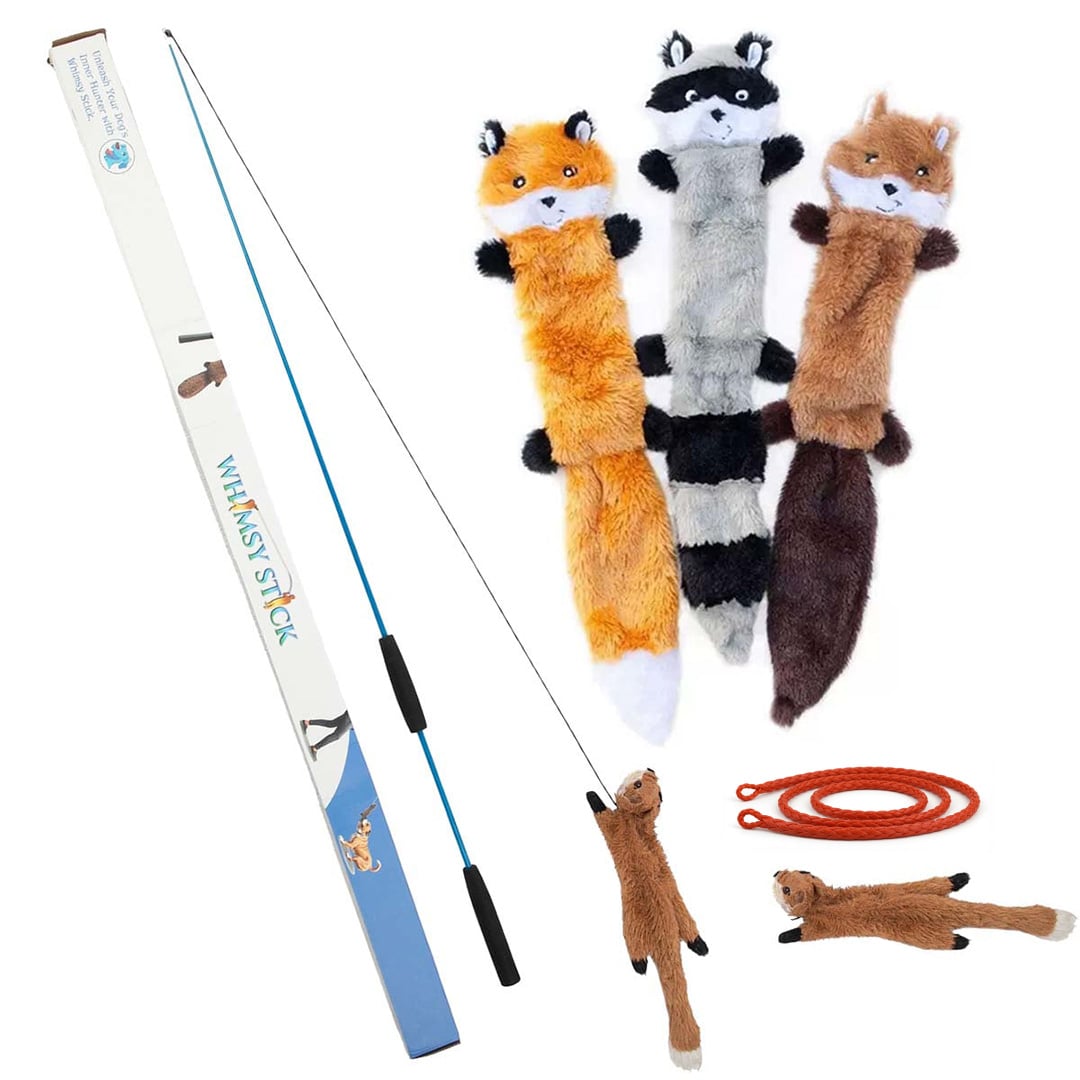
Alyssa T. · Rugged XL · ShepherdWay more equipped to hold up to the body slamming my shepherd does. The string attachment is improved and my girl is VERY happy to have her squirrel back. Best purchase I ever made.
Whimsy Stick Rugged XL
The supervised outlet for a jaw that destroys everything else: sprint, catch, shake, and a clean release on your cue.
- One-piece reinforced fiberglass pole, no telescoping joint to snap
- 800-lb Dyneema static line with a quick-swap lure loop
- Free US shipping and a 30-day money-back guarantee
No toy survives a bored power chewer forever. Size up, bend-test, supervise, and replace. Then spend the drive on a chase you control.
Related Guides
Power Chewer Toys: FAQ
What should I buy if my dog destroys every toy?
Buy for the chewing style, not the word indestructible. Pick chews too big to fit fully in the mouth and soft enough to bend, supervise them, and throw them out once pieces come off. Then add a daily chase-and-catch outlet, such as a heavy flirt pole run by you, so the drive stops landing on the toy box.
Are there any truly indestructible dog toys?
No. Every toy can be broken by a determined dog with enough time, and the hardest ones trade toy damage for tooth damage. VCA lists hard, non-bending chew toys among the causes of fractured teeth. Treat indestructible as a marketing word and judge a toy by size, flexibility, and how it fails.
What is the strongest dog toy for aggressive chewers?
Aggressive chewer usually means strong chewer, not an aggressive dog. The strongest safe choice is a firm but flexible chew sized larger than the dog’s mouth, used under supervision. For the chase and shake drive, a one-piece pole on a high-rated static line holds up better than any rope or plush toy I have used with client dogs.
Are antlers and bones safe for power chewers?
VCA advises eliminating bones, antlers, cow hooves, nylon chews, and pizzle sticks to prevent fractured teeth. The AKC notes that many veterinarians recommend avoiding antlers, and that anyone who does offer them should supervise every chew.
How do I know if a chew toy is too hard?
Try to bend it. VCA’s rule is to throw out chews or toys that do not readily bend. The AKC adds that chews that are too hard can crack teeth or cut gums. If you could hurt your own knuckle knocking on it, it is too hard for a power chewer.
What size toy should a power chewer have?
Bigger than you think. The AKC advises picking chews large enough that the dog cannot get the entire thing in its mouth at once, and balls that are not so small they could be swallowed. Size up again whenever wear shrinks the toy.
When should I throw a damaged toy away?
As soon as pieces start coming off, the toy cracks, stuffing shows, or a chew wears down to a swallowable nub. The AKC says to take a chewed-down stick away before the dog can swallow what is left. A damaged toy is a swallowing risk, not a bargain.
What if my dog swallowed a piece of a toy?
Call your vet. VCA calls foreign body obstruction one of the more common and potentially life-threatening problems vets see, and lists vomiting, diarrhea, belly pain, appetite loss, straining, and lethargy as signs. Time matters, so do not wait for symptoms to get worse.
Can a flirt pole lure survive a power chewer?
Not forever, and no lure is meant to. Lures are the wear part of any flirt pole, which is why Whimsy Stick lures swap off in seconds and the Bundle ships with three. The pole and the 800-lb Dyneema line are built for power dogs. Put the pole away after each session, never leave it out as a chew.
Why does my dog destroy toys in minutes?
Usually a mix of normal chewing and an unmet drive. The ASPCA calls chewing perfectly normal and notes that bored dogs look for ways to entertain themselves. In my client dogs, the fastest shredders were almost always the least exercised, and the toy was simply the only job available.


