Whimsy Stick

Dog Enrichment Toys & Mental Stimulation Toys for High Energy Dogs | Whimsy Stick
Dog Enrichment Β· Mental Stimulation Β· High Energy

Dog Enrichment Toys & Mental Stimulation Toys for High-Energy Dogs

Most dog enrichment toys only cover one of the two neurological systems your high-drive dog actually needs addressed. Here’s what separates effective dog enrichment toys from ones that miss the mark β€” and the two-category routine that produces real calm.

Christopher Lee Moran Professional Dog Trainer Β· Instinctual Balance Β· Coaldale, CO
9 min read
2
Dog enrichment toy categories that matter
6
Steps in drive-resolved enrichment
5–10
Minutes per flirt pole session
2–3 wk
To see behavioral change
TL;DR

Dog enrichment toys fall into two categories that address different neurological systems. Cognitive dog enrichment toys β€” puzzle feeders, snuffle mats, lick mats, chews β€” engage problem-solving and olfactory systems and produce calm and decompression. Drive-resolved dog enrichment toys β€” flirt poles, lure wands β€” trigger and complete the full predatory sequence and produce genuine neurological tired. High-energy dogs with high prey drive are typically missing the second category of dog enrichment toys entirely. That’s why adding more cognitive enrichment toys produces diminishing returns β€” you’re feeding the wrong system. The most effective routine runs drive-resolved enrichment first, then closes with cognitive enrichment as the cooldown. Both have a role. Most enrichment advice for high-energy dogs only covers one of them.

The Two Categories of Dog Enrichment Toys That Actually Matter

The term “enrichment” covers a lot of ground. Kong stuffers, snuffle mats, and flirt poles are all enrichment in the broadest sense β€” they all provide mental and physical engagement beyond basic walks and meals. However, they don’t operate on the same neurological systems, and they don’t produce the same outcomes. For most dogs the distinction doesn’t matter much. For high-energy, high-prey-drive dogs, it’s the whole thing β€” and getting it wrong is why so many owners collect a drawer full of enrichment toys that don’t actually solve the behavior problem they’re trying to address.

According to the American Kennel Club, structured predatory play is among the highest-value enrichment activities for dogs because it addresses neurological drive needs that cognitive enrichment cannot reach. Furthermore, VCA Animal Hospitals confirms that handler-controlled chase activity produces measurably better behavioral outcomes than passive enrichment alone β€” which is exactly why drive-resolved enrichment outperforms cognitive enrichment as a standalone strategy for high-drive dogs.

Category 1 Dog Enrichment Toys

Cognitive Dog Enrichment Toys

Engages problem-solving, scent processing, and object manipulation. Slows the dog down, provides decompression, reduces boredom. Excellent for most dogs as a daily routine component. Not enough on its own for high prey drive dogs.

Examples: puzzle feeders, snuffle mats, lick mats, Kongs, chew toys, scatter feeding, nose work

Works for most dogs Β· Not enough alone for high prey drive
Category 2 Dog Enrichment Toys

Drive-Resolved Dog Enrichment Toys

Triggers and completes the full predatory sequence β€” orient, stalk, chase, catch, possess, release. Activates and resolves the prey drive system specifically. Produces physical fatigue and neurological calm in 5 to 10 minutes.

Examples: structured flirt pole sessions, lure wand work, controlled tug with full predatory sequence

Essential for high prey drive dogs Β· The missing category

I’ve worked with hundreds of dogs whose owners had the right dog enrichment toys β€” daily walks, Kongs, puzzle feeders, snuffle mats β€” and the dog was still pacing at 9pm. In almost every case the missing piece was drive-resolved enrichment. They were feeding the cognitive system completely while missing the prey drive system entirely.

β€” Christopher Lee Moran, Instinctual Balance Dog Training Β· Coaldale, CO

Why Cognitive Dog Enrichment Toys Don’t Tire High-Drive Dogs

This is the question owners ask most often: “I gave her a puzzle feeder and she finished it in four minutes and now she’s staring at me again.” The puzzle feeder β€” a cognitive dog enrichment toy β€” worked exactly as designed. It provided engagement and made mealtime last longer. The reason it didn’t tire the dog is that cognitive enrichment doesn’t reach the prey drive system.

Prey drive is a distinct neurological hardwiring that runs on a six-step predatory sequence: orient, stalk, chase, catch, possess, release. The calm that owners are trying to produce comes from completing that sequence through to step six. Cognitive enrichment tools engage the problem-solving and scent systems β€” genuinely valuable β€” but they don’t trigger orient or stalk, let alone chase and catch. The prey drive system remains unaddressed, which is why the dog finishes the puzzle and immediately goes looking for something else to do.

Consequently, adding more cognitive enrichment to a high-drive dog produces diminishing returns. This isn’t a criticism of puzzle feeders and snuffle mats β€” they’re excellent tools for the right application. The problem is using them as the primary dog enrichment toy strategy for a dog whose dominant need is prey drive resolution. For more on the neurological mechanism behind this, see Benefits of Play for Dogs.

Where Each Dog Enrichment Toy Category Fits

Every dog enrichment toy has a place. This is the honest category map β€” what each type of dog enrichment toy actually addresses, what system it reaches, and when each works best.

Puzzle feeders

Excellent for slowing mealtime and decompression. Best used as cooldown after drive-resolved work β€” not as primary enrichment for high-drive dogs.

Cognitive enrichment
Snuffle mats

Strong for olfactory enrichment and decompression. Deeply calming. Same limitation β€” don’t address prey drive specifically. Best as a cooldown dog enrichment toy.

Cognitive enrichment
Chews & Kongs

Excellent for oral stimulation and extended calm. Less effective for dogs who chew from unresolved prey drive β€” they’re typically disinterested after 5 minutes.

Cognitive enrichment
Flirt pole / lure wand

The primary drive-resolved dog enrichment toy. Triggers and completes the full predatory sequence in 5 to 10 structured minutes. The dog enrichment toy that produces real tired and builds impulse control simultaneously.

Drive-resolved enrichment
Fetch toys

Moderate physical exercise. A useful dog enrichment toy but not a complete one β€” activates retrieve drive while skipping stalk and chase phases. Can escalate arousal through repetition rather than resolving it.

Physical exercise
Tug toys

A good supplemental dog enrichment toy, particularly strong for working breeds as a reward marker. Starts mid-sequence so doesn’t run the full predatory cycle. Useful in combination with drive-resolved enrichment.

Physical enrichment

What Missing the Right Dog Enrichment Toys Looks Like

Most behaviors that owners label as “behavior problems” are accurate reports of unmet enrichment needs β€” specifically, a dog enrichment toy routine that covers cognitive enrichment while entirely skipping drive-resolved enrichment. These are the most common presentations from dogs whose dog enrichment toy routine is incomplete.

Can’t settle in evenings β€” pacing, spinning, zoomies at 8 or 9pm despite a full day of cognitive enrichment

Destructive chewing that doesn’t respond to chew toys or cognitive enrichment

Obsessive fixation on anything that moves β€” squirrels, bikes, joggers, cars

Leash reactivity to movement β€” lunging, barking, hard to redirect

Staring, pacing, or following the owner around looking for something to do

Demand barking, jumping, or constant solicitation for attention and play

None of these behaviors require punishment. They’re signals that the dog enrichment toys in the current routine are addressing the wrong system. Adding drive-resolved dog enrichment toys to the routine typically produces meaningful behavioral change within two to three weeks. The Flirt Pole for Overexcited Dogs guide covers the specific application for dogs presenting with these patterns. Additionally, see the full Flirt Pole Training Guide for the complete structured session method.

The High-Energy Dog Enrichment Toy Routine That Actually Works

Sequence matters more than most owners realize when building an enrichment routine. Using cognitive enrichment first on a high-drive dog often produces frustration β€” the prey drive system is still running at full activation and the puzzle doesn’t satisfy it. Drive-resolved enrichment first brings arousal down so everything else in the routine lands properly. This is the template; adjust timing to your schedule, but keep the sequence.

5–10 minStart here
Drive-resolved enrichment first β€” structured flirt pole session

Wait before every release, drop-it after every catch, deliberate all-done ending. This is the dog enrichment toy session that resolves the prey drive system and brings baseline arousal down for everything that follows. Full method at the Flirt Pole Training Guide.

Drive-resolved enrichment
10–20 minOptional
Walk or outdoor sniff β€” decompression

After the drive-resolved dog enrichment toy session, arousal is lower and the walk becomes a genuine decompression activity rather than a trigger-loading event. Let the dog sniff extensively β€” sniffing is itself a form of cognitive dog enrichment toy work that reinforces the calm state.

Decompression
10–15 minCooldown
Cognitive enrichment β€” puzzle feeder, snuffle mat, or chew

With the prey drive system resolved by the earlier drive-resolved session, cognitive dog enrichment toys now work as designed. The dog can actually settle into a puzzle or chew rather than abandoning it after two minutes. This is the phase where these enrichment tools deliver the calm their manufacturers promise.

Cognitive enrichment
RestTarget state
Place or crate β€” genuine rest

The target state after a complete dog enrichment toy routine: drive resolved, cognitive system satisfied, physical exertion complete. A dog that has been through this full dog enrichment toy sequence is genuinely ready to rest rather than manufacturing problems to solve.

Target behavioral state

The dog enrichment toy routines that work are the ones that treat the two systems separately. When clients in Coaldale, Salida, Buena Vista, and across the Arkansas Valley add drive-resolved enrichment before their cognitive enrichment sessions, the change in behavior happens within two weeks. The tools haven’t changed β€” the sequence has. That sequence is the intervention.

Dog Enrichment Toys for Working Breeds: Why the Rules Change

Working breeds β€” German Shepherds, Belgian Malinois, Border Collies, Siberian Huskies, terriers, bully breeds β€” often have drive levels that cognitive enrichment alone simply cannot address. These breeds were developed to work for hours at high intensity, and their prey and work drives are significantly stronger than in companion breeds. For these dogs, drive-resolved enrichment is not optional β€” they are the primary category, with cognitive enrichment as supporting.

Using only puzzle feeders and snuffle mats as dog enrichment toys for a Malinois or a working-line GSD is, as I tell my Coaldale clients, like giving a marathon runner a crossword puzzle as their workout. The cognitive enrichment toys are fine. They’re just completely wrong for the primary need. For breed-specific applications see the GSD and Malinois enrichment guide and the Border Collie enrichment guide.

Choosing the Right Drive-Resolved Dog Enrichment Toy

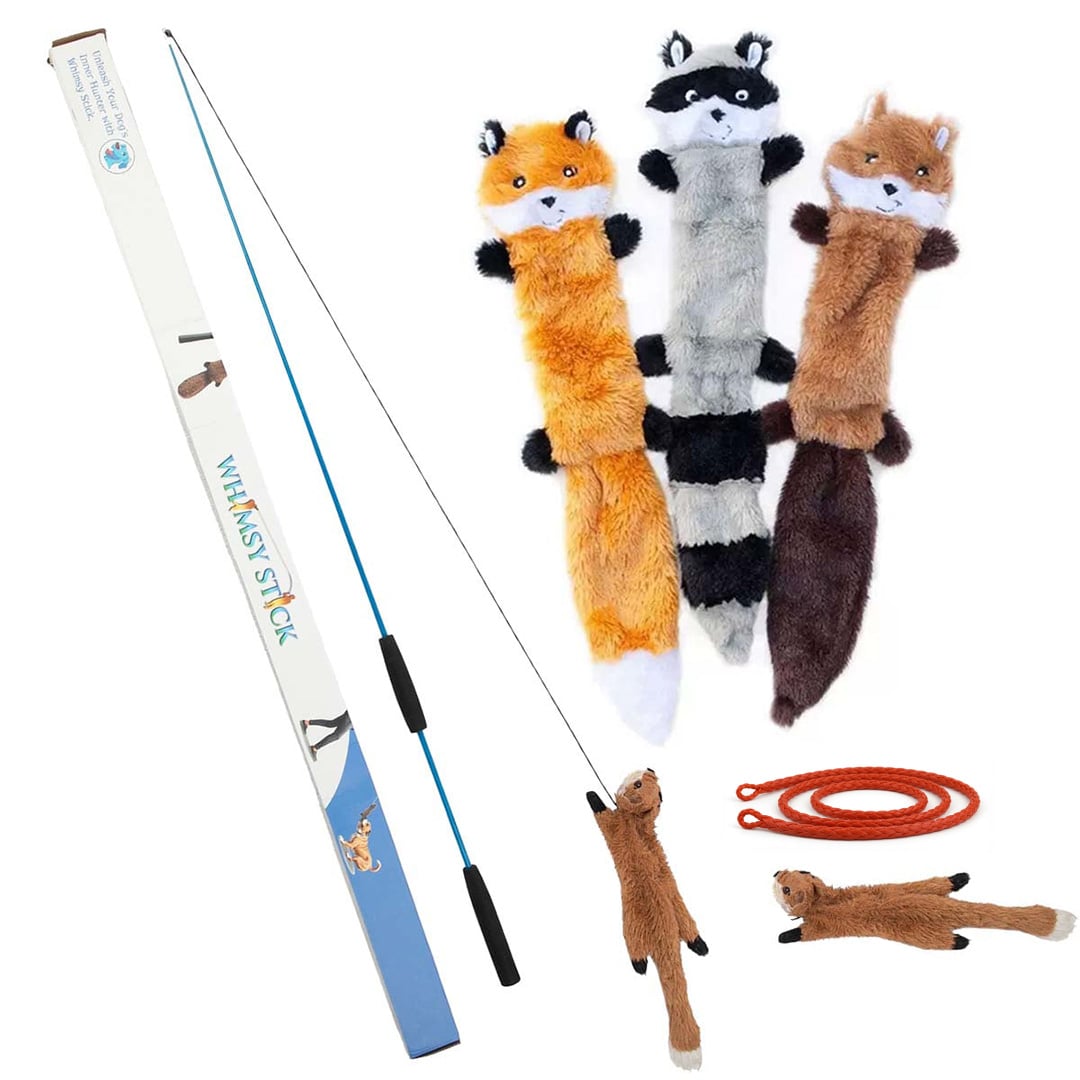
For the drive-resolved component of any dog enrichment toys routine, construction needs to match the dog’s size and drive level. A dog enrichment toy that fails mid-session β€” snapped line, broken rod, destroyed lure β€” ends the session at the worst possible moment. The Whimsy Stick is built specifically for the structured training context these sessions require: Kevlar no-snap-back line, a responsive rod for wide ground arcs, and replaceable lures.

The Standard is the right choice for dogs under 40 lbs. The Rugged XL is the right dog enrichment toy for dogs over 40 lbs and high-drive working breeds. If your dog is the type whose behavior doesn’t respond to cognitive enrichment alone, choose the right dog enrichment toys for the drive level.

Whimsy Stick Standard β€” the drive-resolved dog enrichment toy for dogs under 40 lbs

Kevlar line, no snap-back, replaceable fleece lures. The drive-resolved dog enrichment toy for small to medium high-drive dogs.

Shop Standard β†’
Whimsy Stick Rugged XL β€” the drive-resolved dog enrichment toy for dogs over 40 lbs

Reinforced for working breeds. 8-ft radius, 4 lures. The dog enrichment toy built for dogs who actually need drive-resolved enrichment at a serious level.

Shop Rugged XL β†’
Commonly Asked Questions

Dog Enrichment Toys β€” FAQ

Most dog enrichment toys β€” puzzle feeders, snuffle mats, Kongs, chew toys β€” engage the cognitive and olfactory systems and slow the dog down. They work well for that purpose. But for dogs with high prey drive, the underlying issue is unresolved prey drive, not boredom. Prey drive requires physical activation and completion through the full predatory sequence to resolve. Enrichment toys that only address cognitive needs don’t reach that system. That’s why a high-drive dog who just finished a puzzle session is still pacing β€” the cognitive system was satisfied but the drive system is still running. The solution is adding drive-resolved enrichment to the routine.
Cognitive dog enrichment toys β€” puzzle feeders, snuffle mats, lick mats β€” engage problem-solving and olfactory processing, calm the cognitive system, and provide decompression. They’re excellent enrichment tools for most situations. Drive-resolved dog enrichment toys β€” flirt poles, lure wands β€” trigger and complete the predatory sequence through movement-based interaction. High-energy dogs need both enrichment categories, but are typically missing the drive-resolved component entirely. Adding more cognitive enrichment to a drive-motivated dog produces diminishing returns because you’re addressing the wrong system.
For dogs with high prey drive, the most effective mental stimulation toys for dogs are movement-based enrichment tools: flirt poles and lure wands that trigger and complete the predatory sequence. These movement-based tools produce both physical exertion and neurological resolution in the same 5 to 10 minute session. For the cognitive enrichment component, puzzle feeders and snuffle mats work well as cooldown enrichment after drive-resolved play β€” arousal is lower after the flirt pole session, which makes the cognitive enrichment satisfying rather than frustrating.
Most problem behaviors in high-energy dogs β€” destructive chewing, excessive barking, pacing, reactivity, inability to settle β€” are symptoms of unmet drive and insufficient mental engagement. Enrichment toys reduce these behaviors by addressing the underlying cause. Drive-resolved enrichment reduces baseline arousal by giving the prey drive system a daily outlet. Cognitive enrichment reduces boredom and provide decompression. When both categories of enrichment are used consistently in the right sequence, problem behaviors reduce because the dog’s actual needs are being met.
The most effective dog enrichment toy routine follows a specific sequence: start with drive-resolved dog enrichment toys (5 to 10 minute structured flirt pole session), follow with a decompression walk if possible, then close with cognitive dog enrichment toys (puzzle feeder, snuffle mat, or chew). Sequence matters β€” using cognitive dog enrichment toys first on a high-drive dog produces frustration because the arousal system is still running and the puzzle doesn’t satisfy it. Drive-resolved enrichment first brings arousal down so the cognitive enrichment phase actually delivers results.
Working breeds β€” German Shepherds, Belgian Malinois, Border Collies, terriers, bully breeds β€” often have drive levels that cognitive dog enrichment toys alone can’t meaningfully address. For working breeds, drive-resolved enrichment is the primary category, not an optional addition. Cognitive enrichment is a supporting component. Using only puzzle feeders and snuffle mats as dog enrichment toys for a Malinois is like giving a marathon runner a crossword puzzle as their workout.
Cognitive dog enrichment toys β€” particularly food-dispensing toys and chews given at departure β€” can help with mild separation anxiety by providing a positive association and giving the dog something to focus on. However, dog enrichment toys are not a treatment for separation anxiety, which requires a structured desensitization protocol. A consistent enrichment routine can be part of a broader behavior modification plan but shouldn’t be the sole intervention for dogs with significant separation anxiety.
Christopher Lee Moran
Professional Dog Trainer Β· Instinctual Balance Β· Coaldale, CO

Christopher is the founder of Instinctual Balance Dog Training in Coaldale, Colorado and creator of the Whimsy Stick. He specializes in drive-based training with high-energy and reactive dogs across Salida, Buena Vista, CaΓ±on City, and the Arkansas Valley. His dog enrichment toy framework β€” drive-resolved enrichment first, cognitive enrichment second β€” is the foundation of his behavioral intervention approach.

This article is for educational purposes only and is not veterinary advice.

Most dog enrichment toy routines miss half the equation.

Cognitive enrichment toys are great.
Drive-resolved is what’s missing.

Standard for dogs under 40 lbs. Rugged XL for working breeds. Both ship free from Coaldale, Colorado.

0
    0
    Your Cart
    Your cart is emptyReturn to Shop