
What you read here is from my own experience training dogs, it’s not veterinary or medical advice. See the full exercise disclaimer →
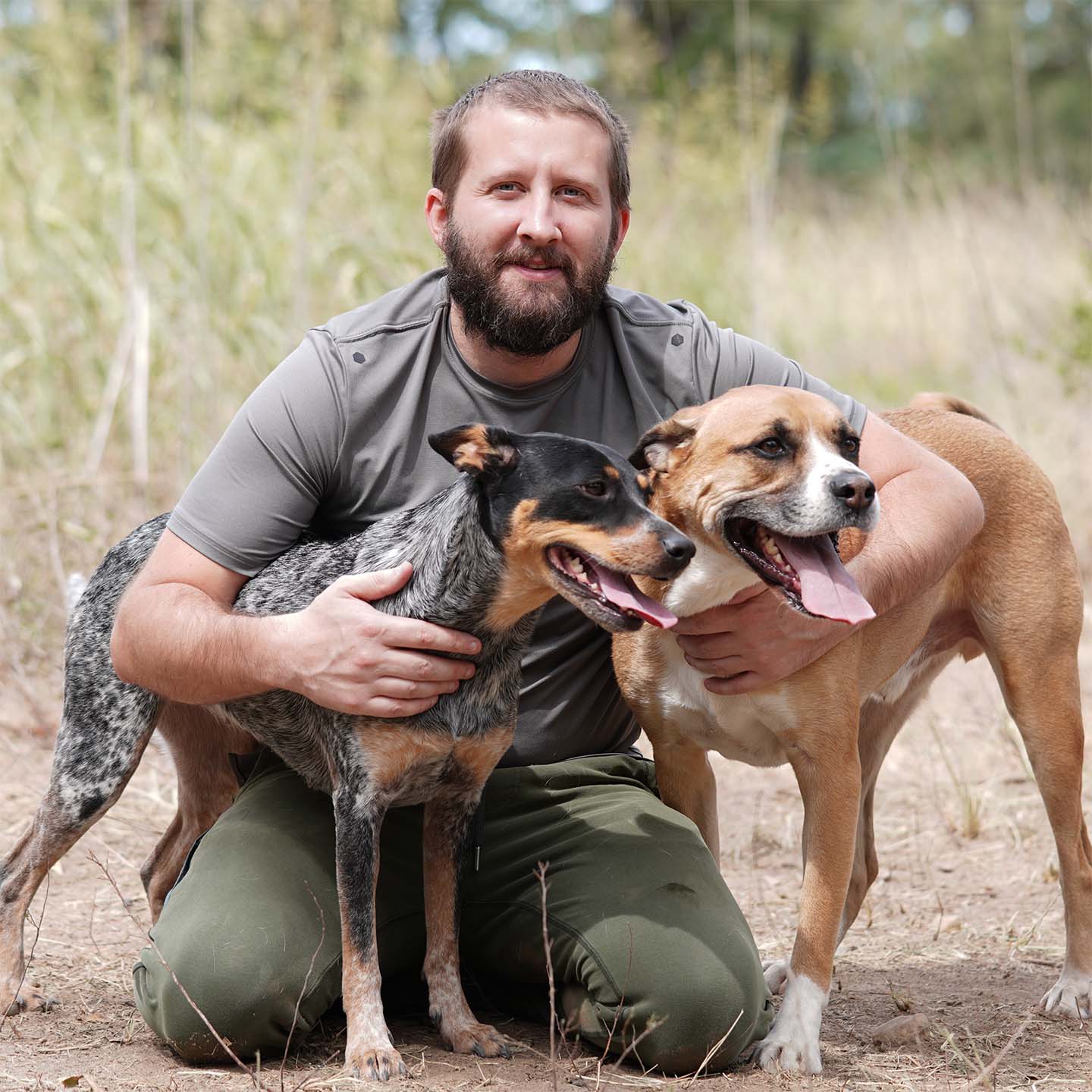
This is how Whimsy Stick got started. I’m a working dog trainer with 9+ years of hands-on work and around 400 client dogs. I started out as a Wag walker and sitter in 2016 (202 reviews, 4.9 avg), then built a dog-adventures service, then moved into private training. The Whimsy Stick came out of all that. I prototyped it with high-drive client dogs for seven years before I ever sold one to a dog owner.
Everything below is how I got here and how to pick the right one for your dog. For the underlying method, see the flirt pole training guide. For the full review history, see 306 reviews across 7 platforms.
Who This Page Is For
- People thinking about a Whimsy Stick who want to know who built it and why.
- Owners of reactive dogs who’ve tried everything and still have a dog that can’t settle.
- Working-breed homes (Mals, GSDs, Rotts, pits, herders) that are running out of ideas.
- Trainers checking it out before they recommend it to their own clients.
- Anybody who wants the why behind it, not a sales pitch.
I started as a dog walker. I ended up redesigning the flirt pole.
It took me about nine years and three career changes to get from one to the other, and one Belgian Malinois that would not settle down on a fifteen-mile hike. I started out in 2016 as a verified Wag walker and sitter, and the oldest of my 306 reviews are from that year. It wasn’t just walking around the block twice either, I was running pack hikes for high-drive working dogs, six to eight hours of mountain terrain off-leash, every day. You hear a lot that exercise by itself fixes behavior and I believed that at first, but after two solid years of doing it every day I knew it was wrong.
Those dogs came back with tired legs and their heads still going. I’d get calls from owners asking why their Lab was still chewing the couch, or their cattle dog was still nipping the kids, or their Mal still couldn’t sit through dinner, so the exercise by itself wasn’t doing it.
From adventure guide to private training
So I quit running miles and started working on structure. I built a private training practice and took the cases other trainers had failed on, resource guarders and dogs with bite histories and rescues that came home and shut down for a month, and working breeds that were three weeks from getting rehomed. A lot of those dogs had plenty of training. What they didn’t have was a way to finish the hunt, they’d get going and never get to finish what they’re wired to do. The 66 training reviews on Yelp, Google, and Facebook are from that work.
A tired dog isn’t the same as a satisfied dog. What I have found is a dog with a satisfied animal instinct is a much better behaved dog, and that comes from getting to finish the hunt, not from racking up miles. That’s what Whimsy Stick is built on.
The two dogs who refined the method
Everything I learned on client dogs I tried again at home with my own two. They’re wired completely different from each other, and both of them taught me the same thing, that this goes a lot deeper than commands and treats.
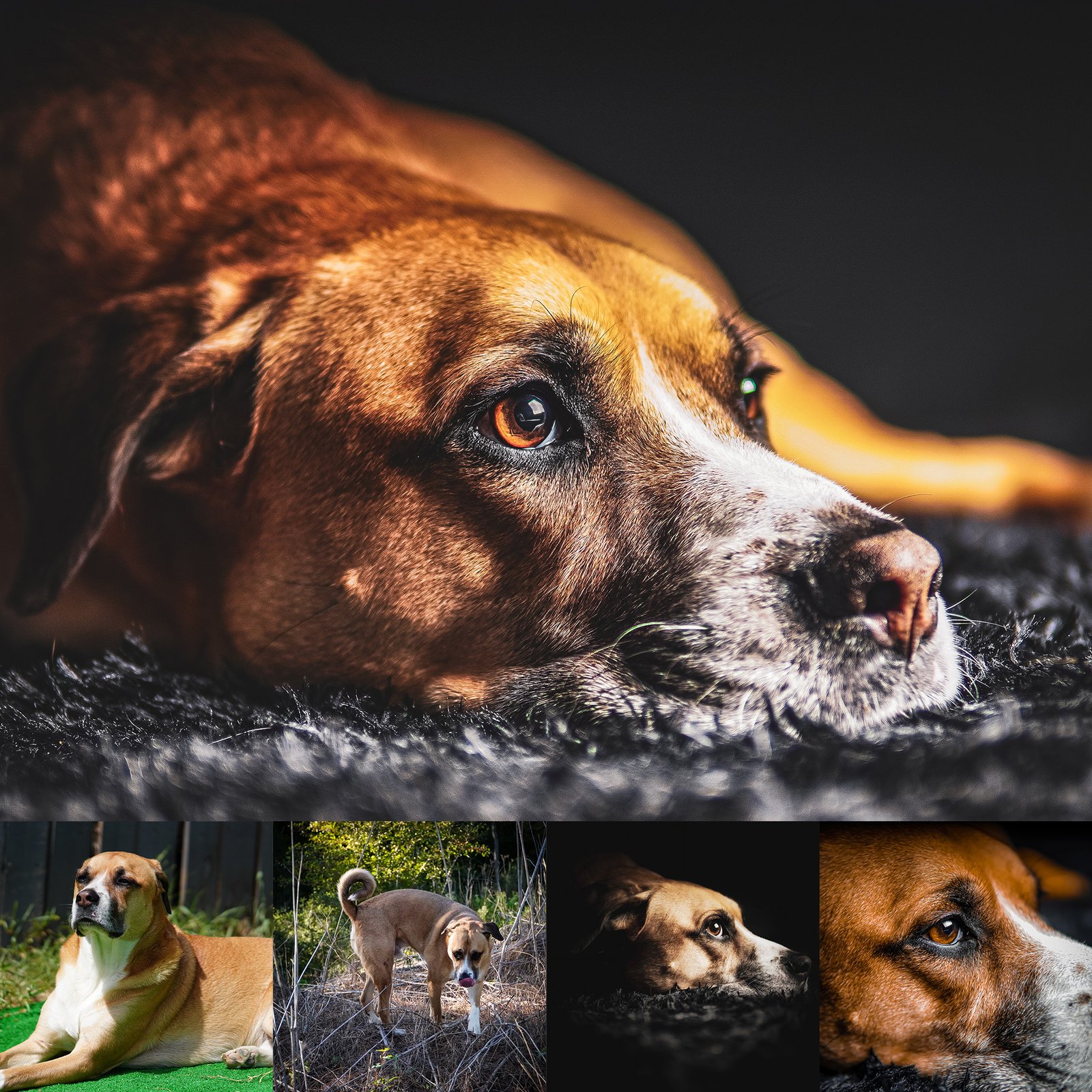
Jax
Driven · Food-Motivated · Endless EngineJax came to me overwhelmed. He’s smart and he’s got a big engine and he didn’t have anywhere to put it, and regular exercise just made him more wired. With him I learned drive with nowhere to go turns into chaos, and when he gets to finish the hunt the right way, that same engine makes him a focused working partner.
Jax will work for food and he likes structure, so he’s kind of the live demo for everything on this site.
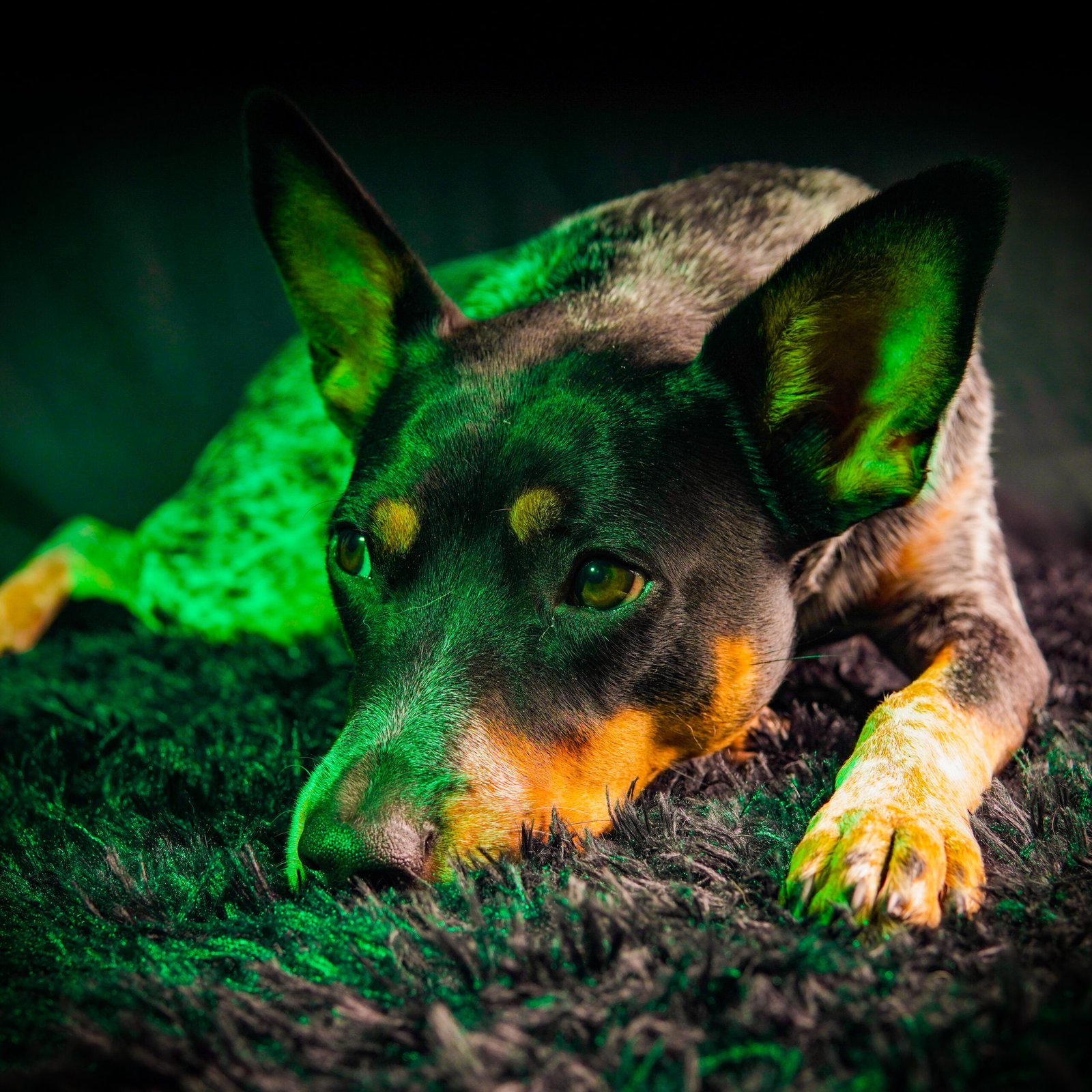
Artemis
Rescue · Connection-Driven · Trust FirstArtemis came out of a rescue where the staff had to use tongs to clean her kennel. Food didn’t mean anything to her and if I put pressure on her she’d shut down. What worked was just being there and being clear, over and over again, till she decided on her own to come engage with me.
She taught me bonding comes down to trust a lot more than treats, and you get that trust by being the same person every single rep.
The Science: the predatory motor pattern.
Dogs got a hunting sequence from wolves and biologists call it the predatory motor pattern. For training I break it into four stages, and most of the exercise people give their dogs only hits one or two of them.
First the eyes lock on and the body gets low, so the hunt actually starts with the dog going still.
Then they take off after it as fast as they can go.
Then they get their mouth on it.
And then they get to own it, and that’s when a dog can actually settle down.
Why most exercise misses the loop
A walk doesn’t really hit any of these. Fetch gets a couple of them but ends without the win, cause a tennis ball doesn’t give anything back. Tug gets the capture but skips the stalk and the chase. A flirt pole is the cleanest tool I’ve found that runs the whole thing, in about ten minutes, in a backyard, with a dog of any size. When a dog never gets to finish, that drive has to go somewhere, and a lot of times it comes out as chewed shoes and barking at the delivery guy and lunging at the end of a leash.
If you doubt any of this, watch the video below. It’s a pet Mexican Red Wolf on a couch running the whole sequence on a stuffed toy, eye-stalk, grab-bite, kill-bite, dissect. That’s the wiring your dog got too, and a flirt pole lets them finish it on something you actually want them chasing.
With 10 years of experience working with high-energy dogs, I have found that a dog with a satisfied animal instinct is much better behaved. That’s why I created what I believe to be the best flirt pole for dogs.
Christopher Lee Moran · Founder, Whimsy Stick LLCIf you’re reading this and feeling guilty for not knowing sooner, don’t. Nobody teaches this stuff, and I never heard the dog walking world talk about the predatory motor pattern. You’re here looking, and that counts.
For the owner who feels they failed their dog for 3 yearsI tested the flirt poles I could find. None held up.
Once I knew finishing the hunt was what mattered, I needed a tool I could put in my clients’ hands. So I bought the flirt poles I could find, handed them out to my clients and watched what broke on real working dogs. They were too short or bulky, had a violent bungee cord, or were just too heavy.
| What I Tested | The Problem | Verdict |
|---|---|---|
| Telescoping poles | Joints collapse mid-session under hard pulls from medium dogs | Returned |
| Bungee-cord designs | Snap-back hits the dog in the face on miss; teaches flinch | Rejected |
| Generic fleece lures | Shred in three sessions with a 50-lb dog | Wasted money |
| Cheap rope cords | Fray and snap at full velocity; lure becomes a projectile | Dangerous |
| One-piece fiberglass + braided cord + Kevlar/Dyneema | None. This is the build. | Whimsy Stick |
So I built it myself. I found that about a 5-foot fishing rod worked the best, so I customized one with no eyelets and no reel, cause let’s not lie, you ain’t reeling in a dog. It ended up as a one-piece fiberglass shaft so nothing collapses, a braided cord with no bungee snap-back, and a 450-lb Kevlar line on the Standard and an 800-lb Dyneema line on the Rugged XL. Nothing on it is there cause it was cheap or easy, it’s there cause it held up to the dogs I work with. For the complete construction breakdown, see the complete flirt pole buying guide.
Controlled Freedom: the training philosophy behind the tool.
Whimsy Stick is the product and Controlled Freedom is the method behind it. They both come from the same idea, that dogs need a real outlet for real drives, inside some structure that you control. Controlled Freedom stays away from two extremes you see a lot in dog training.
The first one says you shut the drive down. You correct it and leash-pop it and kennel it. That gets you a quiet dog, but a brittle one that can blow up the second the lid comes off. The other one says just let the dog “be a dog,” free run with no structure and no rules. That gets you a dog that decides on its own that its job is guarding the windows and barking at every leaf.
Controlled Freedom is in the middle. You run the start and the middle and the end, and the dog gets the chase and the catch and the win. You hold the structure and the dog gets to be satisfied, and you both walk away calmer. For the framework applied to specific behavior problems, see reactive dog training.
Structure and instinct fulfillment are not opposites.
In one ten-minute session the Whimsy Stick does both. The wait works on impulse control, the chase gives the drive what it wants, the catch finishes it, and the all-done builds the off switch. Same dog, just calmer instead of shut down.
Why you should listen to anything on this page.
I don’t have some big Instagram following and I don’t sell certifications. What I have is reps, ten years of them, around 400 client dogs, and a lot of those were dogs other trainers wouldn’t take. My training business has a 5.0 average across its public reviews, and a lot of that work was reactivity, resource guarding and over-the-top dogs whose owners were already looking at rehoming.
Whimsy Stick is the only product I’ve ever put my name on. I put it on there cause I use this exact pole with my own dog and with clients every week, and if it stops working I’ll stop selling it.
I train dogs every week and this is the flirt pole I hand to my own clients. If something better came along tomorrow I’d change the build tomorrow, but until then this is what I trust.
Which Whimsy Stick is right for your dog.
There’s two models and they split at 30 lbs. Under that the Standard is plenty, and over that, or for any dog with a hard mouth and serious drive, you want the Rugged XL. The 3-lure bundle gives you two extra lures, and I’d get that if you’re playing every day.
A one-piece fiberglass pole with a 450-lb Kevlar line and a fleece lure. It’s lighter, so you get the control you need for puppy foundation work and smaller adult dogs.
A heavy-duty fiberglass shaft with an 800-lb Dyneema line and one lure. It’s built for the pull a driven working-breed dog puts on it when they catch, and in my own use it holds up to a 120-lb power breed.
Same heavy-duty shaft and 800-lb Dyneema line with three lures. That’s the one I’d get if you play every day or your working breed goes through lures fast.
About Whimsy Stick: FAQ
Background & story
Who created the Whimsy Stick flirt pole?
I did. My name is Christopher Lee Moran, and I’m a working trainer with nine-plus years of hands-on dog work and around 400 client dogs. I started in 2016 as a verified Wag walker, built a dog-adventures service, then moved into private training. I built the Whimsy Stick cause none of the flirt poles I could buy were something I trusted to put in a client’s hand. 306 reviews across 7 platforms document the work.
What makes the Whimsy Stick different from other flirt poles?
A working trainer designed it around one thing, letting a dog finish the whole hunt safely. It’s a one-piece fiberglass pole with a braided cord that doesn’t stretch and lures you can swap out. Nothing telescopes and nothing snaps back at you.
What is Controlled Freedom dog training?
Controlled Freedom is the way I train, and I built it over 9+ years of hands-on dog work. The idea is structure and discipline can go right alongside letting a dog satisfy its instincts. You run the framework and the dog gets to finish the drive, and you both walk away calmer.
Method & application
Does the Whimsy Stick help with reactive dogs?
That’s a big part of why I built it. Chase play with structure lets a dog finish the hunt that a walk leaves hanging, and a dog that’s satisfied is usually easier to work with. It won’t fix reactivity by itself, but it can make the leash work easier to practice, and if there’s fear or aggression involved bring in a qualified behavior pro too. For the full framework, see reactive dog training.
How is a flirt pole different from walking or fetch?
A walk gives a dog smells and sights and movement, but it doesn’t let them hunt. Fetch gets part of it but ends without a real win. A flirt pole runs all four, stalk, chase, capture and win, and for a lot of wound-up dogs a short structured session does something a long walk doesn’t.
What is the predatory motor pattern?
It’s the hunting sequence dogs got from wolves, and I train it as stalk, chase, capture and win. When a dog gets to finish the whole thing they tend to settle, and when they only get part of it (chase with no catch, or a catch with no win) a lot of them stay wound up. For the full breakdown, see predatory motor pattern explained.
Models & practical
Which Whimsy Stick model is right for my dog?
If your dog is under 30 lbs, the Standard is built for you. If your dog is 30 lbs or more, or a high-drive working breed at any size, get the Rugged XL. The 3-lure bundle gives you two extra lures, and I’d get it if you play every day.
How long do Whimsy Stick lures last?
It depends on the dog. Lures are wear parts, and hard chewers and working breeds go through them faster, that’s why the bundles and the Pro Kit exist. Replacement lures are $12.95.
Is the Whimsy Stick safe for my dog?
The pole is one-piece fiberglass so there’s nothing to collapse on a hard pull, and the cord is braided line with no bungee to snap back in a dog’s face. The lure hangs on a 450-lb Kevlar (Standard) or 800-lb Dyneema (Rugged XL) line. Like any flirt pole, you still supervise, keep the lure low and put it away when you’re done.
What is your return policy?
30-day money-back guarantee on every order. If it doesn’t work out for your dog, email me and I’ll refund you, and you pay return shipping unless the pole failed. I’m a one-man company and I want you happy with it, so I’ll work with you.


