
Most interactive dog toys for large dogs offer distraction, not fulfillment. High-prey-drive dogs need the full predatory motor sequence completed: stalk, chase, capture, win. That is what produces neurological resolution and genuine calm. A structured prey drive tool does this in 5 to 10 minutes. Puzzle toys, solo balls, and motorized gadgets do not. If your large dog is blowing through toys, it is not because they need a tougher toy. It is because they need a different category entirely.
Interactive Dog Toys for Large Dogs, Ranked by a Trainer
Every category below has been through my client dogs, including the big ones that grade toys the hard way. Each gets three marks: does it actually tire a large dog, does it survive one, and does the dog still care by day four. The sections after the list unpack the why.
Structured chase tool (flirt pole)
The only category that runs the whole hunt: stalk, chase, capture, win. You drive the lure, so the game never repeats and the dog never files it under furniture. The pick of the list for any large dog with real drive, and the rest of this guide explains why.
Tug systems with rules
Real shared work and a legitimate bite outlet when you run it with a start cue and a clean drop. It skips the stalk and the chase though, and with a 90-lb dog every round is also a strength contest you have to win.
Snuffle mats
Nose work genuinely settles dogs, and big dogs enjoy it too. It calms rather than tires, so treat it as the warm-down after real exercise instead of the exercise itself.
Puzzle feeders
One fixed solution, and a sharp large dog cracks it in minutes, then carries the whole thing around the kitchen. Fine as breakfast entertainment, untouched prey drive afterward.
Treat-dispensing balls
A slower food bowl that rolls. Some dogs bat them around happily, yet the drive that eats your furniture never gets addressed, and the treats add up on a big frame.
Lick mats
Deliberately the opposite of exercise: licking is decompression. Useful in the cooldown slot after a session, and wrong as a substitute for one.
Electronic and motorized toys
Novelty for a day, then ignored, and the housing rarely survives large-breed paws. The most expensive way I know to not tire out a dog.
Signs Your Large Dog Isn’t Being Mentally Satisfied
Before we get into what works, check whether any of these sound familiar:
Still hyper after a long walk
Destroys things when left alone
Fixates on movement obsessively
Won’t settle no matter what
These are not signs of a bad dog. They are signs of a dog whose instincts have nowhere to go. These are the exact symptoms that most “interactive dog toys” fail to address, because most toys in this category are designed for cognitive distraction, not drive fulfillment.
The difference matters. Distraction keeps a dog occupied the same way scrolling your phone keeps you occupied. It passes time. It does not satisfy anything neurologically deep. For a large dog with real prey drive, distraction lasts about 20 minutes before the underlying drive reasserts itself on your furniture.
Why Most Interactive Dog Toys Don’t Work for Large Dogs

Prey drive is a neurological sequence dogs evolved to perform. Every step is hardwired in order, and skipping any part leaves the system loaded:
That is not a behavior problem. That is a biological need. The American Kennel Club recognizes predatory sequence behaviors as deeply hardwired instincts in working and herding breeds, and the AVMA identifies unmet behavioral needs as a primary driver of destructive and compulsive behavior in domestic dogs. When that sequence does not get fulfilled, it leaks out everywhere: pulling on leash, fixating, redirected biting, destroying furniture, not settling after exercise.
The mistake most owners make is buying a toy that only satisfies part of the sequence. Chase gets covered by a ball. Bite gets covered by a tug toy. Food-seeking gets covered by a puzzle feeder. But almost nothing on the market lets a large dog run through the full sequence in a controlled way.
Partial activation only
Full sequence resolution
If your dog is blowing through toys, it is not because they need a tougher toy. It is because they need a tool that completes the neurological sequence those toys only partially activate.
How to Actually Stop Destructive Behavior in Large Dogs
Chewing the baseboards. Shredding furniture. Counter surfing. Digging up the yard. These are not signs of a difficult dog. They are signs of a dog whose prey drive has no outlet.
Large dogs have big energy budgets. Labs, Shepherds, Rottweilers, Great Danes: all bred to work, herd, guard, or hunt. When that drive has no channel, it finds one. Usually at your expense. For power-breed-specific protocols, see best for pit bulls and power breeds.
Here is what most advice gets wrong: physical exercise alone does not fix this. A long walk burns calories but does not resolve the predatory motor pattern. Your large dog comes home physically tired and mentally still wound up. Give it an hour and they are back at the couch cushions.
What works is neurological fulfillment. Five minutes of structured chase work does more for a large dog’s behavioral state than a 30-minute walk. That is not marketing language. It is how the predatory motor pattern functions. PetMD confirms that predatory behavior in dogs is instinct-driven, not discipline-driven. That is exactly why punishment fails and drive fulfillment works.
6-Step Routine That Actually Produces Calm
Ask for a sit before the lure appears. Sit Reward calm. This tells the nervous system a structured event is starting, not a free-for-all.
Success looks like: dog holds the sit without lunging, eyes tracking the lure but body still.
5 to 6 rounds of 20-second bursts. Pause between rounds, cue sit or down, then restart. Wait The wait before each release builds impulse control at real arousal levels.
Success looks like: dog disengages from lure when you pause, offers a sit or down without prompting by round 3.
Stop the lure and let the dog have it. 3 to 5 seconds of possession. Get it This is the step most owners skip. Without the win, the predatory sequence is still incomplete and the dog stays loaded.
Success looks like: dog grabs lure, shakes it briefly, then body relaxes, with tension visibly dropping out of the shoulders.
Offer a high-value treat to swap for the lure. Drop it This keeps possession from turning into guarding, and teaches the dog that giving up the prize does not end the fun. It restarts the loop.
Success looks like: dog drops lure voluntarily within 2 seconds, looks to you rather than re-grabbing.
Closing the session and locking in the calm
Steps 1 through 4 light up the predatory motor pattern. Steps 5 and 6 land it. Owners who skip the ending wonder why their dog stays revved. The closeout is where the work actually pays off.
Lure away and out of sight. Give the verbal all-done cue, then ask for down or place. All done The cue marks the boundary between play and calm. Dogs learn this faster than most owners expect.
Success looks like: dog settles into the down or place within 10 seconds, breathing rate dropping within 30 seconds.
Follow with a chew, lick mat, or stuffed Kong. Place This anchors the transition from high arousal to genuine rest. Over time the dog learns that a session always ends in something satisfying, not in frustration.
Success looks like: dog settles with the chew without circling or vocalizing, stays put for 5 to 10 minutes on its own.
Consistent daily sessions produce meaningful behavioral change in 1 to 2 weeks for most large dogs. Over time the nervous system downregulates, destructive behavior loses its grip, and the dog that used to shred your couch starts sleeping on it instead.
The Pre-Departure Trick for Home-Alone Dogs
The pet industry has built an entire product category around the wrong solution for home-alone dogs. For example, puzzle feeders, solo rolling balls, lick mats, and snuffle mats are useful for some dogs. But they are not the answer for a large dog left alone with real drive.
The smarter approach: use a structured prey drive session before you leave, not instead of other toys.
Five to ten minutes of structured chase work before you go out the door changes the equation completely. The drive has been addressed. Now the puzzle feeder is enough. A tired, drive-resolved dog sleeps while you are gone instead of redesigning your living room.
The puzzle feeder isn’t broken. You’re just using it on a dog whose prey drive hasn’t been addressed yet. Run the session first. Then the passive toy works, because the dog is actually ready to be passive.
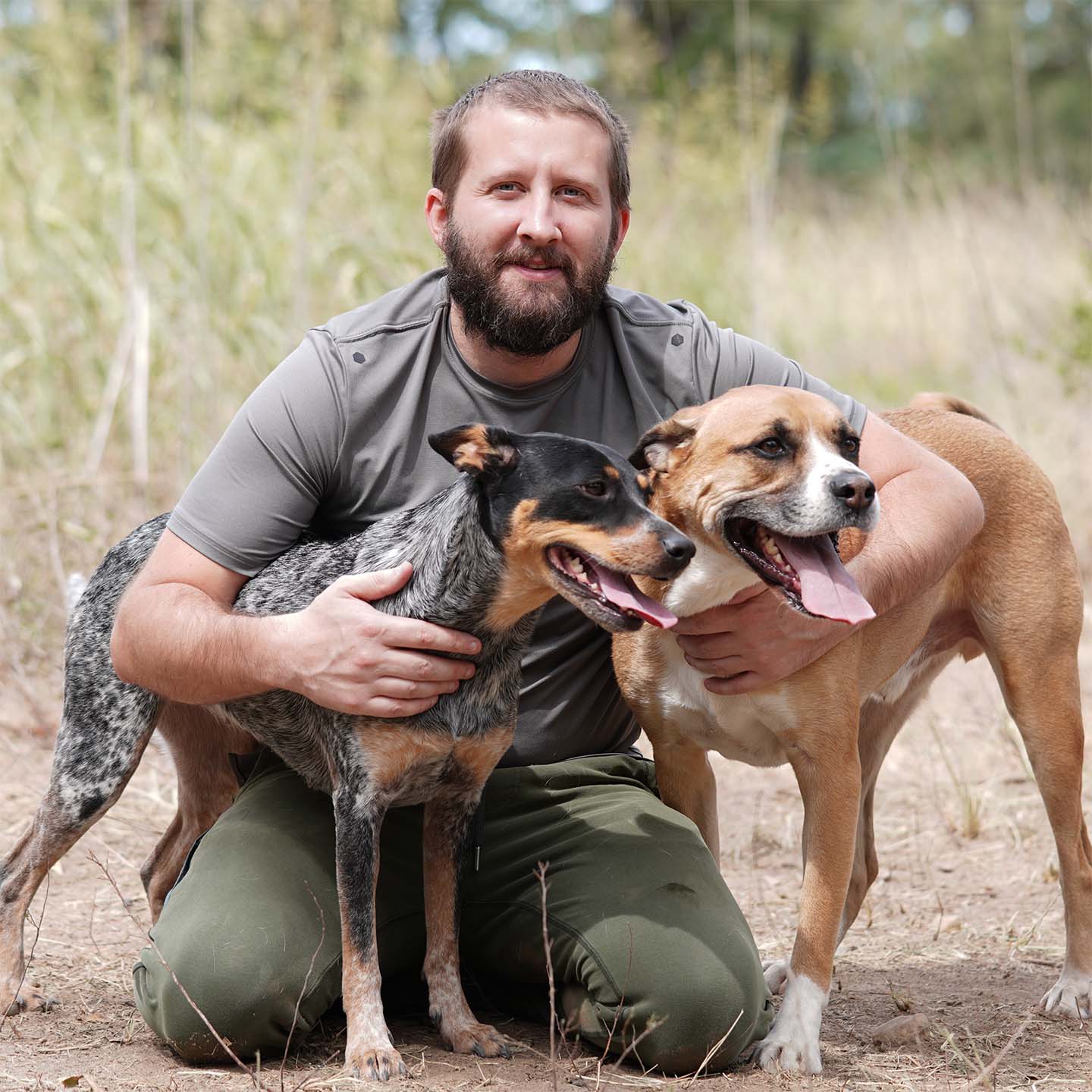
Christopher Lee Moran · Working dog trainer, founder of Whimsy StickA 5-to-10-minute prey drive session before you leave changes the entire equation. Drive resolved means the passive toy is now enough. A satisfied dog sleeps. An unsatisfied dog redesigns your living room.
Flirt Pole vs. Puzzle Toy: What Actually Tires Them Out
They solve different problems. Understanding the difference tells you where each belongs in your dog’s routine.
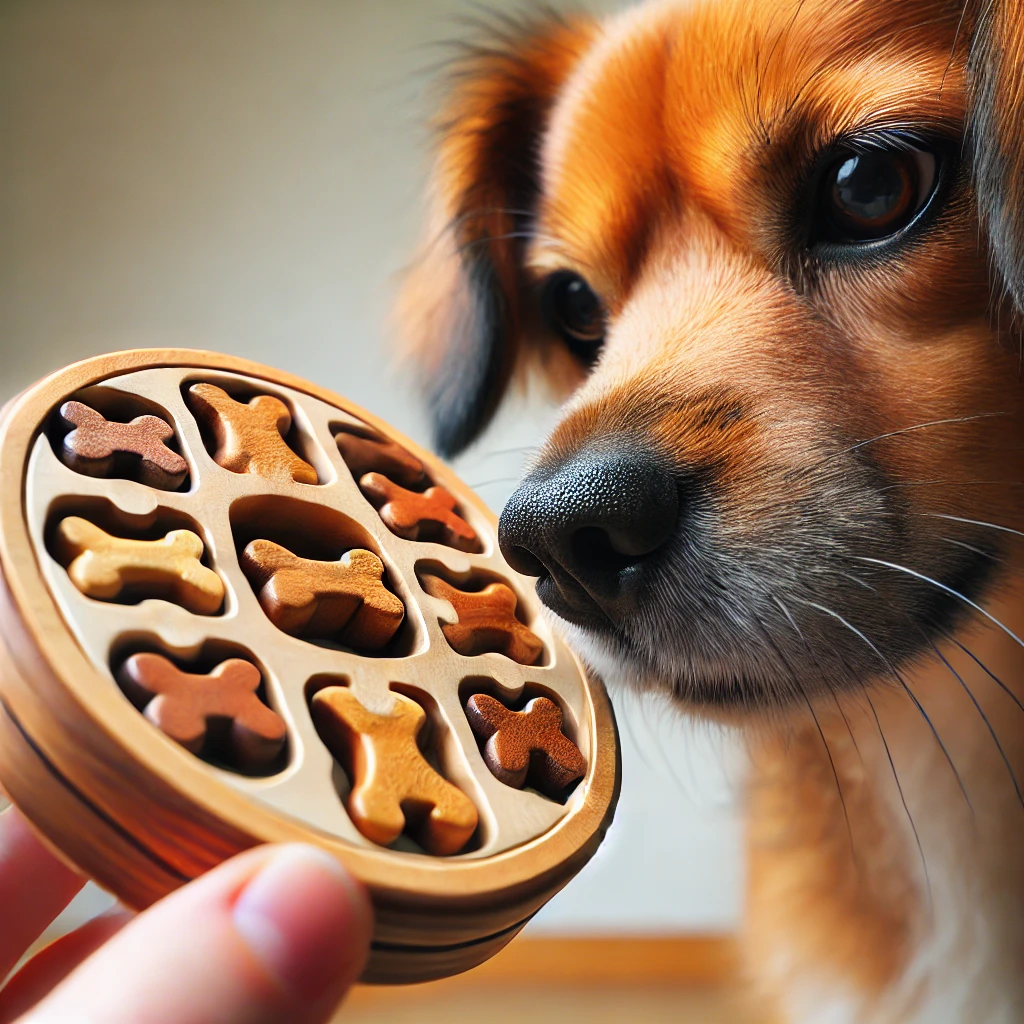
Puzzle toys engage cognitive function: sliding panels, hidden compartments, treat dispensers. Real value for mental fatigue. But the limits for large dogs: most puzzles are built for small-to-medium breeds. Large dogs figure them out fast. For example, a Border Collie solves a Level 2 puzzle in 90 seconds. A Malinois just picks it up and carries it around.
Active prey drive tools require engagement between the dog and its own instincts, under handler direction. The best ones tap into natural behavior patterns, not just food-seeking mechanics. For more on what separates a durable trainer-grade pole from cheap competitors, see why fiberglass wins.
The 5-factor head-to-head
Use both. Puzzle toys have a place in the rotation. But if you are choosing a primary tool for a large dog with real drive, the active prey drive tool wins on every axis that matters: physical output, drive resolution, impulse control, and the bond that only happens during active shared play.
Is This the Right Tool for Your Dog?
The right fit
- Large dogs (30+ lbs) with high prey drive
- Any breed that destroys toys and furniture
- Dogs still restless or hyper after walks
- Dogs that are destructive when left alone
- High-energy working breeds (Shepherds, Malinois, Rotties, Labs)
- Owners who want to build impulse control during exercise
Not the right fit
- Dogs with clinical anxiety requiring veterinary treatment
- Any dog with orthopedic injuries (without vet clearance)
- Aggression toward people: see a behavior professional first
- Puppies under 12 months at full intensity (modified protocols only)
- Owners looking for a leave-it-and-forget-it solo toy
- Replacement for professional behavior modification in severe cases
If your dog fits the “This Is For” column, you are not dealing with a behavior problem. You are dealing with an unmet biological need. That is a completely different problem. It has a completely different solution. And it responds to structured prey drive work faster than most owners expect.
What to Actually Look For When Buying
If your large dog needs a tool that resolves drive rather than distracting from it, evaluate these five factors:
Five things to evaluate before you buy
- Durability. If it does not survive a serious session with a large dog, it is not built for a large dog. Thick-walled construction, not hollow PVC.
- Range of motion. Large dogs need to run, not trot. The tool must give them real distance to work with: at least a 6 to 8 foot chase radius.
- Drive activation. Movement needs to trigger chase instinct: unpredictable, fast, and responsive to the dog’s behavior in real time.
- Impulse control built in. The best tool is not just exercise. It is also building self-control under real arousal: sit before chase, drop-it after capture.
- Replaceable lure system. Lures are consumable. A quick-swap system means replacing an $8 component instead of a $30 tool.
Safety Notes
Always supervise sessions. Play on grass or soft surfaces, never concrete or slick floors. Keep the lure at or below shoulder height for large dogs to protect joints. End sessions before the dog is exhausted, not after. If your dog shows signs of overarousal (inability to respond to cues, frantic snapping, trembling), stop the session and provide a calm decompression activity. The ASPCA notes that destructive behavior in dogs is most effectively addressed by meeting underlying physical and mental stimulation needs, not through punishment.
This article is for educational purposes. If your dog’s behavior is sudden or extreme, consult your veterinarian. For full buying guidance, see the complete buying guide.
Do not use a flirt pole with a dog that has active orthopedic injuries, clinical aggression toward people, or untreated anxiety that causes self-harm. Get veterinary or professional behavior clearance first. This tool is a training aid for healthy, high-drive dogs, not a fix for medical or severe behavior conditions.
Bear: 95 lbs, 8 toys destroyed in 6 months. Settled in 11 days.
Bear is a 4-year-old male German Shepherd mix, 95 lbs, adopted at 2 years old. In the six months before we started, his owner had replaced 8 toys: three rope tugs, two rubber chew rings, two puzzle feeders, and a motorized ball. Average lifespan per toy: under three weeks. Daily walks averaged 45 to 60 minutes. Bear was still wired on return. He destroyed a couch cushion and two door frames when left alone.
We started one daily 7-minute Rugged XL session before the owner left for work. The Controlled Freedom method in practice: sit before release, 5 chase intervals with a down between each, deliberate win on the final round, then a chew for cooldown. No other changes to the routine.
The 11-day result, three-month follow-up
By day 11: zero destructive incidents. Bear began offering a down on his own after sessions ended. The owner’s words: “He’s a completely different animal. Not calmer, just satisfied.” Three months later, no regression.
Same prey drive science, sized for smaller dogs. Quick-swap lure system. Trainer-built for the full predatory sequence.
$55.95
Reinforced for large breed pressure. 8-ft chase radius. Quick-swap lure system. Designed by a trainer who spent 10 years watching the wrong tools fail with big dogs.
$74.95 · Free US shipping included
Three quick-swap lures so a worn lure never ends a session early. Same reinforced pole. Best value for dogs who put real pressure on their gear.
$94.95 · Free US shipping included


One Response