
TL;DR
The predatory motor pattern is the hunting sequence dogs inherited, and for pet dogs that’s stalk, chase, capture, win. When it never gets finished it can show up as problem behavior. When the dog gets to finish it, a lot of dogs settle a lot easier, and when they don’t, that leftover drive can turn into jumping or tearing stuff up or reactivity or a dog that just can’t calm down.
Understanding this one concept goes a long way toward explaining why walks don’t calm your dog down, why fetch winds some dogs up more, and why a short structured flirt pole session can do more for a lot of dogs than a long walk. For the basics on the tool, see what is a flirt pole.
Who This Is For
- You’ve got a high-drive dog that doesn’t settle after walks or fetch
- You’re trying to figure out why your dog tears stuff up, nips or can’t focus
- You’re a trainer who wants the background behind prey-based training
- You’ve got a herding, sporting, terrier or working breed and you’re seeing that breed’s drive come out
Signs Your Dog Needs This
- Wired after a long walk or run, zooming around the house, can’t settle
- Jumping, nipping or mouthing all the time, especially when they’re worked up
- Furniture, shoes or bedding getting torn up, especially when they’re alone or bored
- Lunging and barking on leash, locking onto other dogs or anything that moves
- Obedience didn’t fix it, the dog will listen but the energy’s still there
Quick definition before we get into it
Predatory motor pattern (noun): The built-in sequence canids use to find, go after and get prey. In wolves the full sequence is orient, eye-stalk, chase, grab-bite, kill-bite, dissect, consume. In dogs, breeding made some parts stronger and some weaker depending on the breed. For pet dog behavior the four parts that matter most are stalk, chase, capture, win.
The Full Predatory Sequence: Wolf to Dog
Dogs inherited the same basic hunting sequence wolves use, but most breeds only show parts of it. People bred dogs for different jobs over a long time, so some parts got turned up and some got turned down depending on what they needed from that breed. The sequence is still in there, it just got changed around.
Biologists Raymond and Lorna Coppinger described the full sequence as running from orienting and eyeing prey, through stalking, chasing, grab-biting and kill-biting, to dissecting and eating it.
In pet dogs the later parts (kill-bite, dissect, consume) are mostly turned down. What they do need is the middle of it, so stalk, chase, capture and win.
The four phases that matter for pet dogs
When all four happen in order the dog has had a whole hunt, start to finish. Pretty much every other page on this site comes back to this, and it’s why I think a structured flirt pole session can do things for a dog that a lot of walking won’t.
This is what your dog inherited. A pet Mexican Red Wolf on a couch, dissecting a stuffed toy through the full sequence. You can watch the eye-stalk, grab-bite, kill-bite and dissect happen right there. Your dog has the same pattern in it, and the lure on a flirt pole gives it a safe place to go.
Domestication didn’t take the predatory motor pattern out of dogs, it just changed it. Your dog still wants to finish it, so you can either give them a structured outlet or let that drive come out as problems.
How Breeding Changed the Sequence
Breeding didn’t make up new behaviors, it turned some parts up and some down. The AKC overview of predatory behavior in dogs confirms that breed-specific work was built around amplifying or muting these phases. If you know which parts are strong in your breed, a lot of what your dog does starts to make sense.
| Breed Group | Amplified Phases | Suppressed Phases | What You See |
|---|---|---|---|
| HerdingBorder Collie, Aussie, Sheltie, Corgi | Eye-stalk, chase | Grab-bite, kill-bite | Staring, circling, nipping heels, chasing bikes and kids |
| Sporting / RetrieversLab, Golden, Springer | Chase, grab-bite (soft mouth) | Eye-stalk, kill-bite | Carrying everything, mouthing, retrieving obsessively |
| TerriersStaffie, Jack Russell, Pit Bull | Grab-bite, kill-bite (shake) | Eye-stalk (less patient) | Shaking toys, tenacious grip, explosive chase |
| SighthoundsGreyhound, Whippet, Saluki | Chase (extreme) | Grab-bite (often release) | Explosive sprinting, zoomies, chasing anything |
| GuardianGreat Pyrenees, Anatolian, Kangal | Orient (alert/patrol) | Most predatory phases | Watchful, territorial, low chase drive |
| Working / ProtectionGSD, Malinois, Doberman | Full sequence (balanced) | Minimal suppression | High drive across all phases |
That’s why a Border Collie herds the kids, a Lab carries everything around, a Jack Russell shakes its toys like it’s killing them, and a Greyhound takes off after anything that moves. For working breeds, see high prey drive training.
Why Incomplete Sequences Cause Behavioral Problems
When the sequence never gets finished, the urge never gets an ending, so it just stays on, and that drive has to go somewhere.
With pet dogs a lot of times it comes out as jumping, nipping, begging for attention, tearing stuff up, being overexcited all the time and not being able to settle. The dog gets worked up with nothing to finish it, so it finds something else to do and that’s the “bad behavior” you see. The behavioral problems pillar goes through each of those.
Trainer guidance from the AKC on channeling and controlling prey drive reinforces the same point: dogs without an appropriate outlet for predatory drive are far more likely to develop problem behaviors.
What the dog experiences
- the flirt pole explained: the head-term guide to the flirt pole
- Drive turns on but never finishes
- The dog gets worked up with nothing to finish it
- Dog looks for something else to do
- Problem behaviors show up
- Owner sees “bad behavior”
- More obedience doesn’t fix it
What the dog experiences
- Drive turns on and gets finished
- The game gets a real ending
- The dog comes down on its own
- Dog settles without being told
- Problem behaviors can ease up
- Impulse control gets practice too
A lot of times a dog like this just doesn’t have enough to do. Some of what you’re seeing might come from a chase that never gets finished. The impulse control drills put the on/off switch right into the chase while the dog is fired up.
Prey Drive vs. Predatory Motor Pattern
Prey drive is the want, the engine that makes your dog want to chase and grab and hang onto things. You can’t really change how much prey drive a dog has, they’re born with it.
The predatory motor pattern is what the dog actually does with that drive. A dog with a lot of prey drive and no outlet is like an engine revving in park, and a lot of times that revving is what you see as hyper, reactive or destructive.
You can’t change how much prey drive a dog has any more than you can change how big it gets. What you can do is let them finish the chase so that drive has somewhere to go besides tearing stuff up and reacting.
So the drive is what it is, but you can do something about where it goes. Drive is how much is in the tank. The motor pattern is where it goes. Give the dog a way to finish the chase and a lot of times things get better, and if you don’t, the drive finds its own outlet and you probably won’t like it.
Why Common Exercise Methods Fail
A walk doesn’t really give them any of the chase. Fetch gives them the chase and part of a retrieve but skips the stalk, and they don’t get much of a win. Tug gives them the grab but skips the stalk and the chase. So each one leaves part of it unfinished.
A flirt pole can cover all four in one session, start to finish with a clear ending, and that’s what I’m after for a calmer dog. For how much exercise your dog needs every day, see how much exercise does my dog need. If you’ve got a high-drive breed that’s having the hardest time with this, the high-energy dog protocol is made for them. And to pick the right pole for your dog’s size and drive, the buying guide has all three with the exact specs.
How to Complete the Predatory Motor Pattern
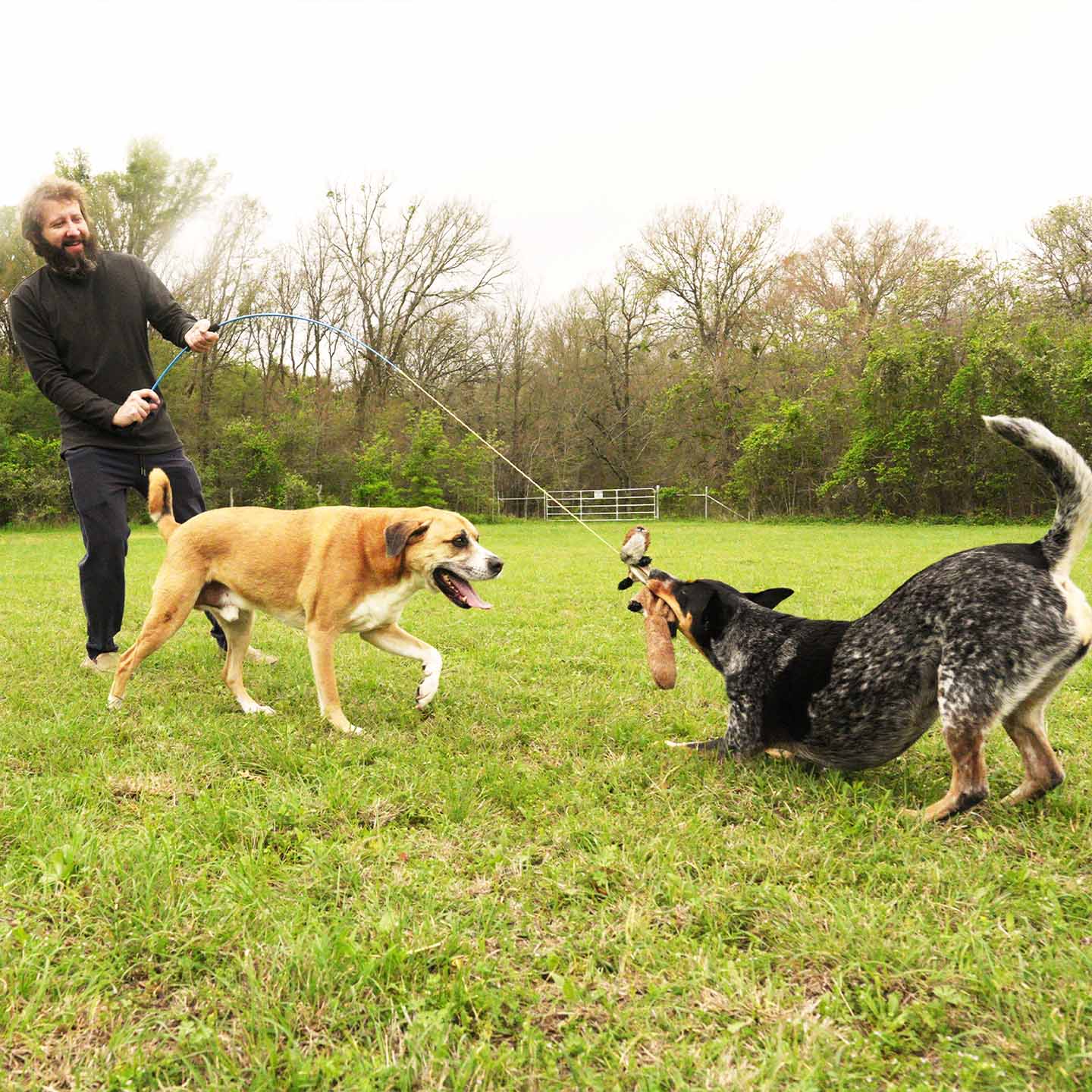
Each step below lines up with one part of the chase. Do ten to fifteen minutes with impulse control cues mixed in and the dog gets to run the whole thing several times.
Phase 1: Activation (stalk + chase)
Start with the dog in a sit or down and the lure still on the ground, and watch for the eyes to lock on, the body to drop a little and the weight to shift forward, cause that’s the eye-stalk. I’d hold it 3 to 5 seconds before you release.
Phase: StalkRelease the dog and move the lure around on the ground so they can’t guess where it’s going, in wide arcs with no tight circles, all out for 30 to 60 seconds. Dogs chase hardest when it moves like something alive, not like a toy on a string.
Phase: ChasePhase 2: Resolution (capture + win)
Every three or four reps, slow the lure down and let the dog catch it, and honestly don’t skip this. A dog that never gets to catch it never gets the end of the game, and the catch is what turns all that excitement into a satisfied dog.
Phase: CaptureAfter the catch, let the dog hold onto it for 3 to 5 seconds, cause that’s the win, they actually get to have it, not just touch it. Then cue “drop” or trade for a treat and go again, cause if you skip the win you just wound them up with no ending.
Phase: WinFor the whole session step by step, plus breed changes and how to build impulse control, see the Training Guide. There’s a link in the sidebar.
Predatory Motor Pattern, FAQ
The concept
What is the predatory motor pattern in dogs?
It’s the hunting sequence dogs inherited from wolves, and for pet dogs the part that matters for behavior is four steps, stalk, chase, capture, win. Finishing it gives the dog a clear ending, and when they never get to they can stay wound up, and that’s behind a lot of behavior problems.
Is the predatory motor pattern the same as prey drive?
No. Prey drive is the want (the engine), and the predatory motor pattern is what the dog does with it (the gears). The prey drive training guide covers how to channel drive into structured work.
Where did the concept come from?
The predatory motor pattern was described by Raymond and Lorna Coppinger in Dogs: A New Understanding of Canine Origin, Behavior and Evolution (2001). Their work described how breeding changed the sequence from breed to breed rather than removing it, and that’s the idea this whole page is built on.
Did wolves and dogs have different predatory motor patterns?
Wolves run the whole thing all the way through to eating. Dogs still have the sequence, but breeding decided which parts each breed shows, and most pet dogs don’t need the kill-bite or the eating to be satisfied.
Behavior and breeds
Why does the predatory motor pattern matter for behavior?
The way I see it, a lot of behavior problems in pet dogs come back to a chase that never gets finished, and when it doesn’t get finished regularly that drive can come out as jumping, nipping, tearing stuff up, reactivity and restlessness. I’ve found a dog with a satisfied animal instinct is much better behaved.
How do different breeds express the pattern?
Breeding turned up different parts in different breeds, so herding breeds like the Border Collie have a big eye-stalk and chase, sighthounds like the Whippet have a huge chase, and retrievers and gun dogs have a strong chase and grab with a soft mouth. Terriers go hard on the grab-bite and shake, northern hunting breeds like the Akita keep a strong grab-bite and kill-bite, and guardian and drover breeds like the Rottweiler are lower on chase but big on orienting and controlling. The breed table above has the rest.
What happens when the pattern is not fulfilled?
That leftover prey drive can come out as problems, like tearing stuff up, being hyper, reacting on leash, jumping, nipping and not being able to settle, and for more on each of those see the behavioral problems pillar.
Practice and training
Does fetch complete the predatory motor pattern?
No, fetch is mostly the chase and bringing it back, so the dog never stalks, doesn’t really catch anything on their own and doesn’t get much of a win. A flirt pole can give them all four in order, stalk, chase, capture, win, and that’s why I’d pick it over a long game of fetch for a dog that needs to settle.
How do you complete the predatory motor pattern?
The easiest way I know is a structured flirt pole session, cause the still lure gets the stalk, moving it gets the chase, letting the dog catch it is the capture and letting them hold it is the win. In 10 to 15 minutes they can run the whole thing several times.
Can you train using the predatory motor pattern?
Yes. When you put cues like wait, drop-it and recall into the chase, the dog practices them while they’re fired up, and that’s when you need them to work in real life, cause a sit right before the chase is a lot harder for a dog than a sit in a quiet classroom. That’s a big part of what I call Controlled Freedom.
For more on drive, impulse control and behavior, see the full training blog.


