
How Often Should You Use It?
How often should you use a flirt pole? For a healthy adult dog, I’d do about 10 minutes most days. High-drive working breeds a lot of times do better with two shorter sessions, morning and evening. Puppies and older dogs need a lot less, and your vet gets the last word on both. Doing it most days matters more than how hard any one session is.
Quick chart: healthy adult, about 10 minutes most days · high-drive working breed, two shorter sessions a day · puppy, short and gentle, a few times a week · older dog, 2 or 3 short, easy sessions a week.
By Christopher Lee Moran, working dog trainer, about 10 years and around 400 client dogs. I’m a trainer, not a vet, and I make the Whimsy Stick, so I’m not neutral about flirt poles. New to the tool? See what a flirt pole is.
Who this is for
- People who just got a flirt pole and are figuring out a routine
- Anybody whose dog loved it for a week and then stopped caring
- People who play every so often and aren’t seeing much change
- People playing twice a day who are worried it’s too much
- Puppy owners trying to figure out when it’s OK to start
- People with older dogs who want to keep them moving
- People with high-drive breeds like Huskies, Border Collies and Malinois
Signs your dog needs a routine
- Destructive when left alone, chewing furniture, shredding bedding, getting on the counters
- Reactive on leash despite training. A flirt pole won’t fix that alone, but it can give the drive somewhere to go while you work on it with a trainer
- Restless in the evening, pacing and nudging you even after a walk, cause a walk doesn’t let a dog hunt
- Rough play that escalates fast, and a chase game with rules gives them practice coming back down
- You’ve tried more walks and it’s not working
- Bored of every toy within minutes, cause a toy lying on the floor doesn’t move or run off
For a healthy adult dog: about 10 minutes, most days
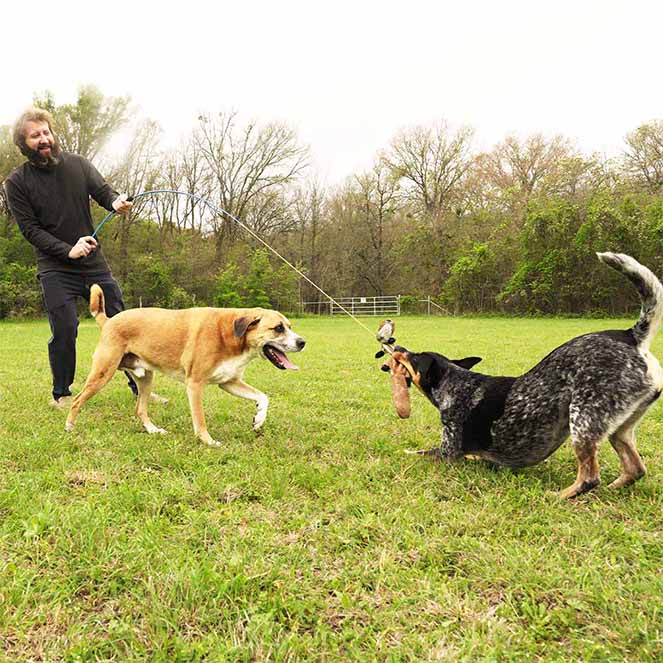
If your dog is grown, healthy and has a decent amount of drive, this is where I’d start. About 10 minutes on grass or something soft, with a catch every few rounds, and end it while your dog still wants more. A couple of rest days a week is fine for most dogs, but you don’t have to take them.
Ten minutes is long enough for your dog to run the whole thing, stalk, chase, catch and win, a bunch of times. Go a lot shorter and they don’t get many rounds in. Go a lot longer and they can overdo it. I wouldn’t let a session run past 15 minutes.
What you can look for
- A tired dog after every session
- Over time, a dog that seems more relaxed and settles easier
- A dog that stays in shape
What my clients tell me most is their dogs are a lot more relaxed and calmer, and they just seem more satisfied. How you run the session matters as much as how often, so the flirt pole training guide is worth a read.
Four things that change the answer
Four things change how often: your dog’s age, their drive, what you’re using it for, and how long they’ve been doing it. Here’s how each one moves the number, and which ones win when they don’t agree.
1. Age
This one matters the most. Under 6 months I’d just let a puppy check out a lure that isn’t moving, with no chasing. From 6 to 12 months it’s short, slow sweeps on the ground, a few minutes at most with no hard turns, a few times a week. Full sessions wait until your vet says the growth plates are closed. Grown dogs can go most days, and older dogs drop to 2 or 3 shorter, easier sessions a week.
2. Drive
High-drive breeds usually need more, not less. Huskies, Border Collies, Malinois, working-line Shepherds and pit bull types a lot of times do better with two shorter sessions a day, morning and evening, cause splitting it up keeps them from getting too wound up. Average dogs do the regular session, and laid-back dogs can be fine every other day.
3. Your goal
If you’re working on restlessness or a dog that tears things up, I’d go most days. If your dog is already pretty balanced and you just want to burn some energy, every other day works. Self-control work has its own setup, which is on the impulse control drills page.
4. How long they’ve been doing it
A dog new to the flirt pole needs to work up to it. The first week I’d keep sessions short and every other day and see how your dog does, then build toward the full 10 minutes most days. Dogs that get thrown into it full speed can end up sore or too wound up, so ease in. The first week is laid out in how to introduce a flirt pole.
When they don’t agree: age and how long they’ve been doing it set the limits, and drive and your goal work inside those. A high-drive puppy still gets puppy sessions, and so does an older dog that still has plenty of drive.
The frequency chart: find your dog’s row
Find your dog’s row, then match it to what you’re using the flirt pole for. That’s where I’d start, and then you adjust it to your dog.
| Your dog | Behavior work | Burning energy | Keeping it up |
|---|---|---|---|
| Puppy under 12 months | Waits and drop-its with a still or slow lure, a few minutes | A few short, gentle sessions a week, lure on the ground | Short and easy, skip it with any joint concern |
| Grown, healthy dog | About 10 minutes most days | About 10 minutes most days | 4 or 5 sessions a week |
| High-drive working breed | Two shorter sessions a day | Two shorter sessions a day | Once a day once they’re in shape |
| Older dog | 2 or 3 short, easy sessions a week, no jumping | 2 or 3 a week, check for stiffness the next day | 1 or 2 a week, the thinking part matters more now |
The vet comes before the chart. If your dog has joint problems, talk to your vet first no matter which row they’re in. If your dog is getting over an injury or surgery, forget the chart until your vet clears them. Play on grass, not concrete, keep the lure on the ground, and skip the hot part of the day.
A flirt pole doesn’t replace the walk either. The AVMA points out that walking is mental stimulation for a dog to smell, see and hear beyond the limits of your yard, and a flirt pole can’t give him that.
Signs you’re using it too often
A flirt pole is hard exercise, more like sprints than a jog, and if you do it too often you’ll see it in your dog. If you see any of these, cut back on how often and how long until they go away.
- Limping or stiff the day after. Play on grass and drop a session a week, and if it keeps up, see your vet.
- Not as into it anymore. A dog that used to run to the pole and now hangs back might be sore or burned out, so take a few days off.
- Still panting long after the session. That usually means the sessions are too long, so make them shorter.
- Won’t start the game. If a dog that’s usually playful won’t start, they’re telling you something, and I’d listen.
- Clicking, popping or pain while playing. Stop right away and see a vet before you play again.
- Wound up the rest of the day. Pacing, whining and barking at you for the next session means it’s winding them up more than it’s helping.
None of these mean you have to quit. They mean what you’re doing right now is too much for your dog. Drop a session a week, make the rest a couple minutes shorter, play on grass, and give your dog a week or so to rest up. If something doesn’t clear up, see your vet.
Rest is part of it. Four dogs lying calmly on cots and a bed indoors. Hard work needs rest days too.
Flirt pole for overexcited dogsSigns you’re not using it enough
This one’s pretty common too. People play every once in a while, don’t see much, and decide it doesn’t work, when really they just aren’t doing it enough.
- Tired right after, wired again in an hour. Try most days instead of every so often.
- Still restless or destructive with “regular” use. A lot of times regular means 2 or 3 times a week, and for a dog with a lot of drive that might not be enough. If it’s real reactivity, get a trainer involved too.
- Going looking for the flirt pole. Bringing you toys or staring at where you keep it means your dog wants more.
- Better on session days, worse on off days. It’s helping, you’re just not doing it enough.
- Not much change after a good while. How often you’re playing is a good place to look before you go looking for something else.
If you only play every so often, you’re gonna get every-so-often results. Making it part of the day matters more than how hard you go at it.
What to expect if you stick with it
Every dog is different, so I’m not gonna give you a schedule. You’ll have a tired dog after the first session. Some dogs are a little sore early on while they get used to it, and if it’s more than a little, back off and ask your vet. After a while most dogs start looking forward to it, and the flirt pole stops being a fix for something and turns into just what you and your dog do. Once your dog is in better shape you might want to go a little longer, but I’d still keep it under 15 minutes.
If you play most days, get a pole that holds up
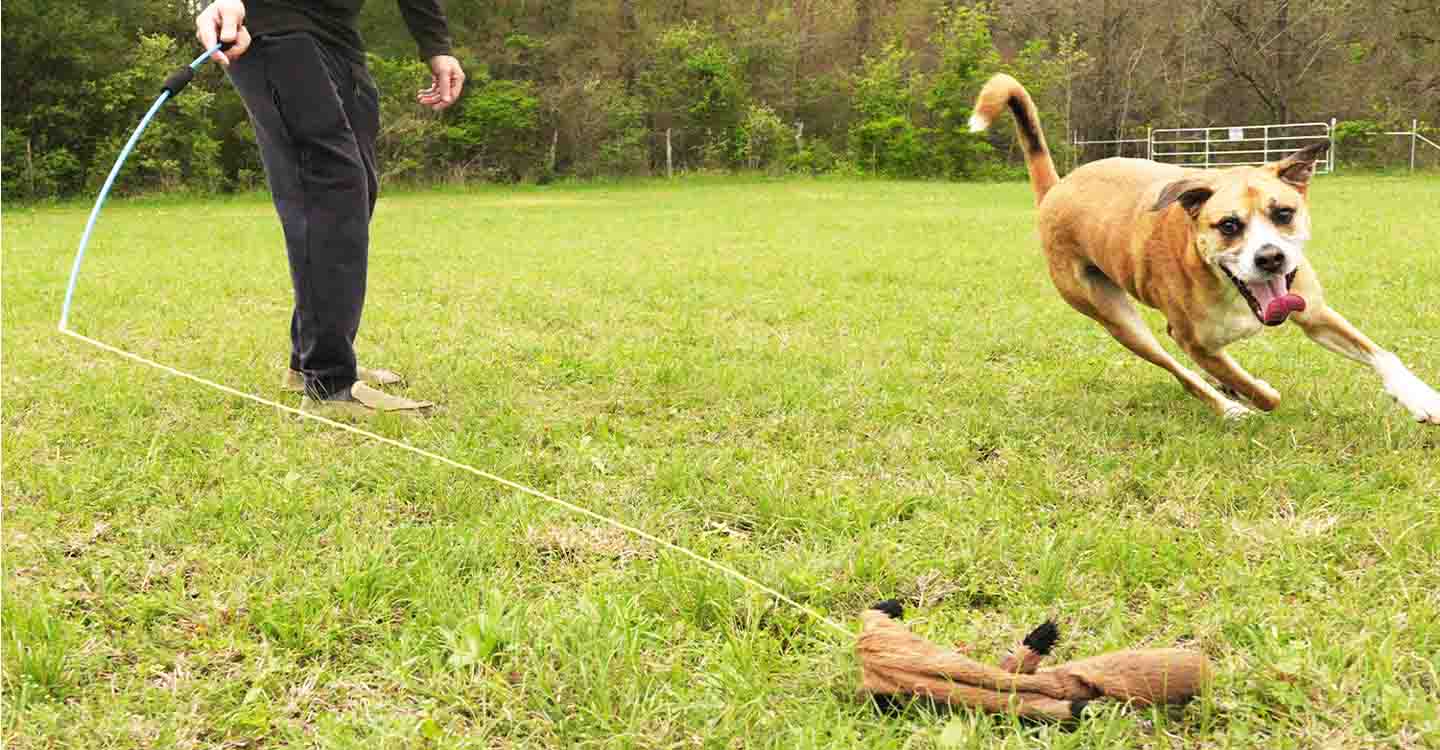
Daily use is hard on gear. The Rugged XL is one 46-inch piece of reinforced fiberglass with no joints and an 800-lb Dyneema line that doesn’t stretch, for dogs 30 lbs and up. In my own use it holds up to a 120-lb power breed. The Standard is for dogs under 30 lbs, with a 450-lb Kevlar line. I bought the flirt poles I could find, handed them out to clients and watched what broke, then built my own and tested it on high-drive client dogs for years before I ever sold one.
Rugged XL + 3 Lures
- Dogs 30 lbs and up · 800-lb Dyneema line
- 3 lures to rotate · free US shipping
Rugged XL Pro Kit
- The XL with 5 lures and a spare line
- For daily use · free US shipping
Rugged XL
- Same pole and line, 1 lure
- Dogs 30 lbs and up · free US shipping
The Standard
- Dogs under 30 lbs · 450-lb Kevlar line
- $20 flat US shipping, cause it goes in a longer box
Every order has a 30-day money-back guarantee, and you pay return shipping unless the pole failed. Lures and line are wear parts, and a lure is $12.95 when one wears out. For build details, see the flirt pole buying guide.
Want more of this in your Google results? Add Whimsy Stick as a preferred source.
How often to use a flirt pole: FAQ
How often should I use a flirt pole?
For a healthy adult dog, about 10 minutes most days. Some high-drive dogs do better with two short sessions, morning and evening. Puppies get short, gentle sessions a few times a week, and older dogs do fine with two or three short ones a week. It depends on your dog’s age, drive and how they handle it.
Can I use a flirt pole every day?
Yeah, most healthy adult dogs can go every day. Keep it under 15 minutes, put a catch in every few rounds, and play on grass, not concrete. Puppies and older dogs with joint problems are different, and every day is too much for them.
How long should each flirt pole session be?
About 10 minutes for a healthy adult. Go much shorter and they don’t get many rounds in, and past 15 they can overdo it. Puppies and older dogs get a lot less, and whatever the age, I’d quit while your dog still wants more.
Can you over-exercise a dog with a flirt pole?
Yes, cause it’s hard exercise, kind of like sprints. Watch for limping, soreness the next day, losing interest, panting that won’t settle and stiff joints. If you see any of that, cut back, and see your vet if it doesn’t clear up.
Should I use a flirt pole twice a day?
With high-drive working breeds like Huskies, Border Collies, Malinois and working-line Shepherds, I’d usually split it into two shorter sessions, morning and evening. That tends to work better than one long one and keeps them from getting too wound up. An average dog is fine once a day.
How often should I use a flirt pole for a puppy?
Under 6 months, just let them check out a still lure. From 6 to 12 months, a few short, slow sessions a week with the lure on the ground and no jumping. Full sessions every day wait until your vet says the growth plates are closed. For the rest of puppy life, see stop puppy biting.
How often should I use a flirt pole for a senior dog?
Two or three short sessions a week, nice and easy, with a slower lure kept low and no sharp turns or jumping. Plenty of older dogs still love it. Watch for stiffness after and back off if you see it, and if there are joint problems, talk to your vet first.
When will I see results from regular flirt pole use?
You’ll have a tired dog after the first session, but the rest takes time and every dog is different. What my clients tell me most is their dogs are a lot more relaxed and calmer, and they seem more satisfied, once it becomes part of the day.
What if my high-drive dog still seems wired after a session?
Check how you end it. A session that just stops can leave a dog wound up, so finish with a last catch and drop, say all done, put the lure away and reward a calm down. The high-energy dog guide goes deeper.
Get the routine right. Get the tool to match.
A short session most days is what I’d shoot for. One-piece fiberglass, a line that doesn’t stretch, and a 30-day money-back guarantee.
Add the Rugged XL + 3 Lures, $94.95Under 30 lbs? See the Standard, $55.95
Based on my own experience training dogs. Not veterinary or behavioral medical advice. Exercise disclaimer.


