
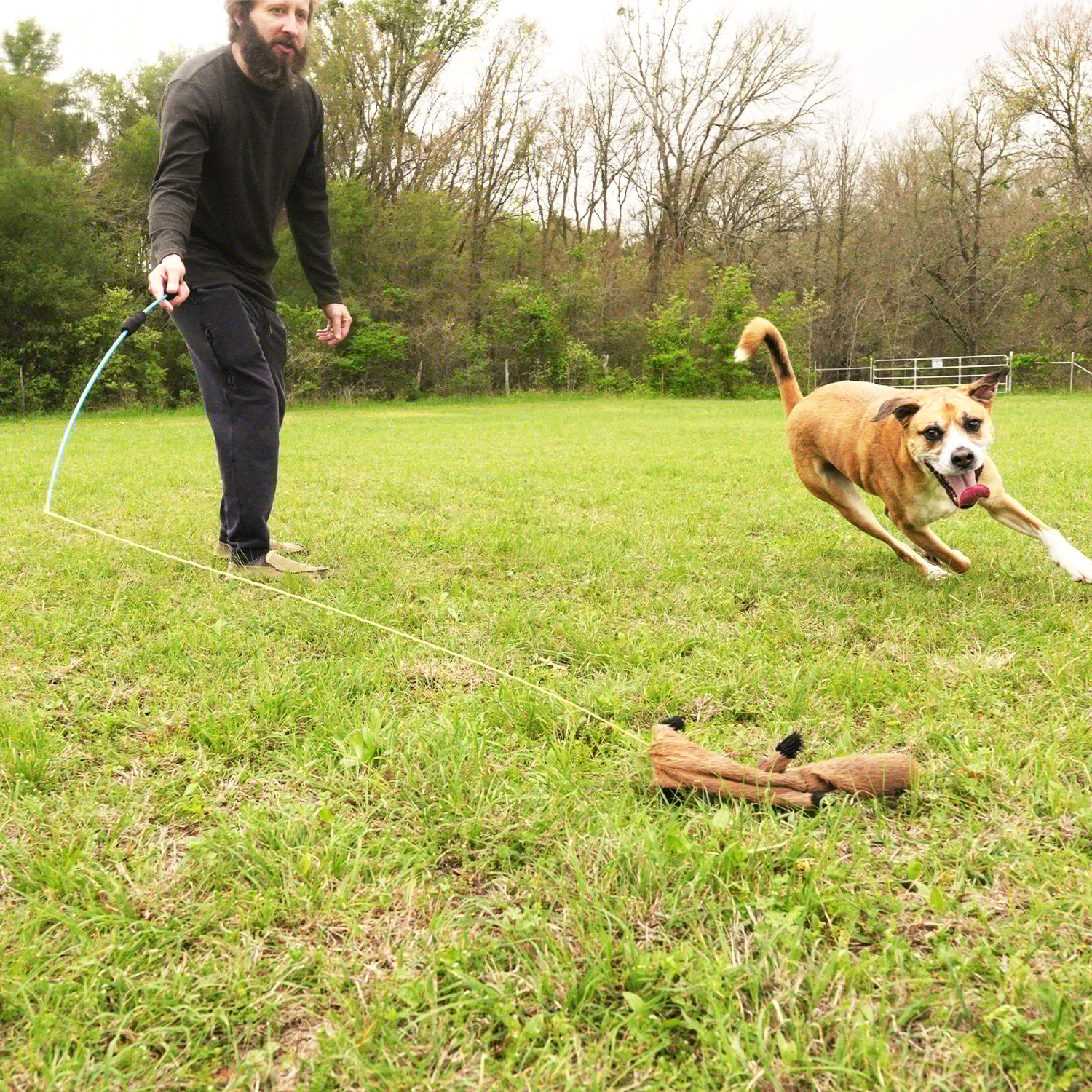
A flirt pole is a flexible pole with a line and lure. You move the lure, your dog chases it. That sounds simple. But the behavioral science behind it is what makes it the most effective training tool most owners will ever use.
It completes the full predatory motor pattern dogs evolved to perform. That is why 10 minutes of structured work produces deeper calm than an hour-long walk. This page explains what it is, how it works, why it changes behavior, and which one to buy.
Read this if your dog does any of the following
- the flirt pole and flirt stick: the head-term guide to the flirt pole
- Still hyper after a long walk or run, physical exercise isn’t landing
- Destroys furniture, shoes, or household items when left alone
- Lunges, barks, or fixates on squirrels, bikes, or other dogs outside
- Knows every command in the house and ignores them all outside
- Can’t settle after exercise, paces, whines, or stays wired for 30+ minutes
- Has been labeled “too much” or “untrainable” by a previous trainer
Your dog’s drive is running without an outlet
- Zoomies every evening with no clear trigger, the prey sequence is backing up
- Obsessive ball fixation or toy guarding, the win phase never completes properly
- Mouthing or nipping during play that escalates faster than you can control
- Hypervigilance on walks, head swiveling, unable to disengage from environmental triggers
- Frustration barking when restrained or on leash near high-value stimuli
- Zero impulse control at the door, in the car, or before meals, arousal has no structured outlet
Quick definition before we dig in
Flirt pole (noun): A dog training tool consisting of a flexible pole, a durable line, and an attachable lure designed to mimic prey movement. Used to engage the full predatory motor pattern (stalk, chase, capture, win) for behavioral modification, impulse control training, and mental enrichment. Also known as: flirt stick, dog lure toy, chase pole.
Anatomy of a Flirt Pole
A flirt pole has three components, and each one serves a specific function in triggering and completing the prey sequence.
In practice, the quality of each component determines whether the flirt pole works as a behavioral training tool or breaks after one session. That is why professional flirt poles like the Whimsy Stick exist, built to the engineering tolerances that make the prey sequence work.
How a Flirt Pole Works
A flirt pole works by engaging the predatory motor pattern, the hardwired neurological sequence every dog inherited. In wolves the full sequence is: orient, stalk, chase, grab-bite, kill-bite, dissect, consume. In domestic dogs, selective breeding shortened this to the four phases that matter for behavior.
When this four-phase sequence completes, the dog’s nervous system registers it as a successful hunt, the neurological reward is genuine satisfaction, not just physical tiredness, and that is the distinction most owners miss. A 10-minute flirt pole session produces deeper calm than a 45-minute walk because the predatory loop closes. Research from the American Kennel Club supports the link between structured prey drive fulfillment and improved impulse control.
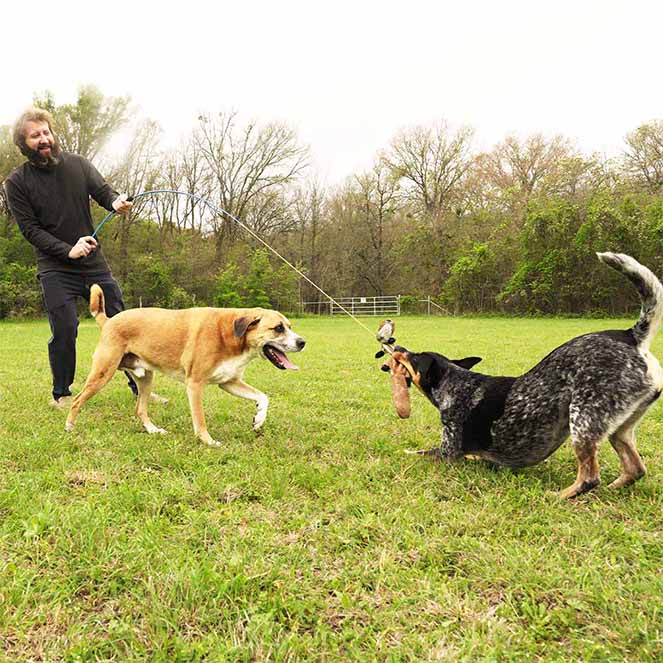
A flirt pole does not just tire your dog out. It completes a neurological cycle. The difference between physical exhaustion and neurological satisfaction is the difference between a dog that passes out for 20 minutes and a dog that settles calmly for the rest of the evening. That distinction is the whole framework.
Why a Flirt Pole Is Different from Everything Else
Particularly, most dog owners rely on three exercise methods, walks, fetch, and tug, and all three are incomplete.
Particularly, walking does not engage prey drive at all. It provides movement and environmental stimulation, but no part of the predatory motor pattern fires, your dog stays hyper after walks because the predatory loop never fires. For the matching question of daily volume, see how much exercise does my dog need.
Indeed, fetch covers the chase and retrieve phases but skips the stalk and rarely gives a satisfying win. The dog runs out, picks up the ball, brings it back, the sequence never completes, and arousal stays elevated.
In short, tug covers the capture and hold phases but skips the stalk and chase entirely. It builds jaw strength and engagement, but the neurological sequence is fragmentary.
What it covers
- Walk: movement only, no prey drive
- Fetch: chase and retrieve, no stalk or win
- Tug: capture and hold, no stalk or chase
- Dog stays in arousal loop
- Physical exhaustion without mental completion
- Behavioral problems persist
What it completes
- Full sequence: stalk, chase, capture, win
- Neurological satisfaction, not just tiredness
- Impulse control built into every session
- Handler focus trained at high arousal
- 10 to 15 minutes produces deep behavioral calm
- Behavioral problems addressed at the root
Why Flirt Poles Change Behavior
In fact, most behavioral problems in pet dogs are not obedience failures, they are symptoms of unfulfilled instinct. When the predatory motor pattern does not get completed regularly, the unresolved drive has to go somewhere: jumping, nipping, and attention-seeking, destroying furniture, the dog that cannot calm down no matter what you try.
Your dog is not badly behaved. Your dog is underemployed.
A flirt pole gives the drive a legitimate daily outlet, and when the prey sequence completes, the neurological pressure drops and behavioral symptoms resolve because the root cause has been addressed. The ASPCA identifies unmet instinctual needs as a primary driver of destructive and anxious behavior in dogs, which is exactly what structured predatory play addresses.
A flirt pole is not an exercise upgrade. It is a behavioral intervention. The exercise is a side effect. The real value is completing the neurological cycle that keeps your dog mentally stable. For the matching guide on channeling drive, see prey drive training.
Your dog is not bad. Your dog is underemployed. A flirt pole is the simplest job description you can hand them: stalk, chase, capture, win. Then settle.
Christopher Lee Moran · Working Dog TrainerThe Flirt Pole as a Training Tool
Indeed, beyond drive fulfillment, a flirt pole is among the most efficient obedience training tools available. When used with structure, every session automatically builds four behaviors: wait (before release), recall (mid-chase interruption), drop-it (after capture), and handler orientation (the dog checks in with you because you control the game).
Generally, the reason these behaviors stick is arousal specificity. Traditional obedience training happens at low arousal in a living room, but real-world situations happen at high arousal, and behaviors trained at calm do not transfer reliably to high-drive situations. This is the core of the Controlled Freedom method: a flirt pole trains those behaviors at exactly the arousal level where they need to hold. For the full session structure, see the training guide.
“Untrainable” outdoors. Recall went from 0 out of 10 attempts to 8 out of 10 in 3 weeks.
For example, bella’s owner tracked every recall attempt for two weeks: 0 successful mid-chase recalls out of 47 tries. After just 3 weeks of daily 12-minute flirt pole sessions, mid-chase recall success jumped to 8 out of 10. Leash-reactive episodes dropped from 11 per week to 2. Bella went from pacing and whining for 30+ minutes after walks to settling calmly within 4 minutes.
The Basic Session Protocol
A flirt pole session without structure is just exercise. With structure, every rep builds wait, recall, drop-it, and handler orientation simultaneously. Five steps, 10 to 15 minutes, done.
Set the Wait Cue
Additionally, hold the lure still on the ground. Ask for a sit or down. Hold position for 3 to 5 seconds before release. No release until the dog is still. The session has not started until the dog demonstrates control.
Cue: WaitRelease and Drive the Chase
Give a release word and drag the lure erratically along the ground, direction changes, sudden stops, unpredictable movement. Keep it low. Let the dog drive hard into the chase phase.
Cue: Release word (e.g. “Get it”)Complete the win cycle, steps 3 through 5
Let the Dog Win
In fact, every 2 to 3 reps, let the dog catch and hold the lure. Do not yank it away. Let them shake it, carry it, own it for 5 to 10 seconds. This is the neurological payoff, the win phase must complete or the sequence stays open.
No cue, let it happenAsk for Drop-It to Restart
Meanwhile, after the dog has held the lure, give your drop-it cue. The moment they release, restart the chase immediately. The reward for dropping is the next chase, you never need to bargain with food to get the lure back.
Cue: Drop itEnd on a Win, Then Settle
Overall, the final rep of every session must be a clean capture. Let the dog hold the lure. Ask for a sit or down. Put the pole away. Give water. The session ends on a calm win, not a chase, this is what produces the post-session settle.
Cue: Sit / Down- Grass or turf only
- 10–15 minute sessions
- Let the dog win every 2–3 reps
- End on a clean capture + settle
- 4–5 sessions per week minimum
Do not use a flirt pole on hard surfaces. Concrete and tile multiply impact forces on joints with every direction change. Grass or turf only, especially for dogs under 18 months whose growth plates are still closing.
No 180-degree reversals at full speed. Drag the lure in sweeping arcs and curves, not sharp doubles back. The ACL does not care how much prey drive your dog has.
If your dog has a diagnosed orthopedic condition, a history of joint injury, or is severely brachycephalic, get clearance from your vet before starting. For the full safety breakdown, see flirt pole safety.
The Whimsy Stick, built for real prey drive
Which Dogs Benefit
Specifically, almost every dog with functioning prey drive benefits from a flirt pole, which covers the vast majority of breeds. High-drive breeds see the most dramatic results because they have the most unresolved drive to address.
Generally, breeds that respond particularly well include German Shepherds and Belgian Malinois, Border Collies, herding breeds like Corgis, Shelties, and Australian Shepherds, Pit Bulls, Staffies, Huskies, Labs, and Goldens. The tool is not limited to high-drive breeds, Dachshunds, French Bulldogs, Beagles, and mixed breeds all engage with flirt poles effectively. For the deeper protocol specific to high-energy dogs, see best for high-energy dogs.
Particularly, the dogs that benefit the least are extremely brachycephalic breeds with severely compromised breathing (like English Bulldogs) and dogs with diagnosed orthopedic conditions that prevent running. For those dogs, modified low-intensity protocols can still work. Consult your vet before starting any high-intensity chase work.
Choosing the Right Flirt Pole
In contrast, not all flirt poles are the same. The pet industry is full of cheap versions that snap, tangle, and use the wrong lure action. Professional flirt poles are built around three engineering decisions: pole flex under load, line tangle resistance at speed, and lure construction that resists shred while still triggering strong prey response.
Indeed, the short version: for dogs 30 lbs and under, you want the lighter Standard pole with a smaller lure sized for a smaller jaw. For dogs over 30 lbs, you want the reinforced Rugged XL, heavier-duty line, and lures built to survive grab-bite force. Picking the wrong size is the most common mistake new buyers make, the product card above this section shows all three models with exact pricing.
Where Flirt Poles Come From
Additionally, flirt poles have been used in professional working dog training for decades, police K9 units build prey drive in detection and patrol dogs with them, protection sport trainers (Schutzhund, French Ring) use them to develop chase engagement and bite commitment, and wildlife conservation programs use modified versions to condition dogs for tracking work.
In fact, the tool moved into the pet owner space when trainers recognized that the same prey drive mechanics that build reliable working dogs also resolve the behavioral problems most pet owners deal with daily. The underlying principle is identical whether the dog wears a badge or sleeps on your couch: a dog that completes the predatory motor pattern regularly does not need to create its own outlets through destruction, reactivity, or anxious behavior.
Flirt poles were not invented for pet owners. They were adopted by pet owners from the professional training world because they work. The behavioral science is the same whether the dog wears a badge or sleeps on your couch.
What Is a Flirt Pole, FAQ
The definition
What is a flirt pole for dogs?
Is a flirt pole a toy or a training tool?
What is the predatory motor pattern?
Practice and safety
Are flirt poles safe for dogs?
Why is a flirt pole better than fetch?
What size flirt pole should I get?
Frequency and use
Can puppies use a flirt pole?
How often should I use a flirt pole?
Breeds and history
What breeds benefit from a flirt pole?
Where did the flirt pole originate?
For more trainer protocols, see the full training blog.


