
Quick summary
The best flirt pole for a Labrador Retriever depends on which Lab you have. Working-line and high-drive show-line Labs need the Rugged XL with its Dyneema line and reinforced construction. Lower-drive show-line Labs may not need flirt pole work at all. Joint protection rules are stricter for Labs than for most breeds because of the documented hip and elbow dysplasia risk.
The Lab-specific protocol: 8 to 10 minutes per session for healthy adults, 5 to 8 minutes for adolescents under 24 months, with the lure kept at ground level and wide arcs only. The structured wait and drop-it phases address the mouthing problem most Lab owners struggle with. This sits inside the broader best flirt pole for high energy dogs framework with the underlying method in the flirt pole training guide.
Who This Guide Is For
- Owners of a Lab who still vibrates after a 60-minute walk or a long fetch session.
- Working-line, field-line, or American-style Labs with visibly high prey drive.
- Lab owners dealing with mouthing, jumping, or door-greeting problems past adolescence.
- People whose Lab obsesses over the ball to the point of skipped meals.
- Adolescent Lab owners (8 to 24 months) trying to manage the teenage Lab phase.
- Multi-Lab households where two Labs amplify each other’s arousal.
Signs Your Lab Needs Structured Flirt Pole Work
- Cannot settle within an hour after a long walk or retrieve session.
- Mouths or grabs hands, sleeves, leashes, or guests when excited.
- Door-charges, jumps on people, or counter-surfs despite training.
- Demand-barks or paces when expected stimulation is delayed.
- Goes harder rather than calmer with more fetch or more walking.
- Is a 1 to 3 year old working-line or field-line Lab with no structured outlet.
The Working Line vs Show Line Difference Most Owners Miss
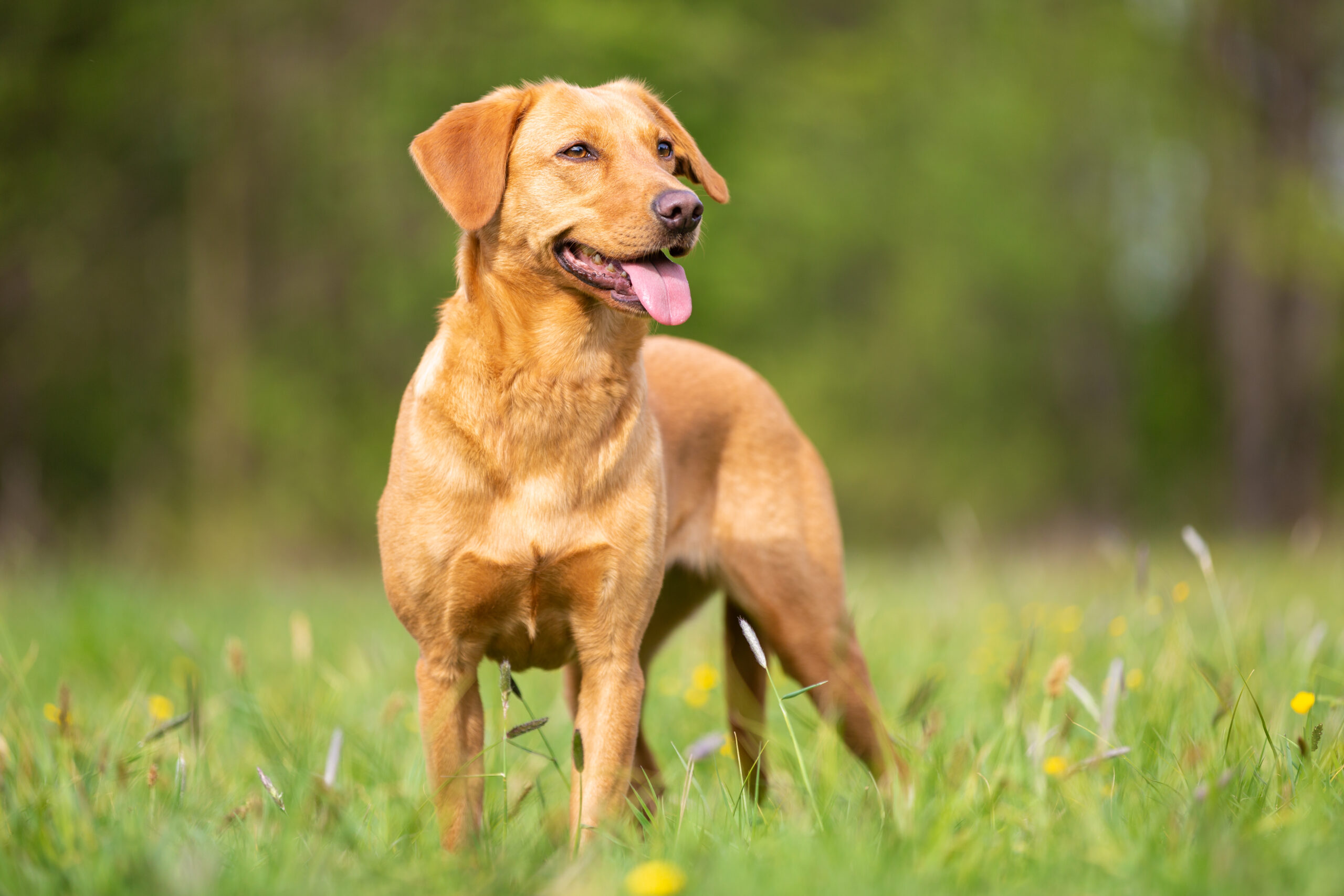
For any Lab owner, the single most important diagnostic is whether your dog is working line or show line. The AKC recognizes one Labrador Retriever breed standard, but the breeding pool has diverged into two functionally distinct dog types over the last 60 years. Working-line Labs (also called field line, American line, or hunting line) were bred for prey drive, retrieving stamina, and structured work in waterfowl and upland field environments. Show-line Labs (also called English line, conformation line, or bench line) were bred for the AKC breed standard appearance and a calmer family-companion temperament.
Working-line Labs are leaner, faster, and visibly higher-drive, narrower heads, longer muzzles, more athletic builds. Show-line Labs are stockier, blockier in the head, and shorter-legged with thicker coats. The temperament gap is bigger than the appearance gap. A working-line Lab needs structured drive fulfillment daily or behavioral problems escalate fast. A show-line Lab may be content with normal walks and casual play. According to the AKC Labrador Retriever breed profile, the breed’s working purpose drove the original conformation. Modern breeding splits have produced two distinct functional types from the same registered breed.
The quick line diagnostic
Most owners do not know which line their Lab comes from because most pet Labs are mixed-line backyard breedings. The behavior test matters more than the pedigree paperwork. If your Lab is still vibrating after a 60-minute walk plus a 20-minute fetch session, treat them as working-line regardless of what the papers say. If your Lab settles on the couch within 20 minutes of returning from a normal walk and shows no demand behaviors during the day, you have a show-line temperament. The flirt pole protocol may be optional for your dog.
Drive profile and daily needs
- Lean, athletic build with narrower head.
- High prey drive and intense retrieving focus.
- Needs daily structured drive outlet to settle.
- Adolescent phase (8–24 mo) is intense.
- Flirt pole work is high-value, often essential.
- Mouthing and jumping common without structure.
Drive profile and daily needs
- Stockier, blockier build with thicker coat.
- Moderate drive, calmer in home environments.
- Walks and casual play usually sufficient.
- Adolescent phase exists but is milder.
- Flirt pole work optional for many show-line Labs.
- Watch for obesity, not arousal, as primary risk.
Field-bred drive
- High prey drive, ignites fast, stays elevated
- Leaner build, longer endurance
- 10–15 min sessions, 4–5× per week
- Mouthing and reactivity most common issues
Stockier build, softer drive
- Moderate prey drive, slower to ignite
- Heavier build, higher joint load
- 8–12 min sessions, wider arcs, softer surface
- Weight management and elbow dysplasia watch
The line matters more than the breed name on paper.
Two Labs from the same registered breed can have radically different behavioral needs. A working-line Lab whose owner treats them like a show-line Lab gets labeled hyper, destructive, or untrainable when the actual issue is unfulfilled drive. The flirt pole protocol resolves this within 2 to 3 weeks of daily sessions. The dog does not change. What you are asking the dog to do changes.

The working-line versus show-line distinction is the single most useful frame for understanding what your Lab actually needs. Working-line Labs are predatory motor pattern dogs in retrieving clothing. The flirt pole completes the sequence that fetch alone never finishes. For the underlying mechanism, see predatory motor pattern.
Why “Just Play More Fetch” Fails Driven Labs
Fetch and walks are the conventional advice for tiring out a Lab, and both fail driven Labs for the same reason. Neither completes the predatory motor pattern the brain expects to finish. The sequence is stalk, chase, capture, win, release. In particular, fetch skips the stalk and the structured release. Walks activate the stalk and scan but never reach the catch or possession phase. Both produce physical fatigue while the underlying arousal stays activated. The result is a tired Lab who still cannot settle.
Fetch specifically becomes a problem for high-drive Labs because the dog enters a pure-sprint repetition state. There is no wait phase to train impulse control and no possession resolution because the dog returns the ball immediately. The chase loop runs over and over without any of the regulatory phases that train an off-switch. The result is what most Lab owners describe as ball obsession, which is not actually about the ball. It is about the dog being stuck in mid-arousal with no resolution mechanism.
The retrieving obsession problem
Driven Labs do not just enjoy retrieving. They become single-tracked on the activity to the exclusion of normal behaviors. Owners describe Labs who skip meals to keep retrieving. The dog refuses to come inside, ignores other dogs in favor of the ball, and develops visible anxiety when the ball is put away. That is not a Lab being a Lab. It is an unfulfilled predatory motor pattern expressing through the only outlet the dog has been given. The structured flirt pole protocol resolves the obsession by completing the sequence the fetch loop never finishes. For the broader application across hyper dog profiles, see how to calm a hyper dog.
Joint Protection Rules Specific to Labradors
Labrador Retrievers have the highest hip dysplasia registry submissions of any breed in the OFA database. Elbow dysplasia rates are also elevated. This is why joint protection rules during flirt pole work matter more for Labs than for most other breeds. Ignoring these rules with a Lab is not a minor mistake. Repeated tight-arc chase movement during the growth phase or with an at-risk adult dog accelerates joint wear in ways that show up years later as visible mobility decline.
Three rules apply to every Lab flirt pole session regardless of line, age, or fitness level. First, keep the lure at ground level throughout the entire session. No jumping after the lure, no upward-arc patterns, no situations where the Lab leaves the ground to engage. Second, run wide arcs only. The chase circle should be wide enough that the Lab is running and decelerating through curves, not pivoting in tight loops. Third, limit session length based on the dog’s age and current joint health: 8 to 10 minutes for healthy adults, 5 to 8 minutes for adolescents under 24 months, and zero flirt pole work for Labs with confirmed dysplasia or CCL repair history. According to AVMA guidance on canine activity and joint health, controlled-arc exercise consistently produces better long-term outcomes than high-impact unstructured play in breeds with documented orthopedic risk.
When to skip flirt pole work entirely
Three categories of Lab should not run structured flirt pole sessions: confirmed hip or elbow dysplasia (any grade), recovery from CCL or TPLO surgery within the past 12 months, and dogs under 12 months who should run stage 1 and stage 2 of the graduated protocol rather than full chase work. Stage 1 stationary lure foundation work starts at 8 weeks. For these dogs, substitute scentwork, mat-based engagement training, or food-puzzle enrichment as the daily structured outlet. A vet consultation is appropriate before starting any chase-based exercise with an at-risk Lab. The diagnostic framework still applies. What changes is the tool used to complete the predatory sequence safely.
The Lab-Specific Protocol and Daily Schedule
The core five-step structured protocol applies to all dogs. Wait, controlled chase, catch and possess, drop-it on cue, and all-done into settle, that sequence is the same regardless of breed. What changes for Labs is session length, frequency, and the specific behavior problems the protocol addresses. Working-line Labs need this protocol daily, ideally twice daily. Lower-drive show-line Labs may only need it during transition events like puppy adolescence, household changes, or behavioral regression.
Lure on the ground, completely still. The Lab orients and locks on. Ask for a sit or stand-wait and hold 5 to 10 seconds before releasing. This is where the impulse control gets built. For driven Labs, expect the first week to feel like the dog is fighting the wait. That is correct. The wait phase is the actual work, not the chase.
Cue: WaitSuccess looks like: Lab holds the wait position until your release word with eyes on the lure.
Release cue, then move the lure deliberately along the ground. Smooth direction changes, occasional brief pauses to re-engage the stalk, no upward arcs. The pauses interrupt pure-sprint mode and re-orient the Lab. Your movement tone sets the session tone. Frantic lure movement amplifies arousal. Deliberate movement channels it.
Cue: Get itSuccess looks like: Lab chases at controlled pace, breaks off when the lure pauses, and re-orients to stalk rather than bulldozing forward.
Possession, drop-it, and the close
Every three to four reps, stop moving and let the Lab catch the lure. Allow 3 to 5 seconds of full possession before cueing the out. This step matters more for Labs than for most breeds because the retrieving genetic background expects to carry and possess. Denying possession entirely creates exactly the ball-obsession behavior most owners are trying to fix.
Success looks like: Lab grips the lure, stands or walks with it, and waits for the out cue rather than immediately dropping or pulling away.
Cue out, reward the release, restart from Step 1. This is the impulse control rep that transfers directly to Lab mouthing problems. A Lab who can release a prey item on cue at peak arousal can release sleeves, leashes, hands, and toys in everyday contexts. The drop-it skill is the single highest-value behavior you train through this protocol with a Lab. For the full impulse control progression, see flirt pole impulse control drills.
Cue: OutSuccess looks like: Lab releases on the first cue without repeated asking, and holds still briefly before returning to the wait position.
The all-done sequence
After 8 to 10 minutes (or 5 to 8 minutes for adolescents), end with one final catch and drop-it. Say all-done and put the toy completely out of sight. Immediately ask the Lab for a down or place and reward calm. Do not walk away and leave the dog to come down on their own. The settle cue bridges activation to calm. After 3 to 5 minutes of settled behavior, release with your release word. This is how you build a genuine off-switch in a driven Lab.
Cue: All done → PlaceSuccess looks like: Lab settles on the place cue within 60 seconds post-session and holds a down without getting up to sniff for the toy.
I have seen Labs go from impossible to manageable in 14 days by replacing one daily walk with one structured flirt pole session. The owners thought their dog needed more exercise. The dog needed less exercise with more structure. Especially, the drop-it on cue under drive is the skill that fixes the mouthing problem most Lab owners thought their dog would outgrow.
Christopher Lee Moran · Working Dog TrainerCase study: 18-month working-line Lab
18-month working-line male, obsessive retriever and chronic mouther
The owner had been doing 90-minute morning walks plus 30 minutes of fetch daily. Despite that volume, the Lab still mouthed every guest, demand-barked through dinner, and could not hold a down for more than 3 seconds. A third trainer had been hired and medication was on the table.
We replaced the morning fetch with an 8-minute structured flirt pole session. The morning walk dropped to 30 minutes for decompression sniffing rather than exhaustion. Total exercise time decreased by 50 percent. Structure increased significantly.
By day 10, the Lab was holding the wait cue through the doorbell. By week 3, the mouthing problem had reduced by an estimated 80 percent and the owner reported the first calm evening at home in 14 months. Same Lab. Same household. Structure was the only variable that changed. For more on the underlying behavior framework, see flirt pole for overexcited dogs.
The daily schedule for a high-drive Lab
Morning structured session: Run 8 to 10 minutes of the full protocol within an hour of waking. This sets the regulatory baseline for the day.
Mid-day decompression walk: A normal 30 to 45 minute leash walk for sniffing and environmental exposure. This is not the regulation tool. It is enrichment.
Evening reset session: A second 5 to 8 minute structured session if the Lab is escalating in the late afternoon. Working-line Labs typically need this evening session ongoing. For show-line Labs, the morning session alone usually carries through. Labs who are hyper after walks get the most from running this session after the afternoon walk to close that arousal loop.
The Adolescent Labrador Phase (8 to 24 Months)
The adolescent Lab phase is the hardest 16 months most Lab owners will ever experience. This is when puppy obedience appears to disappear. The body grows past 50 pounds while the brain is still developmentally a teenager. Drive levels reach adult intensity before regulation capacity has caught up. This is also when most Labs get returned to shelters. The structured protocol is the highest-value intervention for this phase specifically.
| Stage | Age | Session Length | Activity |
|---|---|---|---|
| Introduction | 8–16 weeks | 3–5 min | Lure low, slow movement, win every rep |
| Building drive | 4–12 months | 5–8 min | Add wait cue, 2 reps before first win |
| Full protocol | 12+ months | 10–15 min | Full 5-step structure, drop-it trained |
Two adjustments apply to adolescent Labs. First, session length stays shorter: 5 to 8 minutes maximum until the dog is past 24 months. Growth plates finish closing through 18 months in most Labs, which is why the wait/drop ratio increases during stage 2 (6 to 12 months) before graduating to full stage 3 chase work. Regulation capacity is genuinely lower at this age and longer sessions degrade the impulse control work rather than building it. Second, frequency stays daily but consistency matters more than intensity. A missed adolescent Lab session sets back the protocol by roughly two days. Three consistent weeks produces measurable behavioral change that carries forward into adulthood.
What to expect week by week
Week one feels like fighting the dog through every wait. The Lab will break the sit-wait, grab the lure prematurely, refuse to release, and generally test every part of the protocol. This is not the protocol failing. This is the protocol working. Every break of the wait is a rep where the Lab learns the wait was required. Week two feels noticeably easier. The wait holds for 5 seconds reliably, the drop-it cue starts producing voluntary releases, and the post-session settle begins happening within 5 minutes instead of 20. Week three is when carry-over starts. The Lab holds a sit through guests arriving, mouthing reduces significantly, and the household feels different.
Common Lab Behavior Problems This Protocol Resolves
The structured flirt pole protocol resolves a specific cluster of Lab behavior problems that share a common root cause. All of them come from unfulfilled retrieving drive expressing through alternative outlets. Owners typically address each behavior in isolation with no success because the underlying driver stays active. The protocol resolves them together because the underlying regulation skill is what was missing.
Lab mouthing is retrieving drive expressed without a sanctioned target. The protocol gives the dog a structured object to mouth, then trains release on cue at maximum arousal. The drop-it skill transfers directly to hand and sleeve mouthing in everyday contexts. Most Lab owners see mouthing problems reduce by 60 to 80 percent within 14 days of daily sessions.
Door behavior is arousal management failure during transitions. The all-done settle cue trains the Lab to downshift on command, which transfers to doorbell and arrival contexts. By week 3 of consistent sessions, most Labs hold a place cue through the door knock that previously triggered uncontrolled chaos. For the broader reactivity framework, see reactive dog training.
Destructive and obsessive behaviors
Destructive chewing in a driven Lab is unresolved arousal seeking an outlet. Structured sessions before crating or alone-time periods produce a regulated Lab who can self-settle rather than redirect onto furniture. Most owners see destruction drop significantly within 2 weeks. For the full breakdown, see why dogs destroy things when bored.
Ball obsession is not enthusiasm. It is an unresolved predatory motor pattern stuck in the chase loop. The structured protocol completes the sequence by including the wait, possession, and release phases that fetch skips entirely. Most Labs show reduced fixation on the ball within 10 days of running the structured protocol instead.
Impulse control failures
Counter-surfing in adolescent and adult Labs is impulse control failure expressed in a high-value context. The protocol trains impulse control under drive, which is the hardest version of the skill. Once that harder version (releasing a prey item on cue) is established, the easier version (sitting near food without grabbing) follows naturally.
The structured flirt pole protocol resolves regulation-based behavior problems. It does not resolve fear-based reactivity, separation anxiety with panic-level symptoms, or guarding behaviors that have escalated to bites. Those categories need behavior modification work with a qualified trainer or veterinary behaviorist alongside or instead of the protocol. If your Lab is biting, panicking when alone, or showing fear-based aggression, prioritize the behavioral consult and use the structured sessions as a supportive tool.
Which Whimsy Stick Fits Your Labrador
Most adult Labs need the Rugged XL. Adult Labrador weights typically range from 55 to 80 pounds, which is well above the 30-pound cutoff where the Standard model is appropriate. The Rugged XL uses a reinforced rod, a Kevlar non-elastic line, and a heavier-duty lure system. It is designed for the sustained lateral pull a 60-plus-pound driven dog generates during the catch phase. Toy-tier flirt poles fail under exactly this load profile, which is why most owners of large breeds end up replacing equipment every few weeks until they switch to a professional build.
The Standard Whimsy Stick fits Labs under 30 pounds. This typically means Lab puppies on stage 1 foundation work, where the stationary lure protocol builds impulse control without joint load. The Standard also fits small show-line females who finish their growth on the lower end of the breed range. If your Lab is 30 pounds or under as an adult, the Standard is the right choice. If your Lab is over 30 pounds (which describes the vast majority of adult Labs of both lines), go with the Rugged XL.
Recommended equipment for Labs
Reinforced rod, Dyneema line, no snap-back. Built for the sustained pull a driven Lab generates. The clean movement transmission lets you channel retrieving drive instead of triggering uncontrolled sprint mode.
Kevlar line, no snap-back. The clean movement control needed for stage 1 foundation work with Lab puppies starting at 8 weeks and the same tool through adulthood for smaller Labs. Paired with the graduated three-stage protocol for any Lab under 18 months, stage 1 from 8 weeks, stage 2 from 6 months, stage 3 from 12 months.
For the complete construction analysis of why these design choices matter for driven dogs, see the complete flirt pole buying guide.


