Fetch is an incomplete predatory sequence. Dogs chase, briefly capture, and return the ball to the handler over and over again without ever satisfying the underlying prey drive. For moderate-drive dogs played in moderation, fetch is fine. For high-drive dogs played daily, fetch tends to build compulsion rather than resolve it. Flirt pole work completes the full sequence (stalk, chase, capture, win) and produces real settling instead of brief aerobic tiredness.
But if your dog is obsessed with the ball, gets hyper instead of tired after fetch, or cannot stop bringing you things to throw, this guide explains why and what to do instead. Start with the flirt pole training guide if you want the protocol first.
Who This Is For
- Anyone whose dog seems to need more fetch every week instead of less
- Owners of ball-obsessed dogs who cannot self-regulate around toys
- Dogs who get aerobically tired from fetch but never mentally settle
- Anyone whose dog has developed joint stress from repetitive jumping fetch
- High-drive breed owners considering whether to keep fetch in the routine
Fetch Is an Incomplete Sequence
First, dogs are descended from predators. And predators have a wired-in motor pattern that runs from prey detection to consumption. Specifically, the full canine predatory sequence is: orient (notice prey), eye (lock on visually), stalk (close the distance carefully), chase (commit to pursuit), capture (physical contact and possession), and consume or win (the resolution that closes the loop).
In fact, every dog has some version of this sequence baked into their behavior, modified by breed selection. For example, Border Collies were bred to amplify the eye-stalk phases and suppress the kill-bite. Also, terriers were bred to amplify the capture-kill phases. Plus retrievers were bred to amplify the chase-and-bring-back phases and reduce the capture-and-keep instinct. Still, the sequence itself is in every dog.
So fetch hits three of those phases: chase, brief capture, return. Specifically, it skips the orient and eye phases (the ball is just thrown, no tracking required). And the capture is so fast it barely registers as completion. And worst of all, the dog never gets to win the prey. The ball returns to the handler immediately, which programmatically tells the predatory system: the hunt is not over, throw it again.
This is why repetitive fetch with a high-drive dog tends to build drive instead of release it. In short, the dog’s nervous system is running a loop it cannot exit. So once you switch to flirt pole work, the next question is dose: see how often should I use a flirt pole for the daily protocol that resolves the drive without overdoing it.
Fetch is the dog version of swiping through a feed without ever finishing a thought. Motion without resolution. The brain stays activated because the sequence never closes.
Christopher Lee Moran · Instinctual Balance Dog Training
Why Some Dogs Develop Ball Obsession
Also, ball obsession is not a personality quirk. It is the predictable outcome of running an incomplete predatory sequence hundreds of times with a high-drive dog. In fact, the pattern looks like this:
First, early fetch sessions feel great. Then dog gets exercise, owner gets to interact, the relationship feels strong. However, each repetition trains the dog to associate the handler, the ball, and the throwing motion with intense prey arousal. Specifically, because the sequence never resolves, that arousal does not get processed and released. Instead, it accumulates as a predictive expectation. The dog learns: this person, this toy, this motion = prey is about to appear.
By the time obsession is visible (the dog drops the ball at your feet 50 times a day, cries at the closet where the ball lives, cannot focus on anything else when the ball is in sight), the underlying mechanism is a conditioned arousal loop. But standard advice (“ignore them, they will stop”) fails because the arousal is not a behavior. It is a state, and the state was built by you across hundreds of sessions.
Also, according to the American Kennel Club’s discussion of prey drive, breeds with high prey drive need structured outlets that channel instinct productively rather than amplifying it. In short, repeated fetch with these breeds tends to amplify rather than channel.
Ball obsession is built by repetition, not by personality. The fix is replacing the loop with a sequence that closes.
What Flirt Pole Work Completes
Flirt pole sessions, run with structure, complete the full predatory motor pattern. So here is the same sequence mapped to a structured flirt pole session:
Orient and Eye
The lure moves slowly across the ground. The dog sees it, focuses, locks on. This is the visual tracking phase fetch entirely skips. The dog’s predatory wiring lights up at this stage already, even before any chase has happened.
Stalk (the missing phase)
The dog holds position, watches, may crouch, may close distance carefully. Wait cue holds them at this phase. This is the impulse control work. Fetch never accesses this phase because the cue is just “go.” So for the layered progression that builds on this foundation, see the flirt pole training guide.
The chase and capture work
Chase at full intensity
Then once released, the dog pursues the lure across wide arcs while you change direction deliberately. The chase phase is the most physically demanding part. This is where the aerobic and anaerobic systems both engage.
Capture and physical possession
Finally, the dog catches the lure. You let them have it. Specifically, they hold it, shake it, possess it briefly. This is the phase fetch reduces to a fraction of a second. In fact, the capture and possession phase is what closes the predatory loop. Without it, the system stays primed.
Win and release
After 15 seconds of possession, trade the lure for a low-value reward, and verbal “all done” cue. The dog has captured, possessed, and ended the hunt on a successful note. The predatory sequence is closed. After that, brain releases activation chemicals and starts the parasympathetic shift. This is the mental settling fetch cannot produce.
The result of running a complete sequence: the dog gets the same aerobic workout as 30 minutes of fetch in roughly a third of the time, plus the mental resolution that produces real settling. In short, the flirt pole closes the loop fetch leaves open.
A real fetch addiction case
Cooper, 3-year-old Lab mix, fetch addiction
For example, Cooper’s owners had been playing fetch every morning and every evening for 3 years. He had developed full ball obsession: dropping the ball at their feet during meals, crying at the closet where the ball lived, ignoring food, ignoring other toys, ignoring affection. In fact, he was getting more wired, not less. They were considering whether something was medically wrong.
We did a 14-day fetch fast (no ball at all) and introduced 10 minutes of structured flirt pole work daily. Days 1 to 4: Cooper protested. Cried at the closet, demanded the ball, was generally insufferable. Days 5 to 10: the protests faded. He started engaging fully with the flirt pole. Settled for the first time in months at 8pm without being asked. Day 14: we reintroduced the ball casually. He played a brief 5-minute round of fetch with no obsession, then put the ball down and walked away. The obsession was gone. The drive had a better outlet.
The Body Costs Owners Overlook
In fact, fetch is harder on a dog’s body than most owners realize. The repetitive vertical jump-and-twist to catch a ball mid-air, combined with the abrupt stops at full speed when chasing a ball that has changed direction, produces cumulative joint stress. In fact, veterinary literature has been raising concerns about repetitive fetch as a contributor to early arthritis, cruciate ligament tears, and lumbar disc issues in active dogs for years.
By contrast, flirt pole work is structurally easier on joints when run correctly. Specifically, the lure stays low and horizontal, which means no high jumping. Also, direction changes are wide and deliberate rather than abrupt and reactive. Plus the dog covers ground with their natural running gait instead of decelerating from full speed to stop. AVMA outdoor activity guidance emphasizes the importance of activity that uses natural gait and movement patterns rather than repetitive stress positions.
Joint-friendly by design
- Lure stays low and horizontal: no high jumping
- Wide arc turns instead of abrupt stops
- Natural running gait throughout the chase
- Controlled session length (10 to 12 minutes)
- Deliberate wind-down protects from cumulative stress
Cumulative joint stress
- High vertical jumping to catch balls mid-air
- Abrupt full-speed stops when the ball bounces
- Twisting body position to catch a changing trajectory
- Sessions often run too long (45+ minutes)
- Repetitive stress on the same joint planes
Of course, this does not mean fetch is dangerous. Instead, it means daily, repetitive, high-intensity fetch with a high-drive dog (especially over years) is a meaningful contributor to orthopedic stress. So switching the daily session to flirt pole work removes that cumulative load while still satisfying the underlying drive.
When Fetch Still Has a Place
Of course, fetch is not categorically bad. For moderate-drive dogs played in moderation, fetch is a fine activity. However, the problems described above show up specifically with high-drive dogs, daily repetition, and long sessions. So if your dog is one of the following, fetch can stay in the routine without issue:
First, older dogs whose drive has naturally moderated and who play fetch casually for 10 minutes a few times a week. Also, moderate-drive breeds (most retrievers actually, despite the breed name, are not high-drive in the working sense) who do not show signs of obsession. Plus dogs whose owners can manage the session length, end deliberately, and not let the ball become a constant trigger between sessions.
So if you want to keep fetch, the rules look like this:
Keep sessions short (10 min max)
One short session per day, not the marathon fetch most owners run. Set a timer. End on a successful catch with the dog still wanting more, not when they finally collapse.
Roll the ball, do not throw it high
Ground rolls along grass produce the same chase satisfaction without the vertical jumping joint stress. This single change reduces injury risk dramatically.
Put the ball away between sessions
The ball is not a household object. It comes out for sessions and goes away when sessions end. This stops the conditioned arousal loop that builds obsession.
Use flirt pole work as the anchor
Run a structured flirt pole session as the daily anchor, then add 10 minutes of casual fetch a few times a week if the dog enjoys it. The flirt pole resolves the drive; the fetch becomes recreation rather than relief.
How to Make the Switch
If your dog is heavily fetch-dependent, do not go cold turkey. In fact, sudden withdrawal from a conditioned arousal source can spike anxiety and acting-out behavior. So the transition plan below works on dogs across the spectrum, from casual fetch enjoyer to full ball obsession.
Week 1 (introduction)
Keep fetch at half the usual frequency. Add a 10-minute structured flirt pole session daily. Use the training guide for technique. Put the ball away between fetch sessions.
Week 2 (shift)
Drop fetch frequency to a quarter of the original. Flirt pole becomes the primary daily session. Some protest behavior is normal in this phase: ignore demands for the ball and offer the flirt pole instead.
Week 3 (stabilize)
Most dogs are settled by this point. Drive is being resolved by the flirt pole work, so the conditioned arousal that powered the obsession is fading. Continue daily flirt pole sessions.
Week 4+ (maintenance)
Optional: reintroduce occasional casual fetch as recreation. Many owners find their dog no longer cares about the ball at this stage, or plays a brief round and walks away on their own. The compulsion is broken.
By the way, the same mechanism that produces fetch obsession produces separation anxiety, demand barking, and destructive chewing in different dogs. So if you want to tire out a high-energy dog in 10 minutes flat, see how to tire out a high-energy dog for the time-efficient protocol.
The Right Tool for the Switch
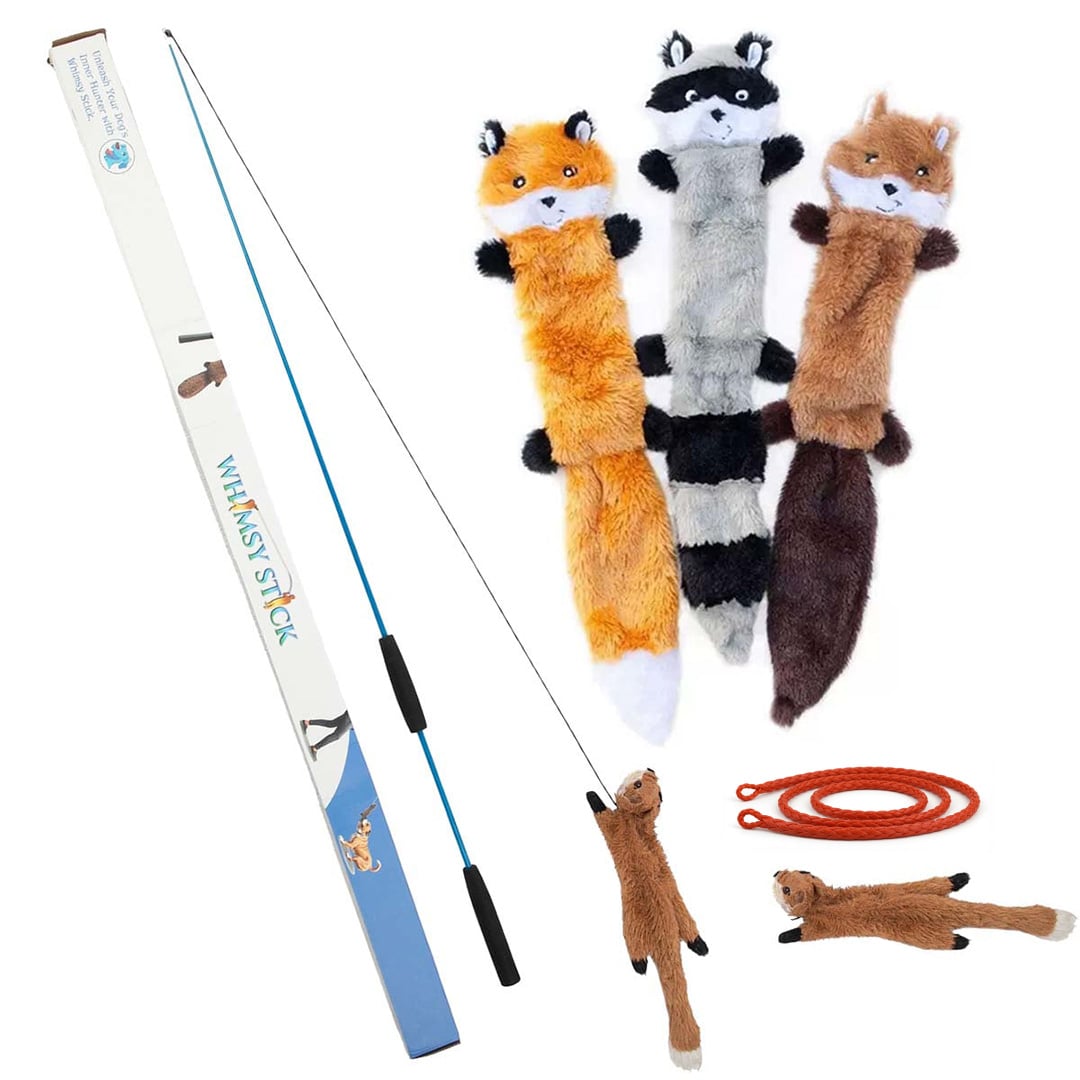
Most flirt poles on the market are built for casual use. But for dogs transitioning off fetch (especially high-drive dogs whose ball obsession proves they have serious prey drive), the construction matters. Specifically, the Whimsy Stick was designed by a trainer for daily structured work with dogs who play hard.
Kevlar line, replaceable lures, designed for daily structured sessions with small to medium dogs.
Reinforced for working breeds. 8-ft radius, heavy-duty construction, 3 lures included. Built for daily work.
For the full size and breed decision framework, see the buying guide.