
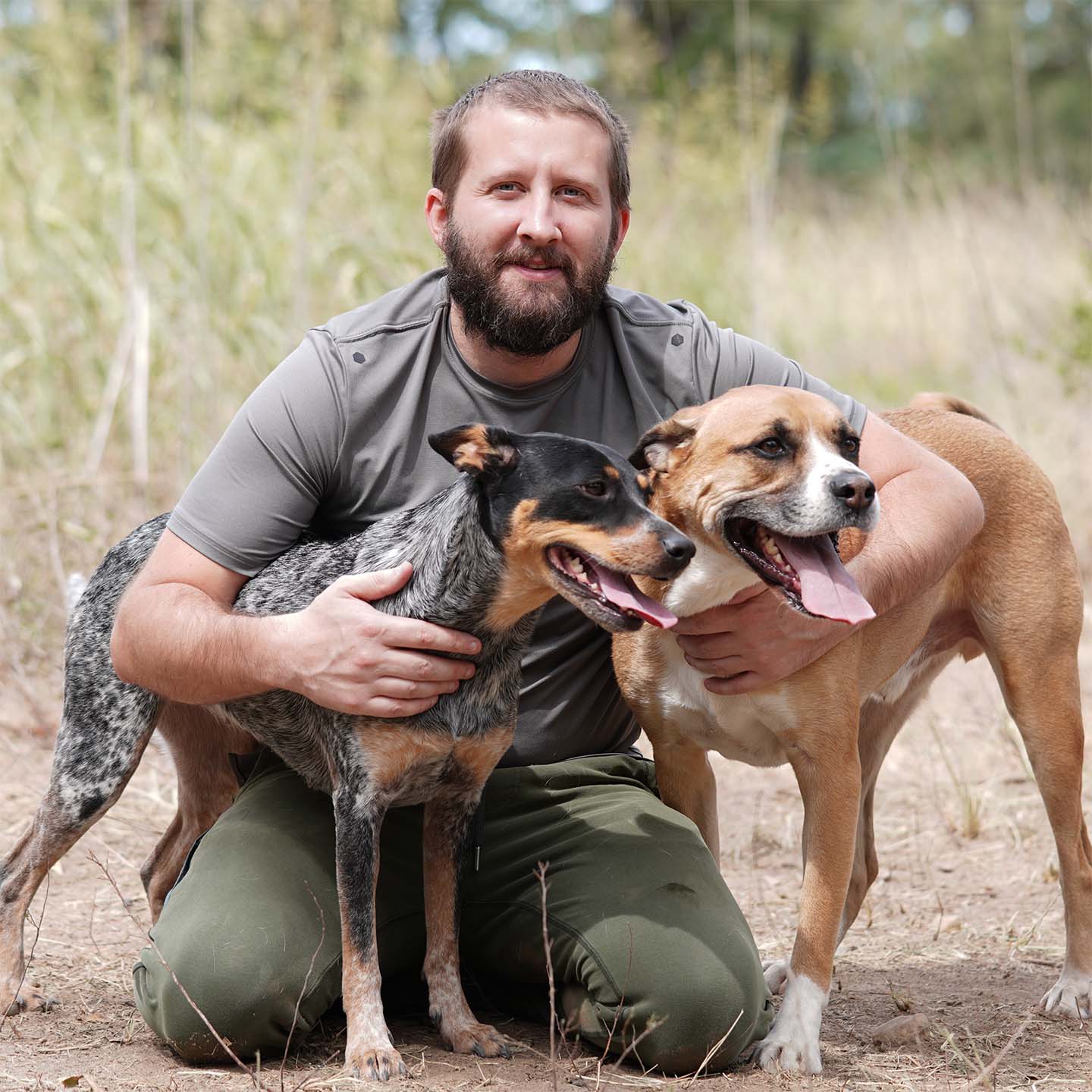
The Mirror You Didn’t Ask For
Your dog is reading you right now, and it’s reading your body a lot more than your words.
It’s picking up how fast you’re breathing, how tight you are, how you’re holding the leash, how high your voice is and how fast you move. Whether you’re leaning forward or back, if your jaw is clenched, if you just sucked in a breath when another dog came around the corner.
And a lot of times it picks that up before you even notice it yourself. Before you say anything or give a command or even decide what to do, your dog may have already read how you’re feeling and started acting off of it.
If you’re calm, your dog has a lot easier time being calm, and if you’re nervous it’s more likely to get nervous too. Brace for trouble and your dog braces right along with you. If you tighten up the leash every time another dog shows up, you just told your dog there’s a threat, and it believes you, cause your body said it before your mouth could get out “it’s okay.”
And “it’s okay” doesn’t mean much to a dog anyway. If your words say safe and your body says danger, the dog’s gonna go with your body.
Anxiety Transfer
Once you see this, it changes how you look at pretty much everything you do with your dog.
Dogs soak up how the people around them are feeling. They’ve lived right alongside people for a really long time and they’re good at reading us, and that didn’t go anywhere just cause their person is now a family in a two-bedroom apartment.
Say you come home stressed from work and your dog is jumping all over you. It may not be disrespect at all, it may be matching you. You came in tense and fast and distracted, the dog read that as “something’s going on,” and came back at you with the same energy.
When you see another dog on the walk and you tighten the leash, shorten it up and hold your breath, that’s a lot of signals all at once. Your dog feels the tight leash and the shorter line and your breathing change. It doesn’t know you’re worried about a dog fight, it just knows something in your body said “threat,” and now it’s gonna react to the threat you just pointed out.
So a lot of times your nerves are part of what’s going on with the reactivity. Your dog may not be where it starts, it may just be turning it up louder.
The Leash as an Emotional Telegraph
The leash is the most direct line between you and your dog, but a lot of people use it like a brake cable. They pull when the dog pulls and yank when it lunges, and they keep it tight the whole time like a security blanket they can’t let go of.
Any tension in that leash says something to your dog. A tight leash doesn’t tell a dog to slow down, it tells it something’s wrong. It sets off the opposition reflex, where a dog pulls against pressure, and it passes your stress along at the same time, right down a six-foot cord to your dog’s neck.
Walking with a slack leash is as much about your nerves as your hands. You have to quit bracing, breathe through it when your dog’s three feet ahead of you instead of correcting right away, and just stand still instead of using force when it pulls.
That’s harder than it sounds. The second the leash goes tight everything in you wants to pull back, and everything in your dog wants to pull forward, so you’re both just reacting and nobody’s leading.
Calm Is Not Passive
People hear “be calm” and think I’m telling them to do nothing. That’s not what I mean by it.
Calm leading means you make your decisions without your feelings driving them. You redirect without getting frustrated, correct without getting mad and praise without going overboard, so you’re steady and in control while you and your dog go about your day.
You’re still a person with feelings, they just don’t get to make the calls. So when your dog pulls toward another dog you don’t panic or yell or jerk the leash, you stop and breathe and wait, and when the leash goes slack you walk on, and that decision came from you being calm and not from you reacting.
It’s a skill, and for a lot of people it doesn’t come natural, especially when they’re already stressed about the dog. But it’s one of the biggest things you’ve got control over, and once you change how you carry yourself your dog has something different to answer to.
What “Calm” Looks Like Mechanically
Your breath. Slow, and in through your nose. When a lot of people breathe through the mouth it speeds up on them and the shoulders creep up and they look tense, so slow nose breathing helps them stay calmer, and your dog can hear the difference.
How you hold the leash. Like you’d hold a cup of coffee and not like you’re hanging off a cliff, so loose fingers and a loose wrist, cause white knuckles go right down the leash to the dog. Try holding it with just your thumb and two fingers, and if the dog yanks it right out of your hand, it needs the leash pressure work in Lesson 06 first.
How you move. Walk at a steady pace, no lurching and no sudden stops except the stop-and-wait you’ll do on purpose in the exercise below. Even if you’ve got no idea where you’re headed, walk like you do, cause that steady sure movement tells your dog you’ve got it handled.
Your voice. Low and short, and quit repeating yourself. If you’re saying “no no no come on let’s go come here stop it no,” that’s just your nerves talking. Say one word one time and then do something, so it’s “Come,” then [wait], and if nothing happens you change direction. Your dog learns off what you do, it’s not learning a thing the fifth time you say it.
Exercise: The Calm Walk Baseline
Record Yourself. Hear What Your Dog Hears.
This one makes you face how calm you think you are versus how calm you really are. The recording doesn’t lie, and a lot of people are pretty surprised the first time they hear themselves on a walk.
- Day 1: The Baseline Walk. Take your dog on a normal 15-minute walk with the same route and pace and everything you usually do, and before you head out, start a voice recording on your phone and stick it in your pocket. Don’t change anything cause it’s recording, just walk like normal and let it pick up your voice, your commands, your breathing, your sighs and how you react to triggers.
- Listen to the recording as soon as you get home. Count how many times you raised your voice and how many times you repeated a command, plus the sharp breaths and sighs and frustrated noises, and every “no,” “stop,” “come on” and “let’s go,” and then notice how long you went quiet between commands and write all that down. That’s your starting point, how much stress you’re bringing on every walk.
Days 2 Through 6: Strip Out the Noise
- Day 2: The Silent Walk. Same route, same dog, with the recording running in your pocket again, but this time there’s no commands and no talking. Breathe through your nose and when your dog pulls, stop, and don’t say anything till the leash goes slack, then walk, and when it pulls again you stop again. No voice and no corrections, you’re either moving or standing still. If it looks back at you that’s good, but don’t overdo the praise, a quiet “good” is plenty. It should be quiet enough that the recording is mostly footsteps and breathing.
- Listen to the Day 2 recording. Count the same things, voice events and commands and stops, and compare it to Day 1. Your voice events should be way down, and your stops will probably be up cause you’re using standing still instead of commands now. That’s what’s supposed to happen.
- Days 3-6: Continue silent walks. As the dog starts to get that a tight leash means you’re not going anywhere, the number of stops should start coming down. It’s learning from what happens, not from you talking. Keep track of how many stops each walk and look for that number to drop.
Day 7: Proof You Can Hear
- Day 7: Record again. Record the whole walk on the same route and then compare it to Day 1. You’re listening for a calmer voice when you do talk, longer quiet stretches, fewer frustrated noises and a walk that goes smoother. You should be able to hear the change in you, and there’s a good chance you’ll see some in your dog too.
A lot of people’s Day 1 recording is full of commands and “no”s and “come on”s and sighs, plus a leash correction or two, and when you add it all up it’s a lot of noise for one 15-minute walk. The dog is just getting buried in it.
What you’re going for by Day 7 is a few quiet “good”s, maybe a “let’s go,” no frustrated noises, and a bunch of silent stops. When the talking drops off like that, the dog has room to think and pay attention to what your body’s doing (moving or standing still) instead of drowning in words. Your numbers are gonna be your own, what matters is which way they’re going.
Exercise: The Trigger Breath Protocol
Replace Your Stress Response with a Breathing Pattern
This is a little skill you’ll use every day for the rest of your dog’s life. It takes about 10 seconds and it can change how a run-in with a trigger goes.
- The moment you see a trigger approaching (another dog, a person, a bike, whatever your dog usually reacts to), take one slow breath in through your nose, about 4 seconds.
- Then let it out through your nose, about 6 seconds out. You make the breath out longer than the breath in on purpose, cause a lot of people find a long, slow breath out helps them settle down, and your dog can feel it when your body loosens up.
- While you breathe, let your leash hand go loose. Open the fingers up a little and let your shoulders drop and your jaw loosen, cause that’s the stuff that tightens up on you the second you see a trigger, and the dog feels it through the leash.
- Then you decide what to do. You can cross the street or turn around or back off to get more distance, or just stop and wait, and it doesn’t matter a whole lot which one as long as you picked it and didn’t just react. That breath gives you about a second before you do anything and that second is where you get to lead.
Practice it without the dog first. Stand in the kitchen and picture a trigger coming and just run through it, breathe, loosen your hands, drop your shoulders, and do that about 20 times till it’s automatic before you try it on walks when there’s nothing around. After a while it’s just what you do when something comes up and your dog has a calmer person to follow.
When This Doesn’t Work
“I can’t stay calm. My dog’s behavior is too extreme.” If your dog’s reactivity is so bad that you just can’t keep it together (lunging, spinning, barking nonstop, pulling you off your feet), make it easier on both of you before you work on your energy. Walk at 5 AM when nobody’s out, walk in your yard on a long line, or walk in a parking lot where you can see triggers from way off. Find somewhere you CAN stay calm and build from there. If nowhere works, your dog needs the foundation work in Lesson 05 and Lesson 06 before walks outside are realistic, and if there’s any biting or you’re getting hurt, get a qualified behavior pro to see your dog in person.
“The silent walk feels wrong. I feel like I’m ignoring my dog.” You’re not ignoring it, you’re talking to it with your body, and that’s the most honest way you’ve got. Moving means “right choice” and standing still means “try again,” and that’s clearer than a bunch of words. If your dog has been tuning out your voice cause it hears it all day, going quiet makes the signals you do give mean something again.
When the Walk Itself Stalls
“My dog pulls the entire time and we barely move.” That’s Day 1 for a lot of dogs. You might spend the whole 15 minutes and only make it a block, and that’s fine, cause you’re not going for distance. If the dog pulls the whole walk and you stop every time, that’s about as clear as you can be with a leash. Keep at it and look for the pulling to ease up over the next few walks.
“I did this for a week and I’m still stressed.” Your own habits can take a while to change. If you’re carrying a lot of anxiety in general, not just about the dog, this lesson can help but it might not be enough by itself, and some of what your dog is showing you may be stress from the rest of your life. That’s not you failing, that’s just good to know.
Progress Scorecard · Lesson 04
Walk Energy Tracker
Write these down every day, and don’t sweat one bad day cause it’s which way the numbers are heading that counts.
| Metric | Day 1 | Day 3 | Day 5 | Day 7 |
|---|---|---|---|---|
| Voice events per 15-min walk | ||||
| Frustrated sounds / sighs | ||||
| Silent stops (stop-and-wait) | ||||
| Repeated commands | ||||
| Your stress level (1-5) | ||||
| Dog’s reactivity incidents |
Move to Lesson 05 When
You’ve got the Day 1 and Day 7 recordings done and you can honestly hear a difference in yourself when you play them back.
Your voice count dropped by half or more between Day 1 and Day 7, so you’re talking at the dog a lot less than you were.
The Trigger Breath Protocol happens on its own now, the nose breath and the long breath out and the loose hands and dropped shoulders, without you running through it in your head.
Something’s changed in how your dog walks since you started the silent walks, maybe it pulls less or checks back with you more or gets past triggers a little calmer, and you can say what it is.
And that’s Phase 1 done, so you looked at the problem in Lesson 01 and proved you can stay consistent in Lesson 02, then found your dog’s drives in Lesson 03 and worked on your own energy here in Lesson 04, and now you’ve got something to build on.
This Week’s Action Plan
Train the Human Before the Dog
What Comes Next
Phase 1 is done. You spent about four weeks learning to see what’s going on, being consistent, understanding your dog and keeping yourself in check. None of that was flashy and none of it looked like “training,” but everything from Lesson 05 on depends on it.
In Lesson 05 we start setting up the physical side of it, the crate, the Place command, boundaries around space, and the dog earning freedom by showing you it can be calm. This is where your dog’s world starts to change, and it’s built on the groundwork you just did, not on force.
You’re ready, so let’s get started.


