
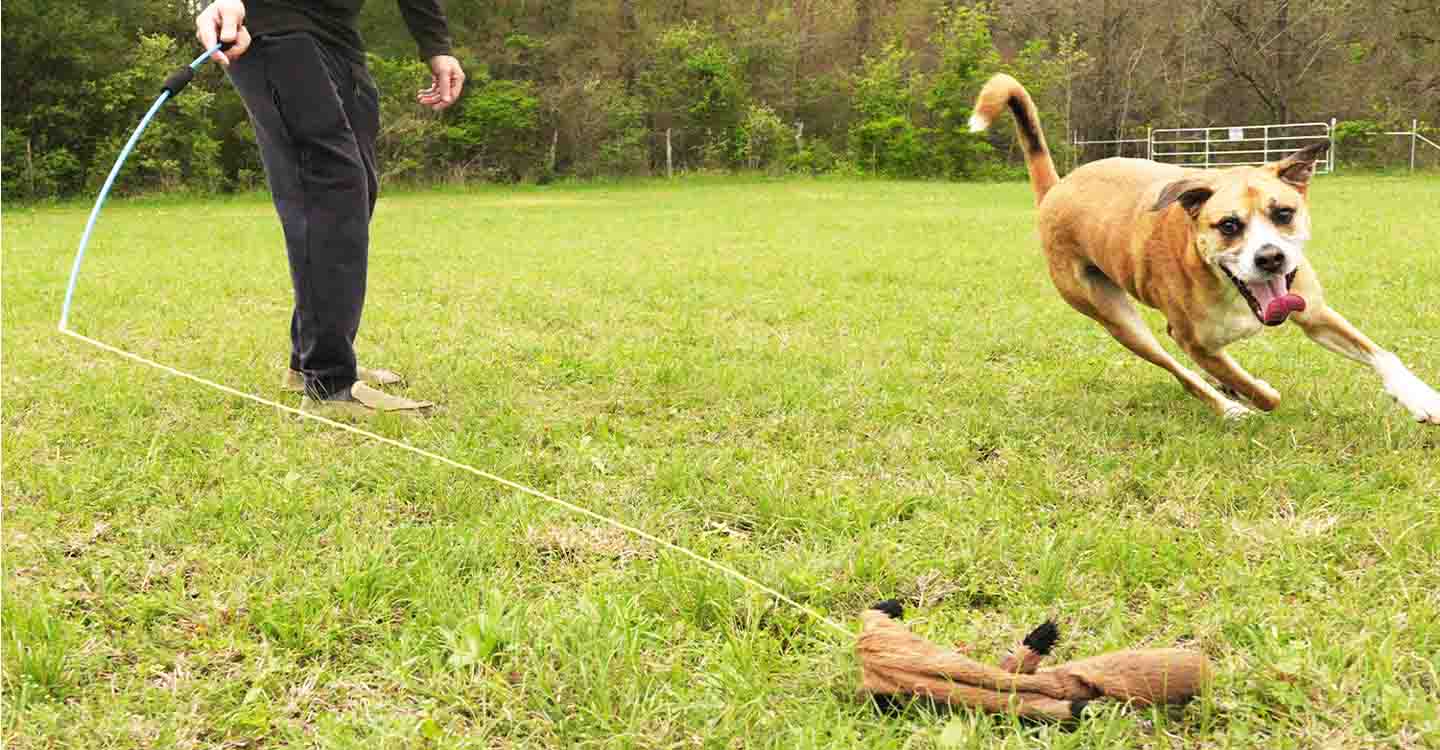
The standard adult dog protocol is daily 10 to 12 minute sessions. In fact, that’s the answer for most healthy dogs between 12 months and 8 years old. Beyond that, frequency adjusts on four variables: age, drive level, your goal, and how long the dog has been conditioned to the tool. High-drive working breeds often need two shorter sessions per day. Puppies under 12 months and senior dogs need substantially less. The full matrix is in §03.
The compound effect matters more than any single session. After two weeks of consistent daily use, the first behavioral improvements appear. By six to eight weeks, the quality-of-life shift is real and measurable. Single sessions tire the dog. But the pattern across weeks is what changes the dog.
Who This Is For
- New flirt pole owners trying to figure out the daily routine
- Anyone whose dog “loved it for a week then stopped caring” (usually a frequency issue)
- Owners running sessions occasionally and not seeing behavioral results
- Owners running twice a day worried they’re doing too much
- Puppy owners trying to figure out when to introduce the tool safely
- Senior dog owners trying to maintain activity safely
- High-drive breed owners (Huskies, Border Collies, Malinois) who need the working protocol
Signs Your Dog Needs This
- Destructive when left alone or understimulated-chewing furniture, shredding bedding, counter-surfing. The dog is burning their drive on whatever is available.
- Reactive on leash despite training-lunging, barking, fixating on other dogs or people. Drive has nowhere to go, so it leaks sideways.
- Restless in the evening-pacing, whining, nudging you, unable to settle after a walk. A walk doesn’t satisfy prey drive. A flirt pole does.
- Rough play that escalates fast-the dog gets amped in two minutes and loses impulse control. Structured predatory outlet resets this within 2 weeks.
- You’ve tried “more walks” and it’s not working-walks are mental and physical but they don’t discharge drive. This does.
- The dog is bored of every toy within minutes-prey drive requires movement, unpredictability, and the capture moment. Static toys can’t provide that.
For A Standard Adult Dog: Daily, 10 To 12 Minutes
In practice, if your dog is between 12 months and 8 years old, healthy, and has moderate to high drive, here’s the default protocol I give every client.
The Default Protocol
Daily sessions of 10 to 12 minutes, on grass or another forgiving surface. Specifically, the dog catches the lure every 30 to 45 seconds. Also, end the session while the dog still wants more. As a general rule, two rest days per week are appropriate but optional for most dogs.
What This Protocol Produces
In short, run it consistently and the daily routine delivers four specific outcomes over time:
- Immediate physical fatigue after every session
- Measurable behavioral improvement within 2 to 3 weeks (less reactivity, easier settling, less destruction)
- Long-term conditioning that holds the dog’s physical and behavioral baseline
- Roughly 70 to 90 minutes of weekly behaviorally-grade exercise
Why The Window Works
Specifically, ten to 12 minutes is long enough to complete the chase sequence-stalk, chase, capture, win-repeatedly. That repetition triggers the dopamine and serotonin shift that drives behavioral change. Below that window, sessions don’t produce enough repetition. Above it, you risk overexertion and joint stress.
In short, if you take nothing else from this article, take this: daily 10 to 12 minute sessions for the standard healthy adult dog. That covers about 70 percent of dog owners. Adjustments for the other 30 percent are in the sections below.
4 Variables That Change The Answer
Four things modify the “how often” answer: age, drive level, goal, and conditioning history. Here’s how each one shifts the protocol-and which ones outrank the others when they conflict.
Age And Life Stage
In practice, the biggest single modifier. Puppies under 6 months shouldn’t use it at all. Puppies 6 to 12 months use gentle 3 to 5 minute sessions 2 to 3 times per week. Adult dogs run the standard daily protocol. Senior dogs over 8 years drop to 2 to 3 shorter sessions weekly with reduced intensity.
Drive Level
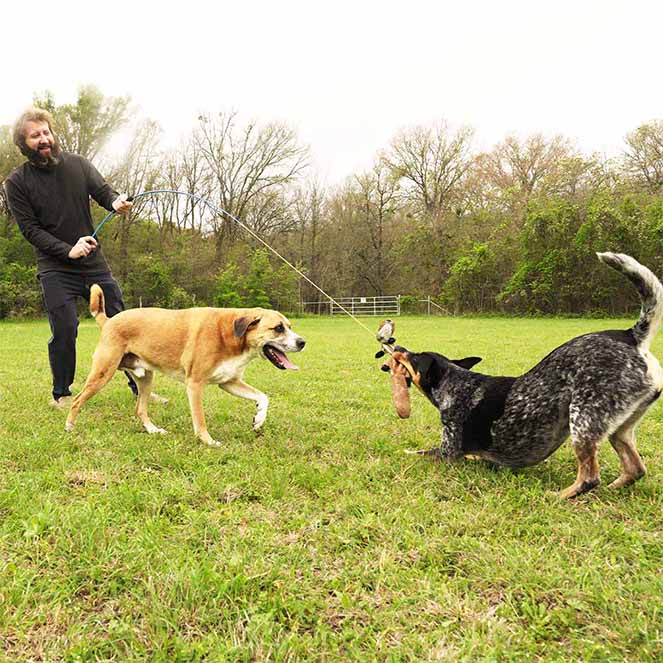
However, high-drive breeds need more, not less. Huskies, Border Collies, Malinois, working line Shepherds, and Pit Bull-type breeds often do better with two shorter sessions per day (8 to 10 minutes morning and evening). That split keeps arousal manageable across the day. Moderate-drive dogs follow the standard protocol. Low-drive dogs (some Bulldogs, Bassets, low-drive seniors) often do well with every-other-day frequency.
Your Goal
What you’re using it for changes how often. Behavior modification (reactivity, destruction, restlessness) requires daily protocol-the cumulative effect doesn’t build otherwise. Energy management on an already-balanced dog? Every other day works. Physical conditioning calls for daily with periodic rest weeks. Impulse control has its own session structure covered in the drill protocol.
Conditioning History
A dog new to the flirt pole needs ramp-up. In week 1, run 5 to 7 minute sessions every other day to assess the dog’s response. Then in week 2, extend to 8 to 10 minutes and increase to daily. By week 3, reach the full 10 to 12 minute daily protocol. Dogs jumped straight to full intensity can develop soreness or overexcitement. The ramp-up matters.
These four variables stack, and the priority order matters. A high-drive 6-month-old puppy still follows puppy-stage frequency-variable 1 wins over variable 2 every time. Likewise, a senior with high drive still follows senior-stage limits. But a behavior-modification case in a moderate-drive dog gets daily protocol even when the standard would be every other day. Age and conditioning history are the strongest constraints. Drive level and goal work within the boundaries they set.
The Frequency Matrix: Find Your Dog’s Row
Find your dog’s life stage in the left column. Match it to your primary goal. The cell gives you the protocol. This is the working matrix I use with client dogs-built from a decade of real cases, not theory. Match the dog to the row, then adjust based on the variables above.
How to read the matrix
Frequency moves on a sliding scale: seniors get 2 to 3 sessions a week, adults get daily, high-drive working breeds get twice daily. Match the row before you set the schedule-life stage and drive are the two variables that overrule every other consideration.
Vet Considerations
For dogs with diagnosed orthopedic issues, consult your vet first regardless of where they fall in the matrix. The AVMA guidance on canine exercise is a useful baseline for dogs with health conditions. For dogs in recovery from injury or surgery, skip the matrix entirely until your vet clears full activity.
Also, same trainer-designed build as the Rugged XL, sized for smaller dogs. $55.95.
Signs You’re Using It Too Often
Flirt pole work is high-intensity exercise-closer to sprint intervals than a jog. Done too often, it produces visible signs in the dog. Watch for the following and, when you see them, reduce frequency and session length until they clear.
The Overuse Signals
- Limping or stiffness 24 hours after sessions. Most common in high-drive dogs running daily on hard surfaces. Switch to grass and drop a session per week.
- Decreased interest or engagement. A dog who used to sprint to the flirt pole and now hesitates is either sore, mentally fatigued, or overconditioned. Take 3 days off.
- Panting that lingers past 15 to 20 minutes after sessions. The dog is operating above their cardio capacity. Shorten the sessions.
- Reluctance to engage or play-bow refusal. A normally playful dog who refuses to start is telling you something. Listen.
- Joint clicking, popping, or visible discomfort during sessions. Stop immediately. See a vet before continuing.
- Behavioral overarousal at non-session times. Pacing, whining, demand-barking because the dog is now keyed up for the next session. So the protocol has become a problem, not a solution.
None of these mean you should stop using the flirt pole entirely. They mean the current frequency is wrong for your specific dog. Drop one session per week, shorten the rest by 2 to 3 minutes, switch to grass, and let the dog recover for 7 to 10 days. The AKC guidelines on exercise and overexertion confirm that high-intensity work requires adequate recovery time regardless of breed. Most overuse signs resolve quickly with a brief deload. If you’re using the flirt pole to manage separation anxiety, jumping, or restlessness, the deload week will not undo the behavioral progress, the compound effect holds.
Signs You’re Not Using It Enough
In fact, the opposite problem is more common than overuse. Owners run sessions sporadically, see modest results, and conclude the tool doesn’t work. The tool works. The frequency doesn’t. Here are the clear signs you’re underdoing it:
The Underuse Signals
- The dog is tired right after, then wired again within an hour. Single-session fatigue without cumulative behavioral effect means you need daily sessions, not occasional ones. That single-session pattern is the clearest underuse signal there is.
- Reactivity, destruction, or restlessness persists despite “regular” use. “Regular” often means 2 to 3 times per week, which isn’t enough for behavior modification. The cumulative effect requires daily. Without that daily rhythm, the behavioral changes simply don’t compound.
- The dog seeks the flirt pole between sessions. For instance, bringing toys, staring at the storage spot, getting excited when you go near it. In other words, the dog is telling you they need more.
- You see improvement on session days, regression on off days. The behavioral effect is short-lived because the protocol isn’t sustained. Daily protocol fixes this.
- Two-month results are minimal. If you’ve used the tool for 8 weeks without real behavioral change, frequency is the most likely cause. Bump to daily and reassess at 4 weeks.
- You feel like nothing is working. When the protocol feels like it’s producing nothing, the answer is almost always more consistent use-not a different tool.
In fact, the single most common feedback from clients who initially struggled: “It started working when I made it daily.” Sporadic use produces sporadic results. Daily use produces compound results. The tool rewards consistency, not enthusiasm.
What Daily Use Looks Like Over 8 Weeks
Specifically, commit to the daily adult protocol for 8 weeks. Here is the realistic trajectory-week by week, what actually changes.
Physical Fatigue Only
Every session ends with a tired dog. No behavioral change is visible yet outside sessions. Some dogs may be sore on day 2 or 3 as they adapt-that’s normal. Stay the course.
Anticipation And Routine Formation
By now the dog starts anticipating sessions and sleeping deeper at night. Watch for the first small behavioral shifts: easier settling in the evening, slightly reduced reactivity on walks. Subtle, but real.
First Real Behavioral Improvement
Then the behavioral markers appear: less destruction, easier settling, measurably better walks, improved impulse control around meals and doors.
Conditioning Effect
By now the dog has built real cardio capacity. Sessions feel easier for them. At this point, you may need to slightly extend session length (to 12 to 15 minutes) or increase intensity to maintain the fatigue effect.
New Baseline
Eventually, by week 6, the improvements stabilize as the dog’s new behavioral and physical baseline. Quality of life for both dog and owner is meaningfully different. At this stage, the flirt pole becomes part of the daily routine, not a behavioral fix. This is the “I have my dog back” point.
In practice, the 8-week mark is where most owners describe a real quality-of-life shift. Not week 1. Not week 2. Week 6 to 8 of consistent daily protocol. Commit to that and the math compounds in your favor.
Case Study: A Husky Who Needed Twice A Day
Read These Next To Go Deeper
Frequency is only half of it. Technique determines whether those sessions actually produce results. The complete technique guide covers the predatory motor pattern sequence, lure mechanics, and how to structure catches. For behavior modification in particular, the 5 impulse control drills use a different session structure than the standard energy-burn protocol. New dogs need the introduction sequence first-how to introduce a flirt pole covers the first week. For total exercise volume by life stage, see how much exercise your dog needs.


