
Quick summary
A flirt pole for overexcited dogs used without structure makes things worse. The same tool used with structure produces genuine neurological calm because the full predatory sequence completes rather than getting interrupted at peak arousal. Unstructured sessions activate drive and never complete it. The arousal spikes with no off-switch.
Structured protocol: mandatory wait before every release, deliberate catch, drop-it on cue, and a clean all-done into settle. That closes the predatory sequence and produces 2 to 3 hours of genuine calm per session. Short daily sessions beat long occasional ones. Apply it every day and expect measurable behavioral change in two to three weeks. The protocol sits inside the broader jumping and attention-seeking behavior framework.
Measured across ~400 client dogs running the full 5-step protocol daily. Genuine settled calm per session, not exhaustion.
Who This Guide Is For
- Owners of dogs that are chronically overexcited and cannot settle.
- Nippers, jumpers, dogs that escalate during play.
- Dogs that are worse after walks instead of calmer.
- Dogs that vibrate through every transition in the day.
- Anyone whose dog has energy but no off-switch.
Signs Your Dog Needs This Protocol
- Nipping, jumping, or grabbing hands and leashes instead of toys.
- Cannot hold a sit for even a few seconds when excited.
- Hyper, whining, or circling after exercise instead of settling.
- Lunging at distractions more aggressively after walks.
- Destroying furniture or redirecting energy onto household items.
- Getting progressively worse with more exercise rather than better.
The Tool Is Not the Problem. Structure Is the Variable.
A flirt pole for overexcited dogs calms the dog when the session has structure, and makes the dog worse when it does not. The tool is neutral. What it does to an overexcited dog’s arousal level depends entirely on how it is used.
Unstructured use trains the arousal system to spike and stay spiked. That means no wait cue, no drop-it, sessions stopped mid-drive, the dog still bouncing off the walls when it ends. The predatory sequence activates and never completes. The dog learns the flirt pole means intense sustained arousal with no resolution, which is the exact state you are trying to get out of.
What structure changes
Structured use does the opposite. A wait cue before each release trains the dog to sit with arousal rather than discharge it immediately. Drop-it after each catch trains the dog to transition out of peak drive on cue. The all-done sequence closes the predatory loop neurologically and produces the post-hunt calm that overexcited dogs rarely experience any other way. According to the American Kennel Club’s impulse control guidance, structured predatory play is among the highest-value enrichment activities. The reason is that it addresses neurological needs, not just physical ones. AVMA behavioral guidance reinforces the same point: handler-controlled sessions produce measurably better outcomes than unstructured exercise for high-arousal dogs.
What it produces in overexcited dogs
- Predatory sequence activated but never completed
- Arousal spikes with no trained off-switch
- Dog learns the toy means sustained frenzy
- Sessions end mid-drive, arousal carries over
- No impulse control trained at any point
- Dog gets harder, not easier, after each session
What it produces in overexcited dogs
- Full predatory sequence completes every session
- Wait cue trains sitting with arousal, the core skill
- Dog learns the flirt pole means structured engagement
- Sessions end with resolution, genuine calm follows
- Impulse control built into every single rep
- Progressively more regulated dog over time
Completing the sequence is what produces the calm
The predatory sequence (orient, stalk, chase, capture, win, release) has a built-in neurological resolution point at the end. Cortisol drops and dopamine releases at completion. When the sequence gets interrupted at peak arousal in an overexcited dog, that resolution never happens and the arousal stays elevated. The all-done protocol is not optional. It is the step that closes the loop and produces the post-session calm. For the underlying mechanism, see the impulse control drills protocol.
The calm is not produced by exhaustion. It is produced by completing the full predatory motor pattern with structure: wait, chase, catch, release, settle. Tire a dog out and you get a physically spent dog who is still neurologically wired. Complete the sequence and you get genuine calm.
Before You Start: One Non-Negotiable
If your overexcited dog does not have a functional drop-it yet, build that before running full sessions. Not a perfect competition-style out, just a reliable enough response that the dog will release the lure within a few seconds when asked, even when aroused. Without this, you cannot complete the session protocol cleanly and the all-done transition becomes a wrestling match that spikes rather than resolves arousal.
The fastest way to build drop-it is through the possession game. Let the dog catch the lure and hold it. Go completely still and neutral. Wait for the voluntary release, mark it, and immediately restart the chase. Restart is the reward. Do this 10 to 15 times over two or three short sessions and most overexcited dogs have the concept. Add the verbal cue once the behavior is happening reliably. Build the drop-it first, then run the full protocol. The full progression is in the impulse control commands guide.
The Five-Step Protocol for Overexcited Dogs
For overexcited dogs specifically, the wait and all-done steps are where most of the behavioral work happens, and neither is optional. Skipping either step turns the flirt pole into the problem instead of the solution.
Wait every single rep
Lure still on the ground, the dog orients and locks on. Ask for a sit or stand-wait and hold it a full 5 to 10 seconds before releasing. This is the primary impulse control training in the session. Do not shorten it.
Cue: WaitRelease and controlled chase
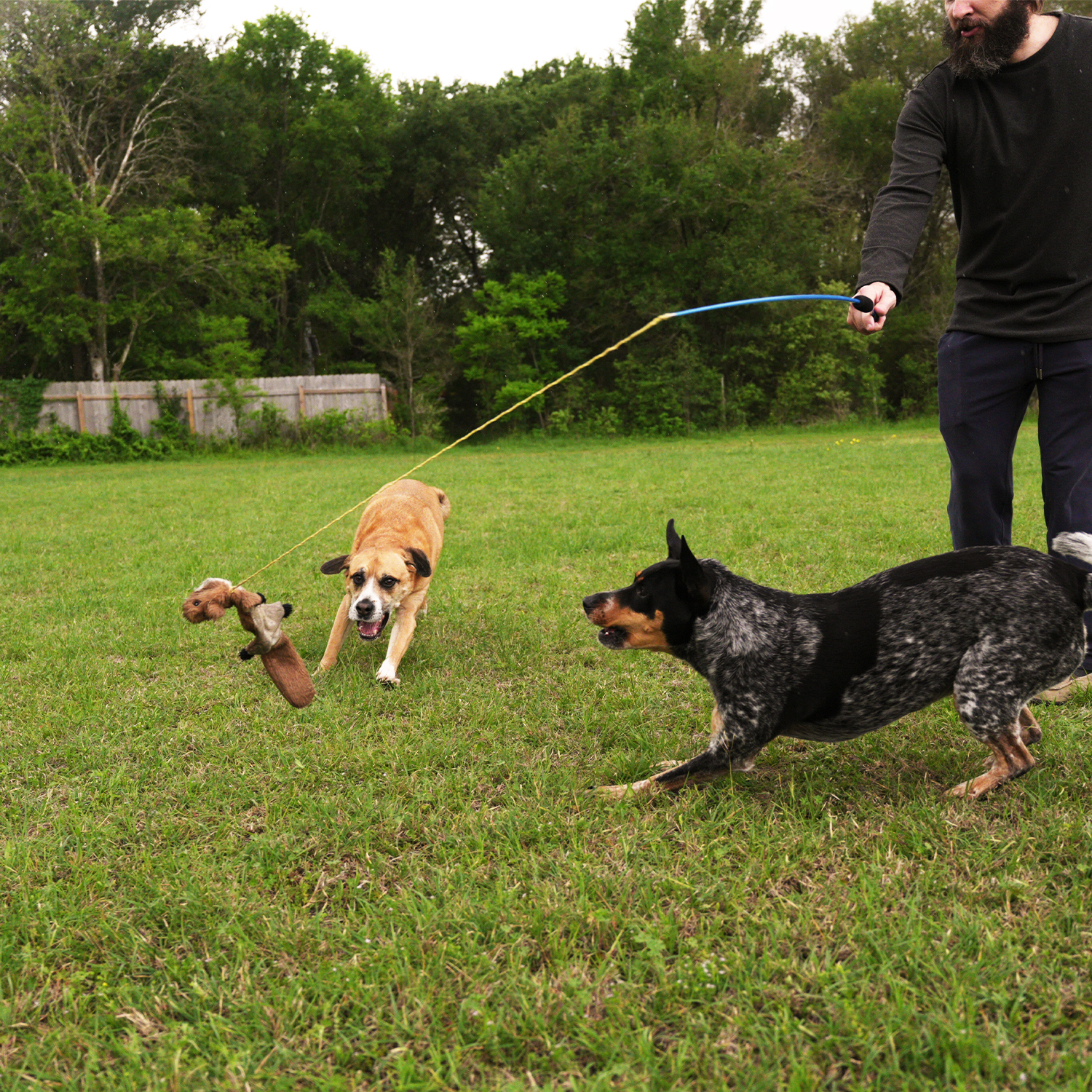
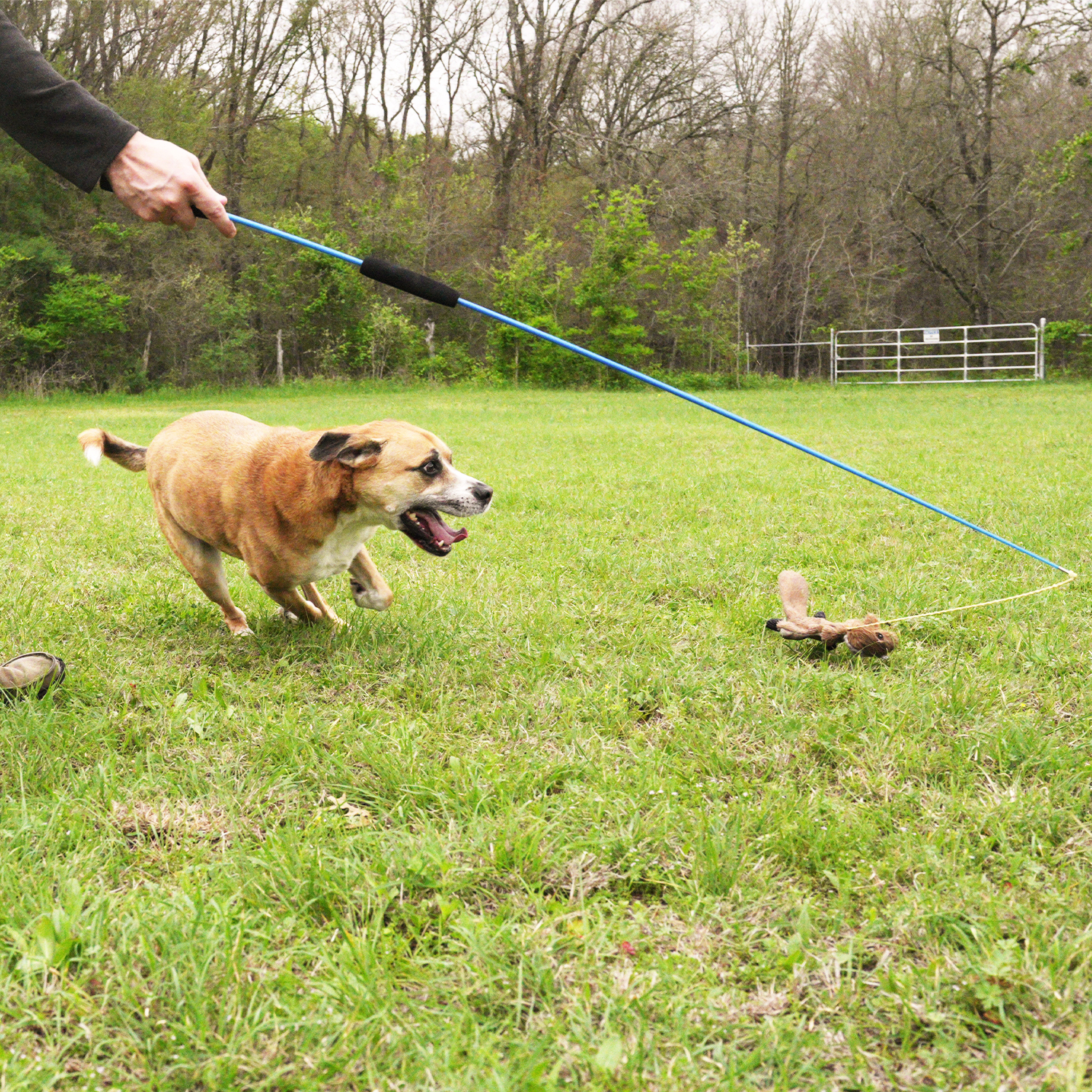
Release cue, then move the lure deliberately: low, smooth, with direction changes and brief pauses. Pauses re-engage the stalk drive. Avoid frantic movement. Your movement tone sets the entire session tone.
Cue: Get itCatch and possess (never skip)
Every three to four reps, stop moving and let the dog catch the lure. Allow 3 to 5 seconds of full possession before cueing the out. Denying possession entirely creates frustrated dogs who escalate.
Drop-it on cue, the impulse control rep
Ask for the out, reward the release, then restart from step 1. The drop-it under drive is the highest-value impulse control training available because the arousal level is at peak. It transfers directly to reactive dog training.
Cue: OutAll-done, toy away, then settle
After 5 to 10 minutes of reps, end with one final catch and drop-it, say all-done, and put the toy completely out of sight. Ask the dog for a down or place and reward calm. The settle cue bridges the transition from activated to calm. After three to five minutes of settled behavior, release with your release word. This is how you build a genuine off-switch.
Cue: All done → PlaceThe session ending is where most people lose all the ground they built. You did everything right for 8 minutes and then put the toy away and walked off. The dog stayed activated, carried that arousal into the rest of the evening, and you concluded the flirt pole did not work. It worked fine. The ending did not.
Christopher Lee Moran · Working Dog TrainerCase study: chronic post-session frenzy
18-month Belgian Malinois, chronic post-session frenzy
The owner had been using a flirt pole for three months with no structure. Sessions lasted 20 to 30 minutes and ended when the owner got tired. The dog was measurably worse after every session. Nipping, circling, unable to settle for over an hour. The owner was about to throw the flirt pole away.
We cut sessions to 7 minutes. Added a mandatory wait before every release. Enforced drop-it on cue after every catch. Closed every session with all-done into a place cue. No other changes to the dog’s routine.
By day 10, the dog was settling within 5 minutes of the all-done cue. By week 3, post-session calm lasted over 2 hours. The owner reported the dog was calmer on walks, less reactive at the door, and stopped nipping guests for the first time in over a year. Same dog. Same tool. Structure was the only variable.
When to Use a Flirt Pole With Overexcited Dogs
Before walks: A 5 to 10 minute structured session 15 to 30 minutes before departure lowers baseline arousal. The dog enters the walk with depleted drive and more threshold space, which produces calmer leash behavior. For the reactivity-specific application, see reactive dog training.
After walks: If the dog returns from a walk still spiraling, a short impulse-control-heavy session (emphasis on wait and drop-it) helps reset arousal. The same principle is covered in dogs hyper after walks.
Evening wind-down: An evening session processes the day’s accumulated stimulation and helps the dog settle overnight. The morning session depletes overnight arousal; the evening session closes the day. For dogs whose arousal manifests as barking overflow, the evening protocol earns its keep fast.
Never when you are already flustered: Use the flirt pole as a planning tool, not a panic fix. If you are already stressed and reactive yourself, your lure movement will be chaotic and the session will amplify the problem rather than address it. If your dog has progressed to overexcitement leads to destruction territory, sessions need to happen before damage windows, not after.
How Often to Run Sessions With Overexcited Dogs
Daily sessions produce the best behavioral results. Two 7-minute structured sessions per day, one before the morning walk and one in the evening, consistently outperform one longer weekly session.
Daily consistency matters more than session length. A dog who receives one structured session every day for two weeks shows substantially more behavioral change than one who receives occasional long sessions. Impulse control habits being built (wait, drop-it, all-done) are learned behaviors that require repetition. Arousal regulation patterns following each completed session reinforce themselves over time when the protocol runs daily.
Results are consistent: two to three weeks of daily structured sessions produces measurable behavioral change in overexcited dogs across all breeds and drive levels. For dogs whose exercise tolerance is part of the picture, the bonding through training guide explains the broader frequency framework.
The Mistakes That Make Overexcited Dogs Worse
Past the 10-minute mark, most overexcited dogs lose the ability to hold the wait reliably or drop-it on cue. At that point you are not training impulse control anymore. You are running a dog who has been pushed past their regulation capacity. Shorter sessions with clean structure outperform longer sessions every time for this profile. If the dog cannot hold a 5-second wait by rep three, the session is already too long or too intense.
Stopping abruptly, toy in the bag, done, leaves the predatory sequence open. The dog’s arousal is at or near peak and has nowhere to go. That unresolved activation carries directly into whatever comes next: the walk, guests arriving, the neighbor’s dog. The all-done sequence is not a nice finish. It is the step that closes the neurological loop. Skipping it is the single most common reason owners conclude the flirt pole did not work.
Handler and arousal mistakes
This is backwards. The wait is harder for overexcited dogs, which is exactly why they need to do it. Skipping it because it is difficult removes the one moment in the session where the dog practices sitting with arousal rather than immediately discharging it. Lower the duration if needed, even 2 seconds is a valid rep, but never eliminate the step entirely.
The handler’s movement tone sets the session tone. Fast, jerky, unpredictable lure movement tells the dog’s nervous system to escalate. Deliberate, smooth, controlled movement with brief pauses produces a different behavioral state even in the same dog. You are not trying to match arousal. You are trying to channel it. Slow the lure down when the dog gets frantic, not up.
Possession and reward mistakes
Constantly denying possession, always yanking the lure away before the catch, produces frustrated, more frantic dogs who fixate harder on the toy rather than engaging with the handler. Every three to four reps, let the dog catch and hold. The possession phase is what makes the release meaningful. Without it, the drop-it has nothing to reinforce and frustration escalates instead of resolving.
The dog can no longer hold the wait cue for even 2 to 3 seconds. Drop-it is gone entirely, the dog is just gripping and will not release. Movement is frantic and unfocused with no tracking behavior. If you see these signs, end the session immediately with all-done and settle, not with more reps. For the next session, cut duration in half and reduce lure speed until the impulse control holds throughout.
The Equipment Variable for Overexcited Dogs
For overexcited dogs specifically, elastic-cord flirt poles are a poor choice when running this protocol. The snap-back when the dog catches the lure produces a startle-spike in arousal that goes the wrong direction entirely. Unpredictable rebound movement makes the lure harder for the dog to track deliberately. The dog reacts to chaotic motion rather than stalking controlled prey, which is a neurologically different and less productive state for this training goal.
The Whimsy Stick Rugged XL uses a Dyneema line that transmits movement cleanly from your hand to the lure with no rebound. What you do with the pole is exactly what the lure does. When you slow down and pause, the lure slows down and pauses too. It does not bounce unpredictably. That precision matters when you are actively managing arousal through movement. The responsive rod design gives you tactile feedback. You can read when an overexcited dog is tracking versus in uncontrolled sprint mode. That allows real-time session adjustment.
Recommended equipment
Kevlar line, no snap-back. The clean movement control that structured arousal sessions need with smaller overexcited dogs.
Reinforced for high-drive breeds. Dyneema line, no snap-back, the clean movement transmission needed for structured arousal regulation sessions with overexcited dogs. Base $74.95 (single lure) or Bundle $94.95 (three lures). Free US shipping included on both.
For the broader case on why a trainer-designed flirt pole is the right category fit for this protocol, see the buying guide.
Flirt Pole for Overexcited Dogs: FAQ
Can a flirt pole for overexcited dogs make the problem worse?
A flirt pole for overexcited dogs only makes things worse when used without structure. Skipping the wait cue, ending sessions mid-drive, using chaotic lure movement, or stopping without an all-done sequence trains the arousal system to spike and stay spiked. Used correctly with mandatory wait before every release, drop-it after every catch, and clean all-done resolution, it is among the most effective arousal regulation tools available.
How long should flirt pole sessions be for an overexcited dog?
5 to 10 minutes is the correct session length. Two shorter daily sessions consistently outperform one longer session. Past the 10-minute mark, most overexcited dogs lose the ability to hold the wait or drop-it. Two 7-minute sessions with a proper cooldown beat one 20-minute session every time.
What is the best way to calm an overexcited dog using a flirt pole?
The full 5-step structured session: mandatory wait before every release, deliberate controlled lure movement with pauses, possession every 3 to 4 reps, drop-it on cue, and a clean all-done sequence into a settle cue. The calm comes from completing the full predatory sequence, not exhaustion. This protocol produces 2 to 3 hours of genuine calm per session.
Use cases & routine
Should I use a flirt pole before walks with an overexcited dog?
Yes, with conditions. A completed session followed by a 5-minute cooldown lowers baseline arousal before a walk. If the session ends without a clean all-done sequence and the dog is still activated, you are walking into stimulating environments with higher arousal than baseline. Always complete the full protocol and wait for the settle cue to resolve before heading out.
Does a flirt pole replace walks for overexcited dogs?
No. Walks provide decompression sniffing and lower-intensity environmental exposure that a flirt pole does not replicate. Both matter. The right daily sequence for most overexcited dogs: structured flirt pole session, proper all-done cooldown, then walk. The dog goes into the walk with lower arousal and more threshold space.
How do I teach drop-it during flirt pole play with an overexcited dog?
Let the dog catch and hold the lure for 3 to 5 seconds, then stop all movement and go completely neutral: no tugging, no pulling, no repeated cuing. Wait. The moment the dog releases, mark it and immediately restart the chase. Restart is the reward. Once the behavior happens reliably, add the verbal cue just before the expected release. Full progression at impulse control commands.
Multi-dog & troubleshooting
Can I use a flirt pole for overexcited dogs when I have multiple dogs?
Separate sessions only, at least until each dog has solid individual impulse control. Running two overexcited dogs together amplifies arousal and removes the structure that makes the tool work. Any resource guarding history means separate sessions permanently. Once both dogs reliably hold the wait and drop-it individually, a supervised turn-taking format can work: one dog holds a down-stay while the other works, then rotate.
What if my dog gets too aroused during the flirt pole session?
If the dog cannot hold even a 2-second wait, will not release the lure at all, or is moving frantically with no tracking behavior, end the session immediately with all-done and settle. Do not add more reps. For the next session, cut duration in half and reduce lure speed until the impulse control holds throughout. This is the dog telling you the intensity exceeded their current capacity.
Expected timeline
How long until my overexcited dog shows consistent calm after sessions?
Most overexcited dogs show measurable behavioral change within 2 to 3 weeks of daily structured sessions. The first week typically feels like most of the session is spent on the wait step. By week two, the wait becomes faster and the post-session settle happens more naturally. By week three, the calm pattern is visibly established and carry-over into walks and household behavior is noticeable.


