

The Short Version
The barking, destruction, evening zoomies, and inability to settle are all symptoms of unmet prey drive with nowhere to go. A structured 5 to 10 minute indoor flirt pole session daily addresses that drive directly. The buying decision and the technique are, in fact, equally important. The full equipment framework is in the flirt pole buying guide.
What you need: an 8-by-8-foot cleared area, a non-slip mat on hard floors, and a deliberate all-done cue at the end. That is it. According to American Kennel Club apartment-dog guidance, drive management is more critical than square footage for apartment dog behavior. AVMA behavioral guidance reinforces that structured handler-controlled play is among the highest-value enrichment activities for dogs in any living situation.
Who This Guide Is For
- Apartment and condo owners whose dogs are destructive or barking despite walks
- Anyone whose dog cannot settle, paces, or has evening zoomies
- People who work from home and need a reliable way to produce calm without leaving
- Owners getting noise complaints or worried about neighbor relations
- Any size dog, any breed, any floor plan
Signs Your Apartment Dog Needs This
- Destructive chewing that does not respond to chew toys
- Excessive barking at sounds through walls
- Evening zoomies that will not stop
- Jumping on guests the moment the door opens
- Inability to settle on a bed or mat for more than a few minutes
- Pacing the apartment restlessly
- Getting complaints from neighbors
- Getting worse with age rather than better despite daily walks
What Is Actually Going on With Your Apartment Dog
The behaviors that make apartment dogs hard to live with are not personality defects. They are what happens when prey drive has no legitimate daily outlet in a space where spontaneous movement is severely limited.
In a house with a yard, a dog makes a dozen small self-directed trips outside throughout the day: sniff the perimeter, trot across the lawn, react to something. That is, in short, low-level drive expression happening continuously. In an apartment, none of that happens. As a result, every ounce of unmet drive accumulates until it finds a way out, usually through your furniture, your sleep, or your neighbors’ patience. The same dynamic causes destroying things while you are away, just expressed differently.
A structured indoor flirt pole session instead addresses this at the source. Unlike a long walk or a trip to the dog park, it completes the full predatory sequence (orient, stalk, chase, capture, win, release) which is the only thing that produces genuine neurological calm. For the full session method, see indoor flirt pole training. For dogs whose apartment behavior includes jumping on guests and attention-seeking, the same protocol addresses both.
Drive looking for something to chase and finding nothing
Oral predatory behavior redirected onto available objects
Drive that built up all day releasing all at once
Arousal spike with no trained off-switch
Nervous system still activated with nowhere to resolve
Drive in a state of chronic low-level activation
Most apartment dog problems are not space problems. They are drive problems. The apartment removes the accidental outlets a yard provides, and without those, the drive goes into your couch instead.
Christopher Lee Moran · Working Dog TrainerWhy a Flirt Pole Works in Small Spaces
The handler-controlled nature of a flirt pole makes it more practical indoors than almost any other drive outlet. Owners usually assume you need outdoor space for effective work. However, the opposite is true. Indoor sessions tighten the timing on the wait cue and the drop-it because the dog has nowhere else to go and no environmental distractions to undercut the structure. Therefore, the one added priority indoors is zero elastic snap-back, since there is no margin for unpredictable rebound near walls, furniture, or glass.
You Control Every Movement
Unlike fetch, the entire session happens in the arc around your body. The dog chases a lure you are moving in deliberate patterns, not sprinting unpredictably across the room. That precision is ultimately what makes it practical in tight spaces.
Mental Load Is High
Tracking, timing the pounce, holding a wait, releasing on cue. All of these engage problem-solving centers alongside the drive system. Mental fatigue from 10 focused minutes is worth more than 45 minutes of physical exercise alone.
Impulse Control Transfers
The wait before each release and the drop-it after each catch are the same skills that make apartment living manageable. You are building door manners, settling with guests, and holding position during every session. See impulse control commands for the full progression.
No Elastic Snap-Back
Cheap elastic-line poles bounce unpredictably and can clear surfaces indoors. The Whimsy Stick Kevlar static line transmits movement cleanly from your hand to the lure with zero rebound, making it safe where space margins are tight. The full construction breakdown is in DIY vs professional flirt pole design.
An apartment is not a limitation for this tool. A flirt pole is handler-controlled by design, which means the footprint is whatever you make it. The pivot point technique works in an 8-by-8-foot area. That is smaller than most living rooms, too.
Setting Up Your Apartment Space
You do not need to rearrange your apartment. You need a cleared area of roughly 8 by 8 feet. Most living rooms have this in front of the couch or in an open corner. Push the coffee table back a foot, check overhead for ceiling fans, and you are ready.
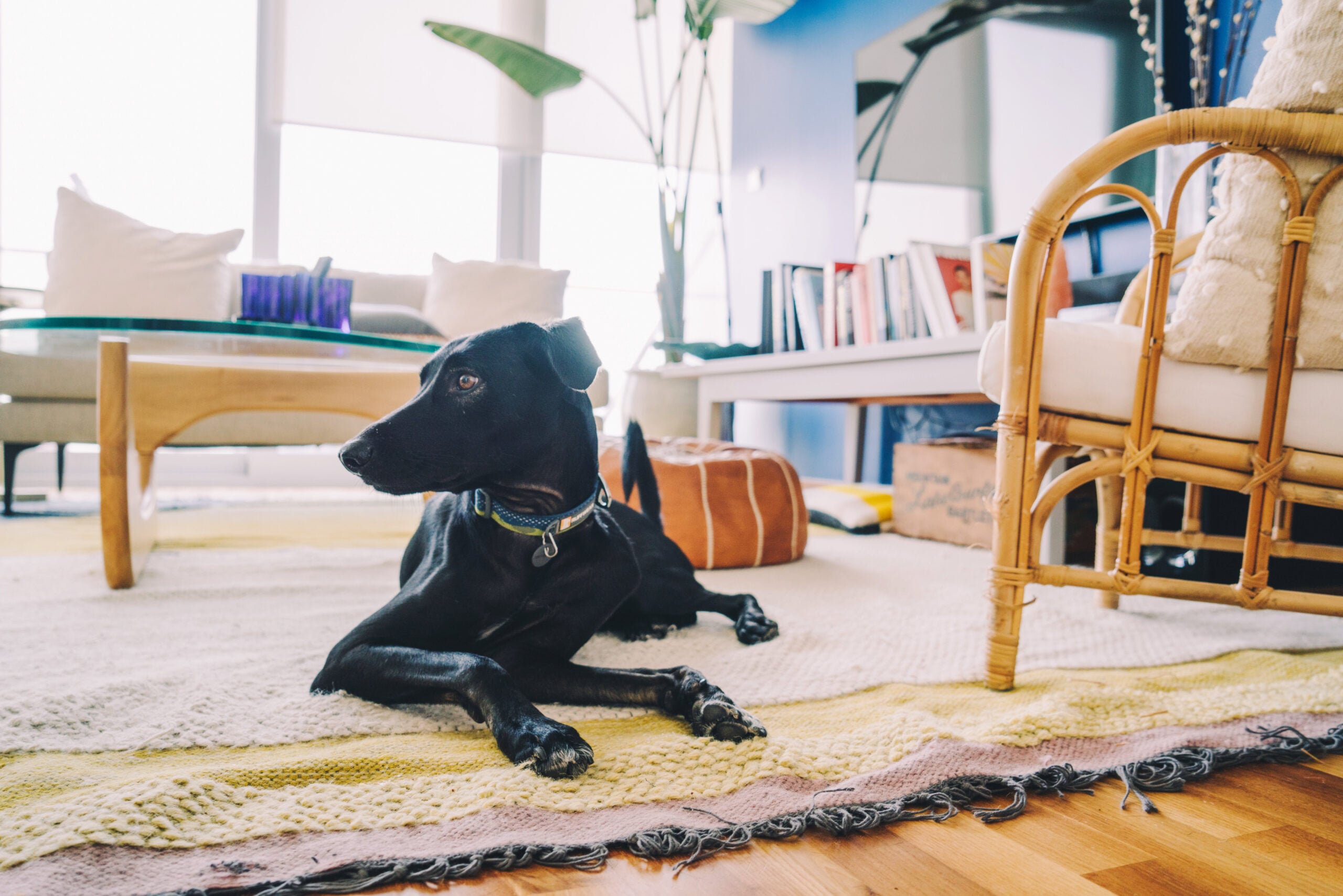
If you have hardwood or tile, put down a yoga mat or non-slip rug in the play zone before starting. Hard floors are slippery at speed and dogs who cannot get traction become tentative about committing to the chase, which defeats the purpose entirely. Similarly, foam tiles work well too and stack away after sessions. This is the single most important setup step and the one most people skip.
For dogs prone to jumping, keep the lure at ground level throughout. Low, horizontal sweeps only. This contains the session to your cleared footprint and protects the dog’s joints over time.
Quick setup checklist
- Minimum space: 6 feet of clear floor for small dogs (under 30 lbs), 8 feet for medium dogs. Push the coffee table aside and you have it in almost any living room.
- Hallway dash pattern: Back-and-forth linear chase between two points. The walls do the containment work for you, ideal for narrow apartments where a living room footprint is tight.
- Figure-8 pattern: Anchor two points (chairs, couch corners, a water bowl and a table leg) and run the lure in a figure-8 between them. Direction changes add stalk moments at each crossover, which is where the neurological work actually happens in a small space.
- Sound floor tip: Lay a yoga mat or area rug in the play zone before starting. It prevents the dog from sliding on hard floors and absorbs impact noise for downstairs neighbors, both problems solved with one step.
Indoor Techniques That Work in Any Apartment
These four techniques are specifically suited to small-space use. In particular, each one maximizes drive engagement within a minimal footprint.
Stand in one spot and do not move your feet. Rotate the lure in a controlled arc around your body. In practice, the dog chases a circumference while you stay planted in the center. This is therefore the most space-efficient method available. The entire session, however, happens within your arm span. Ideal for very small apartments and dogs new to indoor play.
Move the lure in a deliberate figure-eight pattern at ground level. As a result, this keeps the dog turning, changes direction unpredictably, and requires more mental tracking than a simple circle. Therefore, direction changes add a short stalk moment at each crossover point, which is where the neurological work actually happens.
Stand at one end of a hallway and drag the lure slowly toward you, then flick it back. In practice, the dog chases one direction, you draw them back, repeat. As a result, hallway walls contain the session naturally, and the direction reversal adds a pause-and-re-engage that mimics prey stopping to assess.
Move the lure almost imperceptibly for a few seconds, then burst into a fast sweep. The slow phase engages the stalk drive, the phase most exercise tools skip entirely. Then the burst triggers the chase. Alternating these two produces more complete drive engagement than constant fast movement, and it works in a tighter area because slow phases take up almost no space.
The Indoor Session Structure
Same five-step sequence as outdoors. The complete method is in indoor flirt pole training. Indoors, the all-done cue and cooldown are especially important because the dog has no backyard to decompress in after the session ends.
Lure still. Dog locks on. Ask for a sit or stand-wait for 5 to 10 seconds before releasing. This is where the impulse control component gets built. Do not rush it.
Cue: WaitRelease cue, then move the lure using one of the indoor techniques above. Keep it horizontal throughout. Slow creep, burst, direction change, brief pause. Vary the pattern so the dog is tracking and problem-solving, not just reacting.
Cue: Get itEvery three to four reps, let the dog catch and hold the lure for a few seconds. Do not immediately ask for a drop. The possession phase completes the predatory sequence, and completing it is what produces the genuine calm that makes daily sessions worth running.
Cue out, reward the release, restart from the wait. Repeat for 5 to 10 minutes total. If drop-it reliability is still developing, trade up with a high-value treat before asking for the release. The restart itself becomes the reward for the out, which is what makes the cue stick.
Cue: OutVerbal all-done, toy completely put away. Then ask for a place or down-stay and reward calm. In an apartment, the settle cue does the job a backyard normally handles. Do not skip this step. The session ends with arousal unresolved if you do.
Cue: All done → Place4-year-old Corgi in a one-bedroom, noise complaints from neighbors
The owner was walking 45 minutes morning and evening. The dog was still barking at every hallway sound, destroying shoes, and doing zoomies at 9pm that shook the floor. A noise warning came from the building manager.
We added a 7-minute structured indoor session using the pivot point and figure-eight techniques before the morning walk, and a 5-minute evening session before dinner. Walks were reduced to one 20-minute decompression sniff walk. No other changes.
By day 6, the evening zoomies stopped. By week 2, the barking at hallway sounds dropped by roughly 80% (owner’s estimate). At three weeks, the dog was settling on its bed unprompted after sessions. No more noise complaints. Total daily exercise time dropped from 90 minutes to 52 minutes. Less time, dramatically calmer dog.
Breed-Specific Notes for Indoor Training
The principles apply across all breeds, but the adjustments vary. These are the most common apartment dog types and what to watch for with each.
Breeds
Power and small breeds
Breeds
Breeds
Breeds
Keeping Sessions Quiet for Neighbors
A structured flirt pole session is already quieter than most indoor play, the dog is doing focused tracking work in short controlled bursts, not sprinting and skidding wildly. These five steps eliminate the remaining noise entirely.
- Yoga mat or area rug absorbs paw impact and reduces sound transmission to the unit below, the single most effective noise fix available
- Keep the lure low at all times, no jumping means no landing impact, which is the loudest part of any indoor dog activity
- Use soft lures only (fleece, rope) during morning and evening sessions, no squeakers, no hard plastic, nothing that carries through walls during quiet hours
- End sessions before 9pm in most buildings, structured drive work done earlier in the evening prevents the 10pm zoomie spike that actually wakes neighbors
- Flirt pole chase is quieter than ball bouncing, indoor fetch, or tug, the contained footprint and deliberate pacing are built-in advantages for apartment living
The noise problem is mostly a technique problem. Keep the lure low, use a soft surface, and run sessions at reasonable hours. The structural nature of a flirt pole session, short bursts, deliberate resets, a hard stop, makes it a better neighbor than almost any other high-drive outlet available indoors.
Flirt Pole vs Other Indoor Exercise Options
Most apartment owners try multiple approaches before landing on a flirt pole. Here is how the options stack up on the metrics that matter when you have neighbors below you and no yard.
| Method | Drive resolved? | Space needed | Noise level | Time to calm |
|---|---|---|---|---|
| Flirt pole (structured) | Yes, full sequence | 6–8 ft cleared | Low (lure stays low) | 10 min |
| Long walk only | Partial, cardio only | Outdoors required | N/A | 45–90 min |
| Indoor fetch / ball | Partial, no stalk phase | Long hallway | High (ball bounce) | Inconsistent |
| Puzzle feeders | Mental only, no chase | Minimal | Very low | 20–40 min |
| Tug (unstructured) | Arousal raised, not resolved | Minimal | Medium | Can worsen |
| Dog park | Variable, often overstimulating | Outdoors required | N/A | Unpredictable |
Walking tires the body. A flirt pole completes the predatory sequence. Those are two different things. An apartment dog that gets 90 minutes of walking but zero prey sequence completion will still pace, still bark, and still destroy things. The sequence is the thing.
Do not end a flirt pole session mid-chase. Stopping abruptly while the dog is still in full prey mode leaves arousal unresolved and can actually increase reactivity rather than reduce it. Always finish with a deliberate catch, a drop-it, and a verbal all-done before putting the toy away. The all-done cue is what trains the off-switch, skipping it removes the most important behavioral benefit of the entire session.
Which Whimsy Stick Is Right for Your Apartment Dog
For dogs under 30 lbs (which covers most apartment dogs) the Standard is the right tool. It is sized for controlled indoor movement, light enough for precise technique in a tight space, and the Kevlar line produces smooth lure movement with no elastic snap-back. For the full head-to-head with the most commonly compared competitor, see Whimsy Stick vs Squishy Face. For owner-reported results from apartment dog owners specifically, see what apartment dog owners say.
Built for indoor use. Kevlar static line, smooth precise movement, quick-swap lures. The right build for most apartment dogs under 30 lbs.
Reinforced for larger breeds, Labs, Boxers, Huskies, that generate serious force even in a contained indoor session. Includes 1 lure. Free US shipping included.
Same reinforced build with 3 lure options included. Rotate lures to keep engagement high, variety in texture and shape extends session effectiveness over time. Free US shipping included.
The weight cutoff is 30 lbs. Under 30 lbs: the Standard handles everything the indoor protocol requires. Over 30 lbs: the Rugged XL is built for the force those dogs generate. The construction difference is not cosmetic, it is what keeps the session safe when a 55-pound dog fully commits to the chase inside a living room.
For the broader case on why a trainer-designed flirt pole is the right category fit for indoor use, see best flirt pole for dogs.
What If You Cannot Go Outside At All
A real subset of owners cannot use outdoor space. Strict HOAs that ban dogs on common turf. High-rise apartments with elevator-only access where every potty trip is a 20-minute commitment. No-yard buildings where the only outdoor space is a busy sidewalk. Owners with mobility issues or shift work that makes outdoor sessions logistically impossible. For these owners, the rest of the apartment guide still applies, but the demands on the indoor protocol are higher because outside is not a release valve.
Density of structured indoor sessions matters more. Where a yard-equipped owner can run one 12-minute flirt pole session and supplement with a sniff walk, the strict-indoor owner needs two shorter sessions per day plus indoor enrichment between them. Morning flirt pole session (8-10 minutes), midday scatter feed or snuffle mat, evening flirt pole session (8-10 minutes), pre-bed chew or lick mat. This rhythm replaces what a yard provides, the periodic ability for the dog to engage drive on their own schedule.
Indoor-only working space and scent
The hallway becomes the primary working space. Most apartment hallways inside a unit are 10 to 15 feet long, which is exactly the working radius the Whimsy Stick was designed around. Run the lure along the length of the hallway in straight ground-level drags. The dog gets to commit fully to the chase without the spin-and-cut movement that requires more open space. For 30 lb+ dogs, hallway sessions are the configuration I prefer for full-commit chase work indoors.
Olfactory enrichment is non-negotiable. A dog who never gets outdoors loses the single largest source of behavioral regulation in their life: novel scent. Substitute aggressively. Rotate snuffle mats. Hide kibble in different rooms. Bring in outdoor scent on towels rubbed on grass, trees, other dogs (with consent). Run scent games like find-it across the apartment. This is not optional for fully-indoor dogs. It is the difference between a regulated apartment dog and a wired one.
The honest constraint. Strict-indoor life works for low and moderate drive dogs. It does not work indefinitely for high-drive working breeds. A working-line Malinois in a high-rise with no yard access is not a sustainable setup, regardless of how good the indoor protocol is. If that is your situation and the dog is decompensating, the answer is not more flirt pole sessions. It is structural change, daycare a few days per week, a dog walker for midday outings, or in some cases re-evaluating the match. That call is yours, not mine.


