Whimsy Stick

Free Shipping $60+
·
30-Day Money-Back
·
Trainer-Designed
Dog Agility Exercise Toys: Trainer’s Guide | Whimsy Stick
Training & Equipment Guide

Dog Agility Exercise Toys: Complete Trainer’s Guide

Christopher Lee Moran Professional Dog Trainer · Instinctual Balance · Coaldale, CO
12 min read
6
Exercise toy categories
10 yrs
Training high-drive dogs
1
Tool most dogs need first
TL;DR

Most owners buying dog agility exercise toys are trying to solve the same problem: a high-drive dog that destroys things, can’t focus, and won’t settle. The type of toy matters more than most people realize. Six categories of dog agility exercise toys are covered here — what each does neurologically, which dogs each suits, and how to sequence them correctly. The short version: a flirt pole is the foundational tool that builds impulse control and addresses prey drive first. Formal agility equipment is a powerful Phase 2 tool once that foundation exists. Add the obstacle course before the foundation is in place and you get a more dysregulated dog, not a calmer one.

What Dog Agility Exercise Toys Actually Do for a Dog

Before choosing any of these tools, it helps to understand what kind of exercise produces a genuinely settled dog versus what just makes one physically sweaty. There are two neurological systems at work, and the best dog agility exercise toys address both of them.

Physical fatigue depletes muscle energy. A dog that sprints for 30 minutes is physically tired — and that is real and useful. However, it doesn’t touch mental and instinctual needs. Many high-energy dogs can sleep off physical fatigue and be back at the door demanding more within a few hours. Furthermore, repetitive exercise without structure can actually increase arousal in high-drive dogs over time. This is precisely why selecting the right tool matters as much as frequency.

Neural fatigue comes from activating the parts of the brain responsible for drive, decision-making, and impulse control. This is what happens when a dog completes the full predatory sequence — search, stalk, chase, catch, possess. Equipment that engages this sequence produces neural fatigue that plain running can’t. According to the American Kennel Club, structured predatory play is among the highest-value enrichment activities for dogs precisely because it addresses neurological needs, not just physical ones. Additionally, VCA Animal Hospitals confirms that handler-controlled chase activity produces measurably better behavioral outcomes than passive or unstructured exercise.

Consequently, the best dog agility exercise toys tap into neural fatigue, not just physical fatigue. A 10-minute structured session with the right equipment often produces three or more hours of genuine calm that a 45-minute park run doesn’t. Most owners are surprised by how much behavioral change comes from selecting the correct tool — and equally surprised by how little changes when they select the wrong one.

Most behavior problems aren’t obedience problems. They’re energy problems that the right dog agility exercise toys solve — specifically, prey drive that hasn’t found an appropriate outlet. Give a high-drive dog the right outlet and the obedience often follows without a single formal lesson.

— Christopher Lee Moran, Instinctual Balance Dog Training · Coaldale, CO

Six Categories of Dog Agility Exercise Toys

Not all dog agility exercise toys are created equal. Here’s an honest breakdown of what each category does, who it’s for, and where it falls short. Understanding these distinctions is what separates owners who see real behavioral results from those who don’t.

Flirt Poles

The most direct tool in the dog agility exercise toy category for prey drive work. A rod with a lure on a line that activates the chase instinct directly, builds impulse control and physical conditioning simultaneously. Works indoors or outdoors in a small space.

✓ Best starting point for prey drive

Agility Course Equipment

Tunnels, weave poles, A-frames, jumps. Excellent Phase 2 dog agility exercise toys for focus and handler communication. High setup time. Requires impulse control foundation — don’t use this category first.

→ Great with foundation work

Fetch Toys

Balls, launchers, frisbees. Good cardio when combined with commands. Repetitive unstructured use can increase obsessive behavior rather than resolve it — structure every repetition with a cue.

→ Use with structure

Puzzle / Enrichment

Sniff mats, Kongs, lick mats, slow feeders. Valuable mental stimulation but not a primary dog agility exercise toys category — this category doesn’t address prey drive or physical conditioning. Best as a cooldown supplement, not a replacement.

→ Good supplement

Tug Toys

A solid supplemental dog agility exercise toy. Handles physical drive and builds handler engagement. Works best as structured play — the dog should only tug on your cue. Random tug undermines the impulse control that other training builds.

✓ Great when structured

Chew Toys

Antlers, rubber chews, bully sticks. Useful for oral fixation and anxiety management but not a primary exercise tool — physical exercise value is minimal and prey drive is not addressed. Use after proper exercise, not instead of it.

↓ Supplement only

Agility Equipment: The Dog Agility Exercise Toy That Requires a Foundation

Formal agility equipment — tunnels, weave poles, jumps, A-frames, seesaws — is a compelling category of dog agility exercise toys for the right dog. It builds coordination, focus, confidence, and the kind of intricate handler communication that transfers to real-world obedience. Border Collies, Belgian Malinois, Australian Shepherds, and similar working breeds often thrive on this style of structured agility training.

However, there’s a prerequisite most equipment sellers skip: your dog needs a behavioral foundation before this category of dog agility exercise toys works. Without that foundation, obstacle work becomes high-arousal chaos. If your dog can’t hold a stay while distracted, can’t make eye contact when aroused, and can’t disengage from motion on command — dog agility exercise equipment becomes a high-stimulation environment that rewards chaotic movement rather than controlled movement.

I’ve seen dogs go through a tunnel 40 times in a row, amped up and frantic, while their owner celebrates how much “exercise” they got. That dog is more dysregulated at the end of the session than the beginning. The equipment itself isn’t the problem — the missing foundation is. The correct sequence puts impulse control before obstacles, every time.

Important

Agility equipment works best as a Phase 2 addition to your training toolkit. Phase 1 is teaching your dog to operate with control under arousal — reliable stay, reliable recall, and a functional drop-it. The right Phase 1 tool is a flirt pole. Build that foundation first, then add the obstacle course.

Starter agility dog exercise equipment worth owning

If your dog has the foundation and you’re ready to expand your tool collection beyond Phase 1, start with these four pieces in order — each builds on the last:

1
Collapsible tunnel

The easiest dog agility exercise toys concept to learn and the most approachable obstacle available. Builds confidence and forward drive. Good first obstacle for any dog graduating to formal dog agility exercise equipment.

2
Adjustable jump

Start at shoulder height or below. Dog agility exercise toys like jump bars build coordination without joint stress and are an excellent option for physical conditioning. Height increases as the dog gains confidence and muscle through consistent sessions.

3
Weave poles (6 poles)

The most cognitively demanding obstacle in any agility set. Takes weeks to train correctly. Excellent focus builder once the dog understands the footwork pattern from earlier training.

4
Pause box / mat

Not a physical obstacle — a place marker for “stop here and wait.” Arguably the most important dog agility exercise toys purchase you can make for maintaining the impulse control built through earlier Phase 1 sessions.

Flirt Pole vs. Every Other Dog Exercise Tool

The question I get most from clients isn’t which toy to buy — it’s why their dog is still a maniac after an hour at the dog park. The answer is almost always that they’re giving the dog physical exercise without addressing the instinctual need underneath. A flirt pole is the most direct tool for that purpose, and it remains the highest-value option available.

Exercise Tool
Prey Drive
Impulse Control
Physical Work
Space Needed
Flirt pole
✓ Direct
✓ Built-in
✓ High
Small
Agility course equipment
Indirect
✓ High
✓ High
Large
Fetch (ball)
Moderate
Low (without commands)
✓ High
Medium
Tug toy
Moderate
Moderate
Moderate
Small
Puzzle feeder
None
None
Minimal
Small
Dog park / free play
Moderate
None (often reduces)
✓ High
Large

The flirt pole earns its place at the top of that comparison because it hits all three functional columns in a small space in a short session. No other tool delivers that combination. Therefore, the flirt pole is the most efficient option for most owners — and for owners who want to expand their collection, it’s still the correct first purchase. Ten minutes of structured flirt pole work does more for a high-drive dog’s behavior than most hour-long alternatives. The reason is neurological: it addresses the instinctual need, not just the calorie burn.

The dogs I see with the worst behavioral profiles — reactive, destructive, anxious, unable to settle — almost universally have never had their prey drive properly exercised through structured, handler-led play. Not walked, not fetched, not puzzled. The actual chase-catch-possess sequence. Give them that outlet through structured dog agility exercise toys and the behavior profile changes within weeks.

Why Structure Matters More Than Duration in Dog Agility Exercise Toys

Twenty minutes of controlled, structured work with these tools produces better behavioral results than an hour of uncontrolled activity. The difference is whether the dog’s brain is learning anything during the session. Moreover, the ending matters as much as the beginning. A basic structured session — the most important one to get right — looks like this:

1
Sit and wait before the toy comes out

The dog agility exercise toys session doesn’t start until the dog shows self-control. This sets the tone and teaches that access to the toy requires composure first — the most transferable skill any session can build.

2
Release with a cue, then run the chase sequence

“Get it” starts the chase. Move the lure in natural prey arcs — erratic, low to the ground. Let the dog work for the catch. 5 to 8 reps per set before the next rest period.

3
Stop all movement for Drop It — dead prey doesn’t get fought over

When you stop the lure completely, the dog disengages. Mark and immediately restart the chase. Drop It becomes the thing that opens play, not ends it — this is how you build it reliably through structured sessions.

4
Structured “All Done” end — teaches arousal has an off switch

End the dog agility exercise toys session on your terms. Ask for a sit, give a calm verbal release, put the lure away. This is arguably the most useful behavioral outcome any session can produce.

The same structure applies to agility course work. Each obstacle should be entered calmly, worked with focus, and followed by a reset. A dog sprinting chaotically through a tunnel isn’t getting the real benefit of the equipment — it’s supervised chaos. Structure is what converts any tool into an actual behavioral intervention. Without it, even the best dog agility exercise toys produce dysregulation rather than the calm you’re looking for.

How to Match the Right Dog Agility Exercise Toy to Your Dog

The right dog agility exercise toys depend on your dog’s drive level and your training goals. Getting this wrong is expensive and frustrating — choosing Phase 2 equipment for a dog that needs Phase 1 work makes behavior worse, not better.

High-drive dogs (German Shepherds, Belgian Malinois, Border Collies, Huskies, most terriers) need prey drive work as a first priority. The flirt pole is the correct Phase 1 tool for these breeds. Subsequently, formal agility course equipment becomes a productive addition once the foundation is solid. Starting with obstacle equipment before foundation work increases dysregulation in these dogs. They will find the agility course stimulating — but without the foundation, it makes their behavior worse.

Moderate-drive dogs (most Labs, Goldens, mixed breeds, sporting dogs) respond well to structured fetch, tug, and flirt pole as a varied exercise rotation. Furthermore, puzzle feeders complement any exercise routine on rest days. Formal agility equipment is a great optional addition depending on your interest and your dog’s preference.

Low-drive or shy dogs benefit from confidence-building dog agility exercise toys — tunnels, low jumps, sniff work. Don’t start with high-arousal chase games. Build engagement and handler trust first, then layer in more stimulating options as the dog gains confidence. For these dogs, a gentle flirt pole remains useful as long as sessions stay calm and brief. The order in which you introduce dog agility exercise toys matters as much as which ones you choose.

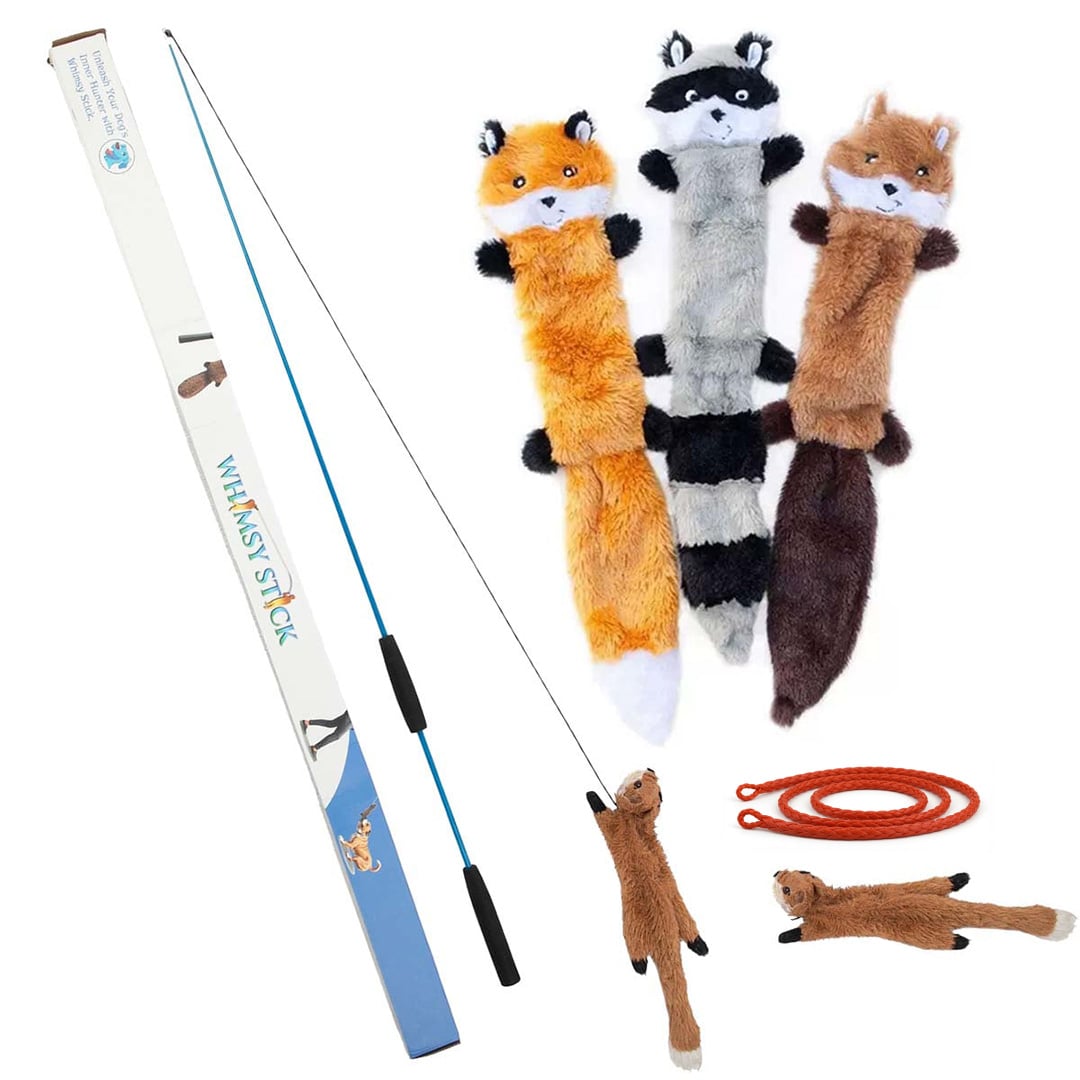
Whimsy Stick — the foundational dog agility exercise toy for drive work

Kevlar line, responsive rod, replaceable lures. Built for the structured training approach in this guide. Standard for dogs under 40 lbs — Rugged XL for power breeds and working dogs. Free shipping and 30-day money-back guarantee.

Shop the Whimsy Stick →

Common Mistakes That Undermine Dog Agility Exercise Toys

A few patterns I see repeatedly that undermine otherwise good training routines — regardless of which specific dog agility exercise toys you own.

Sessions that are too long. More isn’t better with any of these tools. Ten to fifteen minutes of focused work beats 45 minutes of half-engaged play. End sessions while the dog still wants more — this keeps engagement high in future sessions. Above all, a shorter structured session is more valuable than a longer unstructured one.

No cues during play. This applies to every tool in your rotation. If you’re not inserting “wait,” “drop it,” “leave it,” and “all done” into sessions, you’re missing the training opportunity entirely. The dog is always learning something — make sure it’s what you intend. Every exercise session is simultaneously a training session.

Unstructured fetch. Repetitive fetch without commands increases obsessive behavior in many dogs. The retrieve should start with a sit-stay, release on your cue, and the dog should return the ball on command. Nevertheless, unstructured fetch is one of the most commonly misused dog agility exercise toys — fetch without rules creates a more demanding dog, not a calmer one.

Skipping decompression. After high-arousal sessions with these tools, dogs need 15 to 20 minutes to come down physiologically. Don’t immediately crate a dog that’s still aroused. A sniff walk, quiet yard time, or a stuffed Kong are good transitions after any session. Indeed, the post-exercise calm is the clearest signal that your session achieved its goal.

Commonly Asked Questions

Dog Agility Exercise Toys — FAQ

What are the best dog agility exercise toys for high-energy dogs?
The best dog agility exercise toys for high-energy dogs address both physical and neurological needs. A flirt pole is the highest-value single tool because it directly activates prey drive, builds impulse control, and produces neural fatigue — not just physical tiredness. For dogs with a foundation in impulse control, adding formal agility dog exercise equipment like tunnels, jumps, and weave poles creates an excellent secondary training environment. The flirt pole should come first as the foundation before adding other obstacle equipment.
Dog agility exercise toys create two kinds of fatigue. Physical fatigue from running and jumping depletes muscle energy, but high-drive dogs can recover from this within hours. The more valuable outcome from structured play with dog agility exercise toys is neural fatigue — the exhaustion that comes from fully activating the predatory drive sequence through chase, catch, and possess. A 10-minute structured session often produces three or more hours of genuine calm that physical-only exercise doesn’t provide.
Dog agility exercise toys involving jumping should wait until growth plates close — typically 12 to 18 months depending on breed size. However, foundational dog agility exercise toys like flirt poles can be introduced at 8 to 12 weeks with very short sessions, low-intensity movement, and no jumping. The impulse control habits built early with gentle dog agility exercise toy sessions transfer directly into safer agility training later. Start slow, keep sessions under 3 minutes for puppies, and avoid any movement that encourages repeated jumping.
Yes. Most destructive behavior in high-drive dogs comes from unmet prey drive — the dog is running the predatory sequence on furniture because no legitimate outlet exists. Structured play with dog agility exercise toys — specifically flirt poles used with deliberate session structure — gives the predatory sequence a legitimate daily completion pathway. Most owners see meaningful reduction in destructive behavior within one to two weeks of consistent daily dog agility exercise toy sessions. See the full dog destroying things guide for the complete protocol.
A flirt pole is the most space-efficient dog agility exercise toy available — a 10-foot radius is enough for a full session that produces real behavioral results. Tug toys work in any space. Collapsible tunnels can fit in hallways. Most traditional agility dog exercise equipment requires significant outdoor space, which is why the flirt pole is the recommended primary dog agility exercise toy for apartment dogs. For the full guide, see Flirt Pole for Apartment Dogs.
A flirt pole is unique among dog agility exercise toys because it directly activates the predatory sequence — orient, stalk, chase, catch, possess — in a handler-controlled session. Other options like tunnels and jump equipment build coordination and focus but don’t address prey drive directly. The flirt pole is also the only tool that builds impulse control as a structural part of the activity through the wait before release and the drop-it after catch. The full method is in the Flirt Pole Training Guide.
For formal agility dog exercise equipment like tunnels and jumps, no — a foundation in impulse control should come first. Dogs without reliable stay, recall, and drop-it will use dog agility exercise toys chaotically. However, a flirt pole is the dog agility exercise toy that builds that foundation — it’s the right first tool precisely because the structure of the session teaches impulse control at high arousal. Start with the flirt pole as your Phase 1 dog agility exercise toy, build the foundation, then add formal agility equipment as Phase 2.
Daily sessions with dog agility exercise toys produce the best behavioral results for high-drive dogs. A 10-minute structured flirt pole session each morning — before leaving the house — is the highest-impact routine available. For formal dog agility exercise equipment like tunnels and jumps, 3 to 4 sessions per week is appropriate once the foundation is solid. The key is consistency: daily sessions on a schedule — not randomly — is what produces lasting behavioral change and a genuinely settled dog.
Christopher Lee Moran
Professional Dog Trainer · Instinctual Balance · Coaldale, CO

Christopher is the founder of Instinctual Balance Dog Training in Coaldale, Colorado and creator of the Whimsy Stick. He specializes in drive-based training with high-energy and reactive dogs, serving Salida, Buena Vista, Cañon City, and the Arkansas Valley. His approach prioritizes drive resolution through the correct tools before adding equipment. He has worked with every major exercise toy category across hundreds of high-drive clients.

This article is for educational purposes only and is not veterinary advice.

Built for what you just read

Ready to invest in the right dog agility exercise toys?

The Whimsy Stick is designed around the structured training approach in this guide. Kevlar line, responsive rod, replaceable lures. Standard and Rugged XL available. Both ship free with a 30-day money-back guarantee.

0
    0
    Your Cart
    Your cart is emptyReturn to Shop